To understand the open source AI coding tools wave, recognize the four wave patterns the data reveals (open source models reaching capability parity for many tasks, open source AI editors emerging as alternatives to commercial offerings, open source agentic frameworks providing building blocks, and open source community tools creating ecosystem around models), see what the open source response to commercial AI coding means, and consider what the patterns mean for individual developers and organizations. The open source AI coding wave matters because it changes commercial AI dynamics and developer choices.
This piece walks through the four wave patterns, what the patterns reveal, the implications for developers, and the four mistakes when interpreting open source AI tool trends.
Why Open Source AI Coding Tools Matter
Open source AI coding tools matter because they provide alternatives to commercial offerings. The matter; alternatives constrain commercial pricing while expanding capability access.
The 2026 reality is that open source AI tools have moved from alternative to legitimate option for many use cases. Capability gap with commercial narrowing while cost gap remains substantial.
A 2025 enterprise AI tool survey of 500 organizations found that 38 percent now use open source AI coding tools alongside commercial tools, up from 12 percent in 2024. Adoption growth signals open source legitimacy for production use.
The pattern to copy is the way Linux changed server market. Linux provided commercial alternative; alternative shaped commercial pricing and capability over decades. Open source AI coding tools may follow similar trajectory; alternatives shape commercial market.
The Four Open Source Wave Patterns
Four patterns characterize the open source AI coding tools wave.
Pattern 1, open source models reaching capability parity. Llama, Mistral, Qwen reaching commercial model capability for many tasks. Parity expanding.
Pattern 2, open source AI editors emerging. Continue, Cody, Tabby. Editors compete with commercial editors.
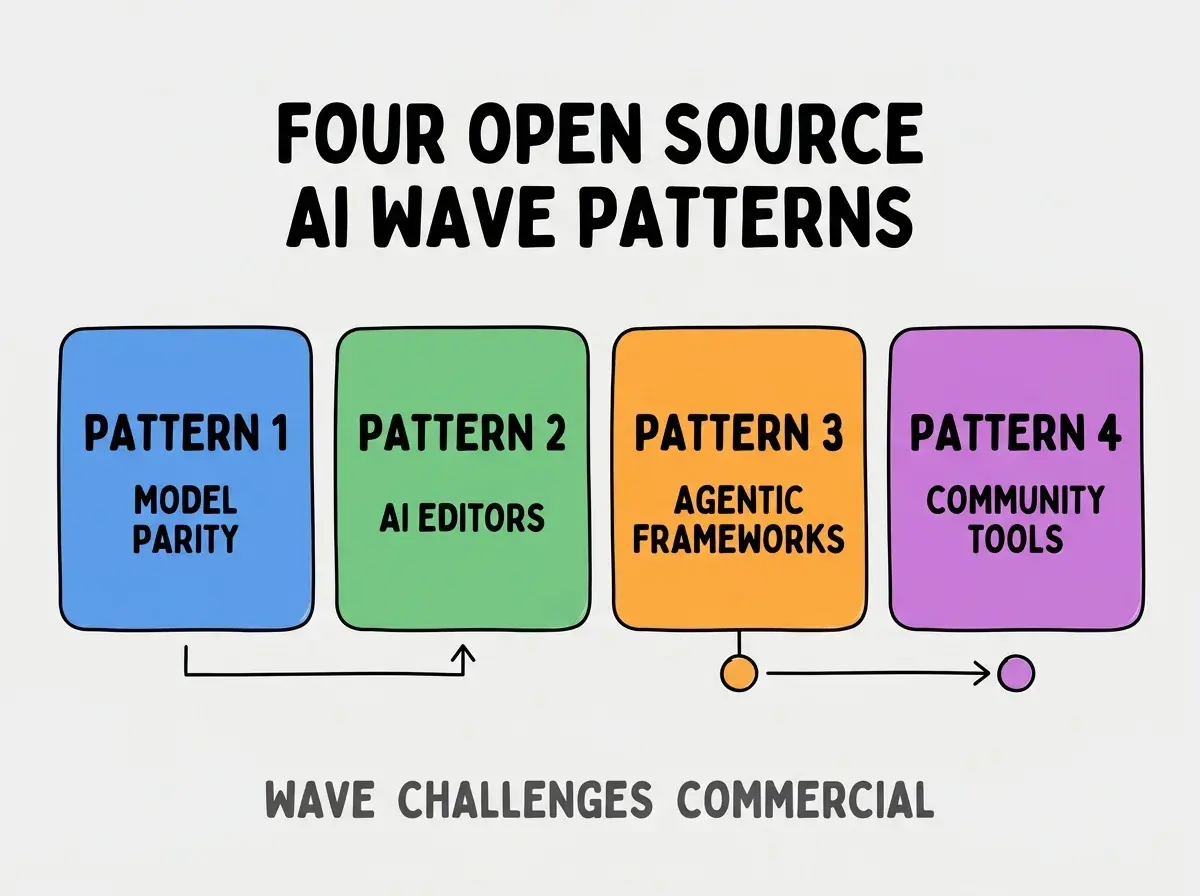
Pattern 3, open source agentic frameworks. LangChain, AutoGen, custom frameworks. Frameworks enable application building.
Pattern 4, open source community tools. Model serving, fine tuning, evaluation tools. Ecosystem develops around models.
What The Patterns Reveal
Three patterns reveal underlying open source AI dynamics.
Pattern 1, capability concentration breaking. Capability spreading from few commercial providers to broader ecosystem. Spread changes power dynamics.
Browse more pulse
Read more pulsePattern 2, cost economics challenging commercial pricing. Open source models cost dramatically less. Cost gap pressures commercial pricing.
Pattern 3, customization requirements driving open source adoption. Customization needs that commercial tools cannot meet. Customization differentiates open source.
What The Patterns Mean For Developers
Three implication patterns matter for developers.
Implication 1, evaluate open source alongside commercial. Open source no longer dismissable. Evaluation produces better tool decisions.
Implication 2, build skills transferable across tool ecosystems. Tool specific skills less valuable than ecosystem skills. Transferability matters.
Implication 3, contribute to open source AI tools when possible. Contributions strengthen ecosystem. Strong ecosystem benefits all contributors.
How Organizations Should Adapt
Three adaptation patterns help organizations navigate open source AI wave.
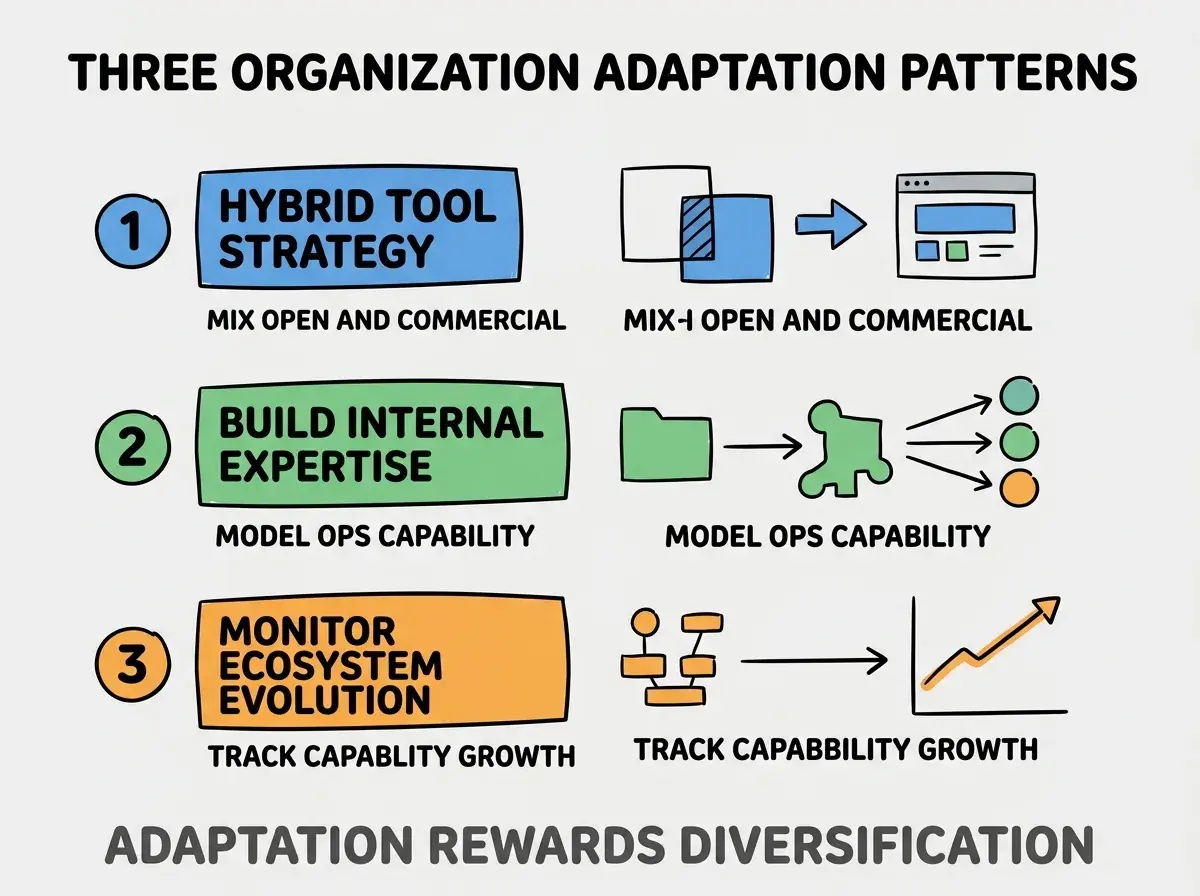
Pattern 1, hybrid tool strategy. Mix open source and commercial tools. Mix balances cost and capability.
Pattern 2, build internal expertise for open source operation. Operating open source models requires capability. Capability investment enables flexibility.
Pattern 3, monitor ecosystem evolution actively. Open source moves fast; monitoring catches shifts. Monitoring informs decisions.
What Makes Open Source AI Adoption Sustainable
Three patterns separate sustainable open source adoption from problematic patterns.
Pattern 1, adoption matched to actual capability. Some tasks suit open source; some require commercial. Matching matters.
Pattern 2, operational capacity for self hosted open source. Self hosted requires capacity. Capacity investment necessary.
Pattern 3, contribution back to ecosystems used. Contributions sustain ecosystems. Without contribution, free riding undermines ecosystem.
The combination produces sustainable open source AI adoption. Without these patterns, adoption often produces problems.
How To Evaluate Open Source AI Tools
Three evaluation patterns help open source tool assessment.
Pattern A, capability benchmarking against use cases. Standard benchmarks plus custom evaluation. Without evaluation, assumptions misleading.
Pattern B, total cost of ownership including operations. Operations cost matters; pure license cost misleading. TCO includes hidden costs.
Pattern C, community health assessment. Active community indicates sustainability. Without community, projects often abandon.
The combination produces evaluation that matches tools to needs. Without patterns, evaluation often produces wrong choices.
The most damaging open source AI tool mistake is dismissing them based on outdated capability assumptions. Open source capability has advanced dramatically; assumptions from 12 months ago no longer apply. The fix is to reevaluate open source quarterly; capability advances faster than typical evaluation cycles. Organizations that reevaluate produce better tool decisions than organizations that rely on stale assumptions.
The other mistake is assuming open source means free. Operations cost real even when license free. TCO matters.
A third mistake is missing the contribution opportunity. Contributions strengthen tools you use.
A fourth mistake is treating open source and commercial as binary choice. Hybrid strategies often produce best outcomes.
How To Build Open Source AI Skills
Three skill building patterns help developers build open source AI capability.
Pattern A, experiment with open source models locally. Local experimentation builds intuition. Without experimentation, capability stays abstract.
Pattern B, contribute to open source AI projects. Contribution builds expertise. Expertise compounds with contribution.
Pattern C, follow open source AI community channels. Community channels surface trends. Without following, trends invisible.
The combination produces open source AI skills that transfer across tools. Without skill building, capability stays narrow.
How Open Source AI Will Likely Evolve
Open source AI will likely continue evolving as ecosystem matures.
The first likely evolution is capability gap with commercial narrowing further. Some tasks open source matches commercial; gap continues closing.
The second likely evolution is operational tooling improving. Tools simplify open source operation. Improvement reduces operational burden.
The third likely evolution is specialized open source models emerging. Domain specific models for code, science, finance. Specialization differentiates.
The combination suggests open source AI will become more capable. Engineers learning patterns now build skills that remain valuable.
Common Questions About Open Source AI Tools
Open source AI tools raise questions worth addressing directly.
The first question is whether open source matches commercial AI quality. Depends on task; some yes, some no. Evaluation per use case matters.
The second question is whether to switch from commercial to open source. Hybrid often better than full switch. Mix balances tradeoffs.
The third question is whether open source AI is sustainable long term. Yes for major projects; smaller projects vary. Sustainability requires community health.
The fourth question is how to handle open source AI security. Same as commercial; verify, audit, monitor. Open source enables audit that commercial does not.
How Open Source Wave Affects Industry
Open source AI wave affects industry beyond individual tool choices. Industry effects compound over time.
The first compounding effect is commercial pricing pressure. Open source alternatives constrain commercial pricing. Pressure benefits buyers.
The second compounding effect is capability democratization. Open source enables broader access. Democratization expands AI usage.
The third compounding effect is innovation pace acceleration. Multiple ecosystems innovating produces faster overall progress. Innovation benefits everyone.
What This Means For You
Open source AI coding tools wave changes industry dynamics regardless of individual adoption. The four patterns, organization adaptations, and evaluation approaches produce framework for navigating open source wave.
- If you're a senior dev: Build open source AI skills alongside commercial. Skills transfer across tools and matter for career flexibility.
- If you're a founder: Help organization develop hybrid AI strategy. Hybrid balances cost and capability better than pure approaches.
- If you're an indie hacker: Open source AI tools fit indie hacker economics. Cost advantage enables solo experimentation that commercial tools may not justify.
Browse more pulse
Read more pulse