Multi-region deployment for low latency in 2026 is justified when you have meaningful user populations on multiple continents and your app's responsiveness suffers because of cross-region network latency. The three patterns that work for vibe-coded apps are: edge compute with regional databases (Cloudflare or Fly.io), read replicas with single-region writes (most managed Postgres providers), and globally distributed databases (CockroachDB, Turso, Spanner). Each pattern has a clear right use case based on whether your app is read-heavy or write-heavy, and the wrong pattern adds complexity without solving the latency problem.
This piece walks through when multi-region is actually justified, the three patterns with their trade-offs, the database choices that hold up, and the four mistakes that turn a working app into a complex one for no benefit.
When Multi-Region Is Actually Justified
The default assumption is that multi-region is always better. It is not. A single-region deployment serves global users in 200 to 400 milliseconds round-trip from anywhere on Earth, which is acceptable for most apps. Multi-region adds operational complexity, cost, and consistency challenges that are only worth it when latency genuinely matters.
The signals that justify multi-region are concrete. You have at least 30 percent of your active users on a different continent than your single deployment. Your app does multiple round trips per user interaction (typical for collaborative or real-time apps). User testing or analytics shows that users in distant regions complain about slowness. Without these signals, multi-region is over-engineering.
A 2025 Cloudflare analysis of 10,000 web apps found that 76 percent of apps with multi-region infrastructure had no measurable latency advantage for end users compared to similar single-region apps. The complexity overhead averaged 4 hours per month of additional engineering time. Multi-region is the right answer for a specific 24 percent of apps with concrete global user distributions; for the other 76 percent it is expensive overhead with no payoff.
The pattern to copy is the way airlines route hubs. Major airlines have a handful of hubs that handle most traffic efficiently. Adding more hubs creates more route options but also more complexity, more crew rotations, and more failure modes. Multi-region is the same: add a region only when the user demand justifies the operational overhead.
The Three Deployment Patterns
Each pattern matches a specific app profile. Choosing the wrong pattern makes everything harder.
Pattern 1, edge compute with regional databases. Use Cloudflare Workers or Fly.io to run your code at the edge near each user, with regional database instances. Reads happen at the edge with the regional database, writes either replicate or route to a primary region. Best for read-heavy apps with global users.
Pattern 2, read replicas with single-region writes. Keep your primary database in one region and add read replicas in other regions. Reads happen locally; writes happen at the primary. Best for apps where writes are infrequent and reads dominate (most content sites, most analytics).
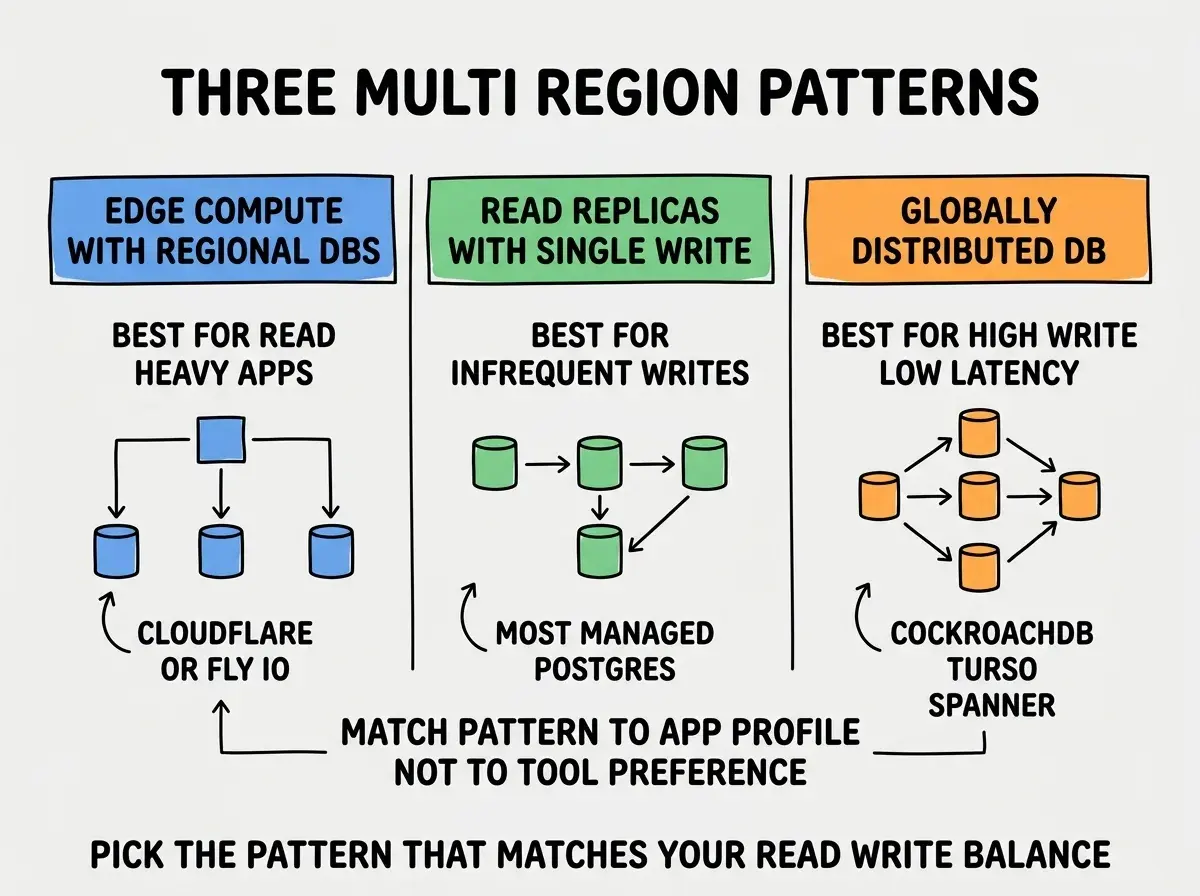
Pattern 3, globally distributed database. Use a database designed for multi-region writes (CockroachDB, Turso, Google Spanner). Each region has both compute and write-capable database. Best for apps with both global users and meaningful write volume per user.
The Database Choices That Hold Up
The database is the hard part of multi-region deployment. Compute scaling is easy; data consistency across regions is genuinely difficult. Three database choices in 2026 handle this well, each for a different scenario.
Postgres with managed read replicas. Use Neon, Supabase, or AWS RDS to add read replicas in other regions. Your app code uses the local read replica for queries and the primary for writes. Setup is small (a few hours) and the tradeoff is that writes still have to round-trip to the primary region.
Browse more scaling and infrastructure guides
Read more grow articlesTurso. Edge SQLite with multi-region replication. Best for apps that fit SQLite's model (mostly key-value with some relational). Operations are simple, costs are low, and reads are sub-50ms globally. Writes still go to a primary, but the primary can be replicated quickly.
CockroachDB. Distributed SQL with multi-region writes and strong consistency. The most powerful option but also the most complex to operate. Worth it for apps with both global users and write volume that matters per user.
What Goes Wrong and How to Avoid It
Multi-region projects tend to fail in predictable ways. Knowing the failure modes upfront is worth more than any specific architecture choice.
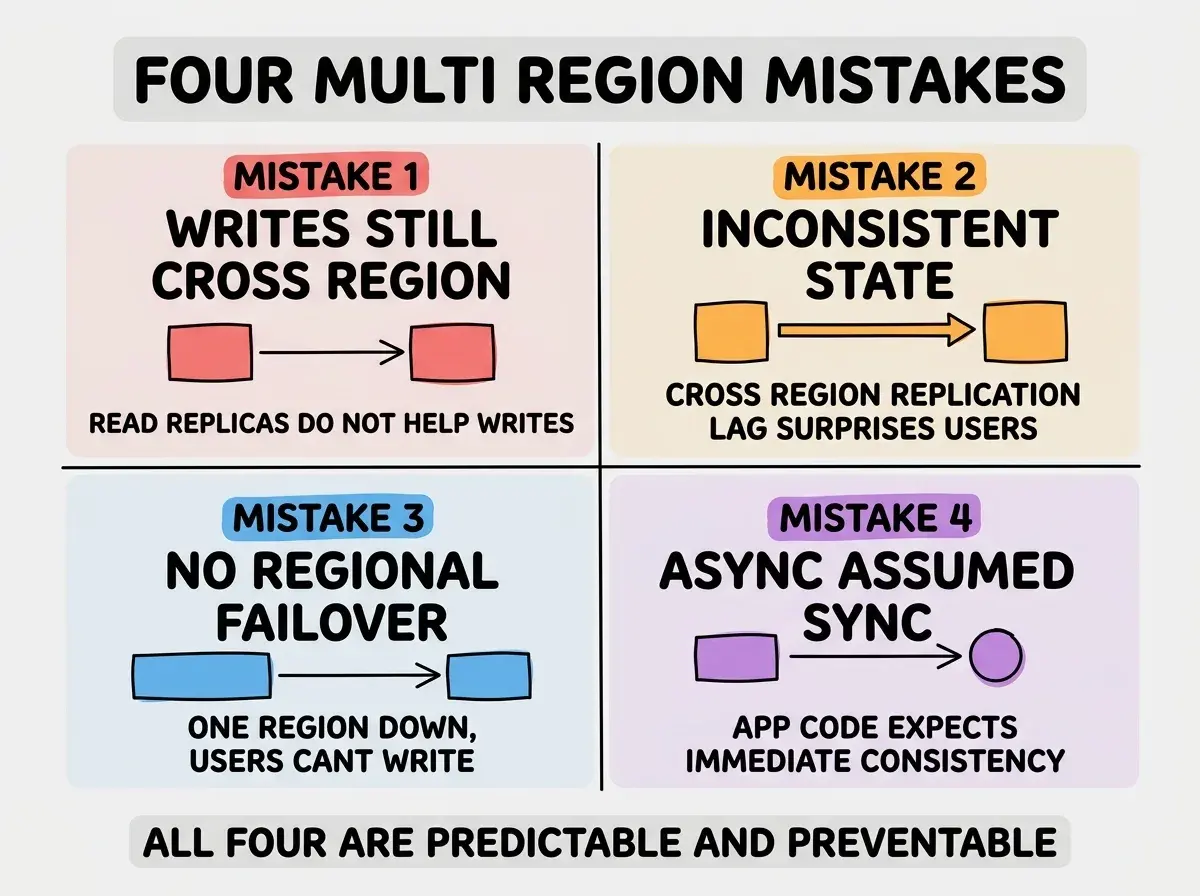
Mistake 1, writes still cross regions. Adding read replicas helps reads but does nothing for writes. Users in Australia writing to a US-primary still have 300ms write latency. The fix is to choose a database pattern that handles your specific write profile.
Mistake 2, inconsistent state. Cross-region replication has lag. A user creates an order in one region; another user in another region does not see it for 200ms. If your app code assumes immediate global consistency, this surprises users. The fix is to either accept eventual consistency in the UX or use a strongly consistent database.
Mistake 3, no regional failover. If one region goes down and your app does not have failover logic, users in that region cannot use the app. The fix is to design for region failure: route to a backup region automatically, or at least show a useful error message.
Mistake 4, async assumed sync. Application code that calls a write and immediately queries for the result fails when the write is replicated asynchronously. The fix is to either read from the primary after writes (sticky read), or to design the UX around eventual consistency.
The most expensive multi-region mistake is treating it as a checklist item rather than an architectural decision. Adding multi-region "for the future" without a current need creates ongoing complexity that drains engineering time forever. The right framing is that multi-region is a specific solution to a specific problem (global users with measurable latency complaints), and you adopt it when the problem is real, not when the problem might appear.
The other mistake is conflating multi-region with high availability. They are different concerns. Multi-region helps with latency for global users; multi-AZ within a single region helps with availability. Most apps need multi-AZ for HA reasons before they need multi-region for latency reasons.
A useful exercise during planning is to actually instrument your single-region app to measure the regional latency your users experience. Most platforms have edge analytics or you can add a simple latency beacon in your client. After a week of data, you have a clear picture of which regions need attention and which do not. Acting on real data beats acting on assumptions about where your users are.
The geographic distribution often surprises teams. Apps that assume their users are in the US frequently find that 30 to 40 percent of traffic comes from elsewhere. Apps that assume Europe is a major market find that APAC has overtaken it. The data is the input that should drive multi-region decisions, not assumptions about where you wish your users were.
What This Means For You
Multi-region deployment is a powerful tool when the problem matches, and an expensive distraction when it does not. Knowing which side of the line you are on is the most important decision.
- If you're a founder: Stay single-region until you have user data showing latency complaints from a specific region. Then add a read replica before considering full multi-region.
- If you're changing careers: Multi-region is a deep specialization that pays well at large companies. Practice on a small app first to understand the consistency challenges.
- If you're a student: Build a single-region app first and watch users in different countries experience it. The latency variation teaches what multi-region actually solves.
Browse more scaling and infrastructure guides
Read more grow articles