Choosing monorepo vs multi repo for AI built projects depends on team size, deployment patterns, and tooling. Four decision factors matter: code sharing needs (high sharing favors monorepo), deployment independence (independent deploys favor multi repo), tooling investment (monorepo needs more tooling), and team coordination (monorepo enables team awareness). Both strategies work for AI projects; decision based on factors not preferences.
This piece walks through the four decision factors, the implementation patterns, what makes each strategy work, and the four mistakes builders make on monorepo vs multi repo.
Why Repo Strategy Matters For AI Projects
Repo strategy matters for AI projects because AI velocity multiplies coordination needs. Wrong strategy compounds friction; right strategy compounds velocity.
The 2026 reality is that monorepo tooling matured (Turborepo, Nx, Bazel) making monorepos more accessible than 2020. Maturation changes calculus.
A 2025 software architecture study of 600 vibe coded projects found that monorepos with proper tooling shipped 31 percent more cross repo features than equivalent multi repo setups, primarily through reduced coordination overhead. Strategy measurably affects velocity at scale.
The pattern to copy is the way Google operates monorepo at massive scale and Amazon operates multi repo at similar scale. Both work; choices reflect organizational structure. Same patterns apply at vibe coder scale.
The Four Decision Factors
Four factors decide monorepo vs multi repo.
Factor 1, code sharing needs. High sharing favors monorepo; isolated favors multi.
Factor 2, deployment independence. Independent deploys favor multi; coupled favor mono.

Factor 3, tooling investment. Monorepo needs more tooling; multi simpler.
Factor 4, team coordination. Monorepo enables awareness; multi enables independence.
How To Implement Each Strategy
Four implementation patterns address each strategy.
Implementation 1, monorepo with Turborepo. Turborepo standard; fast builds, good caching.
Browse more ship
Read more shipImplementation 2, multi repo with shared packages. npm packages share code; clear boundaries.
Implementation 3, monorepo CI/CD. Per package CI; affected packages only.
Implementation 4, multi repo coordination tools. Atlantis, Spacelift; cross repo automation.
What Makes Monorepo Work
Three patterns separate working monorepo from chaos.
Pattern 1, package boundaries clear. Boundaries prevent coupling; without boundaries, monorepo becomes one big app.
Pattern 2, build tooling fast. Slow builds destroy monorepo benefits; fast tooling essential.
Pattern 3, CI runs per affected package. Full CI per change wasteful; affected only.
What Makes Multi Repo Work
Three patterns separate working multi repo from coordination overhead.
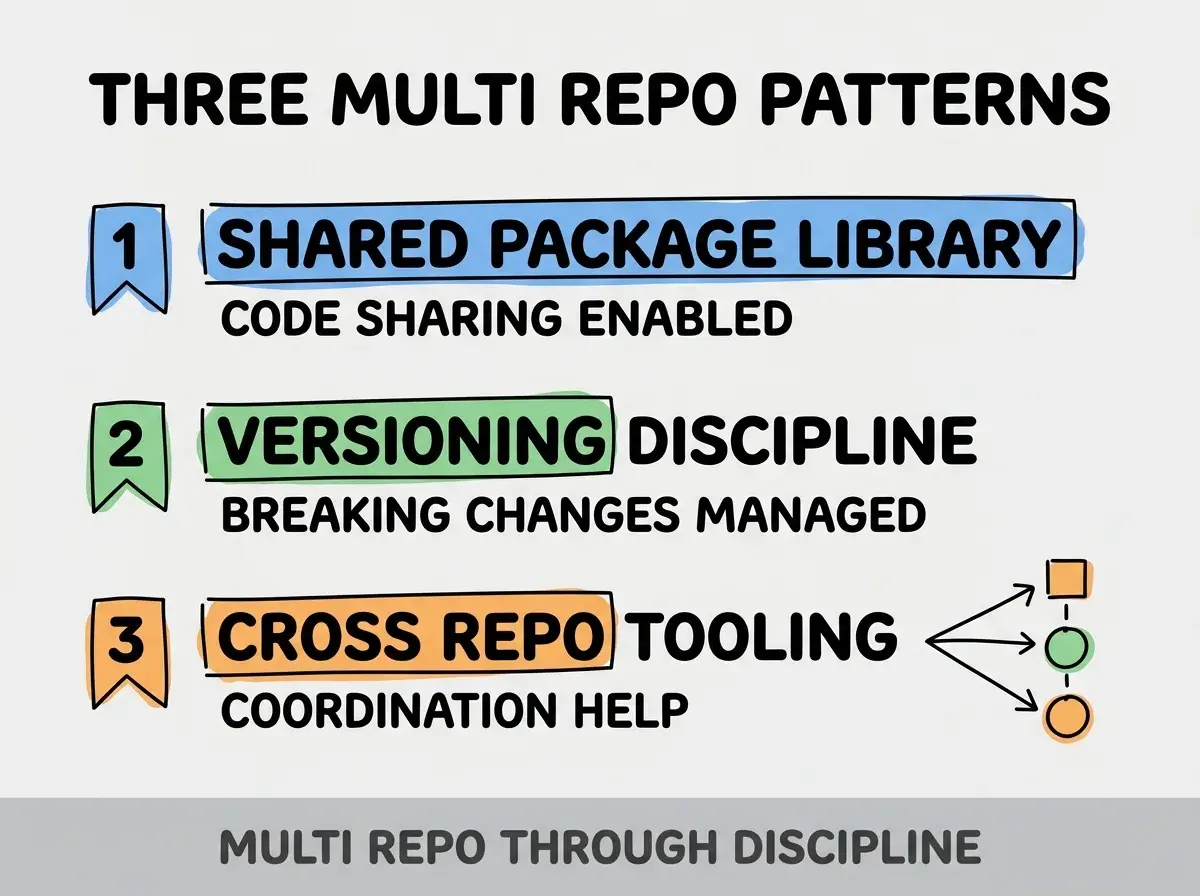
Pattern 1, shared package library. Code sharing through packages; library compounds.
Pattern 2, versioning discipline. Breaking changes managed; SemVer matters.
Pattern 3, cross repo tooling. Tooling reduces coordination; investment justified.
The combination produces working multi repo. Without these patterns, coordination overwhelms.
How AI Affects Repo Strategy
Three patterns reveal AI impact.
Pattern A, AI generates more code. More code increases coordination; either strategy.
Pattern B, AI suggests cross package changes. Monorepo enables; multi requires manual.
Pattern C, AI tooling differs. AI tools navigate monorepos differently than multi.
Common Questions About Repo Strategy
Repo strategy raises questions worth addressing directly.
The first question is whether monorepo or multi for solo. Multi for simple; monorepo for connected.
The second question is whether to use Turborepo or Nx. Turborepo simpler; Nx more features.
The third question is whether to migrate strategies. Yes when justified; migration substantial work.
The fourth question is whether AI prefers monorepo or multi. AI handles both; project structure affects context.
How Strategy Affects Project Velocity
Strategy affects project velocity in compounding ways. Velocity effects compound across team scale.
The first compounding effect is cross feature work. Monorepo enables cross feature; multi adds friction.
The second compounding effect is deployment timing. Multi enables independent timing; mono coordinates.
The third compounding effect is team learning. Monorepo enables awareness; multi isolates.
The combination produces velocity shaped by strategy. Without right strategy, velocity bounded.
How To Migrate Between Strategies
Three patterns help migration.
Pattern A, multi to mono via consolidation. Add packages to single repo; tools follow.
Pattern B, mono to multi via extraction. Extract packages; package boundary stays.
Pattern C, hybrid acceptable. Some monorepos with separate frontend; hybrid common.
The combination enables migration. Without patterns, migration risky.
The most damaging repo strategy mistake is choosing based on preference not needs. Monorepo trendy; not always right. Multi repo "feels cleaner"; not always right. The fix is to match strategy to actual needs across four factors. Builders who match factors choose right; builders who follow trends choose wrong, accumulating friction.
The other mistake is over indexing on tooling. Tooling matters but strategy choice matters more.
A third mistake is missing the team coordination factor. Coordination underrated; affects daily work substantially.
A fourth mistake is treating choice as permanent. Strategy can evolve; ongoing evaluation matters.
What This Means For You
Choosing monorepo vs multi repo for AI built projects depends on team size, sharing, and coordination needs. The four factors, implementation patterns, and sustainability approaches produce strategy that compounds project velocity.
- If you're a senior dev: Strategy expertise expected; learn both deeply.
- If you're a founder: Strategy affects team scaling; consider in technical decisions.
- If you're changing careers: Repo strategy fluency expected; learn patterns early.
Browse more ship
Read more ship