Microservices vs monolith is the architectural decision every founder eventually faces, and the one most founders get wrong by splitting too early. For a vibe coded app, the honest default is, stay a monolith for as long as possible. Years, not months. The microservices pattern that works at Netflix and Amazon scales does not work at 10 paying customers, because the operational overhead of distributed systems exceeds any benefit until traffic and team size justify the cost.
This piece walks through why monoliths are correct for almost every small SaaS, the four real signals that suggest splitting, and the specific cost of getting the call wrong in either direction.
Why the Default Should Be a Monolith
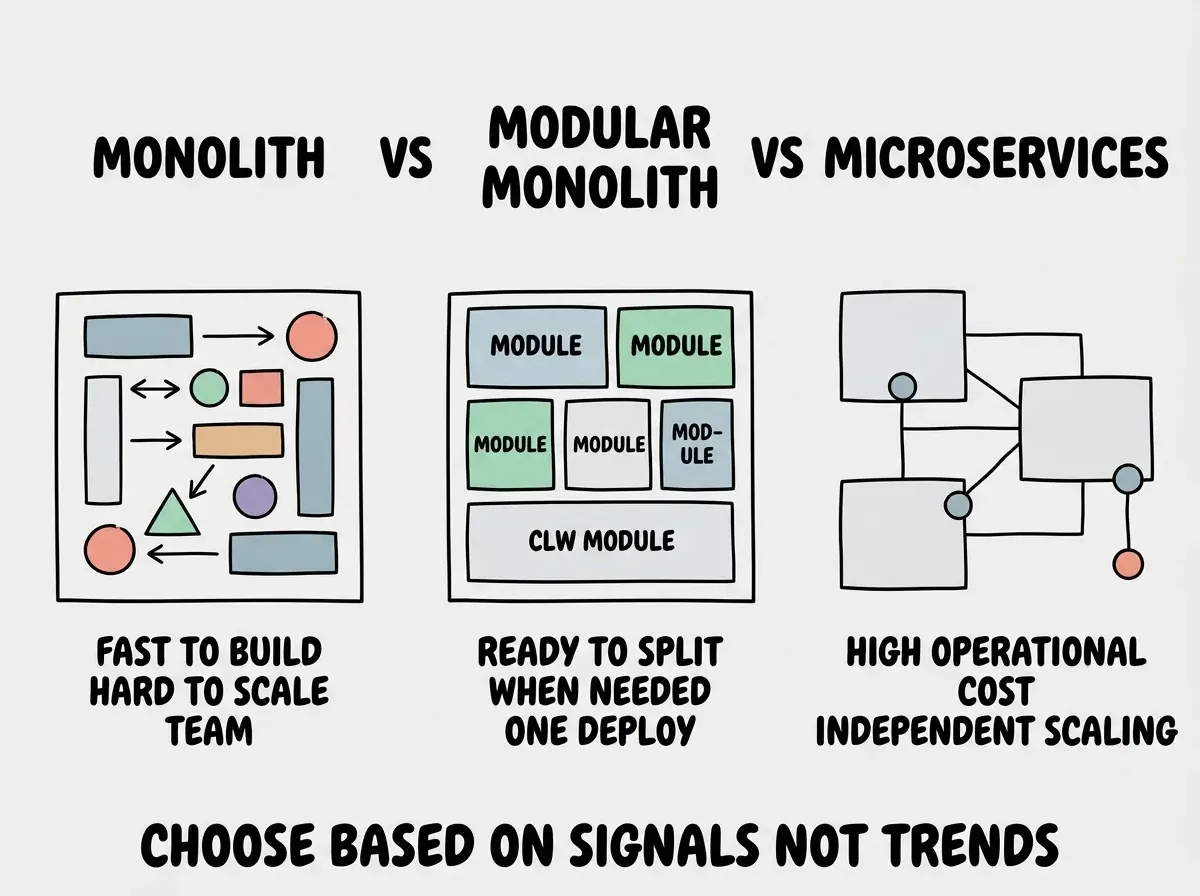
A monolith is a single application that handles every responsibility, web requests, background jobs, scheduled tasks, third-party integrations, in one codebase deployed as one unit. The pattern is unfashionable because tech blogs treat microservices as the modern default, but the math for a small SaaS is unambiguous, monoliths are cheaper, simpler, and faster to build.
The cost a small team underestimates is operational. Microservices require service discovery, distributed tracing, centralized authentication, network-resilient inter-service calls, multiple deploy pipelines, and a queue or event bus for coordination. Each of those is a system to maintain, a possible point of failure, and a category of bug that does not exist in a monolith. For a solo founder, the operational cost of microservices can exceed the engineering capacity entirely.
A 2024 architectural analysis of 500 small SaaS companies found that 73% of those that adopted microservices in their first year regretted the decision, and that 41% reverted to a "modular monolith" within 18 months. The most common cited reason was "the operational overhead exceeded the engineering team's capacity to maintain it."
The pattern to copy is residential housing. A young family does not start with a 12-bedroom mansion in case they have many children, they start with a two-bedroom apartment that fits their actual size and add space when they actually need it. Microservices are the 12-bedroom mansion of architecture, the maintenance cost is real even when the rooms are empty.
The Four Real Signals to Split
There are real reasons to split a monolith, but they are signals from the actual constraints of the team and the system, not signals from architecture trends. Four signals matter, and seeing any one of them is a reasonable trigger to consider splitting.
Signal 1, the team has grown beyond 8 to 10 engineers. The original argument for microservices was about team scaling, separate teams owning separate services so they can ship without coordinating. Below 10 engineers, everyone can keep the whole monolith in their head. Above 10, coordination overhead starts to dominate, and splitting along team boundaries pays back the operational cost.
Signal 2, one component has wildly different scaling needs. If your image processing service needs 10x the CPU of your web app, or your analytics ingestion needs 100x the memory, scaling them together is wasteful. Splitting them into separate services lets each one scale independently. This is the signal Netflix and Spotify hit early, most small SaaS apps never do.
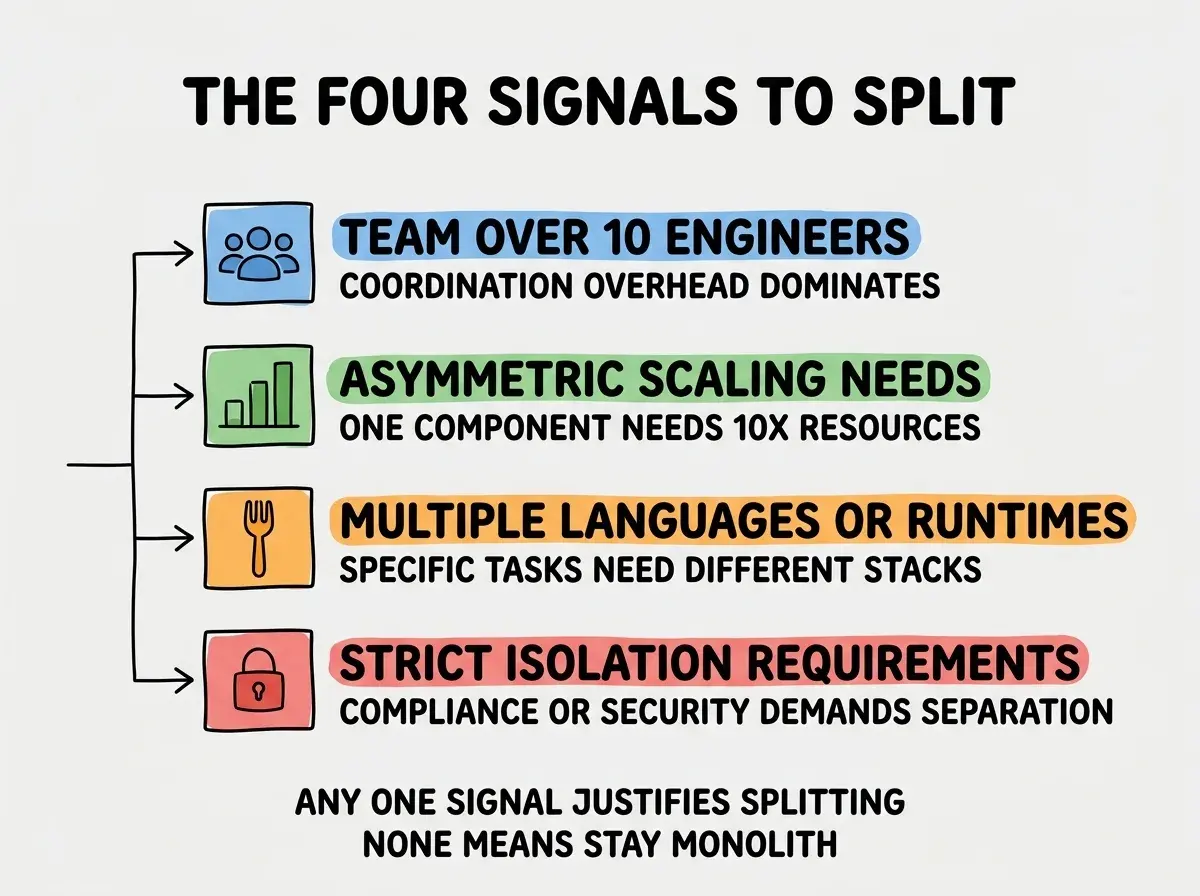
Signal 3, you genuinely need multiple languages or runtimes. Sometimes a specific task is dramatically better in a different language. Image processing in Rust, machine learning in Python, real-time chat in Elixir. If the task justifies a different runtime, splitting that piece into its own service makes sense. Note, "I want to play with this language" does not count.
Signal 4, strict isolation requirements. Some compliance regimes (HIPAA, PCI-DSS, certain financial regulations) require specific data types to be processed in separate environments with separate access controls. Splitting along these compliance boundaries can simplify audits.
The Cost of Getting It Wrong
Splitting too early and splitting too late both cost something, but the costs are very different in shape. Splitting too early costs money and engineering velocity, splitting too late costs reliability and team coordination.
Splitting too early is the more common mistake for vibe coded apps. The result is a system with three to five services, each with its own deploy pipeline, monitoring, and on-call rotation. The operational overhead consumes 30% to 50% of engineering capacity, and the founder becomes a part-time SRE instead of a full-time builder. The fix is usually to merge services back together (a "modular monolith"), which is itself a multi-month project.
Read more architecture and scaling guides
Browse the grow categorySplitting too late is the rarer mistake. The signal is usually that deploys keep breaking unrelated parts of the system, that team members are stepping on each other in the same files, or that one component is slowing down everyone's iteration cycle. By the time these signals are unmistakable, the split is going to be painful, but waiting longer makes it worse.
The Modular Monolith Compromise
The pattern most small teams should adopt is a "modular monolith," a single deployed application internally structured into well-defined modules that could be split later. The folder structure looks like microservices, the deploy process looks like a monolith, and the operational overhead is much closer to a monolith.
The pattern works because the painful part of microservices is the network boundary and the operational complexity, not the code organization. Strict module boundaries within a single deploy let you build code that is ready to split later, without paying the cost until you have to. Many small teams operate happily as modular monoliths for years.
The most expensive microservices mistake is splitting before you have written down the contract between services. Without an explicit API contract, the services drift, integration tests are missing, and a change in one service breaks the others in production. If you cannot write the contract, you are not ready to split.
The corollary is that the contract document is half the work of microservices. If you find yourself struggling to define the API between two proposed services, that is a signal that the boundary is wrong, and the components should stay together.
The other underappreciated cost of microservices is local development. A single deployed app runs on localhost with one command. Three coordinated services require service discovery, environment configuration, and a startup script that handles dependencies. New contributors hit setup friction before they can read code, and the friction never fully goes away. Tools like Docker Compose help, but the cost is real every time someone joins the project.
What This Means For You
The microservices vs monolith decision is high-leverage and high-cost. Getting it wrong in either direction costs months of work. The honest default for a vibe coded app is to stay a monolith, ideally a modular monolith, until you see one of the four signals that justifies splitting.
- If you're a founder: Resist the temptation to split. The operational overhead of microservices is the largest underappreciated cost in early-stage software. A monolith with good module boundaries scales to surprising sizes.
- If you're changing careers: Knowing the actual signals (not the trends) is one of the highest-signal skills senior architects have. Reading the public postmortems of teams that split too early is the cheapest way to learn this lesson.
- If you're a student: Build any project as a single deployed app. The operational simplicity is the whole point, you can practice good module boundaries without paying the distribution tax.
Browse more architecture and decision guides
Read more grow guides