To build a UTM parameter manager with AI tools, follow the four phase approach (define what UTM patterns and naming conventions matter for your team, build the data model that handles campaigns and links, design the link generation interface that prevents naming inconsistencies, and ship with the analytics integration that connects UTM data to outcomes), recognize what separates UTM tools that produce clean attribution from tools that get bypassed for ad hoc URL hacking, and apply the patterns that produce sustained marketing intelligence. The UTM parameter manager becomes valuable when teams use it consistently; without that bar, attribution data fragments into uselessness.
This piece walks through the four phases, the analytics integration patterns, the specific tooling, and the four mistakes that produce UTM tools marketers ignore.
Why UTM Parameter Managers Matter
UTM parameter managers turn ad hoc URL tagging into structured attribution data. The transformation matters; without managers, marketers create UTM parameters inconsistently, producing attribution data that fragments into uselessness when analyzing campaign performance.
The 2026 reality is that AI tools dramatically accelerate UTM tool building while AI integration during link generation can suggest naming conventions, detect duplicates, and validate parameter consistency faster than manual review. The combination means small marketing teams can have UTM tooling matching what enterprise marketing platforms previously required.
A 2025 marketing operations survey of 600 mid sized marketing teams found that teams using purpose built UTM managers reduced attribution data cleanup time by 73 percent compared to teams using spreadsheets and manual URL construction. The structure produces both data quality and time savings.
The pattern to copy is the way coding standards transformed code quality in software engineering. Standards beat ad hoc decisions for sustained quality; the standards produce consistency that ad hoc choices destroy. UTM managers play similar role for marketing data; standards produce attribution quality that ad hoc tagging destroys.
The Four Phase Approach
Four phases produce UTM parameter managers marketers actually use.
Phase 1, define what UTM patterns and naming conventions matter for your team. Source naming, medium naming, campaign naming. Defined conventions produce consistency.
Phase 2, build the data model that handles campaigns and links. Campaigns, links, parameters, validation rules. AI tools generate the schema effectively given clear specifications.
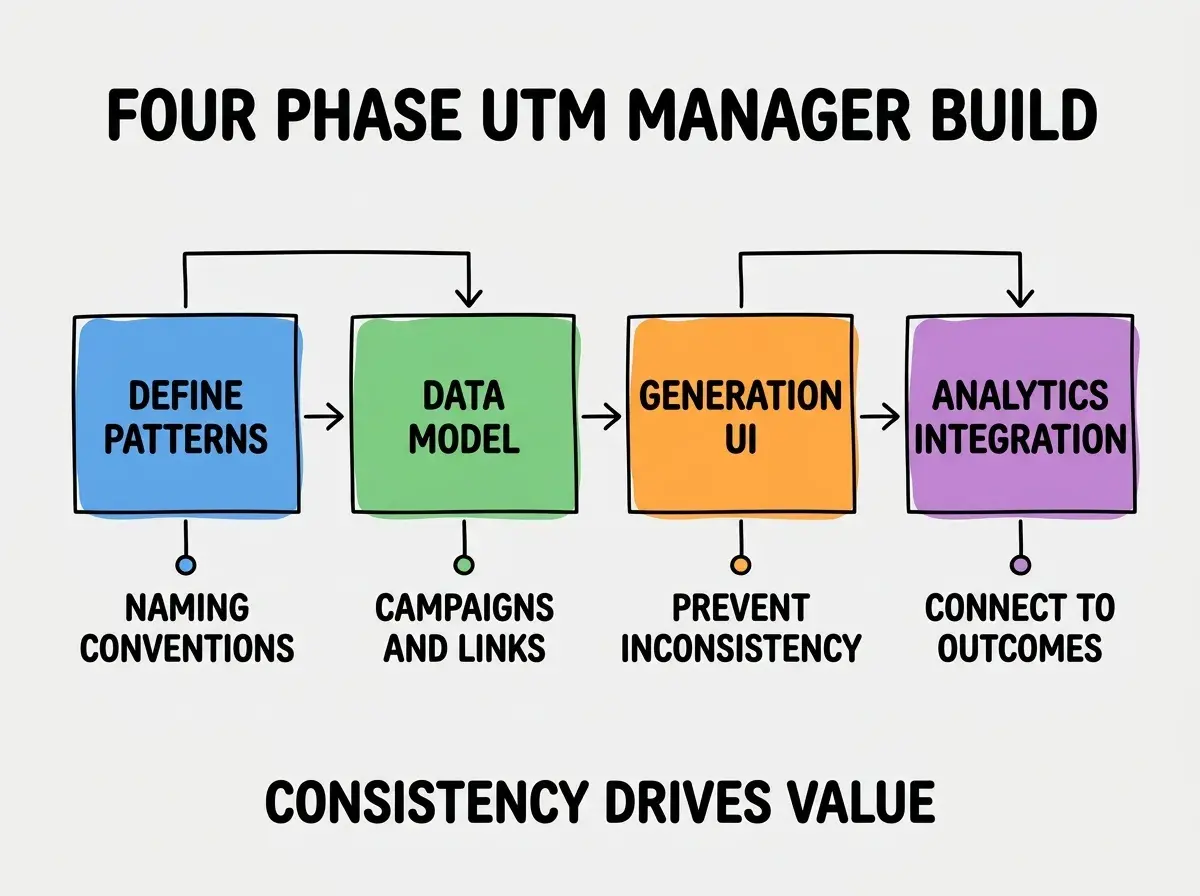
Phase 3, design the generation interface that prevents naming inconsistencies. Dropdown selectors, validation rules, AI suggestions. Generation UI determines whether marketers use the manager or bypass it.
Phase 4, ship with analytics integration that connects UTM data to outcomes. Google Analytics, GA4, custom analytics. Analytics integration produces value beyond just clean URLs.
The Analytics Integration Patterns That Work
Three patterns produce analytics integration that produces marketing value.
Pattern 1, automatic conversion tracking by UTM parameters. Generated URLs sync to analytics with conversion goals. Without conversion tracking, UTM data has limited business value.
Browse more marketer tutorials
Read more build tutorialsPattern 2, cross channel attribution dashboard. UTM data combined across channels reveals attribution patterns. Cross channel view beats per channel views.
Pattern 3, ROI calculation per campaign. Cost per campaign tracked alongside conversion value. ROI calculation makes campaign decisions data driven.
The Specific Tooling That Worked
Three tool categories combine effectively for UTM manager building.
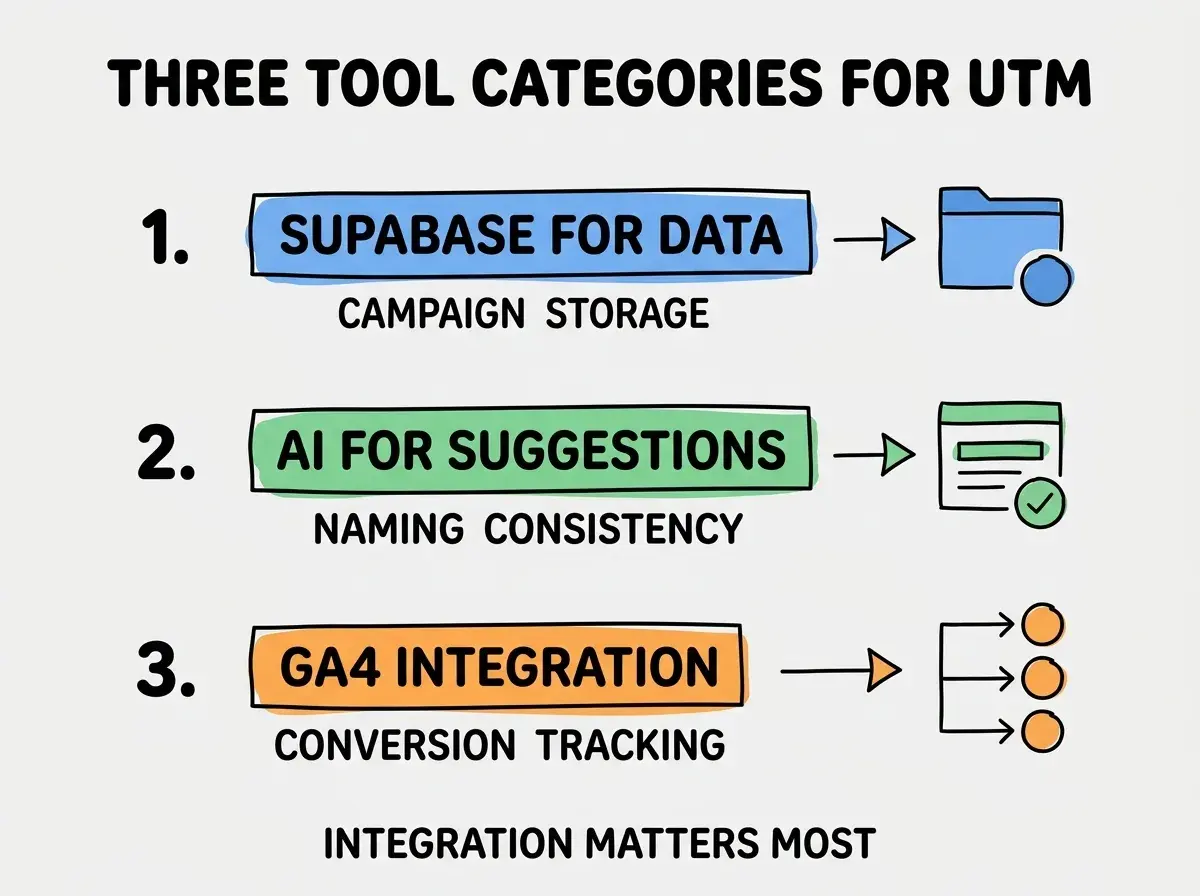
Tool 1, Supabase for campaign data. Campaigns, links, parameters, validation. Relational data fits naturally.
Tool 2, AI for naming suggestions. Claude or GPT suggests UTM parameters matching team conventions. AI reduces friction that strict validation produces alone.
Tool 3, GA4 integration for conversion tracking. Google Analytics 4 API for syncing UTM data with conversion outcomes. Integration produces business value beyond URL hygiene.
What Makes UTM Tools Get Sustained Marketer Use
Three patterns separate sustained marketer use from tool abandonment.
Pattern 1, faster than manual URL construction. Tool must be faster than typing UTM parameters manually. Speed determines daily use.
Pattern 2, integration with existing marketing tools. Buffer, Hootsuite, Mailchimp integration eliminates copy paste. Integration produces use; isolated tools get bypassed.
Pattern 3, team standards enforcement without friction. Validation prevents inconsistency without slowing marketers. Friction enforcement produces bypass; smooth enforcement produces consistency.
The combination produces UTM tools marketers use across all campaigns. Without these patterns, tools get tried then bypassed for ad hoc URL construction.
How to Build Your First UTM Manager
Three implementation patterns help first UTM managers succeed.
Pattern A, start with one team channel before all channels. Email campaigns first or social campaigns first. Single channel validates patterns.
Pattern B, dogfood with marketing team for 4 weeks. Real marketing campaigns reveal usability issues.
Pattern C, instrument link generation completion rate. Are users completing UTM generation flows? Without instrumentation, friction stays hidden.
The combination produces first UTM tools that establish marketer use patterns. Without these patterns, first tools often launch with friction that produces marketer bypass.
The most damaging UTM tool mistake is enforcing strict naming standards without flexibility for edge cases. Strict enforcement produces marketer frustration that drives bypass. The fix is to enforce naming conventions for routine cases while allowing override for edge cases; the flexibility preserves consistency for the 90 percent while allowing the 10 percent edge cases. Strict enforcement without flexibility produces ad hoc URL construction that defeats the tool entirely.
The other mistake is missing the analytics outcomes integration. UTM tools without analytics integration produce clean URLs without business value. The fix is to connect UTM data to conversion outcomes from start.
A third mistake is failing to handle campaign archive workflows. Old campaigns clutter the interface; archive workflows preserve data while cleaning interface. The fix is to design archive flows from start.
A fourth mistake is treating UTM tool as one time build rather than ongoing optimization. Marketing channels evolve; UTM tools should evolve with them.
A fifth mistake is missing the historical campaign data import. Existing UTM data has analytical value; without import, new tools start with empty history that limits comparison and trend analysis.
How UTM Managers Generate Sustained Marketing Value
Sustained value comes from clean attribution data compounding over time. Each campaign tagged consistently adds to the data set that informs future campaign decisions.
The first compounding effect is channel comparison accuracy. Consistent tagging enables apples to apples comparison across email, social, paid, and organic. Without consistency, channel comparison stays apples to oranges.
The second compounding effect is campaign pattern recognition. Historical UTM data reveals which campaign patterns produce conversions; pattern recognition informs future campaign design. Without historical data, every campaign starts from scratch.
The third compounding effect is ROI clarity over time. UTM data plus cost data produces ROI by campaign that informs budget allocation. Budget decisions based on ROI outperform decisions based on intuition or vendor pitches.
The combination produces UTM tools that increase in value over time as data accumulates. The compounding matters; first month value is modest while second year value is substantial.
Common Questions About Building UTM Managers
Building UTM managers raises questions worth addressing explicitly. Two questions come up most often.
The first question is whether dedicated UTM tools beat spreadsheets for small marketing teams. For teams running fewer than 20 campaigns monthly, spreadsheets often suffice; above that threshold, dedicated tools produce time savings that justify build effort.
The second question is integration depth tradeoffs. Deep integration with one analytics platform produces better insights for that platform; shallow integration with multiple platforms produces flexibility. Choose based on whether your analytics setup is consolidated or distributed.
What This Means For You
The UTM parameter manager built with AI tools becomes valuable through naming consistency, analytics integration, and team adoption. The four phases, integration patterns, and tool combinations produce UTM tools marketers genuinely use.
- If you're a marketer: Custom UTM tools beat spreadsheets dramatically for team consistency. Build when team marketing volume justifies the build effort; below that volume, spreadsheets may suffice.
- If you're a founder: Marketing data quality affects business decisions. Invest in UTM discipline early; data quality compounds across all marketing decisions over time.
- If you're a senior dev: AI tools handle UTM tool implementation effectively. The bottleneck is marketing workflow understanding, not implementation; invest in marketing domain understanding more than feature breadth.
Browse more marketer tutorials
Read more build tutorials