A marketer lead scoring calculator helps sales prioritize follow up by ranking leads on likelihood to convert. Four scoring components matter: demographic fit (industry, company size, role), behavioral signals (website activity, content downloads), engagement recency (last interaction time), and intent indicators (pricing page visits, demo requests). Combined components produce a score that ranks leads; without scoring, sales chases leads randomly.
This tutorial walks through the four components, the implementation patterns, what makes lead scoring sustainable, and the four mistakes marketers make on lead scoring.
Why Lead Scoring Matters For Marketers
Lead scoring matters because sales time is finite; chasing every lead wastes effort on poor fit. With scoring, sales focuses on highest probability conversions and revenue compounds.
The 2026 reality is that AI tools (Claude, GPT) can build lead scoring calculators in hours that previously required CRM consultant projects.
A 2025 marketing operations study of 500 B2B teams found that teams with quantitative lead scoring closed 34 percent more deals than teams using sales intuition alone, primarily through better prioritization of high intent leads. Scoring measurably affects conversion rates.
The pattern to copy is the way credit scoring agencies rank loan applicants on multiple factors. Credit history, income, debt ratio, employment all combine into a single FICO score that lenders use. Same patterns apply to lead scoring; multiple factors combine into a number sales actions on.
The Four Scoring Components
Four components form complete lead scoring.
Component 1, demographic fit. Industry, size, role. Foundation.
Component 2, behavioral signals. Activity, downloads. Engagement.
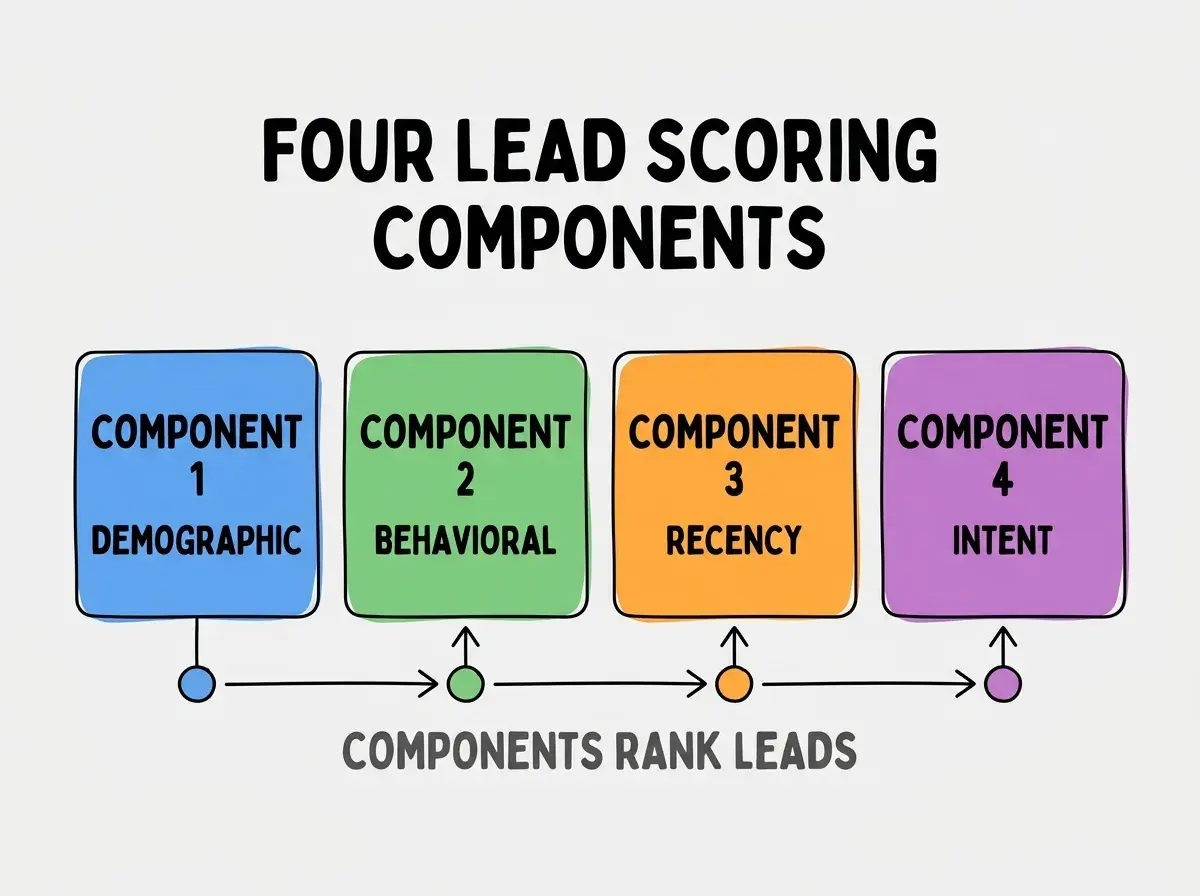
Component 3, engagement recency. Last interaction time. Decay.
Component 4, intent indicators. Pricing visits, demo requests. Buying signals.
How To Implement Each Component
Four implementation patterns address each component.
Implementation 1, demographic from form fields. Form captures industry, size, role; map to score weights.
Browse more build
Read more buildImplementation 2, behavioral from analytics. Page views, downloads tracked; sum with weights.
Implementation 3, recency with decay function. Recent interactions weighted higher; older decay exponentially.
Implementation 4, intent from page tracking. High intent pages (pricing, demo) flagged separately; bonus points.
What Makes Lead Scoring Sustainable
Three patterns separate sustainable scoring from spreadsheet abandonment.
Pattern 1, automated data pipeline. Manual entry fails; integrations maintain data flow.
Pattern 2, score visible in CRM. Sales sees score in workflow; not separate tool.
Pattern 3, regular calibration. Quarterly review; adjust weights based on closed won analysis.
What Makes Lead Scoring Effective
Three patterns separate effective from theatrical.
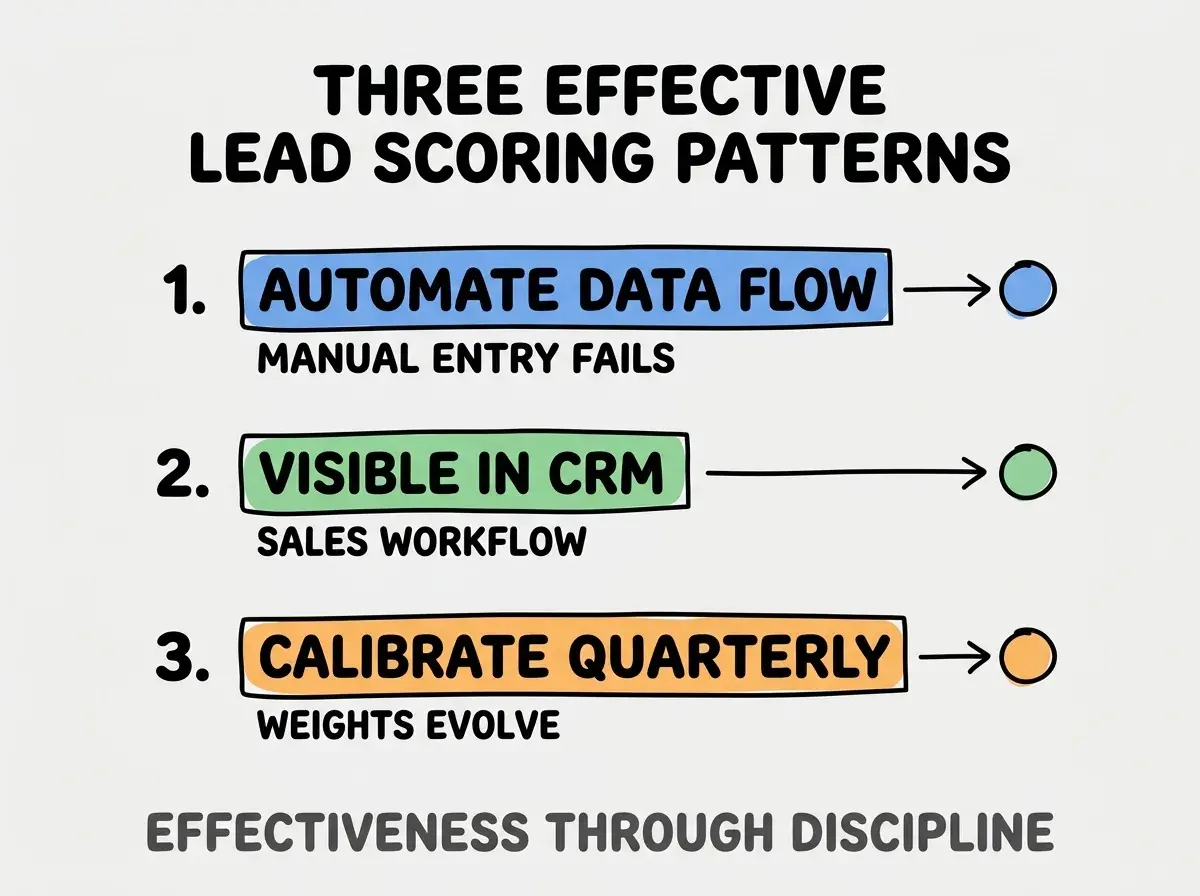
Pattern 1, automate data flow. Manual entry fails over time.
Pattern 2, visible in CRM. Score lives where sales works.
Pattern 3, calibrate quarterly. Weights evolve with closed won data.
The combination produces effective lead scoring. Without these patterns, scoring degrades into ignored numbers.
How To Choose Scoring Weights
Three patterns help weight selection.
Pattern A, start with conventional wisdom. Industry benchmarks; refine from there.
Pattern B, validate against closed won. Backtest against historical conversions.
Pattern C, A B test weight changes. Measure impact on conversion before committing.
Common Questions About Lead Scoring
Lead scoring raises questions worth addressing directly.
The first question is what threshold qualifies a lead. Depends on team capacity; tune to match sales bandwidth.
The second question is what tools to use. HubSpot, Marketo, custom; depends on stack and budget.
The third question is whether AI can replace scoring. AI augments; provides predictions, humans validate weights.
The fourth question is how to handle disqualifying signals. Negative scores; below threshold filtered out.
How Lead Scoring Affects Sales Conversion
Lead scoring affects conversion in compounding ways. Conversion effects compound across pipeline.
The first compounding effect is sales prioritization. Right leads get attention.
The second compounding effect is response time. High score leads contacted faster.
The third compounding effect is win rate. Better targeting better wins.
The combination produces conversion shaped by scoring discipline. Without discipline, conversion suffers from noise.
How To Validate Scoring Accuracy
Three patterns help validation.
Pattern A, conversion rate by score band. High scores convert higher? Validation.
Pattern B, win rate by score range. Top decile wins more? Score works.
Pattern C, sales feedback loop. Sales reports scoring quality; iterate.
The combination produces validated scoring. Without validation, scoring stays aspirational.
The most damaging lead scoring mistake is treating it as set and forget. Scoring weights drift as ideal customer profile evolves; static weights become stale. The fix is to calibrate quarterly against closed won analysis. Marketers who calibrate maintain scoring effectiveness; marketers who set once watch scoring decay until sales ignores the number entirely.
The other mistake is over engineering with too many factors. Five to ten factors maximum; more becomes noise.
A third mistake is missing the negative scoring. Disqualifying signals matter as much as positive.
A fourth mistake is treating scoring as standalone. Scoring is part of go to market system; works with nurturing and routing.
What This Means For You
Marketer lead scoring calculator builds enable quantitative lead prioritization that compounds sales effectiveness. The four components, implementation patterns, and sustainability approaches produce scoring that makes pipeline more productive.
- If you're a marketer: Lead scoring central to operations; calculator skills directly useful.
- If you're a founder: Lead scoring affects sales productivity; investment in scoring justified by pipeline economics.
- If you're a senior dev: Scoring algorithms interesting design problem; transferable to other ranking systems.
Browse more build
Read more build