Lovable vs v0 is one of the most common comparisons in AI building, and also one of the most misleading. Both generate UI from text prompts, but they solve fundamentally different problems. With 92% of builders using AI tools daily and Lovable crossing 8 million users, the real question is which one matches what you are actually trying to build.
Quick Verdict
| Lovable | v0 | |
|---|---|---|
| Best for | Full MVPs, non-technical founders, complete apps | Individual components, React/Next.js developers |
| Price | Free (limited), Starter $20/mo, Launch $50/mo | Free tier, Premium $20/mo |
| Strength | Full-stack app generation with backend, auth, database | High-quality React/Tailwind component generation |
| Weakness | Complex business logic, custom integrations | No backend, no database, no deployment |
The table gives you the short version. The rest of this article explains when each tool actually delivers on its promise and when it does not.
What Lovable Builds
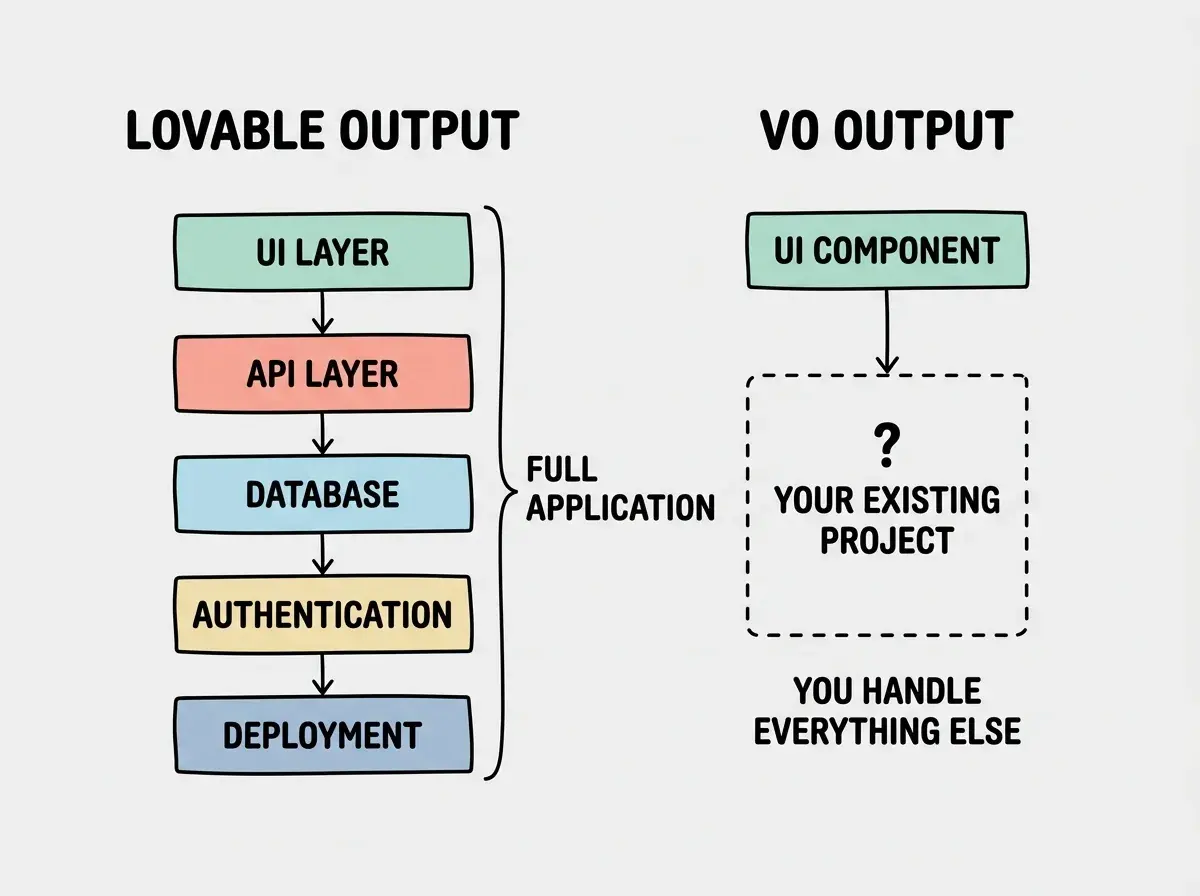
Lovable is a full-stack app builder. You describe an application in plain English and it generates a working product with a React frontend, a Supabase backend, user authentication, and a database. The output is not a mockup or a component library. It is a functioning application that users can log into and interact with immediately.
The workflow is conversational. You start with a prompt like "build a project management tool with team workspaces, task boards, and deadline tracking." Lovable generates the entire application, connects the database tables, sets up auth flows, and gives you a live preview. Then you iterate through chat. "Add a calendar view." "Let users assign tasks to team members." Each instruction modifies the existing codebase and updates the preview in real time.
This conversational iteration is where Lovable genuinely shines for non-technical builders. You never touch code directly. You never configure a database. The AI handles the entire stack, and you focus on describing what the product should do.
The infrastructure underneath is real. Supabase handles the database, authentication, and API layer. Your data lives in a PostgreSQL database that you own and can access directly. If Lovable disappeared tomorrow, your Supabase project and its data would still be there.
What v0 Generates
v0 is Vercel's AI component generator. You describe a UI element and it produces a React component using Tailwind CSS and shadcn/ui. The output is a single component or a small collection of components, not a full application. There is no backend, no database, no authentication, and no deployment. You get code that you copy into your existing project.
The target user is a developer or designer who already has a codebase and needs to quickly scaffold a specific piece of UI. "Create a pricing page with three tiers and a toggle for annual billing." "Build a dashboard sidebar with collapsible navigation groups." v0 generates polished, production-ready components for prompts like these.
The component quality is genuinely impressive. v0's output uses proper accessibility attributes, responsive design patterns, and clean component composition. Because it generates shadcn/ui components (which are unstyled primitives you customize), the code integrates cleanly into existing Next.js and React projects without style conflicts. You are getting source code that becomes part of your project.
But that is all you get. v0 does not know about your database schema, your authentication system, your API endpoints, or your business logic. It generates the visual layer. Connecting that layer to anything functional is entirely your responsibility.
Output Quality Compared
Lovable's UI output is attractive but generic. The designs follow modern SaaS conventions with clean layouts and professional color schemes. You can customize through chat instructions, but the starting point tends toward a specific aesthetic you will recognize across many Lovable-built apps. For MVPs and internal tools, this is perfectly fine. For products where distinctive design is a competitive advantage, you will need significant customization.
v0's UI output is more refined at the component level. Because v0 focuses entirely on individual components, each piece gets more attention. The components handle edge cases like empty states and loading states, and use animation patterns that feel polished. If you put a Lovable-generated dashboard next to one built from v0 components by a competent developer, the v0 version will typically look more intentional.
The difference comes down to scope versus polish. Lovable gives you a complete app that looks good enough to ship. v0 gives you individual pieces that look great but require assembly.
Code Ownership and Portability
Lovable generates React code that you can export to GitHub. The Supabase backend is a separate service you control. In theory, you own everything. In practice, the generated code can be messy and difficult to maintain manually. If you outgrow Lovable and need a professional developer to take over, they will likely want to refactor significant portions of the codebase.
v0 gives you clean, well-structured component code from the start. Because the output is designed to be copied into an existing project, it follows React conventions that developers expect. There is no proprietary runtime, no special imports, and no dependency on Vercel's infrastructure. You copy the code, it is yours, and any React developer can understand and modify it immediately.
If long-term code quality matters for your project, v0 produces cleaner output at the component level. But if you need a working application today and plan to rewrite later anyway, Lovable gets you to market faster. The "right" code quality depends entirely on your timeline.
Pricing Breakdown
Lovable offers a free tier with limited message credits, a Starter plan at $20/month, and a Launch plan at $50/month with more credits and features. Heavy iteration on complex apps can burn through credits quickly. Generating a full app and refining it for a week might consume most of a monthly Starter allocation.
v0 provides a free tier that covers occasional use. The Premium plan at $20/month increases generation limits and adds features like longer prompts and priority access. Premium makes sense if you are using v0 regularly as part of your design workflow.
The real cost comparison is misleading at the subscription level. Lovable at $50/month replaces what might otherwise require a developer, a database service, and a hosting platform. v0 at $20/month replaces the time spent manually building individual components. You are not comparing $50 to $20. You are comparing an all-in-one app builder to a component generation tool inside a much larger development workflow.
Choosing between Lovable and v0 based on price assumes they are interchangeable. They are not. If you need a full application and choose v0 because it is cheaper, you still need to build the backend, set up auth, configure a database, and handle deployment yourself. The $20 you saved on the subscription will cost you weeks of additional work.
Limitations You Will Hit
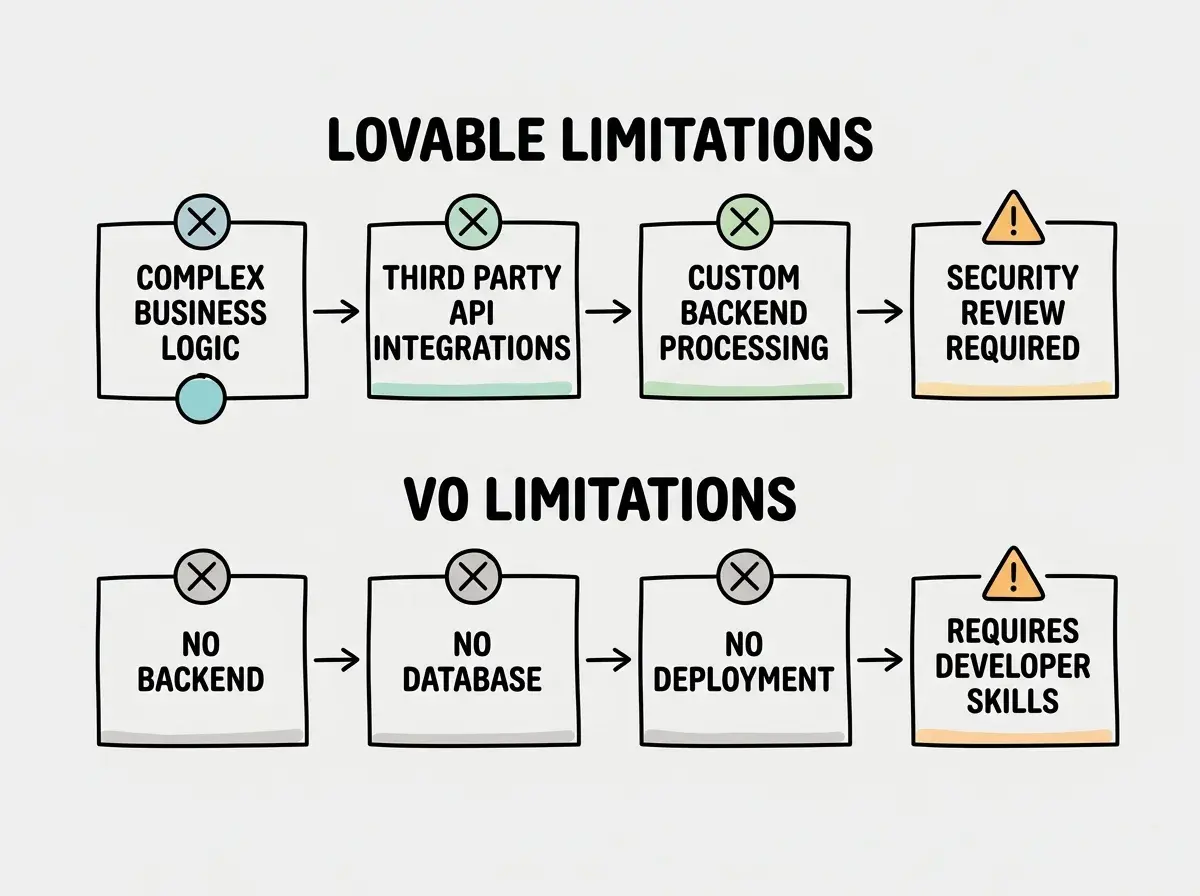
Lovable struggles with complex business logic, third-party API integrations, and anything requiring custom backend processing beyond basic CRUD operations. "Process a payment only if the subscription is active and the monthly limit has not been exceeded" involves conditional logic that Lovable often gets wrong or implements incompletely.
Lovable also had a significant security vulnerability (CVE-2025-48757) where environment variables were exposed in generated code. This has been patched, but it highlights a real risk with AI-generated code handling sensitive data.
v0's limitations are more straightforward. It does not build applications, connect to databases, or handle state management beyond component-local state. The tool has also seen a 71% drop in web visits recently, which suggests that as developers' needs evolve beyond component generation, they are finding v0 less essential to their workflow.
v0 also requires developer skills to be useful. You need to understand React, know how to integrate components into a project, and be comfortable with Tailwind CSS. If you cannot read and modify the generated code, v0's output is just a pretty picture you cannot use.
When to Use Lovable
Use Lovable when you need a complete, working application and you do not have the technical skills (or time) to build one from scratch.
- You are a founder validating an idea and need a functional MVP in days, not months
- You are building an internal tool for your team and do not want to hire a developer
- You need a working prototype to show investors or potential users
- Your app is primarily data collection, display, and management with user accounts
Lovable is the wrong choice when your app requires complex integrations, custom algorithms, or enterprise-grade security.
When to Use v0
Use v0 when you are a developer or designer building within an existing React/Next.js project and need to quickly scaffold high-quality UI components.
- You are building a new feature and need a starting point for the UI
- You want to prototype multiple design approaches for a component quickly
- You are a designer who knows enough React to integrate generated components
- Your project already uses shadcn/ui and Tailwind CSS
v0 is the wrong choice when you need a full application, when you are not working in React, or when you do not have the technical ability to integrate generated components. It is a developer tool that happens to accept natural language input, not a no-code platform.
Find the right tool for your skill level and project scope.
Explore tool guidesDig deeper
A few hand-picked sources if you want to go further.
What This Means For You
The Lovable vs v0 comparison reveals something important about where AI building tools are heading. The market is splitting into two categories. Full-stack builders like Lovable that generate entire applications for non-technical users. And developer-focused tools like v0 that accelerate specific parts of an existing workflow.
- If you are a non-technical founder: Lovable is the obvious choice. It gives you a complete, working application without requiring you to understand code. Start with Lovable, validate your idea with real users, and hire a developer later to rebuild if the idea has legs.
- If you are a designer moving into development: v0 is the better starting point. It generates code you can learn from, and the component-level output is manageable enough to understand piece by piece. Lovable skips the learning entirely, which means you never develop the skills to maintain what it builds.
- If you are a developer building a product: Use v0 for rapid UI scaffolding and build your own backend. You will end up with cleaner code, better architecture, and full control over every layer. Lovable's all-in-one approach trades control for convenience, and most developers find the trade-off frustrating once they need to customize beyond what the AI handles through chat.
Read honest breakdowns of the tools that matter for AI-assisted building.
Browse comparisons