Lovable vs Bolt vs Replit is the question every non-technical founder asks before building their first app in 2026. With 92% of builders now using AI tools daily and millions of people shipping apps without writing code, these three platforms have emerged as the clear frontrunners. But they are not interchangeable, and picking the wrong one costs you weeks.
Quick Verdict
| Lovable | Bolt | Replit | |
|---|---|---|---|
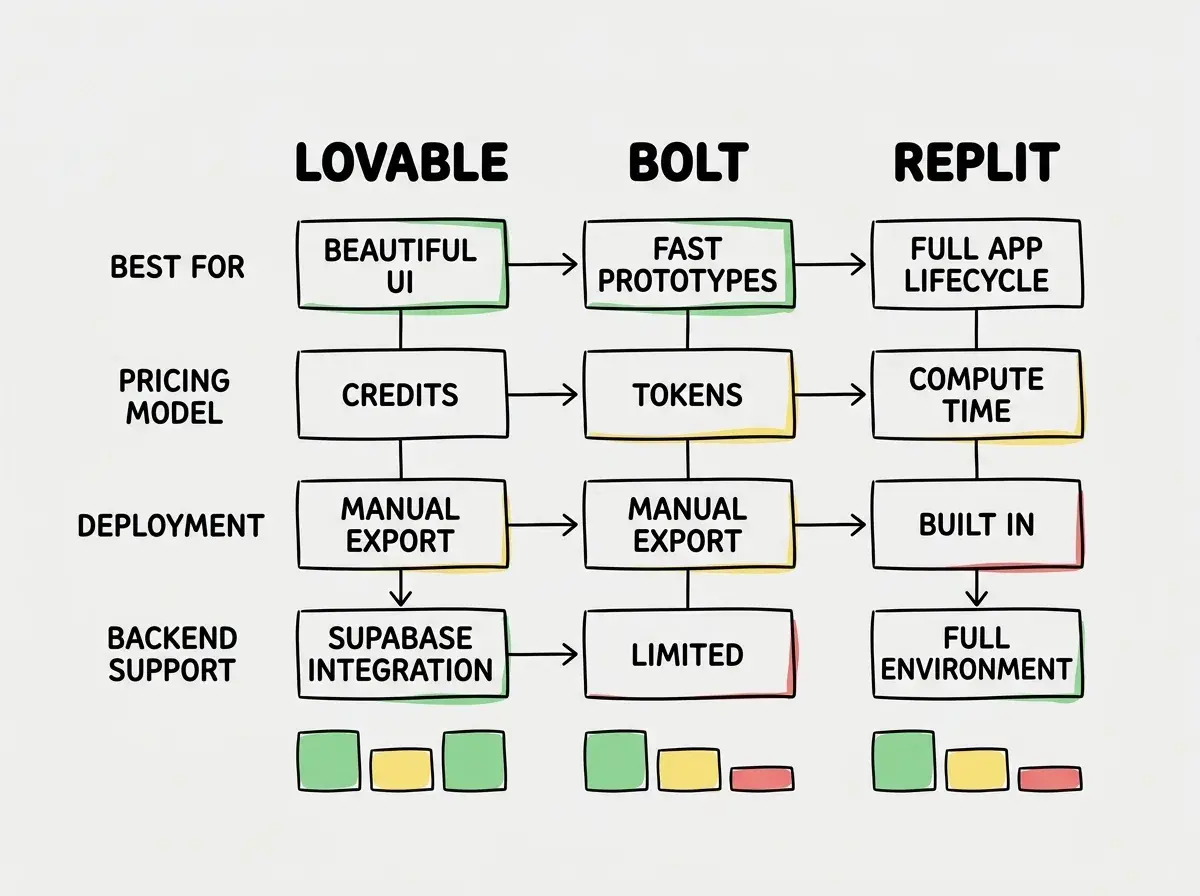
| Best for | Beautiful UI prototypes and polished MVPs | Hackathon-speed prototyping and rapid iteration | Full idea-to-deployed app lifecycle |
| Price | $25-39/mo (credit-based) | $25/mo (token-based) | $25/mo (compute-based) |
| Strength | Stunning UI out of the box | Fastest time to working prototype | All-in-one with hosting built in |
| Weakness | Credit ceiling caps complex projects | Token costs spiral on bigger builds | Slower generation, unpredictable billing |
| Users | 8M+ | Millions | 40M+ |
That table tells you the headlines. The rest of this article tells you what actually happens when you try to build something real with each one.
What Lovable Does Well
Lovable generates the prettiest apps of the three. If you paste a screenshot of a Figma design or describe a landing page with specific visual requirements, Lovable will produce something that looks polished enough to show investors. The UI quality is genuinely impressive, and for founders who need a clickable prototype for a pitch deck or demo day, this matters more than anything else on the feature list.
The Supabase integration is a standout. Lovable connects to Supabase for authentication and database out of the box, which means your prototype can have real user accounts and persistent data without you touching a backend. For SaaS MVPs, this is a significant advantage over Bolt and Replit, where backend setup requires more manual work.
Lovable also handles design iteration well. You can say "make the header sticky, change the accent color to indigo, and add a testimonials section below the hero" and it executes those changes cleanly without breaking what already works. For the visual refinement loop that founders go through dozens of times before launch, Lovable is the least frustrating option.
What Bolt Does Well
Bolt is the fastest of the three for going from idea to working prototype. If you need something functional in thirty minutes for a hackathon, a client demo, or just to test whether an idea has legs, Bolt will get you there before Lovable or Replit finish their first generation. The speed comes from how it handles prompts: Bolt tends to make aggressive assumptions and build forward rather than asking clarifying questions.
The prompt-to-app flow feels the most natural for people who think in conversation. You describe what you want, Bolt builds it, you say what to change, and it iterates. The feedback loop is tight and intuitive. For someone who has never used a code editor and finds even Replit's interface intimidating, Bolt's chat-first approach removes the most friction.
Bolt also handles frontend-heavy projects well. If your app is primarily a user interface with some API calls (a dashboard, a form wizard, a content management tool), Bolt produces clean, functional code quickly. It uses modern frameworks and the output is reasonably well-structured.
These tools solve different problems despite looking similar. Lovable is a design tool that happens to generate code. Bolt is a speed tool that trades polish for velocity. Replit is a development environment that happens to have AI. Picking the right one starts with knowing which of those three things you need most.
What Replit Does Well
Replit is the most complete platform of the three. While Lovable and Bolt focus on generating the app, Replit handles the entire lifecycle: coding, running, debugging, deploying, and hosting. You never leave the platform. For someone who wants to build an app and have it live on the internet with a custom domain, Replit is the only option that does not require you to figure out deployment separately.
The 40M+ user community means problems get solved fast. If you hit an error, someone in the Replit community has probably encountered it and shared a solution. The platform also has built-in collaboration features, so if you eventually hire a developer to take over your project, they can jump into the same environment without any setup.
Replit Agent, their AI assistant, can handle surprisingly complex tasks. It reads your project, understands the structure, installs dependencies, writes code, and runs it to check for errors. For backend-heavy projects (APIs, data processing, scheduled jobs), Replit offers more flexibility than Lovable or Bolt because you have access to a real development environment, not just a code generator.
The Limitations Nobody Mentions in Marketing Pages
Lovable's Credit Ceiling
Lovable's credit-based pricing means every generation, every edit, and every iteration costs credits. On a simple app, this is fine. On a real project with dozens of revisions, the credits run out fast. Most founders report hitting a 60-70% completion ceiling, where the app looks great but the last 30% of functionality (edge cases, error handling, complex business logic) eats through credits at an alarming rate. The jump from the $25 Starter plan to the $39 Launch plan helps, but complex apps can still burn through credits before they are truly finished.
Bolt's Token Spiral
Bolt uses a token-based system, and here is what catches people off guard: every conversation message, every code generation, and every iteration adds to your token consumption. On small projects this is invisible. On ambitious projects with lots of back-and-forth refinement, developers have reported spending $1,000 or more getting a complex app to production quality. The $25/mo plan includes a set number of tokens, and once you exceed that, the per-token pricing adds up quickly.
Replit's Speed and Cost Surprises
Replit Agent is noticeably slower than Lovable and Bolt at generating code. Where Bolt produces a working prototype in minutes, Replit Agent might take considerably longer for the same task. The compute-based billing model also creates surprises: if your app runs background processes, scheduled tasks, or stays "always on" for hosting, your bill can grow in ways that are hard to predict until you get the invoice. Several users have been caught off guard by hosting costs that exceeded their development costs.
Starting a project on one platform and trying to migrate to another halfway through almost always costs more time than starting over. Each tool generates code with different structures, frameworks, and assumptions. Before you write your first prompt, spend fifteen minutes thinking about what your project actually needs at completion, not just what it needs today.
Code Export and Ownership
This matters more than most beginners realize. When you outgrow the platform (and most serious projects eventually do), you need to take your code somewhere else.
Lovable lets you export to GitHub. The code is yours, it uses standard React with Tailwind CSS, and a competent developer can pick it up and continue building. The export experience is one of Lovable's underrated strengths.
Bolt also exports to GitHub. The generated code is clean enough that developers can work with it, though the structure sometimes requires reorganization for larger projects. You own your code and can deploy it anywhere.
Replit is where it gets complicated. Your code lives on Replit's platform, and while you can download it, the hosting and deployment infrastructure is tied to Replit. Moving a Replit-hosted app to another platform (Vercel, Railway, a VPS) requires more migration work than exporting from Lovable or Bolt, because you are not just moving code, you are moving the entire runtime environment.
Understand the fundamentals before choosing a platform.
Start hereWhich One Should You Pick
Forget the feature matrices and marketing comparisons. Answer these three questions:
What does your app need to look like? If visual polish is critical (investor demos, consumer-facing products, design-heavy landing pages), start with Lovable. Its UI output is a tier above the other two, and for first impressions, design quality is not optional.
How fast do you need the first version? If you need something working by end of day for a demo, a pitch, or just to validate that the idea makes sense, start with Bolt. Nothing matches its speed for getting a functional prototype in front of users.
Do you need the app running in production? If you need a deployed, hosted application that real users can access with real data, start with Replit. The all-in-one environment eliminates the deployment complexity that trips up non-technical builders with Lovable and Bolt.
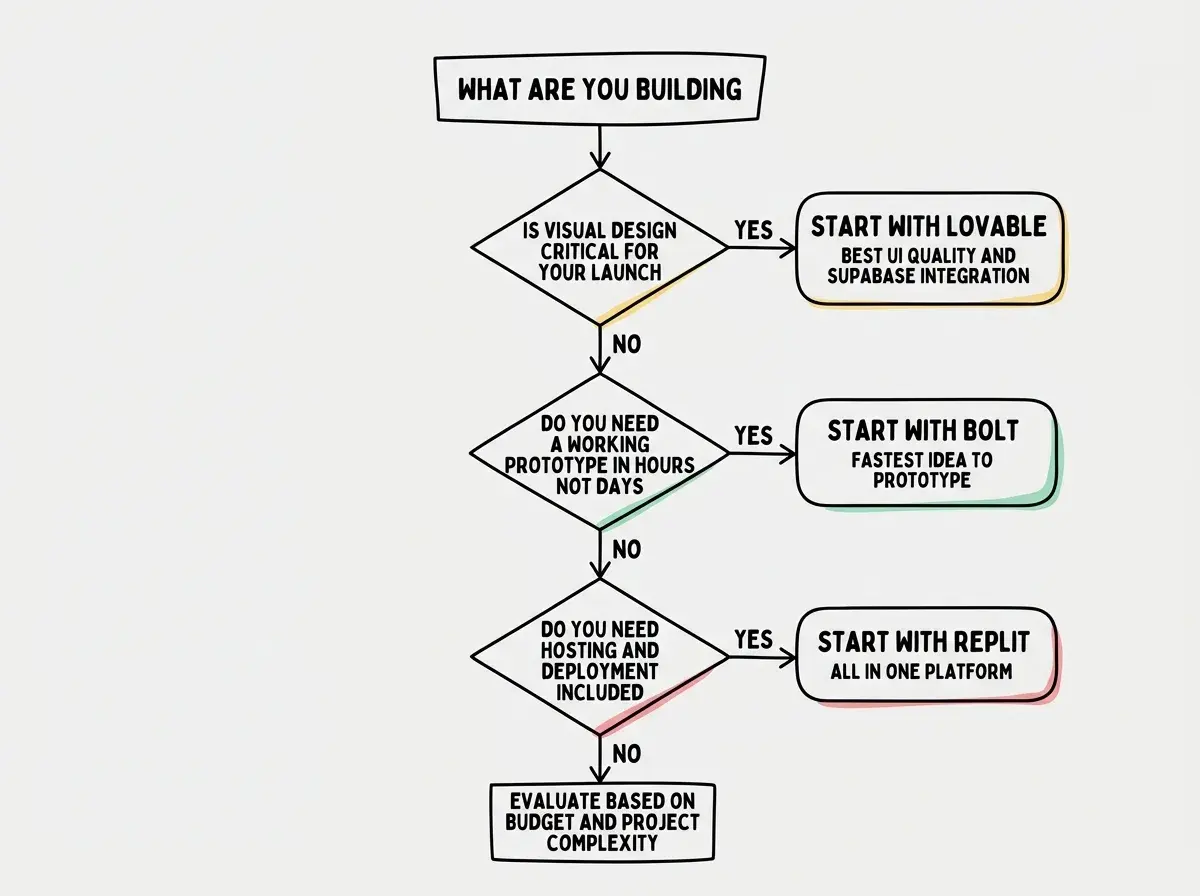
If none of those questions gives you a clear answer, default to Lovable. The code export is clean, the UI quality gives you a head start, and the Supabase integration means you can add real backend functionality without leaving the platform. When you outgrow it, the code transfers well to a custom setup.
Dig deeper
A few hand-picked sources if you want to go further.
What This Means For You
The app builder landscape in 2026 is good enough that any of these three tools can get a non-technical person from idea to working prototype. The differences are in the edges, not the center.
- If you are a founder raising money: Use Lovable. Investors respond to polished demos, and Lovable's UI quality gives you an unfair advantage in pitch meetings. Budget $25-39/mo and plan for a developer to finish the last 30% of complexity that the AI cannot handle.
- If you are exploring whether your idea works: Use Bolt. Get a working prototype in front of potential users as fast as possible. Do not optimize for code quality or long-term architecture at this stage. Validate first, rebuild properly later. Budget $25/mo to start, but watch your token usage on iterative projects.
- If you are building something you plan to run as a real product: Use Replit. The integrated hosting and development environment saves you from the deployment nightmare that kills most non-technical founders' projects. Budget $25/mo for development, but monitor your hosting costs carefully once the app is live.
All three platforms will continue improving rapidly. The tool you pick today is a starting point, not a life sentence. The most important thing is to start building.
Learn how to get better results from whichever platform you choose.
Explore tutorials