To understand Linus Torvalds' "AI is just another tool" perspective from 2024-2026, recognize the four-part analogy he uses (AI is like compilers, like IDEs, like version control, like high-level languages, each of which faced similar hype/skepticism cycles), see why his pragmatic framing has become influential among kernel and systems developers, and apply his lesson to your own AI tool adoption. Linus has navigated decades of tool transitions; his calm framing of AI deserves consideration as antidote to both AI maximalism and AI rejection.
This piece walks through the four-part analogy, the reasoning behind Linus's perspective, the practical implications for developers, and the four areas where Linus's framing might miss something important about AI specifically.
Why Linus's Pragmatism Resonates
Linus Torvalds created Linux and Git, two of the most important software projects ever built. His perspective on AI tools comes from someone who has watched many "this changes everything" tools come and go while focusing on whether they actually help build software better. The pragmatism resonates because it cuts through hype on both sides.
The 2026 reality is that Linus's framing has become influential among engineers who want a sane perspective on AI without rejecting it. The systems and kernel developer communities especially have adopted versions of his pragmatism as cultural default.
A 2025 Linux Foundation developer survey found that systems developers using AI coding tools reported 23 percent higher satisfaction when their teams adopted "tool not magic" framing (echoing Torvalds) compared to teams treating AI as transformative. The framing affected actual outcomes, not just attitudes. Pragmatic framing produces better tool usage and developer experience than either utopian or dystopian framings.
The pattern to copy is the way experienced craftspeople think about new tools. A master carpenter who watches power tools evolve does not treat each new tool as either magical or threatening; they evaluate each tool by whether it helps build better furniture. AI tools deserve the same evaluation; the craft remains paramount, the tools serve the craft.
The Four-Part Analogy
Linus uses analogies to four prior tool transitions that faced similar hype/skepticism cycles.
Analogy 1, AI is like compilers. Compilers transformed how programmers worked. Initial skepticism about whether "real" programmers would use them; they became default. AI tools follow similar trajectory.
Analogy 2, AI is like IDEs. IDEs faced criticism for "spoiling" programmers who could no longer code without autocomplete. They became standard. AI assistance is similar evolution of the IDE.
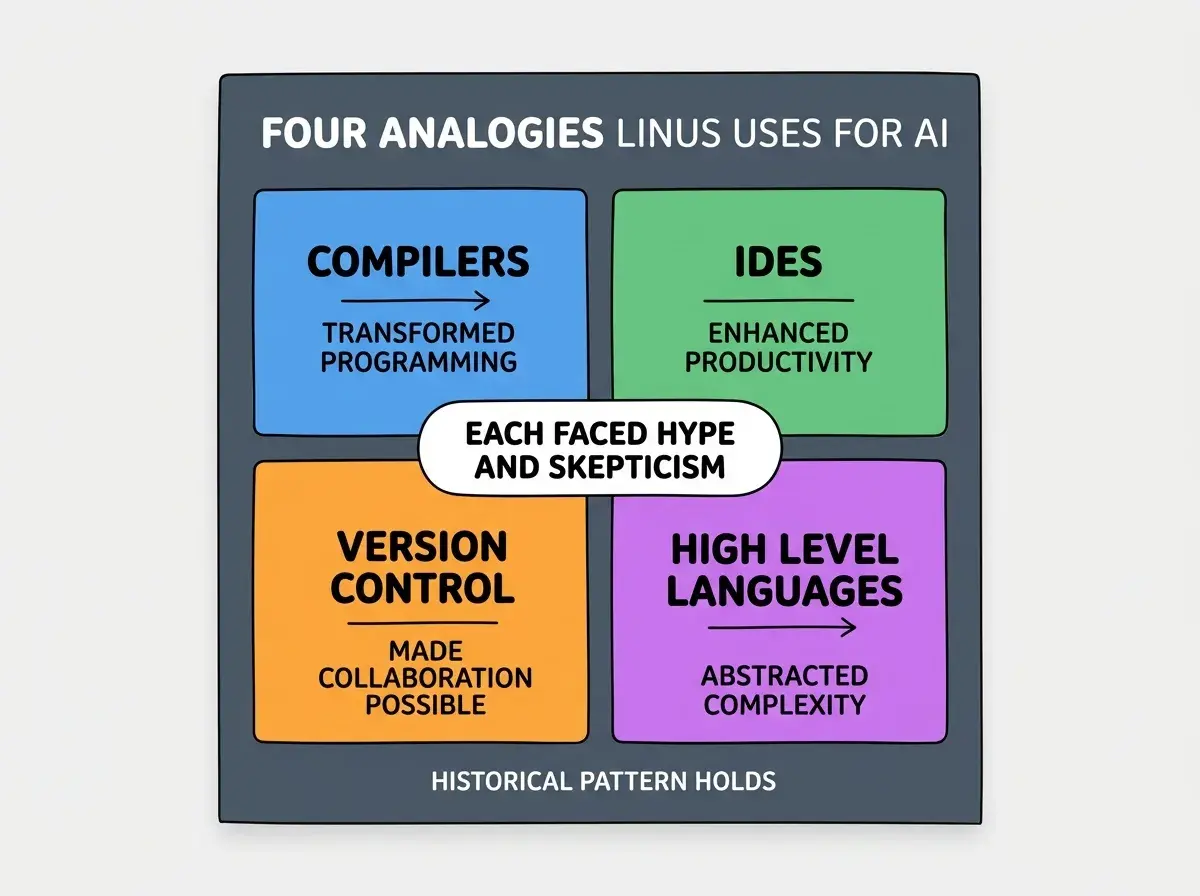
Analogy 3, AI is like version control. Git (which Linus created) faced resistance; some called it overly complex, unnecessary. It became foundational infrastructure. AI tools may follow similar adoption path.
Analogy 4, AI is like high-level languages. C, then Python, then Rust each abstracted complexity. Each faced "real programmers use assembly" skepticism. Each became dominant for their niches. AI is the next abstraction layer.
What This Means For Practical Use
Three practical implications follow from Linus's framing.
Implication 1, master the tool, do not worship it. Like compilers and IDEs, AI tools reward skilled use. Develop fluency with the tools you use; depth matters more than breadth.
Browse more expert perspectives
Read more pulse articlesImplication 2, the craft remains. Tools change; craft persists. Code quality, architecture, debugging, problem decomposition remain core skills. AI tools support craft; they do not replace it.
Implication 3, expect ongoing evolution. The current generation of AI tools is not the final form. Like compilers and IDEs evolved over decades, AI tools will continue evolving. Adoption today is investment in trajectory, not endpoint.
Where Linus's Framing Might Miss Something
Three considerations suggest AI may differ from prior tool transitions in important ways.
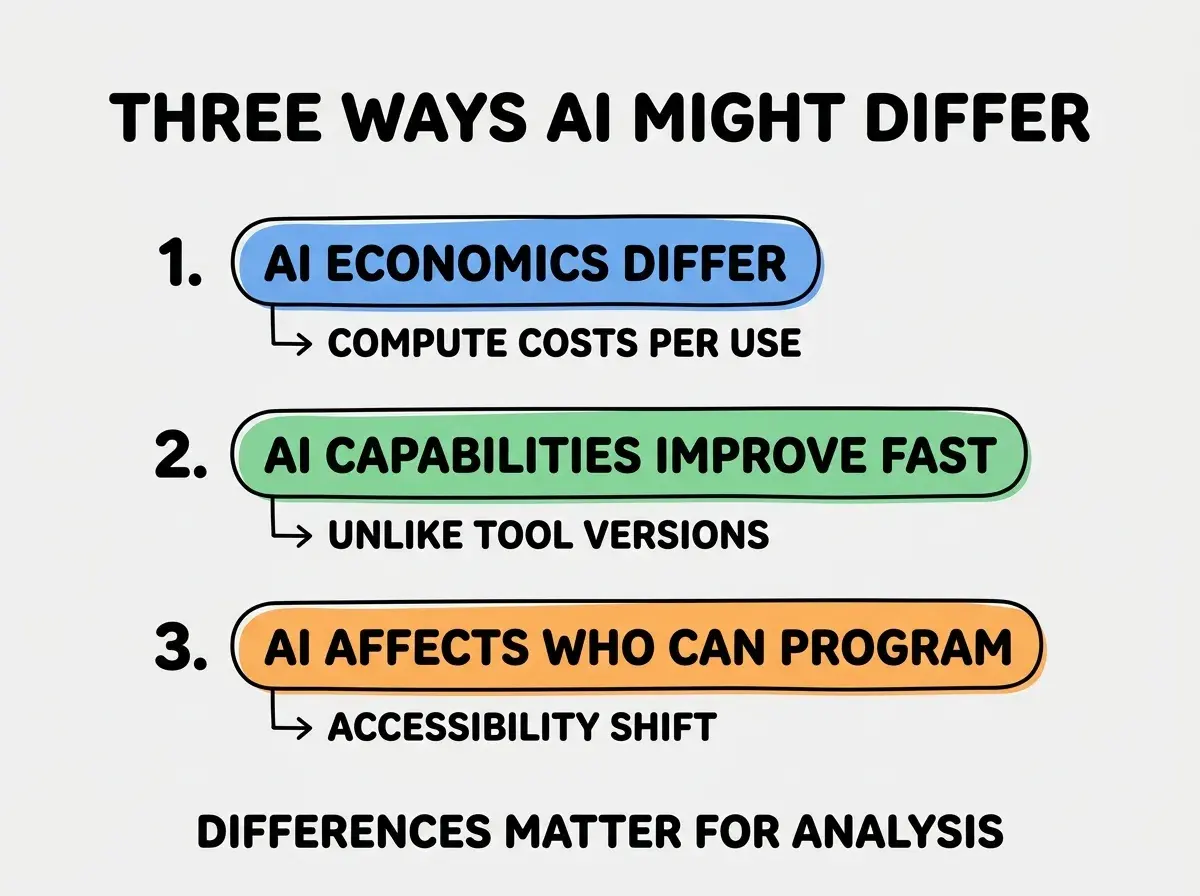
Difference 1, AI economics differ from prior tools. Compilers cost essentially nothing per use; AI has real per-call cost. The economics affect adoption patterns and design decisions in ways prior tools did not.
Difference 2, AI capabilities improve faster than prior tool versions. Compilers improved over years; AI models improve over months. The pace of change has implications for how to invest in tool fluency.
Difference 3, AI affects who can program. Prior tools made programmers more productive; AI makes new categories of people able to program. The accessibility shift may matter more than productivity for established programmers.
How Linus's Framing Affects Linux Kernel Work
Three observable effects emerge from Linus's framing in actual kernel development practice.
Effect 1, AI tools accepted but with skepticism on patches. Kernel maintainers accept AI-assisted patches but apply same scrutiny as other patches. The acceptance is pragmatic; the scrutiny is preserved.
Effect 2, no special workflows for AI-generated code. Same code review process applies. Treating AI as just another tool means it does not get special consideration positively or negatively.
Effect 3, focus stays on what the code does, not how it was generated. The pragmatic test is whether the code is good, not whether AI helped write it. Origin-blind evaluation produces better outcomes than origin-conscious evaluation.
The combination shapes how Linus's framing actually plays out in practice. Other communities can learn from how kernel development integrated AI without drama or special handling.
How to Synthesize Linus With Other Perspectives
Three synthesis patterns help integrate Linus's view with perspectives from others (DHH, Karpathy, Willison).
Pattern A, accept the historical pattern but examine the specifics. Tools do follow hype/disillusionment/integration cycles. Each transition has unique characteristics worth examining within the general pattern.
Pattern B, treat strong voices as inputs not authorities. Linus, DHH, Karpathy each have valuable perspectives; none has the complete picture. Synthesize across perspectives rather than adopting any single one wholesale.
Pattern C, develop your own pragmatic framing. Use Linus's framing as starting point; adapt to your specific context, tools, and goals. Your framing should work for your situation, not be borrowed from someone else's.
The combination produces engagement that improves your own thinking. Without synthesis, engagement with strong voices becomes either uncritical adoption or reflexive rejection.
The most damaging mistake when adopting Linus's "just another tool" framing is using it to dismiss serious analysis of AI specifically. The framing is useful pragmatism but can become an excuse to avoid thinking about what is actually new about AI. The fix is to embrace the pragmatic framing while still doing the specific analysis; "AI is just a tool, AND here are the specific characteristics worth understanding." The "and" matters; "just" can become reductive if it stops further thinking.
The other mistake is treating Linus's perspective as final word because of his stature. Stature reflects past contributions; current positions deserve evaluation on their merits. The fix is to examine the arguments, not just the source. Linus's arguments are often strong; they remain arguments to be evaluated, not pronouncements to be accepted.
A third mistake is generalizing from Linux kernel context to all software development. Kernel development has unique characteristics (long-lived code, performance critical, large team coordination); patterns that work there do not always transfer to web app development or other domains. The fix is to consider domain-specific factors when applying Linus's positions to your work.
What This Means For You
Linus's pragmatic framing provides useful antidote to AI hype on both sides. The four-part analogy, practical implications, and limitations produce balanced perspective.
- If you're a founder: Apply pragmatic framing to AI tool adoption decisions. The "just a tool" framing reduces the temptation to over-invest in AI strategy at the expense of product strategy.
- If you're changing careers into development: Develop your own pragmatic framing influenced by but not identical to Linus's. The skill of pragmatic technology evaluation transfers across your career.
- If you're a student: Study how Linus has navigated decades of tool transitions. The pattern of pragmatic engagement with new tools is worth learning regardless of which specific tools matter when you graduate.
Browse more expert perspectives
Read more pulse articles