To understand DHH's perspective on AI tools and Rails in 2026, recognize four lessons from his recent writing and talks (AI tools are powerful but not magic, productivity gains compound when paired with strong frameworks, the developer's job remains judgment and design, and current excitement may be both warranted and overhyped simultaneously), and apply the perspective to your own AI tool usage. DHH has navigated multiple technology transitions; his perspective on AI deserves consideration even from those who disagree with his Rails-centric worldview.
This piece walks through the four lessons, the context behind DHH's perspective, the practical applications for your work, and the four areas where reasonable people disagree with him about AI.
Why DHH's Perspective Matters
David Heinemeier Hansson created Rails, built Basecamp into a successful business, and has been an opinionated voice in software development for over 20 years. His track record of getting big technology calls right (and wrong) makes his current AI takes worth examining whether you agree or not.
The 2026 reality is that DHH's AI perspective has evolved from skeptical to engaged through 2024-2025. His current views emphasize practical utility while remaining critical of hype. The combination is more useful than either pure enthusiasm or pure skepticism.
A 2025 GitHub developer sentiment survey found that DHH's writing was among the most-cited influences on how Rails developers approach AI tools. The reach reflects 20+ years of building credibility through opinionated, well-defended positions. His current AI takes are influencing how a substantial portion of the Ruby and broader web development community thinks about these tools, regardless of whether individual developers agree with him.
The pattern to copy is the way technology communities benefit from voices that defend specific positions clearly. DHH does not hedge; he stakes positions and defends them. The clarity makes disagreement productive (you can engage specific claims) and agreement actionable (you can apply specific positions). Compare to vague "it depends" voices that produce no real intellectual progress.
The Four Lessons From DHH's Perspective
Four lessons emerge consistently from DHH's recent AI writing and talks.
Lesson 1, AI tools are powerful but not magic. Real productivity gains are real; magical thinking about AI replacing developers is not. Treat AI as powerful tool that requires skilled use to produce real value.
Lesson 2, productivity gains compound with strong frameworks. Rails plus AI is more productive than each alone. Framework conventions plus AI's pattern matching produces high-leverage combinations worth investing in. Implications for tool stack choices.
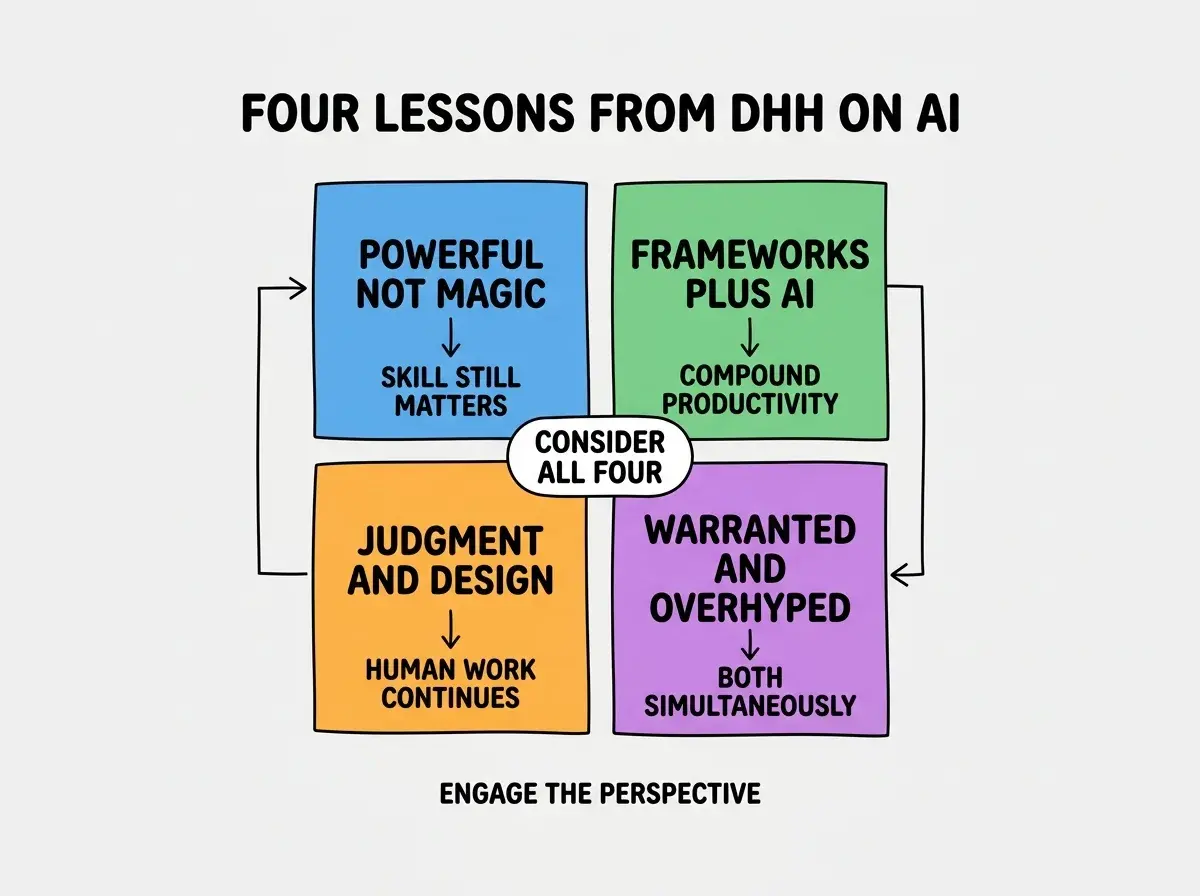
Lesson 3, the developer's job remains judgment and design. AI does not replace the work that requires understanding what to build and why. Engineering judgment becomes more valuable, not less, as code generation gets easier and more accessible.
Lesson 4, current excitement is both warranted and overhyped. Real progress is happening; some claims are overblown. Both can be true simultaneously; treating it as binary misses the nuance that careful thinking requires.
How These Lessons Apply Practically
Three practical applications turn DHH's perspective into actionable patterns.
Pattern 1, invest in framework fluency alongside AI fluency. Strong framework knowledge multiplies AI productivity. Whether Rails, Next.js, Django, or another framework, deep knowledge of one framework pairs powerfully with AI tools and produces compounding returns over time.
Browse more expert takes
Read more pulse articlesPattern 2, develop judgment as core skill. Spend deliberate time on what to build, not just how to build it. The judgment skill becomes increasingly valuable as building skill commoditizes through AI tools.
Pattern 3, calibrate your own enthusiasm with skepticism. When you feel most excited about AI, examine the source of excitement skeptically. When you feel most skeptical, examine your skepticism for confirmation bias. Calibrated enthusiasm produces better decisions than either pure excitement or pure skepticism over time.
Where Reasonable People Disagree With DHH
Three areas of disagreement are worth understanding even if you find DHH compelling overall.
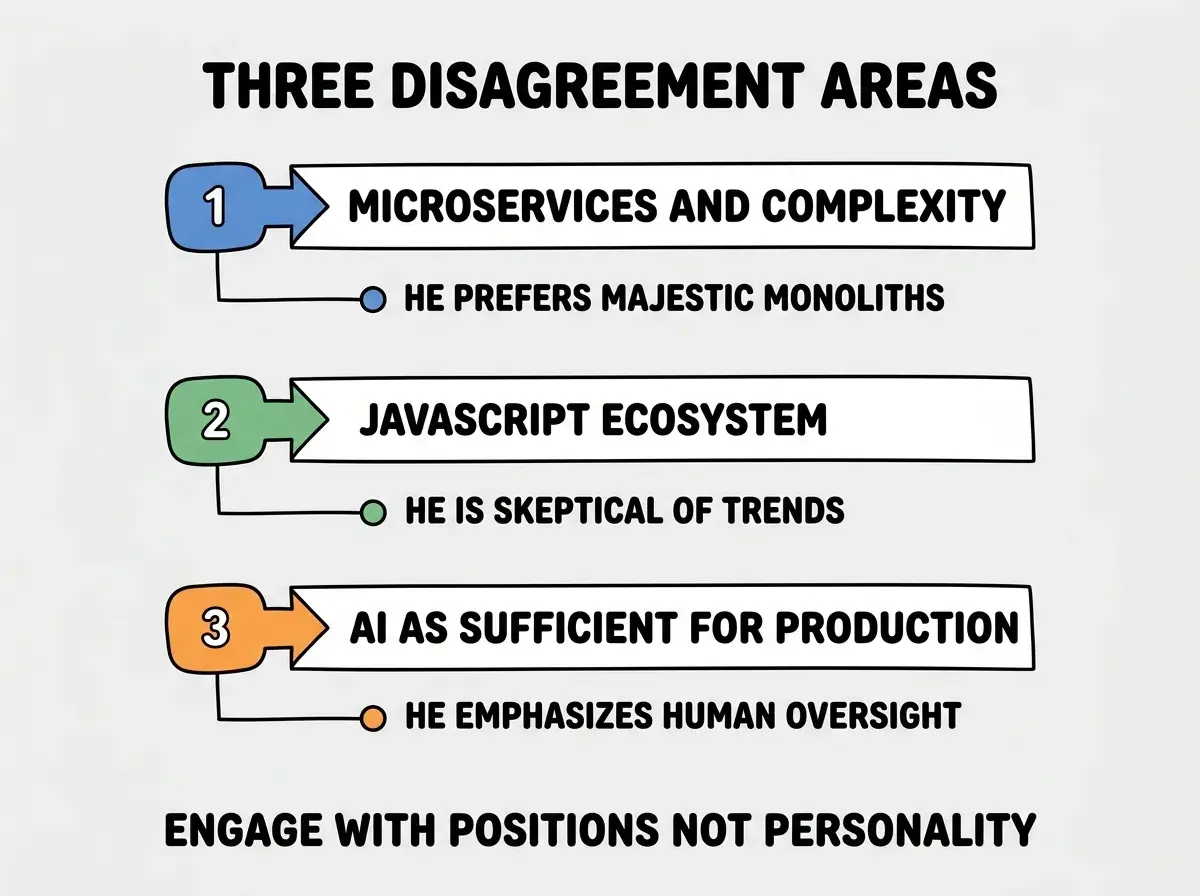
Area 1, microservices and complexity. DHH prefers monolithic architectures; many engineers favor microservices for specific use cases. Both have merit; the choice depends on context and team capacity.
Area 2, JavaScript ecosystem. DHH is openly skeptical of JavaScript framework churn; many developers find specific tools genuinely valuable. The skepticism is partly justified but can become reflexive in dismissing useful tools.
Area 3, AI sufficient for production. DHH emphasizes human oversight strongly; some developers believe AI can handle more autonomously than DHH suggests. The right level of oversight is contested; both extremes have problems worth examining.
What DHH Says About Specific AI Tools
Three specific tool-related positions emerge from DHH's recent writing.
Position 1, AI assistance in IDEs is genuinely useful. Cursor, Copilot, similar tools accelerate genuine work. DHH has acknowledged using and benefiting from these tools in his own development practice.
Position 2, AI writing entire applications is overhyped. Production-ready software requires more than AI-generated code; the gap from demo to production is real. DHH emphasizes this gap consistently.
Position 3, framework conventions plus AI compound powerfully. Rails conventions paired with AI produces high-leverage development. The framework provides the structure AI tools need to produce coherent code.
The combination produces nuanced position that engages with real tool usage rather than abstract AI debate.
How to Engage Productively With Strong Voices
Three patterns help engage productively with DHH or any strong-voiced thought leader.
Pattern A, separate the position from the personality. DHH's positions can be evaluated independently of his communication style. Some readers reject positions because of style; others accept positions because of style. Both miss the actual ideas worth engaging with.
Pattern B, look for the strongest version of the argument. What would convince a reasonable skeptic? The strongest version of DHH's AI positions is more nuanced than the rhetorical framing suggests; engage with that version rather than with strawman caricatures.
Pattern C, test against your own experience. Where do DHH's claims match your experience? Where do they diverge? The friction points often reveal real insights about both his framework and your situation worth examining further.
The combination produces engagement that improves your own thinking. Without these patterns, engagement becomes either uncritical agreement or reflexive disagreement; neither produces intellectual progress.
The most damaging mistake when reading expert perspectives like DHH's is treating them as either gospel or noise. Both extremes lose value. The fix is to engage critically: where does the perspective add to your thinking, where does it differ from your experience, where does it require modification for your context. Critical engagement produces useful synthesis; uncritical reception or rejection produces no learning at all.
The other mistake is following DHH (or any strong voice) into specific tactical decisions without considering your context. DHH's positions reflect his specific situation: established business, specific technology preferences, particular team structure. Your situation differs; the positions may need adaptation. Wholesale adoption of someone else's positions rarely fits your context perfectly.
A third mistake is using DHH's perspective as confirmation bias. Some readers cite DHH because his positions match what they already believe; they would dismiss the same positions from less prominent voices. The fix is to evaluate the arguments independently of who makes them; reasoning quality matters more than reasoner identity.
What This Means For You
DHH's perspective on AI deserves engagement whether you agree or not. The four lessons, practical applications, and disagreement areas produce productive intellectual engagement.
- If you're a founder: Read DHH's recent writing on AI; engage with the strongest version of his positions; apply what fits your context.
- If you're changing careers into development: DHH represents one influential perspective; engage with multiple voices to develop your own perspective.
- If you're a student: Study how strong voices like DHH build influence over time. The pattern of opinionated, well-defended positions is itself worth learning.
Browse more expert analysis
Read more pulse articles