To inherit and maintain an AI built vibe coded project effectively, follow the four phase assessment approach (assess code quality and patterns systematically, understand what the original builder intended versus what code does, evaluate technical debt accumulation level, and plan stabilization before feature work), recognize what makes legacy AI code different from legacy human written code, and apply the patterns that turn inherited AI projects into maintainable codebases. The inheritance challenge matters because more developers inherit AI built projects every quarter as AI coding spreads.
This piece walks through the four assessment phases, what makes legacy AI code different, the stabilization patterns, and the four mistakes that produce inheritance failure.
Why Inheriting AI Built Projects Matters
Inheriting AI built projects matters as AI coding spreads through the industry. The inheritance frequency increases; developers regularly inherit projects that previous developers built using AI tools.
The 2026 reality is that legacy AI code has different characteristics than legacy human written code, requiring adapted inheritance approaches. Without adaptation, inheritance attempts often fail or produce worse outcomes than starting over.
A 2025 codebase inheritance study of 200 transitions found that engineers using AI specific inheritance approaches successfully stabilized inherited projects 73 percent of the time compared to 41 percent success rate for engineers using traditional inheritance approaches. The methodology matters dramatically for outcomes.
The pattern to copy is the way doctors approach patients with incomplete medical history. Doctors do not assume; they assess systematically through tests and observation. Inheriting AI built projects follows similar pattern; assessment through observation matters more than assumptions.
The Four Assessment Phases
Four phases produce successful inheritance of AI built projects.
Phase 1, assess code quality and patterns systematically. Static analysis, manual review, automated metrics. Systematic assessment reveals what intuition alone misses.
Phase 2, understand intent versus implementation. AI generated code sometimes implements something different from what was intended. Understanding intent through documentation, commits, and stakeholder conversation matters.
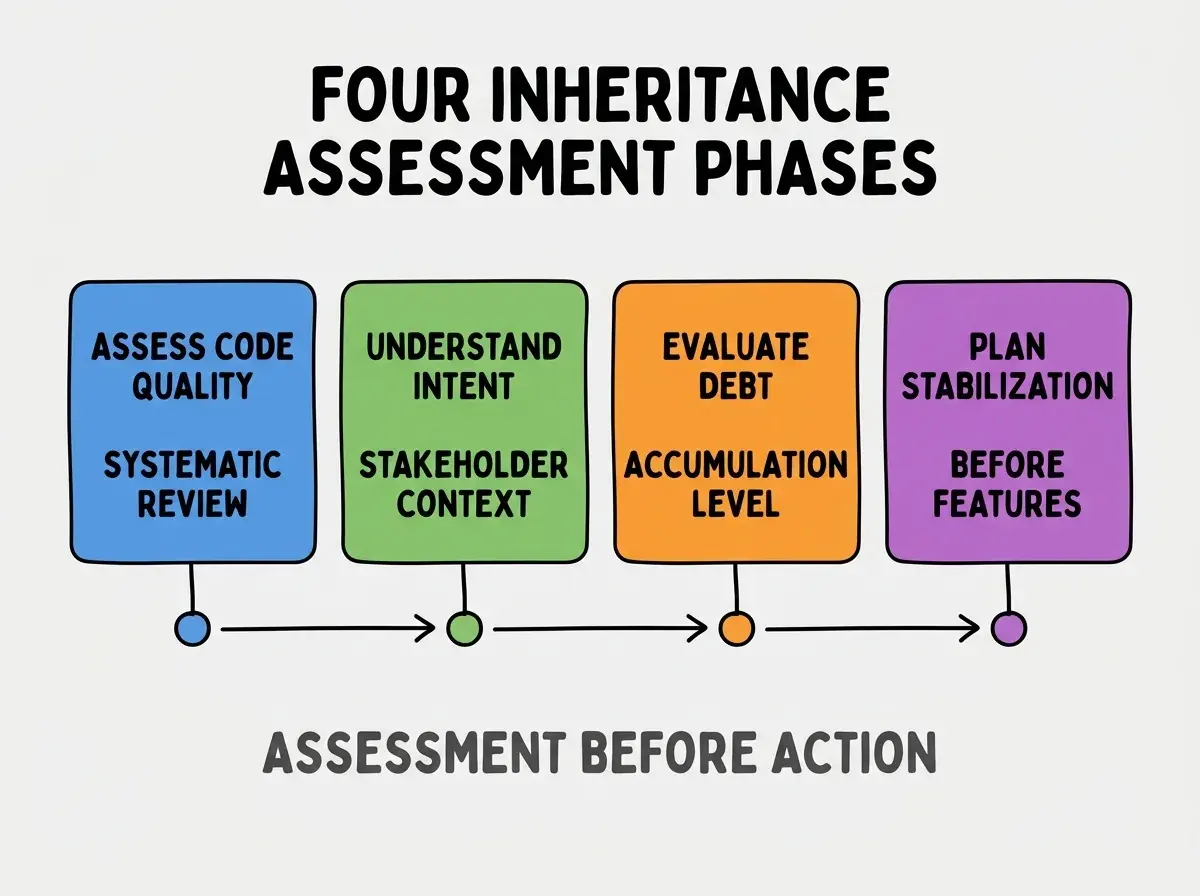
Phase 3, evaluate technical debt accumulation level. Debt levels determine stabilization approach; high debt requires more upfront stabilization while moderate debt allows incremental improvement.
Phase 4, plan stabilization before feature work. Stabilization before features prevents new features building on unstable foundation. Order matters dramatically.
What Makes Legacy AI Code Different
Three differences distinguish legacy AI code from legacy human written code.
Difference 1, less consistent patterns within single codebase. AI applies different patterns to similar problems based on prompt phrasing. Inconsistency requires more careful pattern recognition.
Browse more grow articles
Read more grow articlesDifference 2, comments more often misleading. AI generated comments sometimes describe intent rather than implementation. Comments require verification rather than trust.
Difference 3, more duplication that hides functional intent. Duplicated implementations often differ in subtle ways that matter functionally. Understanding which differences matter requires careful analysis.
The Stabilization Patterns That Work
Three patterns produce successful stabilization of inherited AI projects.
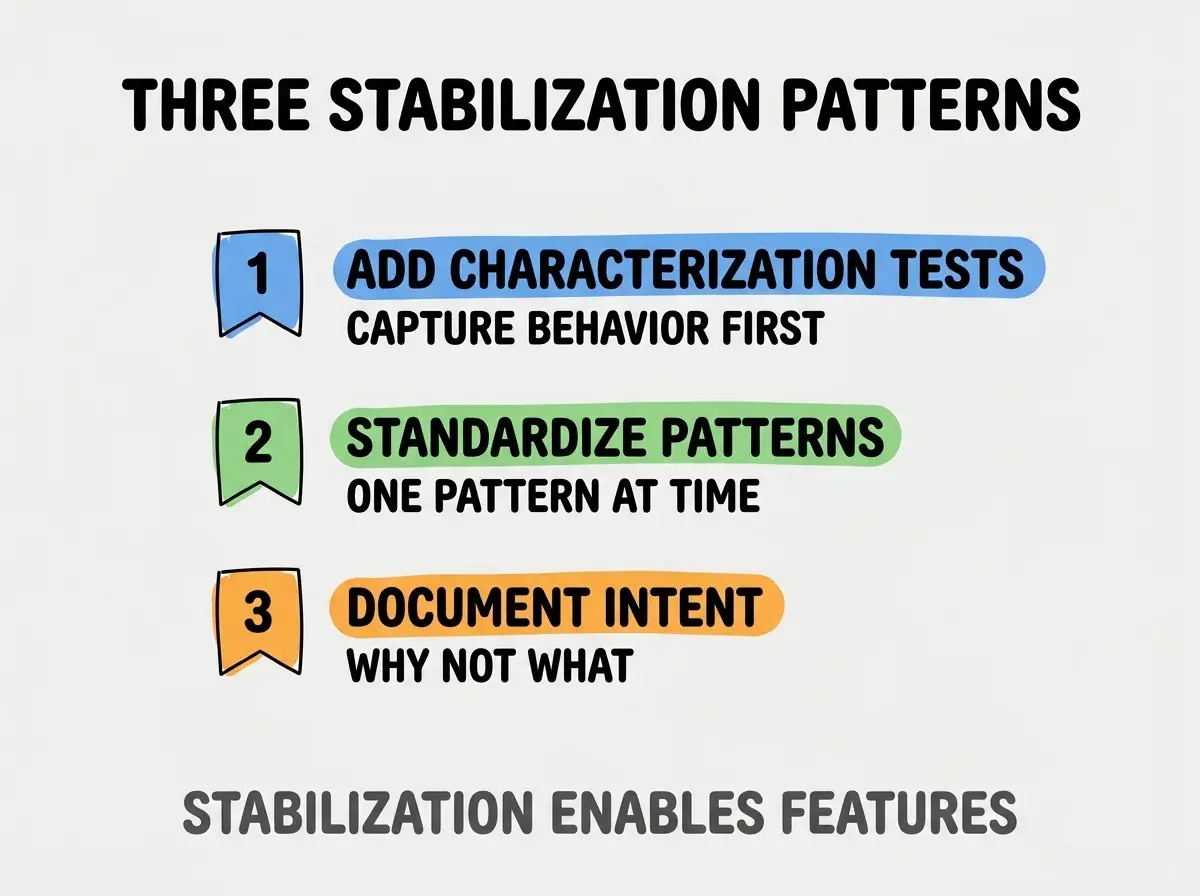
Pattern 1, add characterization tests capturing current behavior. Tests document behavior before refactoring. Without tests, modifications introduce bugs that pre existing behavior would have caught.
Pattern 2, standardize patterns one at a time. Pick one inconsistency, standardize across codebase, then move to next. Incremental approach prevents overwhelming changes.
Pattern 3, document intent that AI generated comments miss. Why decisions were made matters for future modifications. AI generated documentation often describes what code does without why; intent documentation fills gap.
What Makes Inheritance Sustainable
Three patterns separate sustainable inheritance from fork and rewrite cycles.
Pattern 1, accept debt level rather than fight it. Inheriting projects with substantial debt requires accepting current state before improving. Rejecting current state produces frustration that blocks improvement.
Pattern 2, build understanding before changing. Understanding existing code prevents changes that break unobvious dependencies. Understanding takes time but prevents incidents.
Pattern 3, communicate stabilization timeline to stakeholders. Stakeholders expecting immediate features need understanding of stabilization investment. Without communication, stabilization looks like delay.
The combination produces inheritance success that adversarial approaches cannot match. Without these patterns, inheritance often fails into fork and rewrite that wastes accumulated value.
How To Handle Specific Inheritance Challenges
Three specific challenges deserve dedicated approaches.
Challenge A, missing or wrong documentation. Documentation may be missing entirely or describe intended behavior that does not match implementation. Treat documentation skeptically; verify through tests and observation.
Challenge B, original builder unavailable for context. Original builders sometimes unavailable for inheritance handoff. Treat lack of context as expected; build context through analysis rather than expecting handoff.
Challenge C, stakeholders expecting immediate productivity. Inheritance requires understanding period before productivity. Manage expectations explicitly; without management, productivity expectations create pressure that prevents understanding.
The combination produces inheritance approaches that handle realistic conditions. Without handling, inheritance often fails despite strong technical skills.
The most damaging inheritance mistake is the immediate rewrite impulse. Inherited code looks bad initially because unfamiliarity makes it harder to read; rewrite impulse comes from unfamiliarity rather than actual quality. The fix is to resist rewrite impulse for at least 30 days; gain understanding before deciding rewrite is necessary. Most inheritance situations that initially look like rewrite candidates turn out to be stabilization candidates instead. Rewrites carry massive risks that stabilization avoids.
The other mistake is treating inherited code as personal judgment of original builder. Inherited code reflects original builder constraints, time pressure, and tools available. Personal judgment produces friction that prevents productive inheritance.
A third mistake is jumping to features before stabilization. Features built on unstable foundation produce incidents that stable foundation prevents. Order matters dramatically.
A fourth mistake is solo inheritance without stakeholder communication. Inheritance affects business stakeholders; without communication, stakeholders sometimes derail inheritance through unrealistic expectations.
How To Decide Stabilize Versus Rewrite
Three criteria help decide between stabilization and rewrite.
Criterion 1, business value of existing functionality. High value functionality justifies stabilization investment; low value functionality may warrant rewrite. Value drives decision.
Criterion 2, technical debt level. Moderate debt allows stabilization; extreme debt may make rewrite economical. Debt assessment drives decision.
Criterion 3, available time and resources. Stabilization requires sustained effort; rewrite requires concentrated effort. Resource availability drives decision.
The combination produces stabilize versus rewrite decisions that match circumstances. Without criteria, decisions often default to rewrite that wastes value.
How Inheritance Practices Will Likely Evolve
Inheritance practices will likely improve as AI built code becomes more common.
The first likely evolution is tooling for AI code analysis improving. Tools designed for AI code patterns will emerge. Tooling reduces manual analysis effort.
The second likely evolution is industry practices spreading. As inheritance becomes common, best practices will spread through community. Spread reduces individual builder isolation.
The third likely evolution is AI tools assisting inheritance work. Future AI tools may help understand inherited code through analysis. Assistance reduces understanding time.
The combination suggests inheritance will remain challenging but become more manageable through tools and practices. Engineers learning inheritance now build skills that remain valuable as inheritance becomes more common.
What This Means For You
Inheriting AI built projects requires adapted approaches that traditional inheritance methods lack. The four phases, stabilization patterns, and decision criteria produce framework for successful inheritance.
- If you're a senior dev: Inheriting AI built projects becomes more common. Adapted approaches matter; traditional inheritance approaches sometimes fail with AI built code.
- If you're a career changer: Inherited AI projects may be your first development work. Treat the inheritance as learning opportunity; understanding existing code teaches patterns that pure new development cannot.
- If you're a founder: Hire developers comfortable inheriting AI built projects. Inheritance comfort matters as much as new development capability for sustaining AI built products.
Browse more grow articles
Read more grow articles