To handle database schema evolution and migrations long term, follow the four phase approach (design schemas with evolution in mind from start, use migration tools that produce reversible changes, sequence migrations for zero downtime deployment, and monitor migration health across environments), recognize what separates schemas that evolve gracefully from schemas that lock into early decisions, and apply the patterns that produce sustainable schema management. The schema evolution capability matters because schema decisions made in week one constrain features possible in year three.
This piece walks through the four migration phases, what makes schemas evolvable, the tooling that handles long term migrations, and the four mistakes that produce schema migration nightmares.
Why Database Schema Evolution Matters
Database schema evolution determines long term application flexibility. The flexibility matters; schemas that resist evolution force expensive workarounds while schemas that evolve gracefully enable feature development that would otherwise be impossible.
The 2026 reality is that AI tools dramatically accelerate initial schema creation but often miss evolution considerations that experienced engineers build in naturally. Without explicit evolution thinking, AI generated schemas lock into patterns that constrain future development.
A 2025 production database survey of 400 application teams found that teams with intentional schema evolution practices spent 78 percent less time on migration related incidents compared to teams without practices. The time savings reflect the difference between schema changes that work first time and changes that require multiple iterations.
The pattern to copy is the way buildings are designed for renovation. Buildings designed for future modification accommodate changes cheaply; buildings designed for permanence require expensive renovation when changes become necessary. Database schemas follow similar dynamics; design for evolution costs little upfront and saves dramatically over time.
The Four Migration Phase Approach
Four phases produce schemas that evolve gracefully over time.
Phase 1, design schemas with evolution in mind from start. Nullable columns for future required fields, generic id types that accommodate growth, normalized structure that supports change. Design patterns determine evolution capacity.
Phase 2, use migration tools producing reversible changes. Knex, Prisma migrations, Alembic, Flyway. Tools produce structured migrations that AI cannot improvise effectively.
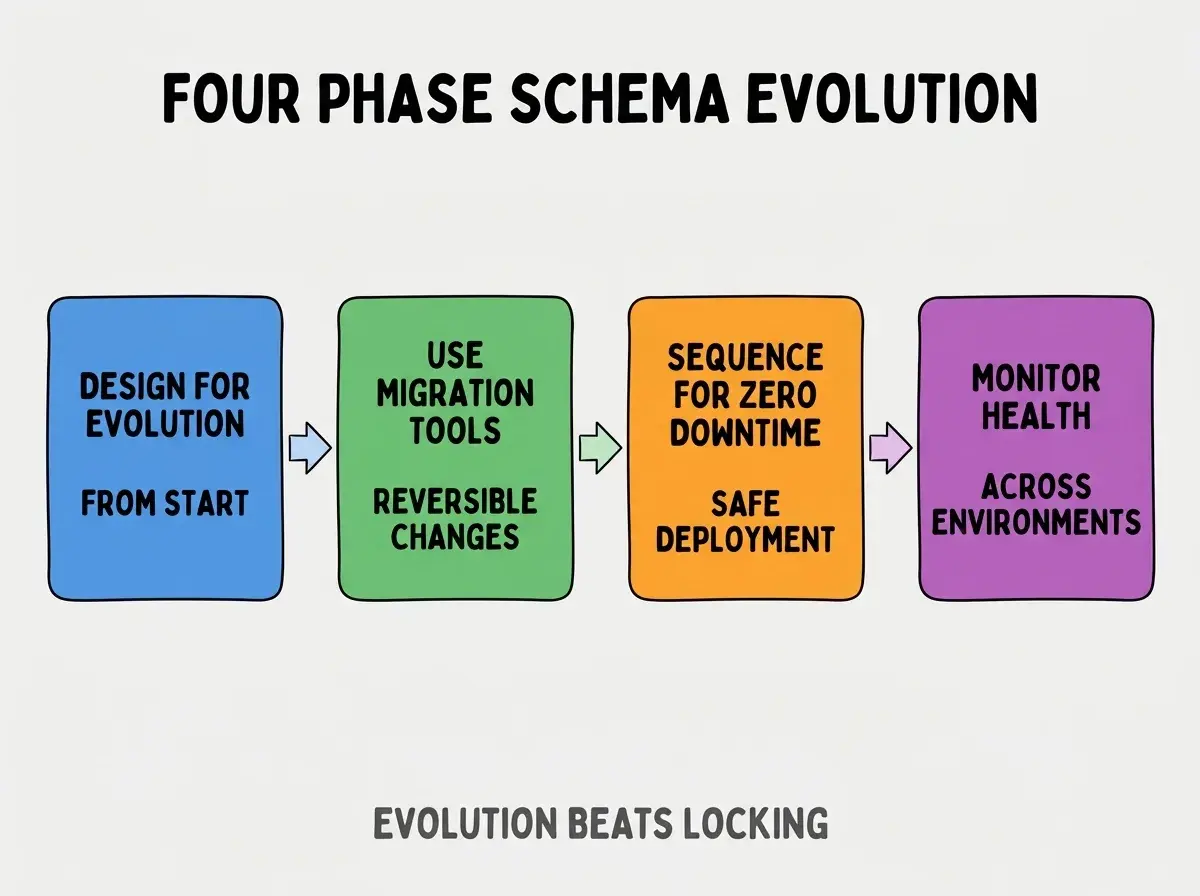
Phase 3, sequence migrations for zero downtime deployment. Add columns first, deploy code that uses both old and new, remove old columns last. Sequencing prevents deployment outages.
Phase 4, monitor migration health across all environments. Migration logs, schema validation, drift detection. Without monitoring, environment drift accumulates silently.
What Makes Schemas Evolvable
Three patterns characterize schemas that evolve gracefully.
Pattern 1, generous nullability for new columns. New columns allowing nulls deploy without backfill; required new columns require backfill that complicates deployment. Generous nullability enables iterative migration.
Browse more grow articles
Read more grow tutorialsPattern 2, soft deletes preserving historical data. Hard deletes lose data needed for future analysis; soft deletes preserve data while supporting deletion semantics. Soft deletes enable future flexibility.
Pattern 3, polymorphic structures supporting type variations. Single table inheritance or polymorphic associations support multiple entity types in single tables. Structures support entity types not anticipated initially.
The Tooling That Handles Long Term Migrations
Three tool categories combine effectively for long term migration management.
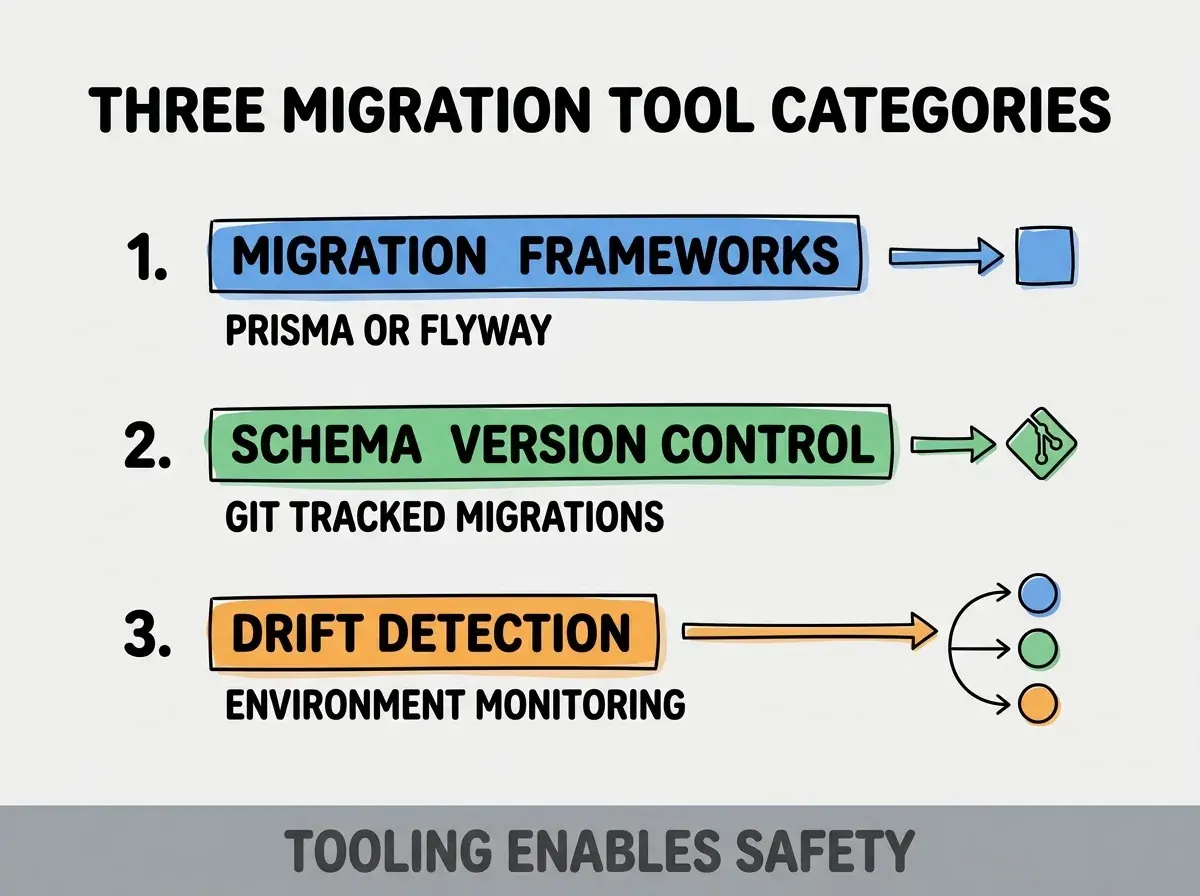
Tool 1, migration frameworks providing structure. Prisma migrations, Knex, Flyway, Alembic. Frameworks enforce migration discipline that ad hoc SQL lacks.
Tool 2, schema version control through git. Migrations tracked in git enable code review and rollback. Without version control, schema changes happen invisibly.
Tool 3, drift detection comparing environments. Tools comparing dev, staging, production schemas catch divergence. Without detection, environments drift apart silently.
What Makes Migration Strategies Sustainable
Three patterns separate sustainable migration strategies from those that create incidents.
Pattern 1, every migration tested before production. Test migrations on staging environment with production like data. Without testing, production migrations sometimes fail in unexpected ways.
Pattern 2, every migration reviewed by second engineer. Schema changes have outsized impact; second pair of eyes catches issues that single review misses.
Pattern 3, every migration reversible by default. Reversibility enables rapid rollback when issues emerge. Without reversibility, rollbacks require complex recovery procedures.
The combination produces migration strategies that scale across projects and team growth. Without these patterns, migration incidents become regular occurrences that erode team confidence and customer trust.
How To Handle Specific Migration Patterns
Three specific patterns deserve dedicated attention.
Pattern A, adding required columns to large tables. Add as nullable, backfill in batches, then add not null constraint. Direct addition of required column to large table can lock table for hours.
Pattern B, renaming columns or tables. Add new column, copy data, deploy code using new column, then drop old column. Direct renames break production code.
Pattern C, splitting tables for normalization. Create new tables, copy data, deploy code using new tables, then drop old table. Direct splits cause downtime.
The combination produces safe migration patterns for the operations that most commonly cause incidents. Without specific patterns, common operations become risky.
The most damaging schema migration mistake is treating migrations as code rather than infrastructure changes. Code rolls back easily; data changes do not. The fix is to treat migrations with infrastructure level care; review carefully, test thoroughly, deploy slowly. Migrations rolled out fast often create incidents; migrations rolled out carefully catch issues before incidents. The care investment dramatically reduces incident rate.
The other mistake is not testing migrations on production sized data. Migrations that work on dev data sometimes fail at production scale. The fix is to test on production sized samples before production execution.
A third mistake is ignoring migration sequencing for zero downtime. Sequencing matters; wrong order produces outages that proper order prevents.
A fourth mistake is treating each migration independently without considering history. Migration history matters; understanding why previous migrations were structured as they were prevents repeating mistakes.
How Schema Evolution Will Likely Evolve
Schema evolution patterns will likely improve as tools mature, but the fundamentals remain stable.
The first likely evolution is AI tools developing better migration awareness. Future AI tools may detect migration risks during generation rather than after. Improvement reduces but does not eliminate need for careful migration practices.
The second likely evolution is database systems supporting better online migrations. Database vendors continue improving online schema change capabilities. Improvements reduce but do not eliminate downtime risks.
The third likely evolution is observability tools improving migration monitoring. Better tooling enables earlier detection of migration issues. Detection enables faster response.
The combination suggests schema evolution will remain critical but become more manageable through tools and practices. Engineers who learn evolution practices now build skills that remain valuable as tooling improves.
Common Questions About Schema Evolution
Schema evolution raises questions worth addressing directly.
The first question is when to denormalize for performance. The answer is when query patterns force it; premature denormalization creates evolution constraints. Denormalize reluctantly when patterns prove necessity.
The second question is how to handle schema changes across microservices. Coordinate changes carefully; cross service schema changes require explicit coordination. Without coordination, services break each other.
What This Means For You
Schema evolution capability determines long term application flexibility. The four phases, evolvability patterns, and tooling combinations produce schemas that support multi year evolution.
- If you're a senior dev: Schema design choices made today constrain features possible years later. Invest in evolution capacity even when it costs short term simplicity.
- If you're an indie hacker: Migration discipline pays back through sustained development velocity. Solo builders especially benefit from migration practices that prevent self created incidents.
- If you're a founder: Database design affects engineering velocity dramatically. Help engineering team invest in schema evolution capacity even when business pressure favors short term feature delivery.
Browse more grow articles
Read more grow tutorials