Hiring managers in 2026 evaluate AI-assisted developers using a different rubric than they used three years ago, and most candidates are still being measured against the old one without realizing it. The shift is not subtle. Conversations with engineering managers across companies, from frontier AI labs to traditional SaaS shops, reveal a consistent pattern of new signals that matter and old ones that no longer carry weight. Understanding what hiring managers actually say behind closed doors is the difference between a 5 percent and a 25 percent interview-to-offer rate.
This piece walks through the four signals that consistently come up in hiring conversations, the disqualifiers that rule out candidates in the first 10 seconds of resume review, and the specific framing that lands interviews at companies that hire AI-fluent engineers.
What Has Changed Since 2022
The hiring conversation in 2022 focused on credentials, years of experience, and the ability to solve algorithm problems on a whiteboard. The conversation in 2026 focuses on shipping evidence, AI fluency, and the ability to make judgment calls about when to trust generated code. The shift mirrors the underlying work change, the bottleneck moved from "writing code" to "reviewing code" to "deciding what to ship."
The result is that some candidates who would have been strong hires in 2022 now struggle, while some candidates who would not have made it past resume screen in 2022 now thrive. The change is real, and the people running hiring loops have noticed even if they have not all updated their public job descriptions to match.
A 2025 survey of 250 engineering hiring managers conducted by First Round Capital found that 71% reported "significantly different" evaluation criteria for AI-fluent candidates compared to two years prior, with 58% specifically saying they now weight portfolio evidence above years of experience for mid-level hires.
The pattern to copy is the way design hiring evolved when Sketch and Figma replaced static portfolios. Hiring managers stopped asking for static design samples and started asking to see the working files, the iteration history, the design system. The work itself was visible in a way it had not been before. AI engineering is going through the same transition.
The Four Signals That Matter
After many conversations with hiring managers, four specific signals consistently come up as the strongest predictors of who gets hired. Knowing them is most of the work of preparing.
Signal 1, evidence of shipping. A live URL where something built by the candidate is in production with real users beats every other signal. Hiring managers describe it as "the only signal I fully trust." Even tiny shipped projects count more than large unshipped ones.
Signal 2, AI fluency demonstrated, not claimed. Candidates who say "I use Cursor" without specifics get nothing. Candidates who say "I built X using Claude Code, here is the prompt sequence I used and the issues I ran into" get serious attention. Specifics signal real practice.
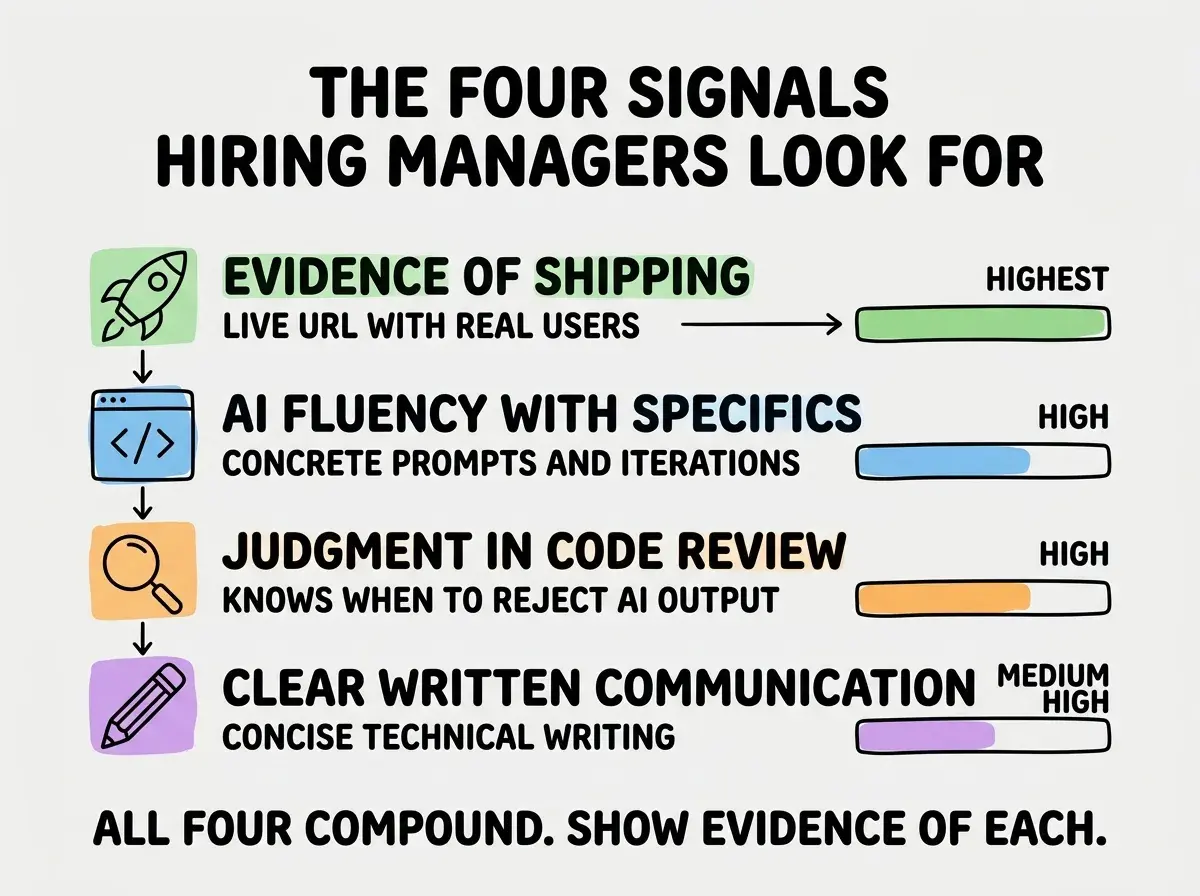
Signal 3, judgment in code review. Hiring managers ask candidates to review AI-generated code as part of the interview process at most companies. Candidates who can confidently say "this is wrong because" or "this works but is not what we want, here is why" stand out. Candidates who accept the code uncritically are filtered out.
Signal 4, clear written communication. AI tools have made clear writing more important, not less. Candidates who write tight, specific case studies and well-structured cover letters are taken more seriously. Many hiring managers describe the writing as a proxy for thinking.
The Disqualifiers
The first 10 seconds of resume review usually involves looking for disqualifiers. If any of three patterns shows up, the resume gets cut without further reading.
Disqualifier 1, no shipped work. A resume listing courses, certificates, and tutorials but no working URLs is treated as inexperienced regardless of credentials. The shipped link is the entry ticket.
Disqualifier 2, hiding AI use. A resume that lists "100% hand-coded React app" or "developed without AI assistance" raises immediate suspicion in 2026. Either the candidate is lying or they are deliberately handicapping themselves. Both are disqualifying.
Read more career and hiring guides
Browse pulse articlesDisqualifier 3, generic skill list. Resumes with logos for every framework, library, and language ever encountered get cut faster than ever. The signal is breadth without depth, and hiring managers prefer specific evidence of one strong stack over broad claims of many.
What the Interviews Actually Test
The interview format has shifted to match the new rubric. Most hiring loops at AI-fluent companies now include three specific assessments that did not exist in 2022.
Assessment 1, the live coding session with AI tools allowed. Candidates write code with their preferred AI assistant during the interview, while the interviewer watches. The signal is how the candidate prompts, iterates, and handles unexpected responses. Candidates who treat the AI as a junior pair programmer (delegating, checking, refining) score well. Candidates who copy and paste blindly do not.
Assessment 2, the AI code review session. The interviewer shows AI-generated code with intentional bugs (security vulnerabilities, missing error handling, subtle logic errors) and asks the candidate to review it. The signal is the depth and specificity of the review. Surface-level review fails, deep review with specific fixes succeeds.
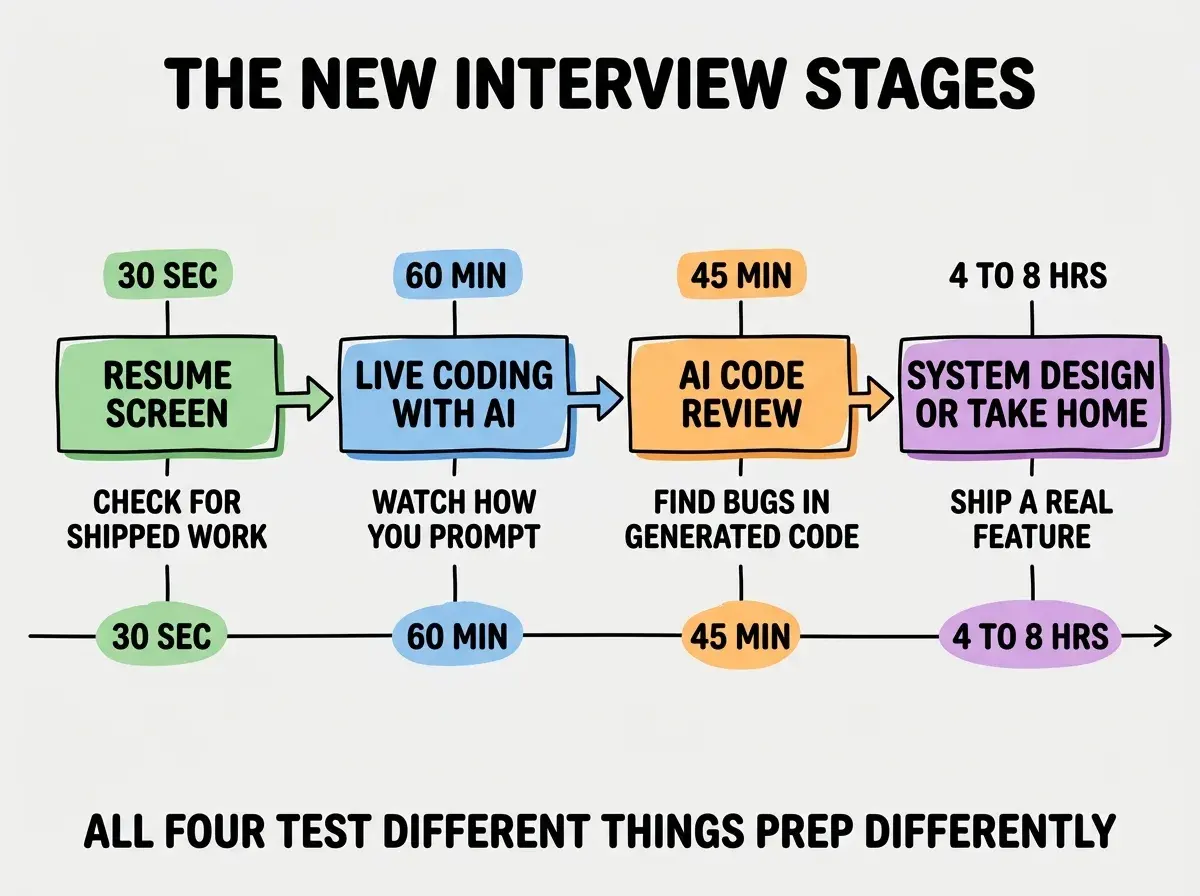
Assessment 3, the take-home that requires real shipping. Many companies now ask candidates to ship a small project end-to-end (deploy a working app, write a 500-word case study, share live URL) within 4 to 8 hours of work. The signal is whether the candidate can finish, not whether they can start.
The most damaging interview mistake in 2026 is treating the AI-tools-allowed coding session like the old whiteboard interview. Candidates who try to demonstrate they can "write the algorithm from scratch" while the AI sits idle signal that they have not internalized the new workflow. The right move is to use the tools openly, demonstrate judgment in how you use them, and finish the problem confidently.
The corollary is that practicing the new interview format is different from practicing the old one. Mock interviews where you write code without AI are now less useful than mock interviews where you build something real with AI assistance and explain your choices.
The other shift worth noting is that some companies are deliberately running both formats in parallel during the same loop, an old-style algorithm interview alongside a new AI-tools-allowed session. The reason is that hiring managers are still calibrating which format predicts on-the-job performance better. Candidates who do well on both styles get the strongest offers, but the AI-tools-allowed sessions are what most of the senior engineers are paying attention to behind closed doors.
What This Means For You
The hiring conversation has changed, the rubric has changed, and the candidates who internalize the change get hired. The candidates who do not are still applying with 2022 resumes to 2026 hiring managers.
- If you're a founder: Update your hiring loop to the new format. Companies still doing 2022-style interviews are losing the AI-fluent candidates to companies that have adapted.
- If you're changing careers: The new rubric is friendlier to career changers than the old one, because shipped evidence beats credentials. Six focused months of shipping can match years of traditional credentials.
- If you're a student: Optimize for shipped work over GPA from the first year. The portfolio compounds across every job application you will make for the next decade.
Browse more hiring and career analyses for the AI era
Read more pulse articles