The 465K AI-first developer job, as featured in widely-shared 2025 hiring posts, is a real role at real companies that pays a real number. The headline obscures more than it reveals though, because the salary band only applies to a narrow profile of candidate, the work is genuinely hard, and the gap between "I want this job" and "I can credibly apply for this job" is years of specific experience. Knowing the difference is what separates ambitious career planning from wishful thinking.
This piece walks through what the role actually involves, who is hiring at this band, what the realistic path looks like for someone targeting it, and the alternatives that pay 80% of the headline with 30% of the requirements.
Why the Number Got So High
The 465K headline number combines base salary, equity, and target bonus at AI-frontier companies, primarily concentrated in San Francisco and a few other hubs. Two specific dynamics drove the band higher than traditional engineering roles. The first is supply, the number of people with deep AI tooling fluency, frontier-grade engineering skills, and the judgment to ship in production is small. The second is leverage, the work these engineers do has direct impact on company revenue and product capability, which justifies premium compensation in a way most engineering roles do not.
The result is that these positions clear at numbers that look extreme but are actually rational from the company's perspective. A senior engineer who can independently ship a working AI agent system that drives 20 percent of company revenue is not overpaid at 465K. The compensation reflects the scarcity, not the difficulty alone.
A 2025 Levels.fyi compensation analysis found that AI-first engineering roles at frontier labs paid roughly 60% above traditional senior software engineering roles at the same company tier, with the top of band reaching 800K+ at the most competitive companies. The premium has grown each year since 2023.
The pattern to copy is the way machine learning engineering compensation rose between 2014 and 2018. The roles paid premium numbers because the supply of qualified candidates was small and the impact was outsized. As the supply caught up, the premium compressed. AI-first engineering is somewhere on a similar curve, currently in the high-premium phase.
What the Role Actually Involves
The work behind the 465K title is more specific than the title suggests. After reading hundreds of job postings and talking to people in the role, the work clusters into four major activities.
Activity 1, designing and shipping AI-driven systems. Not just calling an LLM API, but architecting systems where the AI is doing meaningful autonomous work, with appropriate evaluation, safety, and reliability layers. This is the bulk of the work, often 50 to 60 percent of weekly hours.
Activity 2, evaluation and benchmarking. Building test suites that measure whether the AI system is performing as designed across edge cases, adversarial inputs, and distribution shift. This is the part that distinguishes a real AI engineer from someone who has built a chatbot. Evaluation work is roughly 20 percent of the time.
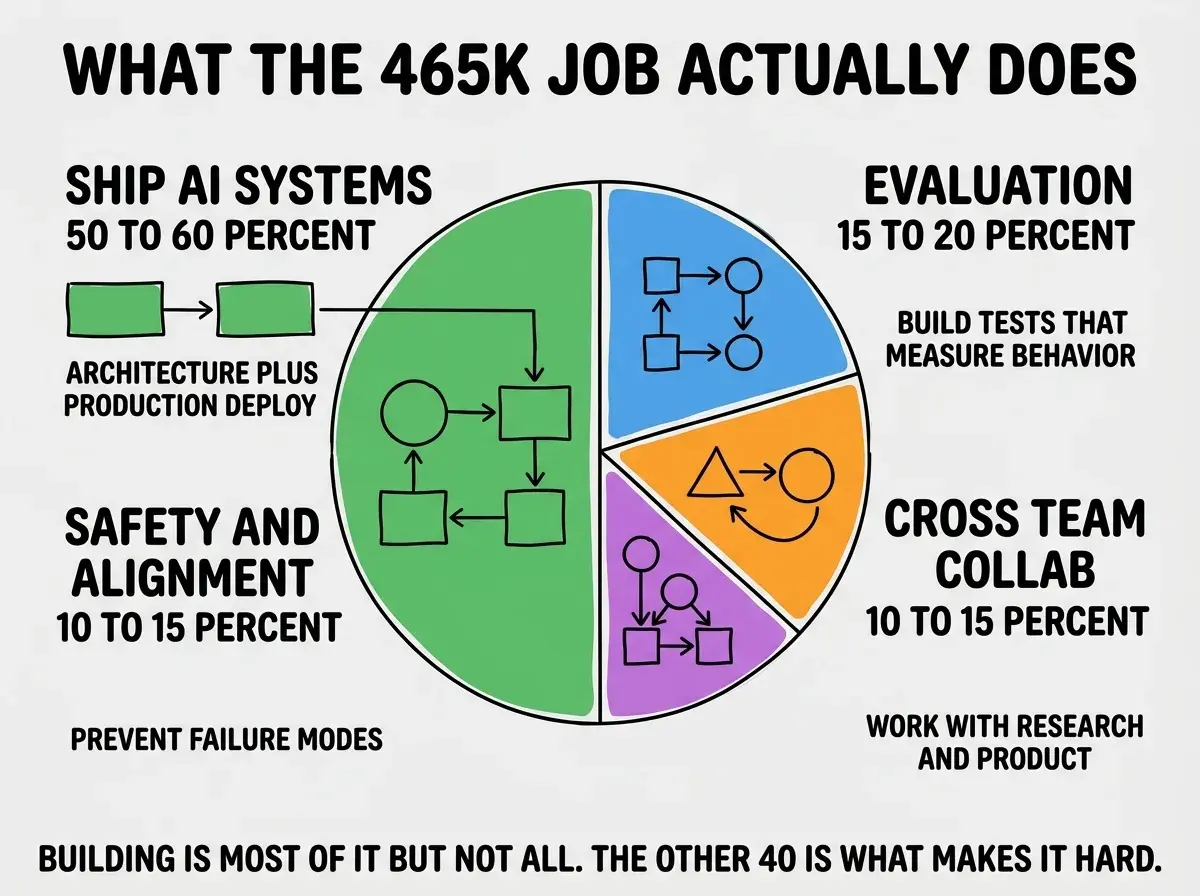
Activity 3, safety and alignment work. Identifying failure modes, building guardrails, and designing systems that fail safely when the AI behaves unexpectedly. This is more specialized, roughly 10 to 15 percent of weekly time, but it is the work that justifies the seniority premium.
Activity 4, cross-team collaboration with research and product. AI-first engineers sit at the boundary of research and product, translating research output into shipped systems. Strong communication and judgment matter as much as technical skill. This is roughly 10 to 15 percent of the time.
Who Is Hiring at This Band
The 465K band is concentrated in three categories of companies. Knowing which category fits your situation is most of the job search.
Category 1, frontier AI labs. OpenAI, Anthropic, Google DeepMind, Meta AI, and a handful of others. These companies hire at the highest bands but have the most competitive bars and concentrate in a few cities. The work is the most cutting-edge but also the most demanding.
Category 2, well-funded AI-first startups. Companies founded in the last 3 to 5 years where AI is the core product, not a feature. Examples include code generation platforms, agent infrastructure companies, and AI-first vertical SaaS. The bands are slightly lower than the frontier labs but still well into the 300k to 500k range, with more equity upside.
Read more career guides for AI-era engineers
Browse pulse articlesCategory 3, large tech companies with AI divisions. Established companies (Google, Meta, Microsoft, Amazon) have created AI-focused teams that pay competitively to retain talent. The bands are similar to the frontier labs but with more bureaucracy and less concentration of frontier work. A reasonable choice if you value stability over edge.
The Realistic Path
The honest path to a 465K AI-first developer role for someone not currently there has three phases. Each phase is roughly 12 to 24 months, and skipping any of them is the most common reason candidates do not break in.
Phase 1, build foundational engineering skill. A 465K AI engineer is a good engineer first, with strong CS fundamentals, the ability to ship production code, and judgment about what to build. This phase usually maps to 3 to 5 years of conventional engineering work.
Phase 2, build deep AI tooling fluency. Live in Cursor, Claude Code, and similar tools daily. Build several agent-based systems, even if just as side projects. Read the technical blogs from frontier labs (OpenAI, Anthropic) and reproduce experiments. This phase rewards focused practice over time, usually 12 to 18 months.
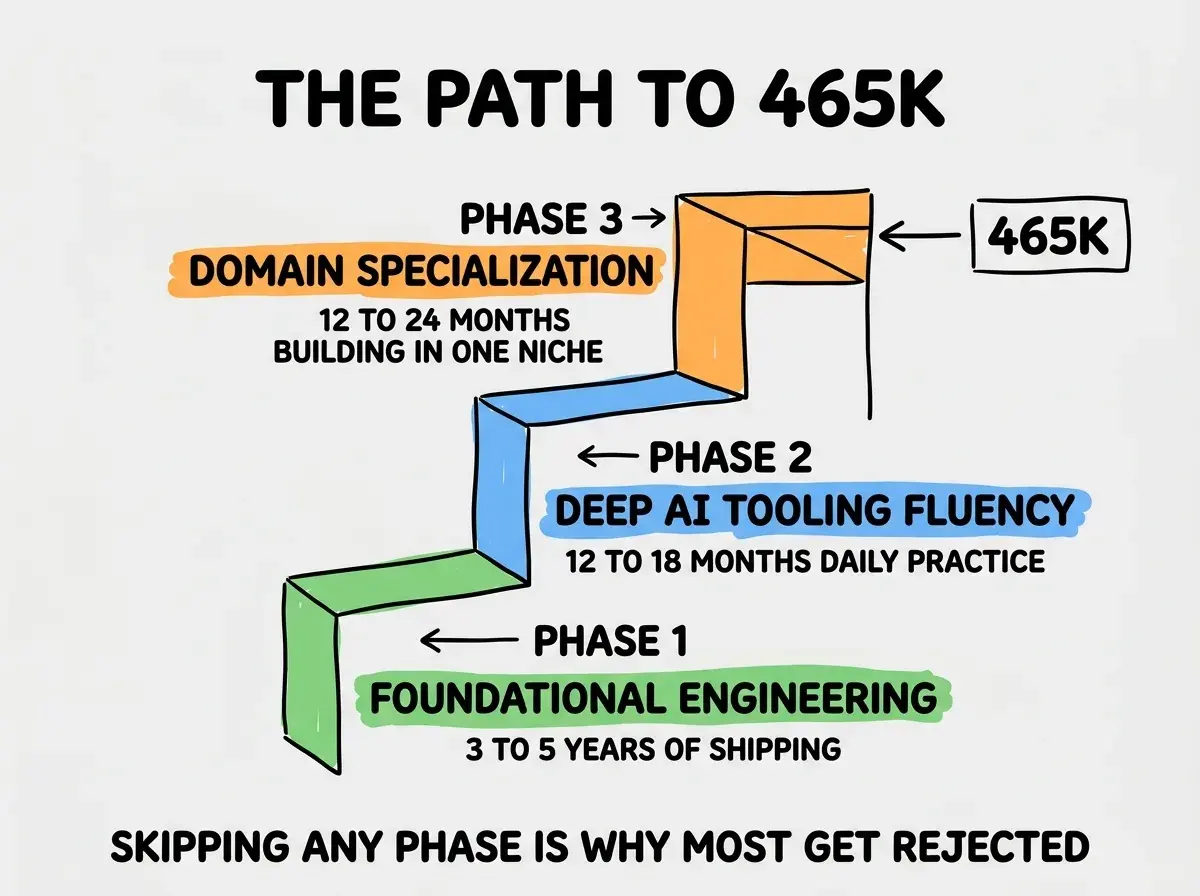
Phase 3, domain specialization. Pick one specific area (agent infrastructure, evaluation, safety, multi-modal systems) and become known for it. Speak at conferences, publish technical blog posts, contribute to open source in the space. Specialization is what gets you past the resume screen at the top companies.
The most damaging 465K-job mistake is applying without phase 3. Candidates with strong general engineering skills but no AI specialization rarely get past the resume screen at the highest band. The candidates who break in have a clear specialty that the recruiter can immediately identify.
The corollary is that the path is not for everyone. Many candidates are better served targeting the 200K to 350K band at less elite companies, where the bar is more achievable and the work is still interesting. The 465K band is small, the rejection rate is high, and the time investment is real.
What This Means For You
The headline 465K number is real but should not be the only target. The realistic question for most candidates is, what compensation level matches my current skills and ambitions, and what is the next reasonable step.
- If you're a founder: Hiring at this band requires understanding the supply dynamics. You will not poach a 465K engineer with a 250K offer plus equity, even if the equity is interesting. Either match the band or compete on a different axis.
- If you're changing careers: The 465K target is unrealistic for the first 5+ years of your transition. Set intermediate targets (200K, then 300K, then 400K) and let your skills compound.
- If you're a student: Choosing a CS or related degree, plus aggressive AI tooling adoption, plus one specialization, is a reasonable plan to reach this band by your early 30s. Patience matters more than effort here.
Browse more career and compensation analyses
Read more pulse articles