To handle failed payments and dunning effectively, follow the four phase approach (immediate retry for transient failures, customer notification with payment method update path, smart retry schedule respecting card network rules, and graceful service continuation or controlled cancellation), recognize what makes dunning recovery sustainable, and apply the patterns that maximize recovery without harming customer relationships. The dunning capability matters because failed payments represent recoverable revenue that proper handling preserves.
This piece walks through the four dunning phases, what makes recovery sustainable, the specific tooling, and the four mistakes that produce dunning failure.
Why Dunning Matters For Subscription Products
Dunning matters because failed payments are common and recoverable. The matter; cards expire, banks decline transactions, accounts hit limits. Without dunning, recoverable revenue becomes lost revenue.
The 2026 reality is that subscription products lose 5-10 percent of revenue annually to involuntary churn from failed payments. Effective dunning recovers most of this loss; ineffective dunning loses it permanently.
A 2025 subscription business study of 500 SaaS companies found that companies with structured dunning practices recovered 73 percent of failed payments compared to 31 percent recovery for companies with ad hoc dunning. The recovery difference translates to substantial revenue impact.
The pattern to copy is the way utility companies handle late payments. Utilities have structured approaches that recover most overdue accounts without alienating customers. Dunning follows similar pattern; structured approaches recover most failed payments without harming customer relationships.
The Four Dunning Phase Approach
Four phases produce effective dunning recovery.
Phase 1, immediate retry for transient failures. Many failures are transient; immediate retry recovers them. Without retry, transient failures become permanent.
Phase 2, customer notification with payment update path. Customers need to know about failures and how to fix them. Without notification, customers lose service unexpectedly.
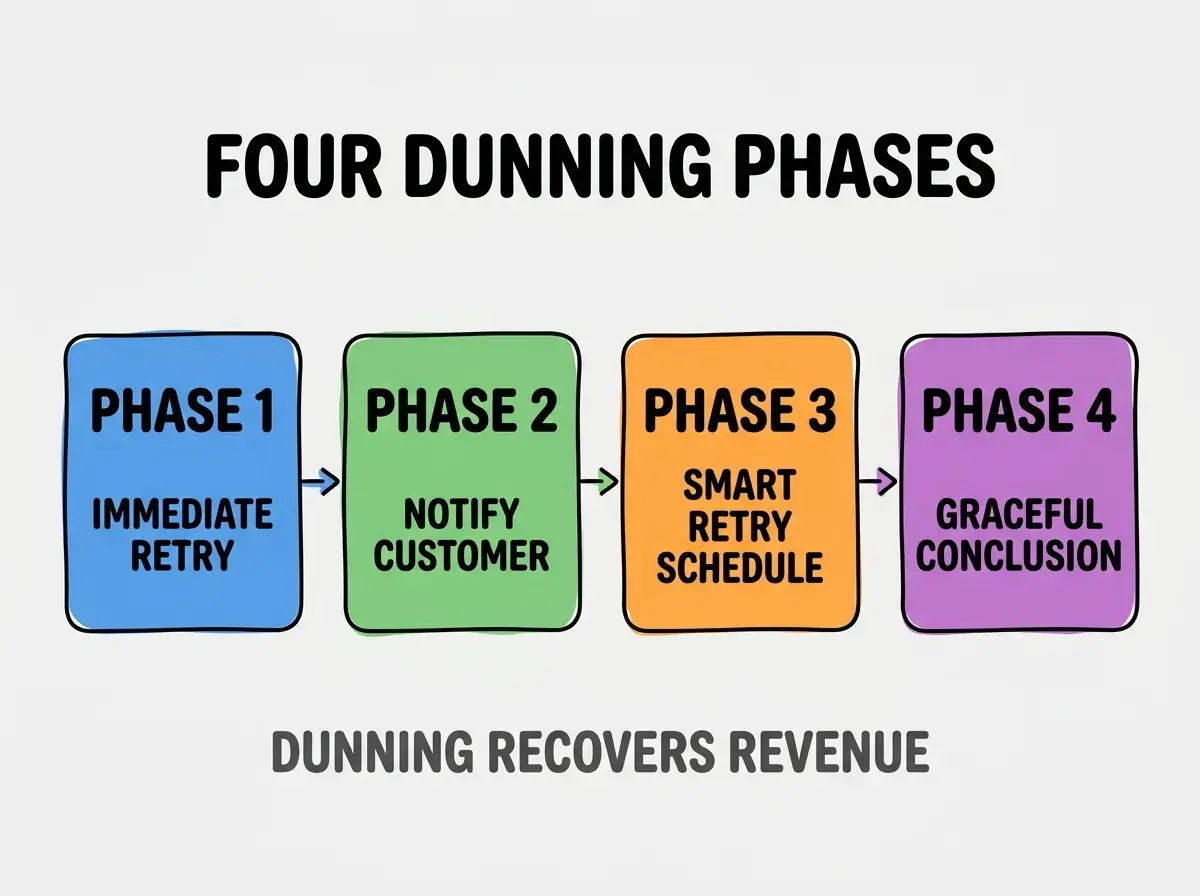
Phase 3, smart retry schedule respecting card network rules. Card networks have rules about retry frequency; smart schedules respect rules and customer goodwill.
Phase 4, graceful service continuation or controlled cancellation. Eventually some payments will not recover; graceful handling preserves option to win back customer later.
What Makes Dunning Recovery Sustainable
Three patterns characterize sustainable dunning practices.
Pattern 1, retry timing aligned with card network rules. Networks limit retry frequency; respecting rules preserves payment processor relationship. Without alignment, processor may restrict account.
Browse more grow articles
Read more growPattern 2, notifications that help rather than annoy. Helpful notifications drive recovery; annoying notifications drive churn. Tone matters dramatically.
Pattern 3, escalation that preserves customer relationship. Eventual cancellation should preserve win back possibility. Without preservation, lost customer becomes permanent loss.
The Specific Tooling That Works
Three tool categories combine effectively for dunning.
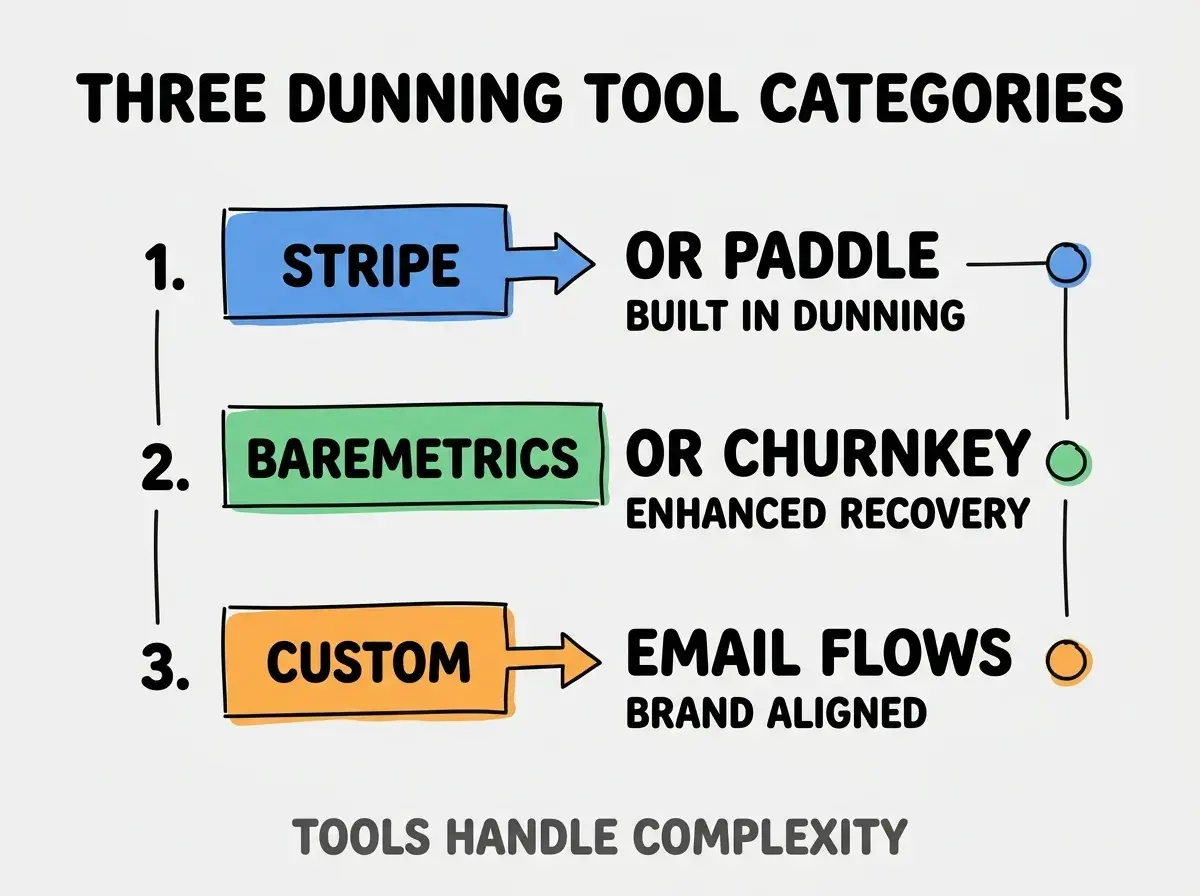
Tool 1, Stripe or Paddle for built in dunning. Payment processors include dunning capabilities. Built in handles basic recovery without additional tooling.
Tool 2, Baremetrics or Churnkey for enhanced recovery. Specialized tools improve recovery beyond basic processor capabilities. Enhancement worth investment for established subscription businesses.
Tool 3, custom email flows for brand alignment. Branded notifications often outperform generic processor notifications. Custom flows align communication with brand voice.
What Makes Dunning Sustainable Long Term
Three patterns separate sustainable dunning from problematic patterns.
Pattern 1, monitoring of dunning effectiveness over time. Recovery rates trend; monitoring catches drift. Without monitoring, recovery erodes silently.
Pattern 2, pre dunning prevention through card update reminders. Reminding customers about expiring cards prevents some failures. Prevention beats recovery.
Pattern 3, customer support escalation for high value accounts. Some accounts deserve human touch. Without escalation, high value accounts may be lost to automated process.
The combination produces dunning that maintains recovery rates over time. Without these patterns, dunning effectiveness erodes as customer base evolves.
How To Handle Specific Failure Types
Three failure types deserve specific approaches.
Failure A, expired cards. Pre expiration reminders, easy update path. Most preventable failure type.
Failure B, insufficient funds. Retry with delay; many recover within days. Network rules govern retry timing.
Failure C, fraud or risk holds. Customer support intervention often required. Automation alone insufficient for fraud holds.
The combination produces failure type specific approaches. Without specific approaches, generic dunning serves all failures mediocrely.
The most damaging dunning mistake is treating failed payments as customer churn rather than recoverable issue. Most failed payments come from technical issues (expired cards, network errors) not customer intent to cancel. The fix is to design dunning assuming customers want to continue; helpful approach recovers most failures while alienating treatment loses customers who would have stayed. Companies treating failures as recoverable produce dramatically better outcomes than companies treating failures as cancellation.
The other mistake is over aggressive retry that triggers fraud flags. Card networks limit retry frequency; aggressive retry produces processor problems. The fix is to respect network rules.
A third mistake is missing customer notification for failures. Customers do not know about failures without notification. The fix is to notify clearly with action path.
A fourth mistake is hard cutoff after first failure. Single failure often recoverable; hard cutoff loses recoverable revenue.
How To Recover Specific Customer Segments
Three segments deserve specific recovery approaches.
Segment A, long term customers with payment failures. Treat as valued customers with technical issues; preserve relationship aggressively. Tenure value justifies effort.
Segment B, new customers with first payment failures. Recovery rates lower; prevention matters more. Handle gracefully but allocate less effort.
Segment C, high value customers regardless of tenure. Personal outreach often justified. Value justifies effort that automation cannot match.
The combination produces segment specific recovery. Without segmentation, generic recovery underserves high value while overserving low value.
How Dunning Will Likely Evolve
Dunning practices will likely continue evolving as payment infrastructure matures.
The first likely evolution is AI assisted dunning emerging. AI optimizing retry timing, message tone, segment treatment. AI assistance improves recovery rates beyond rule based approaches.
The second likely evolution is account updater services becoming standard. Card network services that update card details automatically. Updater services prevent some failures.
The third likely evolution is alternative payment methods reducing card dependence. ACH, bank transfers, alternative methods reduce card failure exposure. Diversification reduces dunning load.
The combination suggests dunning will become more capable. Engineers learning patterns now build skills that remain valuable as tooling evolves.
Common Questions About Dunning
Dunning raises questions worth addressing directly.
The first question is how many retry attempts to make. 4-6 attempts over 2-3 weeks typical; more produces diminishing returns. Schedule respects card network rules.
The second question is whether to offer payment plan during dunning. Yes for high value; payment plans recover what cancellation loses. Plans matter for relationship preservation.
The third question is whether to grace period after failure. Yes typically 3-7 days; grace periods prevent service interruption during transient failures.
The fourth question is how to measure dunning success. Recovery rate (recovered failures over total failures), days to recovery, customer satisfaction. Multiple metrics together reveal dunning health.
The fifth question is whether to involve customer support during dunning. Yes for high value accounts; CS adds personal touch that automation cannot match.
What This Means For You
Effective dunning recovers revenue that ad hoc handling loses. The four phases, tool combinations, and segment approaches produce framework for sustainable dunning.
- If you're an indie hacker: Dunning recovers meaningful revenue; investment pays back through recovered subscriptions.
- If you're a senior dev: Dunning implementation requires careful design; help product team understand technical considerations.
- If you're a founder: Help team prioritize dunning as revenue protection. Without dunning, growth offset by recoverable churn.
Browse more grow articles
Read more grow