To use Lemon Squeezy as an indie hacker in 2026, choose it over Stripe when you want a Merchant of Record service that handles tax compliance globally for you, accept the higher transaction fees as the price of dramatically simpler tax handling, integrate with their straightforward API or hosted checkout, and use their built-in license keys and download delivery for digital products. The trade-off is real: higher fees in exchange for tax simplicity. For most indie hackers selling internationally, Lemon Squeezy is the better default than Stripe.
This piece walks through the four advantages over Stripe, the three trade-offs, the integration patterns, and the four mistakes that lead indie hackers to pick the wrong processor.
Why Indie Hackers Care About Merchant of Record
The Merchant of Record (MoR) distinction is the central reason Lemon Squeezy exists. With Stripe, you are the merchant of record, which means you are responsible for collecting and remitting sales tax in every jurisdiction where you have customers. For US-only businesses this is manageable; for international businesses it becomes a significant operational burden.
Lemon Squeezy is the merchant of record. They handle tax collection, remittance, and reporting in every country they operate in. You get a single payout from Lemon Squeezy; they handle the dozens of tax filings that would otherwise be your problem. For indie hackers selling globally to a few hundred customers, this is transformative.
A 2025 IndieHackers survey of 1,200 solo founders selling internationally found that those using Merchant of Record services (Lemon Squeezy, Paddle, FastSpring) spent 18 hours less per month on tax compliance compared to those using Stripe directly. The freed time went to product work; the higher transaction fees were more than offset by the operational savings. For indie hackers selling globally, MoR services produce better economics despite the higher per-transaction cost.
The pattern to copy is the way Amazon Marketplace handles sales tax for third-party sellers. Sellers focus on product; Amazon handles the tax complexity. Without that abstraction, marketplace selling would be too complex for most sellers. Lemon Squeezy provides the same abstraction for indie hackers selling digital products.
The Four Advantages Over Stripe
Lemon Squeezy beats Stripe in four specific ways. Each matters more for some indie hackers than others.
Advantage 1, tax compliance handled. The headline feature. No US sales tax registration, no EU VAT MOSS, no UK VAT, no GST in 30 different countries. Lemon Squeezy handles it.
Advantage 2, simpler pricing model. Flat fee per transaction (5% + $0.50 as of 2026) covers everything. No separate fees for international cards, currency conversion, or tax handling.
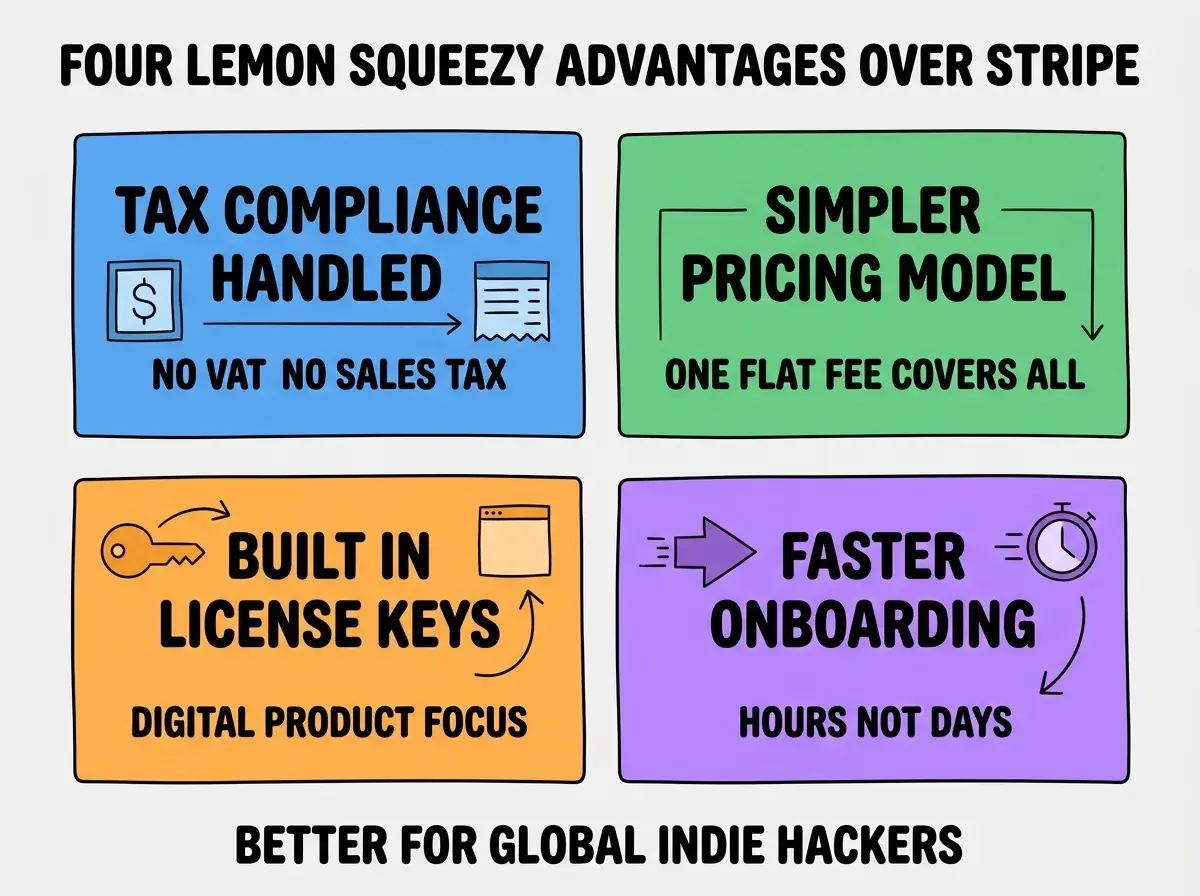
Advantage 3, built-in license keys. Native support for license key generation and validation. Important for software, plugin, and template sellers. Stripe requires you to build this yourself.
Advantage 4, faster onboarding. Account approval in hours rather than days. Critical when you are trying to launch quickly.
The Three Trade-Offs
Lemon Squeezy is not strictly better than Stripe. Three trade-offs determine when Stripe is the right choice instead.
Trade-off 1, higher transaction fees. Stripe is 2.9% + $0.30 in the US; Lemon Squeezy is 5% + $0.50. For high-volume businesses, this gap adds up to thousands of dollars per month.
Browse more monetization guides
Read more grow articlesTrade-off 2, less flexible API. Stripe's API is more powerful and more customizable. Lemon Squeezy is simpler but less flexible. For complex billing logic, Stripe wins.
Trade-off 3, fewer payment methods. Stripe supports many more payment methods (Apple Pay, Google Pay, ACH, SEPA, etc.). Lemon Squeezy covers the major ones but not the full breadth.
When to Pick Lemon Squeezy
Three patterns indicate Lemon Squeezy is the right choice.
Pattern A, selling digital products globally. SaaS, plugins, templates, courses. Tax compliance complexity grows with each new country; Lemon Squeezy eliminates it. The default for indie hackers selling globally.
Pattern B, simple billing logic. One-time purchases, simple subscriptions, no usage-based pricing. Lemon Squeezy handles these cleanly. Stripe is overkill.
Pattern C, fast launch needed. Side project, weekend launch, MVP. Lemon Squeezy's faster onboarding gets you live faster.
When to Pick Stripe Instead
Three patterns indicate Stripe is the right choice.
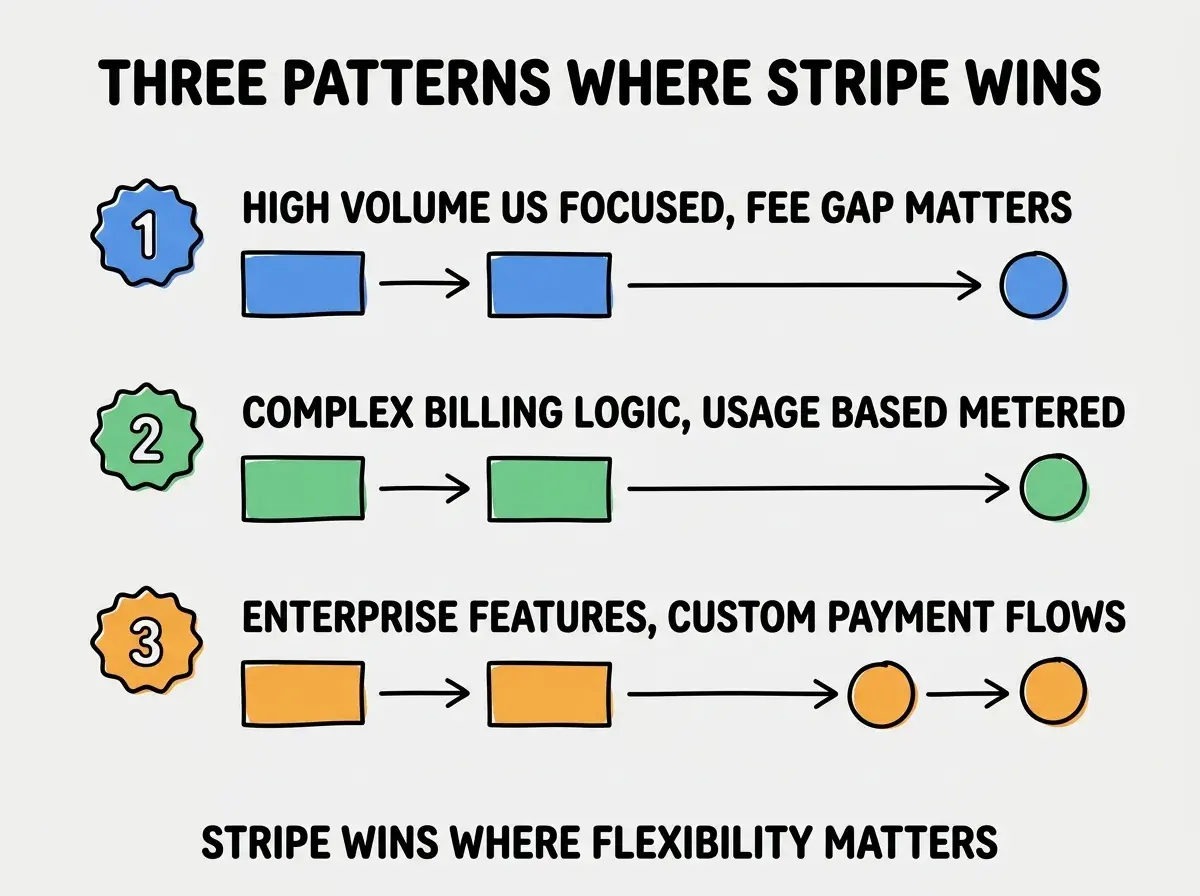
Pattern X, high volume US-focused. Above $50K monthly revenue with mostly US customers. The fee difference matters more than tax simplification.
Pattern Y, complex billing logic. Usage-based pricing, metered billing, complex tier structures. Stripe handles these patterns; Lemon Squeezy struggles.
Pattern Z, enterprise features needed. Custom payment flows, advanced fraud prevention, deep integration with billing systems. Stripe's API depth is unmatched.
The Integration That Ships in a Day
Both Stripe and Lemon Squeezy can be integrated quickly, but Lemon Squeezy is genuinely simpler for indie hackers. Three steps cover most integrations.
Step 1, set up your store. Create products in the Lemon Squeezy dashboard. Configure pricing, descriptions, license key generation if relevant. About 30 minutes.
Step 2, add the checkout button. Lemon Squeezy provides hosted checkout URLs. Add a button that redirects to checkout. Done. About 10 minutes.
Step 3, handle the webhook. When a purchase completes, Lemon Squeezy POSTs to your webhook. Provision access, send license key, etc. About 1 hour for basic implementation.
The whole integration is faster than most Stripe integrations. The hosted checkout removes most of the complexity that Stripe integrations require you to manage.
The most damaging payment processor choice mistake is picking based on transaction fees alone. Indie hackers see Stripe at 2.9% and Lemon Squeezy at 5% and conclude Stripe is cheaper. This ignores the operational cost of tax compliance, which for international sellers can easily exceed the fee difference. The fix is to calculate the total cost of ownership including the time you spend on tax filings, the accountant fees, and the risk of getting compliance wrong. For most indie hackers selling internationally, Lemon Squeezy is cheaper despite the higher per-transaction fee.
The other mistake is using both processors for "redundancy." This sounds prudent but creates significant operational complexity (two webhooks to handle, two reconciliation processes, two refund flows). Pick one and commit; switching costs are real but operational complexity costs are higher. The simplicity of one processor beats the supposed safety of two.
Migration Patterns Between Processors
If you started with one processor and want to migrate to the other, three patterns reduce risk.
Pattern A, new customers on new processor. Existing customers stay on the original processor; new customers go through the new processor. Eventually the original processor's customer base shrinks to zero through churn. Slowest but lowest risk.
Pattern B, scheduled migration. Pick a date, migrate all customers in one window with prepared communications. Highest risk but fastest. Requires good email outreach and customer-facing migration UI.
Pattern C, opt-in migration. Offer existing customers an incentive (slight discount, bonus features) to migrate to the new processor voluntarily. Middle path between A and B. Requires more sustained effort but lower risk than B.
The right migration pattern depends on customer count and tolerance for change. Small customer bases can do scheduled migrations; large bases benefit from new-customers-only or opt-in approaches that spread the work across months.
What This Means For You
Lemon Squeezy is the right default for most indie hackers selling digital products in 2026. The Merchant of Record abstraction is genuinely valuable; the higher fees are worth it for most use cases.
- If you're a founder: Default to Lemon Squeezy if you sell digital products internationally. Switch to Stripe only if specific patterns make Stripe the better fit.
- If you're changing careers into indie hacking: Lemon Squeezy is the simpler starting point. Stripe is the harder path that pays back at scale.
- If you're a student: Build your portfolio projects with Lemon Squeezy if you want real revenue. The faster onboarding lets you ship and iterate without payment-processor overhead.
Browse more monetization guides
Read more grow articles