Google Antigravity 2.0 launched at Google I/O 2026 on May 19, fundamentally changing what "using Google's AI for coding" means. The platform bundles a multi-agent desktop app, a CLI, and a programmable SDK into one developer suite, all powered by Gemini 3.5 Flash, which outperforms last year's Gemini Pro on key coding benchmarks at four times the speed.
Alongside Antigravity, Google previewed Jules V2 (codenamed Project Jitro), which shifts from task-based to goal-based coding agents, and expanded Firebase Agent Skills to Android, iOS, and Flutter. Taken together, this is Google's most coherent developer AI push since the original Gemini release, and it lands during a week where vibecoders have real choices to make about which tools to build on.
Why This Week's Google Announcements Matter
After more than a year of chasing Claude Code and Cursor in the IDE-first AI coding market, Google is betting on a different surface. Rather than competing feature by feature inside an editor, Antigravity 2.0 positions Google as an orchestration layer that sits above the IDE. The desktop app runs multiple agents in parallel across repos and environments. The CLI handles the terminal-first workflow most vibecoders already live in. The SDK lets you build custom agents on the same harness Google uses internally.
The timing is deliberate. Cursor shipped 3.0 with its Agents Window in April. Anthropic shipped Claude Code's Agent View in May. Google needed something that felt like a complete platform answer rather than an incremental update. What came out of I/O 2026 is the most integrated Google developer story in years: one model (Gemini 3.5 Flash), one platform (Antigravity), one agent harness covering everything from the CLI to the enterprise tier.
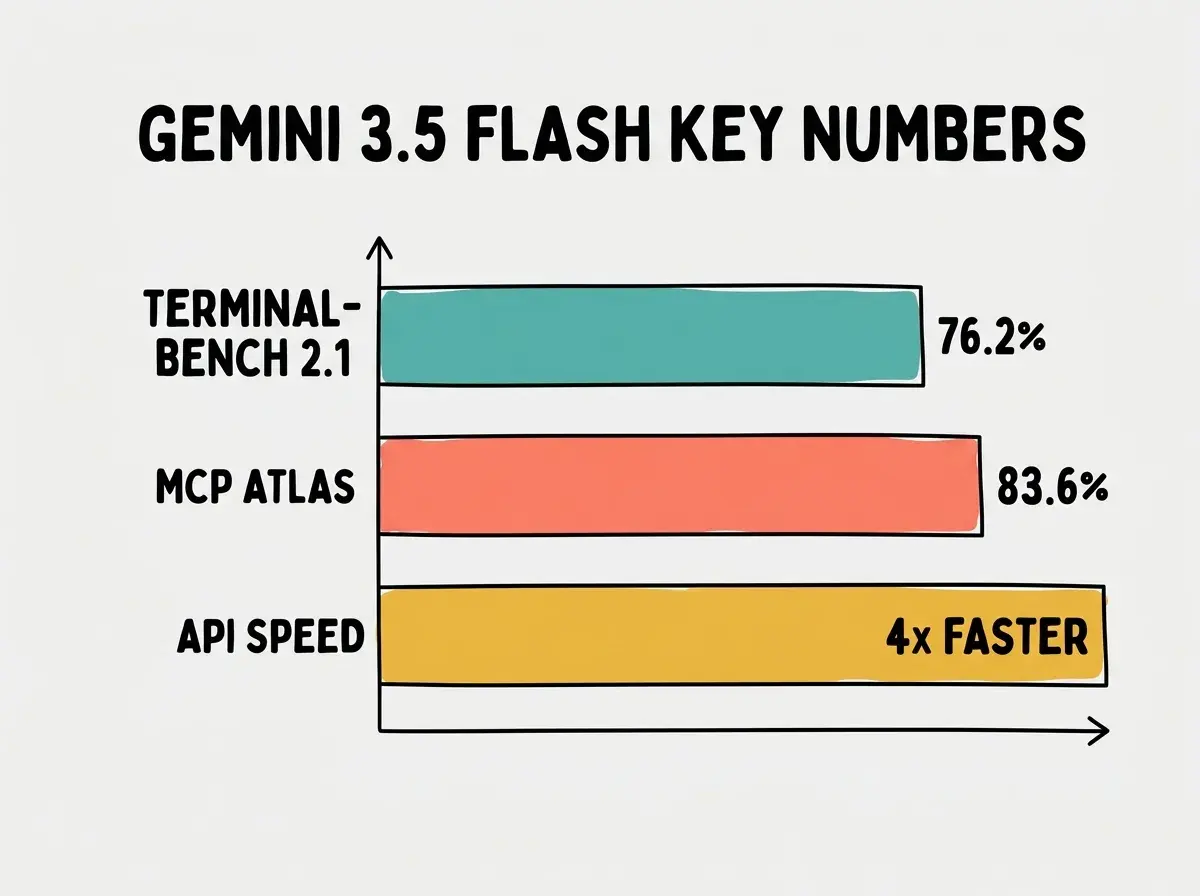
Gemini 3.5 Flash, the model powering Antigravity 2.0, ships at $1.50 per million input tokens and $9 per million output tokens with a one-million-token context window. It runs four times faster than comparable frontier models on the public API and reportedly twelve times faster inside Antigravity's managed execution tier. On Terminal-Bench 2.1 it scores 76.2 percent; on MCP Atlas it reaches 83.6 percent. For agentic workflows that make dozens of model calls per task, speed and token cost matter as much as raw benchmark numbers.
Google's move also signals where the AI coding market is heading next. The IDE-autocomplete battle is largely settled; Copilot, Cursor, and Claude Code dominate it. The next competitive surface is outcome-level orchestration: running many agents against a goal rather than directing one agent at a specific task. Antigravity 2.0 and Jules V2 are Google's opening bids on that surface.
What Is Antigravity 2.0 and How Does It Work
Antigravity 2.0 launched on May 19 as four things simultaneously: a desktop app, a CLI, an SDK, and a managed agents tier inside the Gemini API. Each piece targets a different part of a vibecoder's workflow.
The desktop app is a control surface for running multiple agents in parallel, scheduling background tasks, and connecting to Firebase and Android Studio. Think of it less like a code editor and more like a project management dashboard for agents. You describe what you want to ship; the desktop orchestrates the agents doing it. Dynamic subagents handle parallelized subtasks automatically, and scheduled tasks let you set work running in the background overnight.
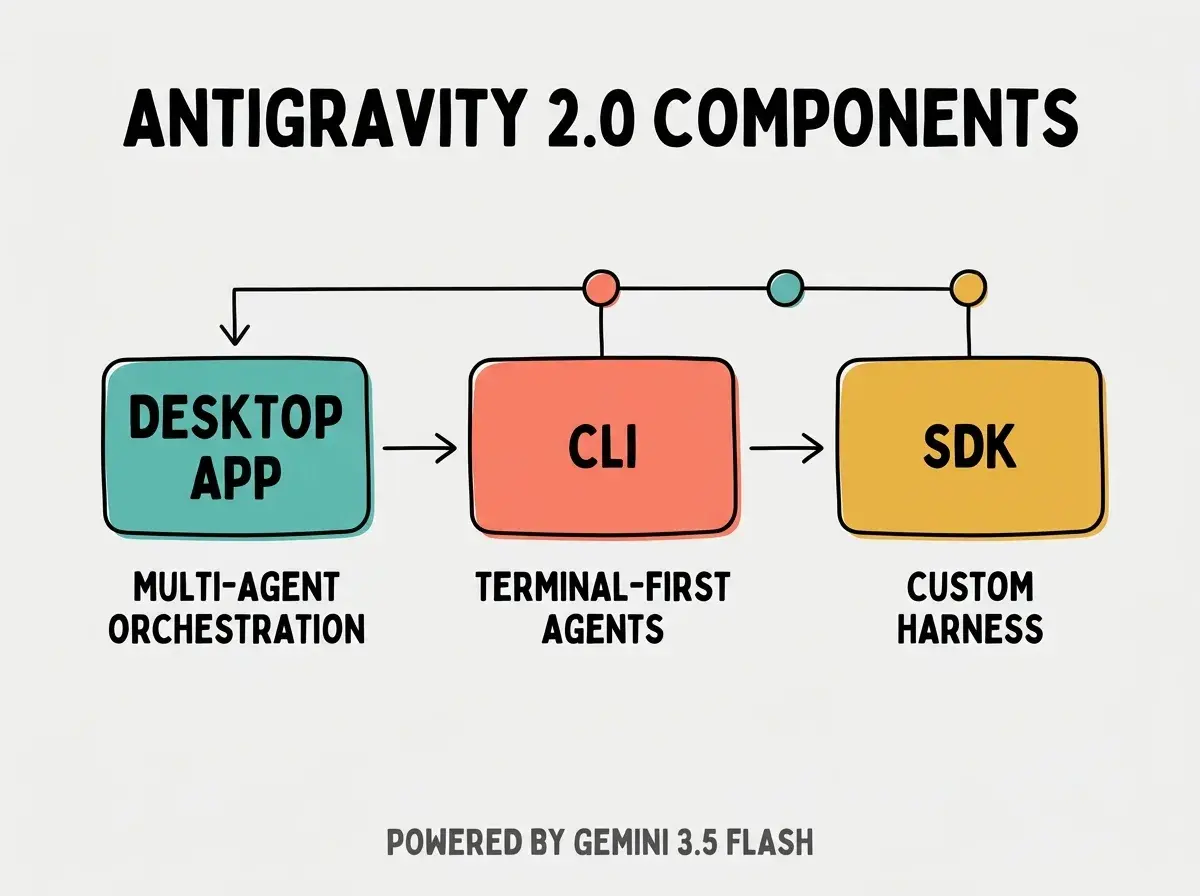
The CLI (renamed from Gemini CLI to Antigravity CLI) is the terminal-first entry point. It is lightweight, scriptable, and designed for multi-step agent flows. If you already run Claude Code or Codex in a terminal, the Antigravity CLI is an immediate addition worth testing for Gemini-backed tasks where 3.5 Flash gives a meaningful speed advantage over older models.
The SDK exposes the agent harness to your own infrastructure, optimized for Gemini models but deployable wherever you host. This targets teams building products on top of Google's agent capabilities rather than using Antigravity as a personal development tool.
Pricing changed alongside the product. A new AI Ultra tier at $100 per month delivers five times the usage limits of the Pro plan. The existing top-tier AI Ultra subscription dropped from $250 to $200 per month, now offering twenty times Pro limits. For vibecoders running parallel agents across multiple projects, the expanded headroom is the practical change that matters most day to day.
Weekly pulse on tools, models, and what actually changes your workflow
Browse all postsWhat Gemini 3.5 Flash Means for Your Agent Pipelines
Gemini 3.5 Flash is generally available via the Gemini API starting May 19. It is the first Gemini release to outperform its own Pro-tier predecessor on coding and agentic benchmarks while running substantially faster. The relevant numbers for vibecoders are speed (four times faster than comparable frontier models), cost ($1.50 input / $9 output per million tokens), and context window (one million tokens).
For agentic workloads, speed is not optional. When a task requires fifteen model calls to navigate a codebase, identify what to change, write the change, and run tests, four-times-faster throughput translates directly into wall-clock completion time. A twenty-minute agentic task becomes a five-minute one. At comparable token cost per call, that reduction compounds across every project you run.
If you are currently using Gemini 3.1 Pro in your own agent pipelines, switching to 3.5 Flash is a straightforward upgrade. The API endpoint changes; the benchmark improvements and speed increase follow. Gemini 3.5 Pro is confirmed for June 2026 if maximum capability over speed is the priority, but for most vibecoder agentic workflows, 3.5 Flash is the right call right now.
The Firebase Agent Skills expansion adds a concrete workflow improvement for mobile builders. Agent Skills for Firebase are specialized context packages that help any supporting coding agent integrate Firestore, Authentication, Crashlytics, and Remote Config with higher accuracy and lower token usage. Mobile skills are new at I/O 2026, covering Android, iOS, and Flutter. One notable detail: Firebase explicitly named Claude Code and Codex as supported third-party agents. If you are already using Claude Code for a Flutter project, you can benefit from Firebase Agent Skills without switching to Antigravity.
Treating Jules V2 (Project Jitro) as production-ready today is the most costly mistake vibecoders will make after I/O 2026. Jules V2 launched with a waitlist, not general availability. The original Jules is stable for async task execution. Jules V2's goal-based paradigm is genuinely different and worth monitoring, but the right move is to join the waitlist and keep running V1 for live projects. Goal-driven agents that autonomously decide which files to change require careful review habits before you trust them on anything customer-facing.
Jules V2 is still worth understanding even while it remains unavailable. The shift from task-based ("add unit tests to auth.py") to goal-based ("raise test coverage to 80 percent") is a different mental model. When the agent has discretion over which files to change rather than being directed at a specific target, the scope of each review session expands. The upside is less time specifying what to do; the downside is that stronger review habits are required to catch unintended changes before they merge.
Common Questions About These Announcements
The practical summary across all three announcements is that two are available right now (Antigravity 2.0 and Gemini 3.5 Flash), one is waitlist-only (Jules V2), and one applies regardless of which tools you use (Firebase Agent Skills). The right response is not to rebuild your stack this week, but to pick the single upgrade that fits your current workflow and add it.
What This Means For You
Google I/O 2026 produced distinct, actionable outcomes depending on what you are building right now.
- If you build Firebase apps on web: Enable Firebase Agent Skills in your existing Claude Code or Codex setup. It is a configuration change that reduces hallucination errors on Firebase API calls without requiring any tool switch.
- If you build mobile apps on Flutter, Android, or iOS: The new mobile Firebase Agent Skills cover your stack as of this week. Enable them and use your current agent workflow; no migration needed.
- If you run Gemini in your own agent pipelines: Switch to Gemini 3.5 Flash. It is faster, cheaper per token, and stronger on coding benchmarks than 3.1 Pro. The migration is an API endpoint change.
- If you want to explore Antigravity 2.0: Install the Antigravity CLI today and join the Jules V2 waitlist. The CLI replaces Gemini CLI and is available immediately. The desktop app is worth exploring if you regularly run more than two parallel agents on a project.
- If you are on a tight budget: The new $100 AI Ultra tier may be the right entry point for running parallel agents without hitting rate limits constantly. Evaluate whether five-times headroom is sufficient before committing to the $200 twenty-times tier.
More weekly pulse on what ships and why it matters for vibecoders
Browse all posts