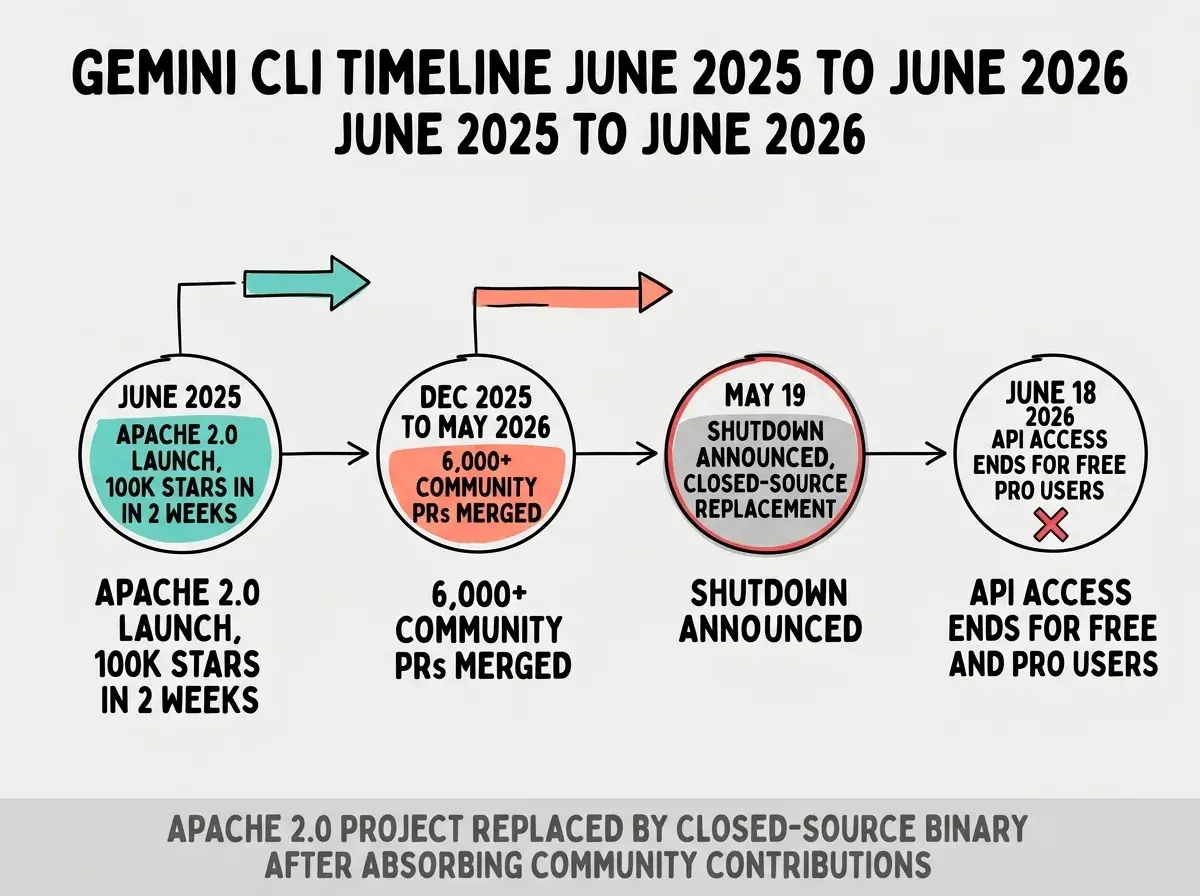
Gemini CLI stops serving requests for free and Google AI Pro users on June 18, 2026 at 23:59 Pacific Time. That is 48 hours from today. If you have shell scripts, GitHub Actions, or CI pipelines that call the gemini command, they will break silently. The migration is a five-step process: install the replacement binary, rename one environment variable, update any scripts that call gemini, adjust for four breaking flag changes, and verify your agent state directory moved.
The change is not just procedural. Gemini CLI was an Apache 2.0 project with more than 100,000 GitHub stars and over 6,000 merged community contributions. Its replacement, Antigravity CLI, is a closed-source Go binary. Developers who submitted those patches are now contributing to an enterprise product they cannot access for free. That gap between the promise of open-source and the reality of the shutdown is what is fueling the loudest backlash in the AI coding tool space since the GitHub Copilot billing reset.
Who Actually Gets Cut Off on June 18
The shutdown applies to three categories: Gemini Code Assist for individuals (the free IDE extension tier), Google AI Pro subscribers, and Google AI Ultra subscribers on the legacy plan. If you fall into any of these groups, your access to Gemini CLI and the Gemini Code Assist IDE extension (for VS Code, JetBrains, and Cloud Shell) ends on June 18.
Two groups are not affected. First, Gemini Code Assist Standard and Enterprise license holders retain access to both the IDE extension and the CLI indefinitely under their existing agreements. Second, developers who authenticate with a paid Google Cloud API key bypass the consumer tier entirely and continue as before. If you call the Gemini API directly using a Cloud project API key, nothing changes on June 18.
The practical question is which group most vibecoders fall into. Gemini CLI's free tier, especially after the addition of Gemini 2.5 Flash as the default model in early 2026, was a cost-free path to running agentic coding tasks. Builders who used it as a no-cost complement to Claude Code or Cursor for specific Gemini-backed tasks are the ones who need to act today.
The hard cutoff is June 18, 2026 at 23:59 PT. After that, any shell script, GitHub Action, or CI pipeline calling gemini on a free or Google AI Pro tier returns an error with no grace period. The replacement binary is agy, installed via curl -fsSL https://antigravity.google/cli/install.sh | bash. Your existing Gemini API key does not transfer; you need a new AV_API_KEY from the Antigravity dashboard before migrating.
Google announced the shutdown at I/O 2026 on May 19, alongside Antigravity 2.0. At the same event, the company introduced AI Ultra at $100 per month, a new middle tier between Pro ($20/month) and the previous premium plan. The Hacker News thread titled "Gemini CLI will stop working from June 18, 2026" surfaced in late May and has driven developer awareness, but a significant number of builders still have not migrated and are approaching the deadline with active dependencies on the old tool.
What Changed Between Gemini CLI and Antigravity CLI
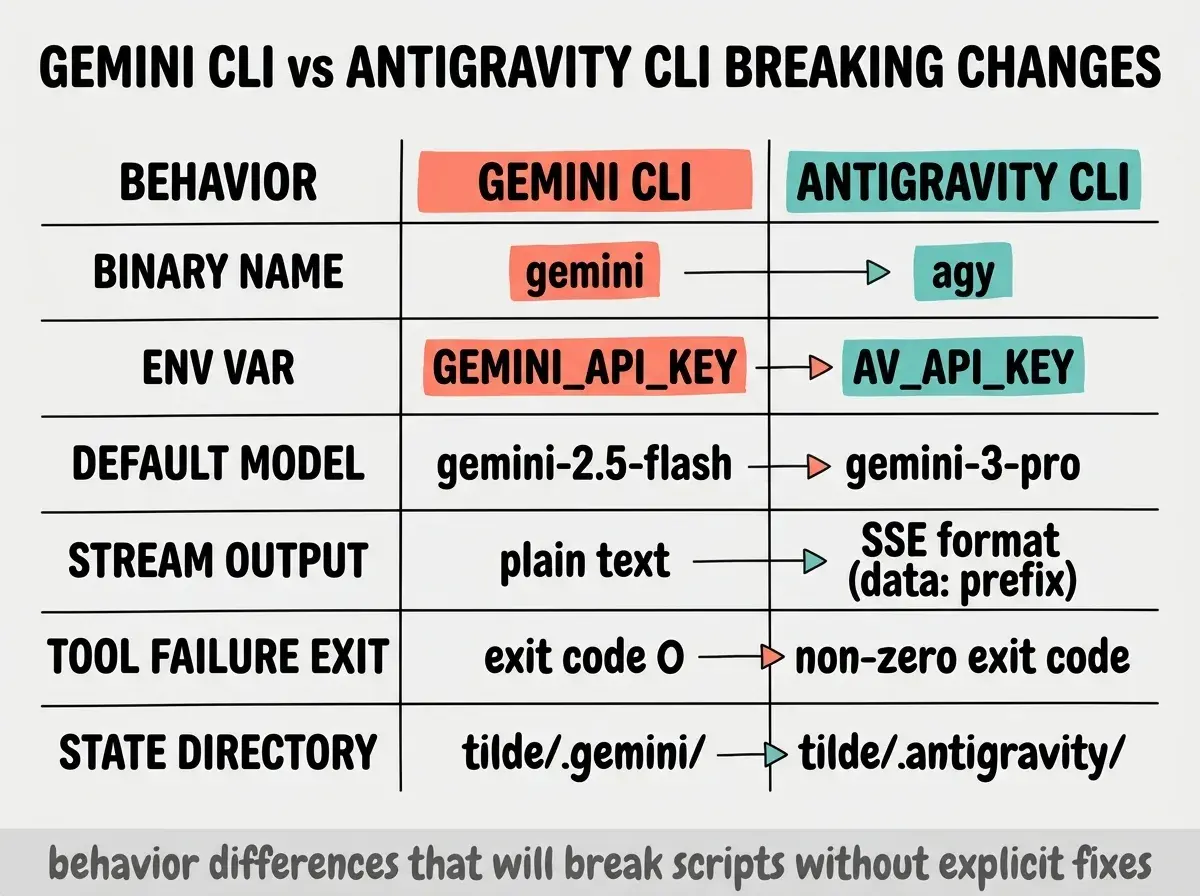
The surface-level change is a binary rename. Gemini CLI was a Node.js package distributed as @google/generative-ai-cli with a gemini executable. Antigravity CLI is a statically compiled Go binary called agy. The distribution method shifted from npm to a direct install script, and the tool is no longer open source.
The deeper change is in authentication. Gemini CLI used GEMINI_API_KEY, drawn from Google AI Studio. Antigravity CLI uses AV_API_KEY, issued from the new Antigravity dashboard at antigravity.google/settings/api. These are different keys even if your underlying Google account is the same. You cannot reuse your existing Gemini API key with the new binary.
Four behavioral differences break existing scripts:
Default model. Gemini CLI defaulted to gemini-2.5-flash. Antigravity CLI defaults to gemini-3-pro. If you relied on the default for cost predictability or specific output formatting, your sessions will run on a different and more expensive model unless you pass --model gemini-3-flash explicitly.
Streaming flag. --stream in Gemini CLI returned chunks as plain text. In Antigravity CLI, --stream emits Server-Sent Events (SSE) by default. Scripts that parse the raw output of gemini --stream will need to strip the data: prefix from each line.
Exit codes. Gemini CLI returned exit code 0 on tool-use failures, letting scripts continue silently. Antigravity CLI returns non-zero exit codes on tool-use failures. Any CI step using || true as a workaround will now behave correctly, but any step that treated a zero exit code as success may now halt unexpectedly.
Agent state directory. The persistent state that Gemini CLI stored in ~/.gemini/ has moved to ~/.antigravity/. If you have automation that reads or writes conversation history from ~/.gemini/, update those paths. The old directory is not migrated automatically.
How to Migrate in the Next 48 Hours
The migration has five steps, none of which require more than a few minutes each.
Step 1: Install the Antigravity CLI binary. Run curl -fsSL https://antigravity.google/cli/install.sh | bash in your terminal. This places the agy binary in ~/.local/bin/agy on Linux and macOS. Verify the install with agy --version. On Windows, download the binary from antigravity.google/docs/cli-install.
Step 2: Get your AV_API_KEY. Log in to antigravity.google/settings/api and generate a new API key. Add it to your environment: export AV_API_KEY=<your-key> in .bashrc, .zshrc, or your secrets manager.
Step 3: Update your scripts. Replace every call to gemini with agy. The subcommand for managing agents changed from agents to agent (singular). Run grep -r "gemini " .github/workflows/ scripts/ to find all call sites before editing.
Step 4: Fix the breaking changes. If you used --stream, add --stream-format text to restore plain text output. If you use exit codes in CI, remove any || true that was masking failures. Update any path references from ~/.gemini/ to ~/.antigravity/.
Step 5: Test before June 18. Run your most-used scripts against the new binary today. The Antigravity CLI free tier gives 20 agent requests per day on the individual plan, which is enough for a smoke test of your critical paths. The paid Pro plan at $20 per month unlocks higher daily limits.
The Vibe Coder Blog covers the tool updates, pricing shifts, and shutdowns that affect how vibecoders work.
Browse All PostsThe Gemini Code Assist VS Code and JetBrains IDE extensions are also affected. After June 18, they will stop making requests for free and Google AI Pro accounts. The replacement is the Antigravity IDE extension, available in both marketplaces now. The extension uses the same AV_API_KEY as the CLI. Install it and authenticate before June 18 to maintain inline code completion and chat functionality in your editor.
What the Open Source Controversy Is About
Gemini CLI launched in June 2025 under the Apache 2.0 license. It hit 100,000 GitHub stars in under two weeks and attracted a sustained community of contributors. According to reporting by TechTimes, more than 6,000 pull requests from community contributors were merged into the codebase before the May 19 shutdown announcement.
The May 19 announcement came without advance notice to the contributor community. The Register noted that Google's move replaced an Apache 2.0 project with a closed-source binary on the same day the community was told their access would end. Developer Andrea Alberti, who had a 27-commit pull request merged the same day as the announcement, asked publicly whether contributors had been "essentially working for free on a code base that will only be used in enterprises."
The practical lesson for vibecoders is straightforward: an open-source license on a Google-hosted project does not guarantee continued free access. The Apache 2.0 license lets anyone fork and maintain Gemini CLI independently, and several community forks appeared on GitHub within days of the announcement. However, none have the same Gemini API access that made the original tool useful, since the API credentials belong to Google, not the project.
Assuming that because Gemini CLI is Apache 2.0, a community fork will fully replace it. The license allows anyone to run the Node.js code, but the Gemini API keys that give it access to the models are tied to Google's infrastructure. Community forks can use the Gemini API with their own keys, but they still depend on the same per-key quotas and the same Google billing decisions. The forks preserve the CLI pattern but do not escape the underlying dependency on Google's terms.
The controversy has a direct implication for how vibecoders evaluate tool choices going forward. When a company releases a developer tool under an open-source license while controlling the API that the tool depends on, the open-source license covers the client code but not the service. This distinction matters when the service is what you are actually building on.
What This Means for Your Vibe Coding Workflow
The migration itself is low-friction for most developers. The gemini to agy rename is a search-and-replace, the env var swap is a .env file update, and the breaking changes in stream format and exit codes affect a minority of scripts that use those flags explicitly.
The more lasting effect is on tool selection strategy. Gemini CLI attracted contributors partly because it was Apache 2.0 and had no vendor dependency beyond the API key. That premise no longer applies. The successor tool is closed-source, tied to Google's billing, and has already seen its free tier reduce from 250 agent requests per day to 20 in under six months. Vibecoders who adopted Gemini CLI specifically because it was freely redistributable should evaluate whether Antigravity CLI meets their requirements at the new usage limits.
For builders who used Gemini CLI primarily as a cost-free Gemini Flash access point in their agent pipelines, the alternative path is to call the Gemini API directly from your own code using @google/generative-ai or the REST API, which gives you model-level control and avoids the CLI layer entirely.
The June 18 deadline is the immediate item. The longer reflection is about which tools in your stack have a similar structure: open-source client, proprietary API, company-controlled access. Knowing that structure in advance is what lets you make a contingency decision before the shutdown notice rather than after.
The official migration documentation from Google covers installation and flag differences in detail. The Google Developers Blog announcement from May 19 remains the canonical source for the change. Both are worth bookmarking before June 18.
The Vibe Coder Blog covers migrations, pricing shifts, and new tool releases for builders using AI to ship faster.
Read More