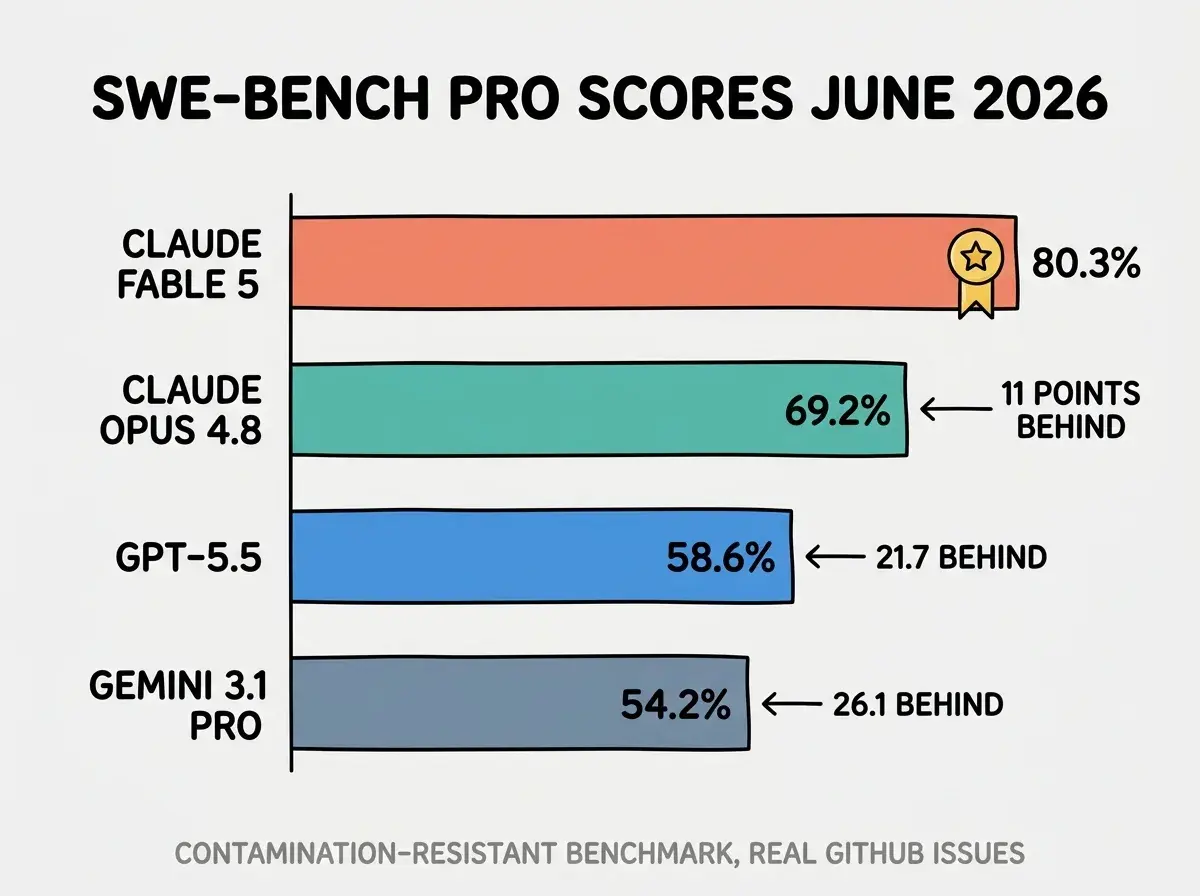
Claude Fable 5, Anthropic's first publicly available Mythos-class model, shipped in Claude Code v2.1.170 on June 9. It is not the default model. You opt in by running /model fable. What you get is an 80.3% score on SWE-Bench Pro, a contamination-resistant coding benchmark, which is 11.1 points ahead of Opus 4.8 and more than 20 points ahead of every competing model currently available. On subscription plans (Pro, Max, Team, Enterprise seats), Fable 5 is included at no extra cost through June 22. It moves to usage credits on June 23.
What Is Claude Fable 5 and Why Does the SWE-Bench Score Matter
The 80.3% SWE-Bench Pro score means Fable 5 resolved more than four in five real GitHub issues submitted to open-source repositories in an automated test. SWE-Bench Pro is designed to resist data contamination by using issues filed after major model training cutoffs, so the number is harder to inflate through training overlap than the original benchmark. Opus 4.8 scores 69.2% on the same benchmark. GPT-5.5 scores 58.6%. Gemini 3.1 Pro scores 54.2%.
For vibecoders, the practical implication is measurable: on tasks involving unfamiliar codebases, multi-file changes, and root-cause debugging, Fable 5 is meaningfully more capable than the model that was the ceiling a month ago. Anthropic's announcement describes the model as suited to "the most demanding reasoning and long-horizon agentic work."
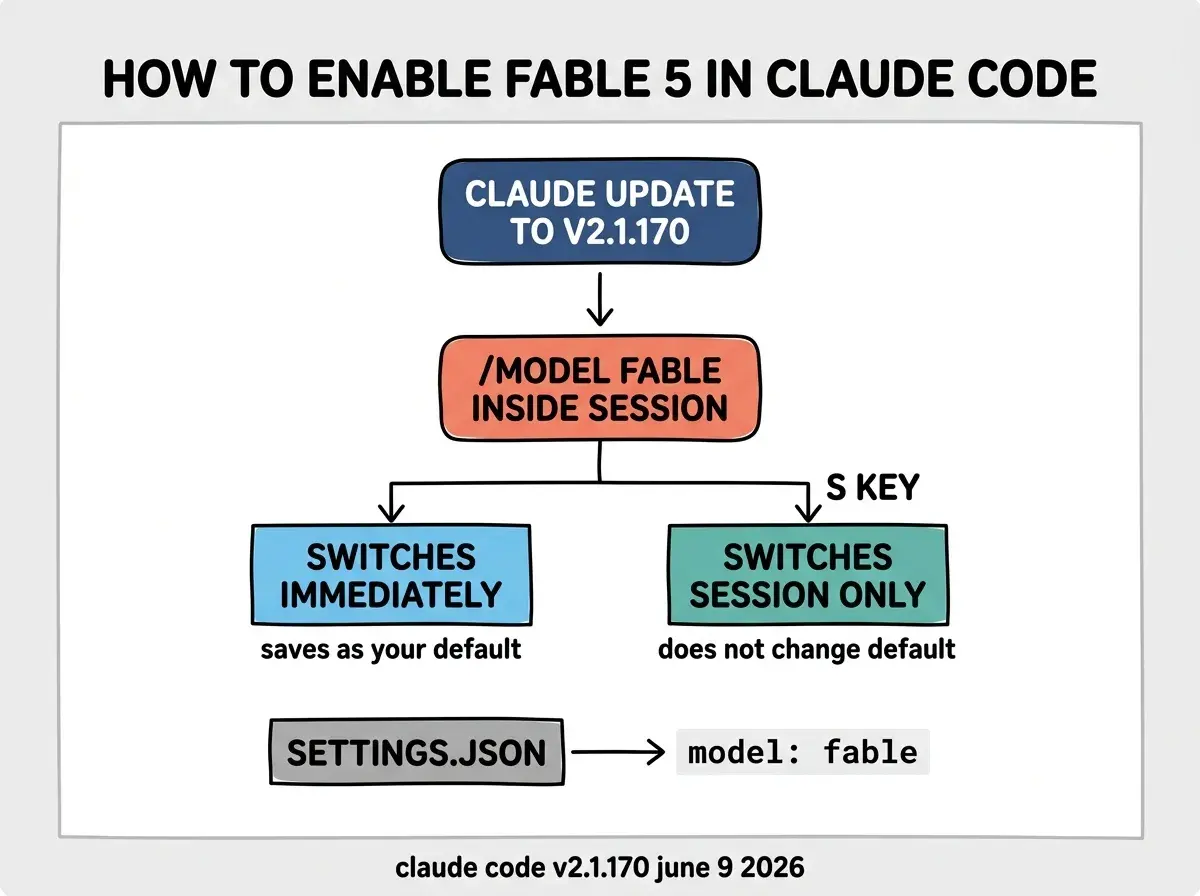
Run claude update to reach v2.1.170 or later, then type /model fable inside any session to switch. The best alias also resolves to Fable 5 if your account has access. Choosing Fable 5 with /model saves it as your default for future sessions until you change it. Through June 22, Fable 5 is included on Pro, Max, Team, and seat-based Enterprise plans with no extra charge. After June 23, it requires usage credits. The model ID for the API is claude-fable-5.
Fable 5 also brings two capability numbers worth tracking: a 1M token context window by default and up to 128k output tokens per request. Both are available on the Anthropic API from launch. On Max, Team, and Enterprise plans, Fable 5 with 1M context is included in the subscription, same as Opus 4.8.
How Do You Enable Fable 5 in Claude Code
Fable 5 requires Claude Code v2.1.170 or later. Older versions do not show it in the model picker and cannot select it. Run claude update to upgrade, then verify with claude --version.
Once updated, there are four ways to use Fable 5:
In-session command. Type /model fable during any session. This switches the model immediately and saves it as your default for future sessions. To switch for the current session only without changing your default, press s in the interactive picker instead of Enter.
At startup. Launch with claude --model fable. This applies to that session only and does not change the stored default.
Environment variable. Set ANTHROPIC_MODEL=fable before launching. This applies to any session launched with that variable and does not override the --model flag.
Settings file. Add "model": "fable" to your ~/.claude/settings.json to make Fable 5 the persistent default for all new sessions.
The best alias is an alternative that resolves to Fable 5 wherever your account has access to it, and falls back to the latest Opus model where it does not. It is useful for teams sharing a settings file across accounts with different plan levels.
The Vibe Coder Blog covers AI coding tool changes focused on what vibecoders need to act on.
Browse All PostsFable 5 is not the default on any account type. The default remains Opus 4.8 for Max, Team Premium, Enterprise pay-as-you-go, and Anthropic API users, and Sonnet 4.6 for Pro, Team Standard, and Enterprise subscription seats. Sessions only run Fable 5 after you explicitly choose it.
What Is Free Until June 22 and What Costs Money After
From June 9 through June 22, Fable 5 is included on Pro, Max, Team, and seat-based Enterprise plans at no extra cost beyond the subscription. On the Claude API and consumption-based Enterprise plans, Fable 5 is fully available from launch at standard usage billing: $10 per million input tokens and $50 per million output tokens.
Starting June 23, Fable 5 is removed from subscription plan coverage. Accessing it after that date requires usage credits on every subscription tier, including Max. The API pricing stays the same: $10/M input and $50/M output.
At $50/M output, Fable 5 is priced at less than half the previous rate for Claude Mythos Preview, which was its restricted predecessor. For vibecoders who previously had no realistic path to Mythos-class capability, this is a meaningful change.
The practical playbook for the next two weeks: if you are on a subscription plan, switch to Fable 5 now and use the free window to test it on your most demanding tasks. Find out whether the 11-point SWE-Bench lead translates into measurable time savings on your actual work before deciding whether to continue at usage credit rates after June 23.
Expecting Fable 5 to work normally on security or biology codebases. Fable 5 runs with safety classifiers that trigger automatic fallback to Opus 4.8 on cybersecurity and biology content. If your repository contains penetration testing tools, CTF challenges, vulnerability scanners, or biology-adjacent code, you may see the session switch to Opus 4.8 on the first request, before you have even sent a prompt, because the classifier reads your workspace context including CLAUDE.md and git status. To check whether your customizations are the trigger rather than your actual code, run claude --safe-mode to start a session without CLAUDE.md or MCP servers loading. If it still falls back, the codebase itself is triggering the classifier.
When Does Automatic Fallback Trigger and What Should You Do
Fable 5 includes safety classifiers for cybersecurity and biology content. When a classifier flags a request, Claude Code automatically re-runs it on Opus 4.8 and shows a notice in the transcript. The session then continues on Opus 4.8. To return to Fable 5 after a fallback, run /model fable again.
By default, fallback is automatic. To review each flagged request before the model switches, open /config and turn off "switch models when a message is flagged." With that setting off, a flagged request pauses with two options: switch to Opus, or edit the prompt and retry on Fable 5.
Fallback can trigger at the very start of a session, before you send any message, because the first request carries workspace context including CLAUDE.md content, git status, and directory structure. A repository with security tooling in its CLAUDE.md or a git history with vulnerability-related commits can trip the classifier on that initial context load. This is expected routing, not an account problem.
For teams doing substantive offensive security work or biology research who need Mythos-class capability, Anthropic's Project Glasswing is the path. Claude Mythos 5 (the same underlying model without the safety classifiers) is available through Glasswing for approved organizations.
What Changed About How Fable 5 Reasons Compared to Opus 4.8
Adaptive thinking is always on in Fable 5. The model decides per step whether and how much to reason before responding, based on task complexity. You cannot turn thinking off on Fable 5. The session toggle, alwaysThinkingEnabled, and MAX_THINKING_TOKENS=0 have no effect. This is different from Opus 4.8, where thinking can be disabled or set to a fixed budget.
The raw chain of thought is never returned. In Opus 4.8, you can see the extended thinking content. In Fable 5, thinking is emitted but the raw content is either omitted (default) or summarized, depending on your thinking.display setting. Set display: "summarized" if you want readable summaries of the reasoning. The thinking blocks are still passed back unchanged in multi-turn conversations for the model to reference.
Effort levels work the same way as on Opus 4.8, from low through max. The default effort for Fable 5 is high, which balances token spend and capability for most coding tasks. Run /effort to adjust, or pass --effort at startup. The ultracode setting (which plans dynamic workflows with xhigh reasoning) is also available on Fable 5 for sessions where you want it to orchestrate parallel subagent work.
What Does This Mean for Your Daily Claude Code Work
The most direct action is updating to v2.1.170 and switching to Fable 5 before June 23 to try it during the free window.
The tasks where the benchmark lead is most likely to show up in practice: root-cause investigations in unfamiliar codebases, long agentic sessions that span multiple files and services, architecture decisions with fuzzy requirements, and debugging failures where the cause is non-obvious from the error output alone. These are the scenarios where the extra investigation and verification that Fable 5 is documented to provide result in fewer correction rounds.
For straightforward tasks like generating boilerplate, writing tests for well-specified functions, or making targeted edits you already understand, Opus 4.8 or Sonnet remain reasonable choices at lower cost.
The pattern that makes sense: use the /effort slider to tune within a model rather than switching models for every task. Fable 5 at medium effort may outperform Opus 4.8 at high effort on many tasks while spending fewer tokens than Fable 5 at high. Test the combination that matches your specific work before the June 23 pricing change takes effect.
The full Fable 5 release notes include capability comparisons and availability details across all deployment platforms including Bedrock, Vertex AI, and Microsoft Foundry.
The Vibe Coder Blog covers AI coding tool changes focused on what builders need to act on.
Read More