To use gamification patterns that engage users in 2026 without feeling cheap, focus on four mechanics that consistently work for genuine engagement (progress visibility that helps users see their own growth, mastery paths that reward skill development, status systems tied to real achievement, and meaningful customization that lets users express identity), avoid the gamification anti-patterns that exploit users (badges for trivial actions, leaderboards that demotivate, daily streaks that punish missing days), and remember that gamification should serve the user's intrinsic motivation rather than replace it. Done well, gamification compounds engagement; done poorly, it trains users to dismiss your product as manipulative.
This piece walks through the four engagement mechanics, the anti-patterns to avoid, the implementation patterns, and the four mistakes designers make when adding gamification to AI-built products.
Why Gamification Often Goes Wrong
Most gamification attempts fail because they apply game mechanics without understanding why games work. Games engage because they offer meaningful challenges that grow user skill; gamification often offers trivial rewards for predetermined actions and produces the opposite effect.
The 2026 reality is that users have grown wary of gamification because so many products have done it badly. Badges for logging in, points for trivial actions, streaks that exploit fear of loss; these patterns are widely recognized as manipulative. Products that gamify well stand out; products that gamify badly damage their reputation.
A 2025 Behavioral Design Research analysis of 200 SaaS products with gamification features found that products with mastery-oriented gamification (progress, skill development, real achievement) had 2.4x higher long-term retention than products with extrinsic-reward gamification (badges, points, streaks). The mechanism was straightforward: mastery patterns aligned with user goals; extrinsic patterns conflicted with user goals. Gamification works when it amplifies what users already want; it fails when it manipulates users into actions they would not otherwise choose.
The pattern to copy is the way martial arts schools structure progression. Belt levels mark genuine skill development; the belt is meaningless without the underlying mastery. Students do not wear belts to feel rewarded; they wear belts because the belts reflect real growth. Software gamification should follow the same principle; the rewards should reflect real value, not produce the value through arbitrary mechanics.
The Four Mechanics That Work
Four gamification mechanics consistently produce real engagement rather than manipulative engagement.
Mechanic 1, progress visibility. Show users their own growth over time. A skill graph, a project portfolio, a track of completed work. Self-comparison drives motivation more reliably than comparison to others.
Mechanic 2, mastery paths. Structured progression toward genuine skill. Tutorial sequences, advanced features unlocked through use, competency tracking. Mastery aligns with user goals.
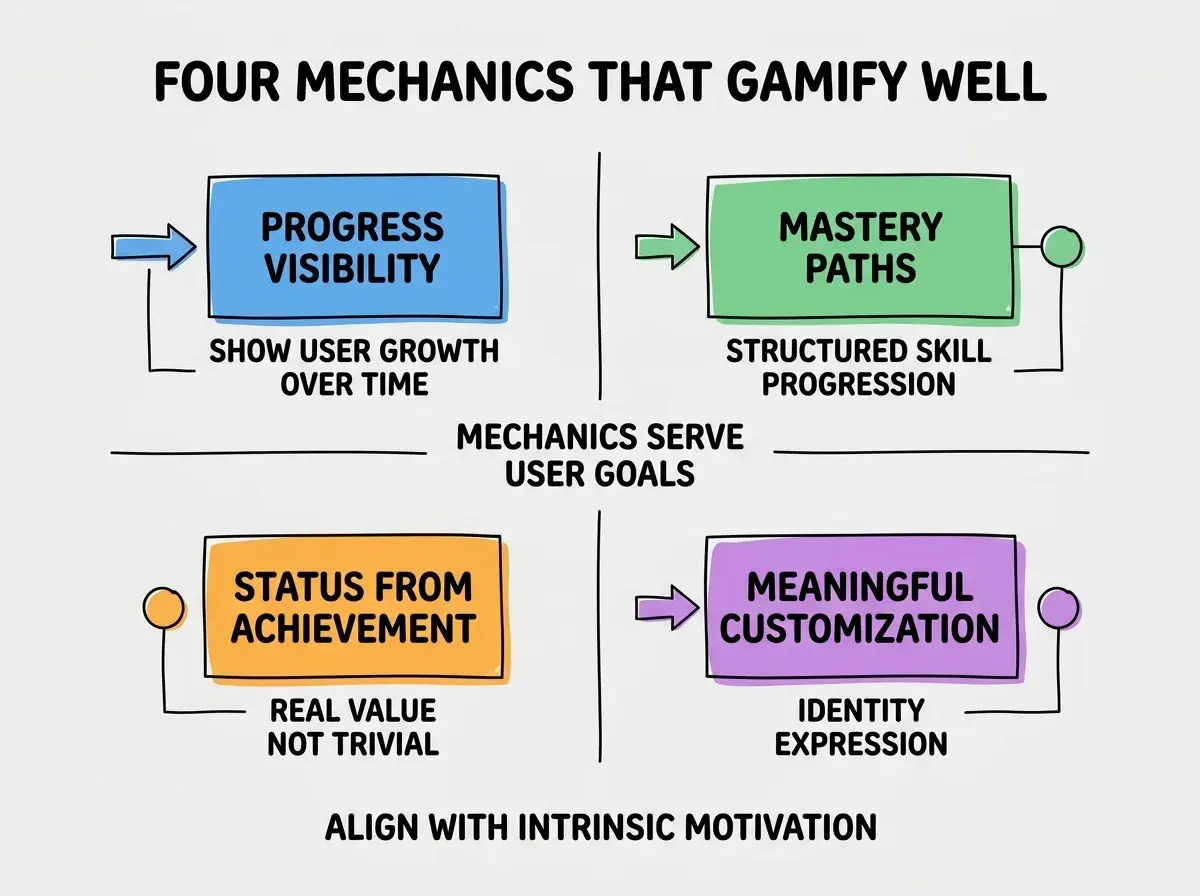
Mechanic 3, status from real achievement. Status indicators tied to genuine accomplishment. A "verified" badge that requires real work to earn; a power-user designation based on actual usage depth.
Mechanic 4, meaningful customization. Identity expression through product appearance or behavior. Custom themes, profile customization, workspace personalization. Customization makes users feel ownership.
The Anti-Patterns to Avoid
Three anti-patterns appear in most failed gamification attempts. Recognizing them prevents the most common mistakes.
Anti-pattern 1, badges for trivial actions. Badges for logging in, completing onboarding, basic actions. Users recognize these as manipulative; the badges damage rather than build engagement.
Browse more product engagement guides
Read more grow articlesAnti-pattern 2, leaderboards that demotivate. Leaderboards motivate the top 10 percent and demotivate the rest. For most products, leaderboards reduce overall engagement rather than increase it. Use sparingly.
Anti-pattern 3, daily streaks that punish missing days. Streaks exploit fear of loss. Users who miss a day feel punished; over time, the punishment generates resentment that exceeds the engagement benefit.
How to Implement Without Falling Into Anti-Patterns
Three implementation patterns help gamify well rather than gamify badly.
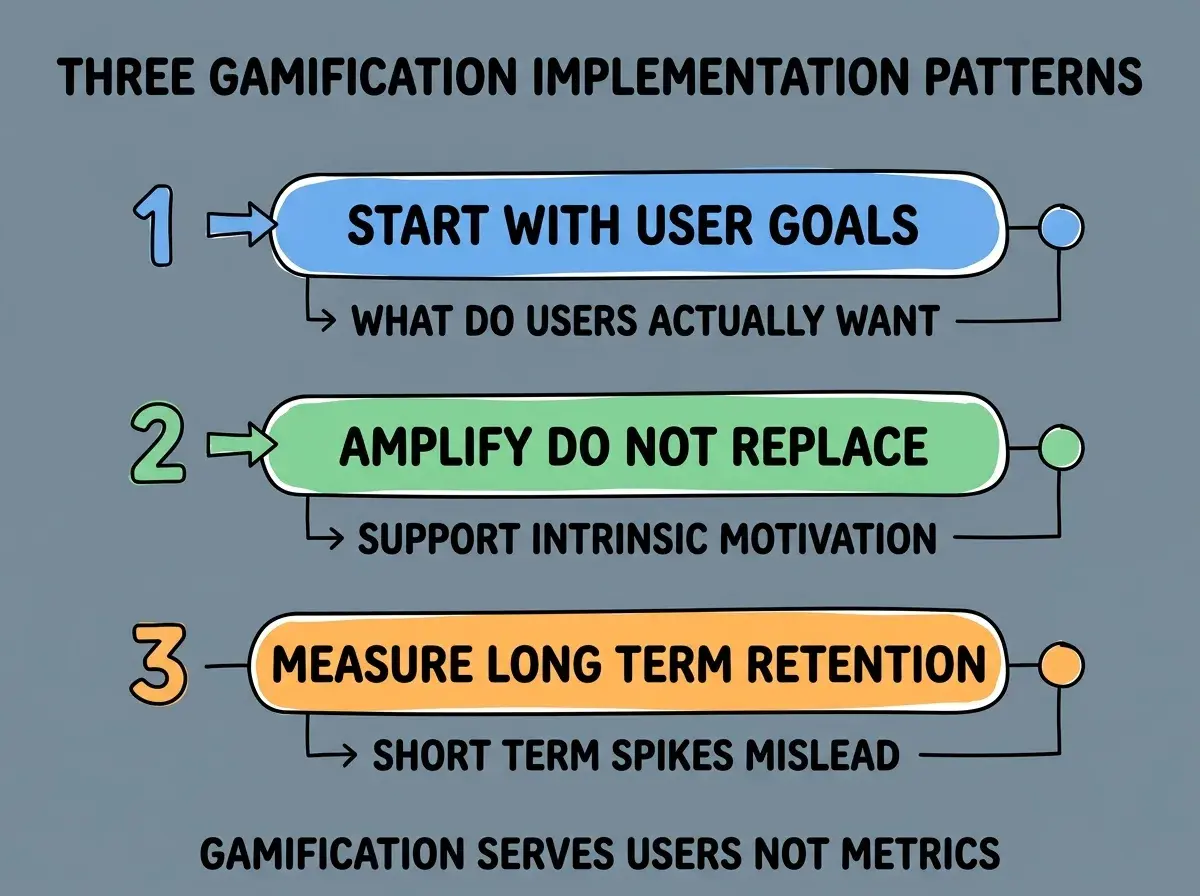
Pattern 1, start with user goals. Identify what users actually want from your product, then design mechanics that help them achieve it. Mechanics divorced from user goals become anti-patterns.
Pattern 2, amplify intrinsic motivation, do not replace it. Users who already want to use your product benefit from mechanics that support their existing motivation. Users who do not want to use your product cannot be sustainably gamified into wanting it.
Pattern 3, measure long-term retention, not short-term engagement. Anti-pattern gamification often spikes short-term engagement (notifications drive logins) while degrading long-term retention. Monitor 90-day retention to catch this pattern early.
How Different Audiences Respond to Gamification
Three audience patterns help calibrate gamification choices to user demographics.
Pattern 1, professional/B2B users often resist obvious gamification. Badges and points in B2B software often feel infantilizing. Subtle progress indicators and mastery paths work better than overt game mechanics.
Pattern 2, consumer users vary widely by category. Fitness apps benefit from competition; mindfulness apps suffer from it. Match mechanics to category norms; what works in one consumer category often fails in another.
Pattern 3, younger audiences accept more gamification than older audiences. Gen Z grew up with gamified apps; older users often perceive the same mechanics as juvenile. Audience research should inform mechanic intensity.
The combination produces gamification that fits the audience rather than imposing one-size mechanics. Without audience awareness, generic gamification fails for specific user bases even when individual mechanics are well-designed.
How to Test Whether Gamification Is Working
Three testing patterns reveal whether your gamification is engaging users or driving them away.
Pattern A, user interviews about how mechanics feel. Ask users about specific gamification elements. Users who perceive mechanics as helpful are engaged; users who feel manipulated are damaged.
Pattern B, track mechanics-related events vs core product events. If badge collection rises while core feature usage falls, gamification is becoming the product instead of supporting it. Mechanics should support core usage, not replace it.
Pattern C, compare retention of users who engage with mechanics vs those who do not. If high-mechanics users have higher retention, mechanics are helping. If retention is similar or worse, mechanics are wasted effort.
The combination produces honest assessment. Without testing, founders assume their gamification works because they like the metrics; the underlying user experience may be quite different.
The most damaging gamification mistake is adding mechanics to a product that has not yet found product-market fit. Founders sometimes use gamification as a substitute for genuine value; the engagement metrics rise temporarily but churn remains high because the underlying product does not solve a real problem. The fix is to focus on product-market fit first, then add gamification only to amplify proven engagement. Products with strong PMF benefit from good gamification; products without PMF cannot be saved by it. Sequencing matters more than mechanics design.
The other mistake is adding too many mechanics simultaneously. Each mechanic competes for user attention; piling on badges, points, streaks, levels, leaderboards produces cognitive overload and user disengagement. The fix is to start with one mechanic that aligns with user goals, validate it works, then add more sparingly. Restraint in gamification design produces better outcomes than comprehensive mechanics.
A third mistake is failing to remove gamification mechanics that test poorly. Some mechanics work in theory but fail in practice for your specific audience. The fix is to A/B test mechanics before broad rollout, then remove ones that do not produce measurable engagement lift. Holding onto unsuccessful mechanics adds visual clutter without delivering value.
What This Means For You
Gamification is real engagement lever when used well in 2026. The four mechanics, anti-patterns, and implementation patterns produce engagement that compounds rather than depleting user goodwill.
- If you're a founder: Add gamification only after product-market fit. Premature gamification masks PMF problems rather than solving them.
- If you're changing careers into product or design: Gamification design is increasingly expected for senior product roles. Study both successful and failed gamification publicly.
- If you're a student: Study how successful products like Duolingo, Headspace, and Strava use gamification. The patterns generalize across product categories.
Browse more user engagement design guides
Read more grow articles