The agentic engineering future is not some far-off science fiction scenario. It is happening right now, messily and unevenly, and most developers are still trying to figure out where they stand in it. 92% of developers use AI daily, 25% of Y Combinator's Winter 2025 batch had codebases that were 95% or more AI-generated, and Andrej Karpathy coined "agentic engineering" as a new discipline. The shift is real. But what does it actually mean for how you work?
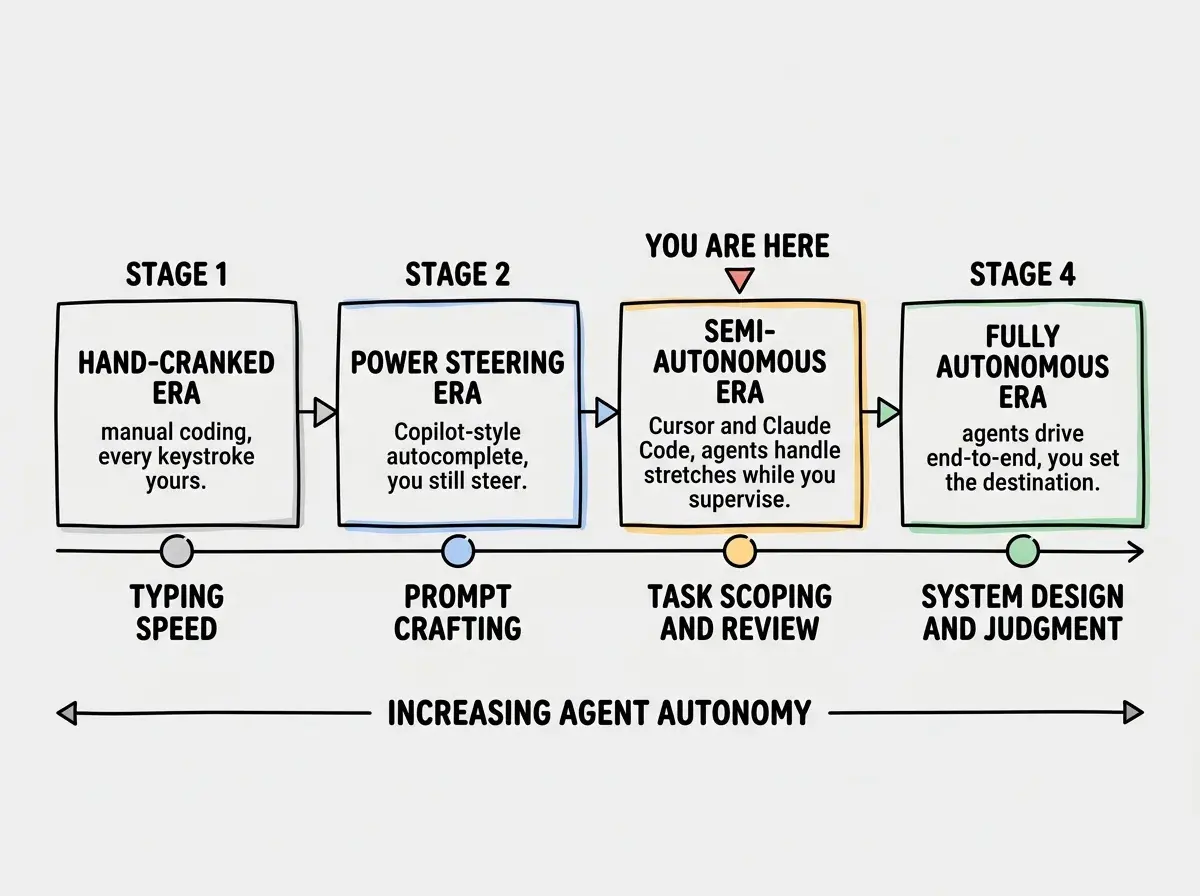
Think of it like the evolution of automobiles. We started with hand-cranked cars where you did everything manually, every line of code typed character by character. Then came power steering, tools like GitHub Copilot that reduced the effort but still required you to steer every decision. Now we are in the semi-autonomous phase, where tools like Cursor and Claude Code can navigate stretches of road on their own while you supervise. And on the horizon sit fully autonomous agents like Devin and whatever comes next, vehicles that can drive themselves from point A to point B while you set the destination.
Each stage of this evolution did not eliminate the driver. It changed what the driver needed to be good at. That is the real story of agentic engineering, and it is the one most people miss when they argue about whether AI will replace developers.
Where We Are Right Now
We are solidly in the semi-autonomous phase. Today's agentic tools can take a well-scoped task, break it down, write the code, run it, debug failures, and iterate until it works. Claude Code can handle multi-file refactors, build features from descriptions, and fix bugs by reading error logs. Cursor's agent mode can navigate a codebase, make coordinated changes across files, and verify its own work.
But here is the thing. These tools still need a human in the driver's seat for anything non-trivial. They are excellent at executing clearly defined tasks and genuinely bad at deciding which tasks matter. They can build what you describe but cannot tell you whether what you described is the right thing to build. The semi-autonomous car handles highway driving beautifully, but it needs you for the navigation decisions, the judgment calls at confusing intersections, and the moment when road conditions change unexpectedly.
This is where most teams sit today. Developers pair with AI agents on implementation while retaining ownership of architecture, prioritization, and quality standards. It works remarkably well when you treat the agent as a capable junior engineer who needs clear direction. It falls apart when you expect it to be a senior engineer who understands your system's history and tradeoffs.
What Is Emerging on the Horizon
Three patterns are forming that will define the next phase of the agentic engineering future. They are not theoretical. Early adopters are using them today, and they will become mainstream within the next year or two.
Multi-agent workflows are the first big shift. Instead of one developer pairing with one agent, you will orchestrate multiple agents working in parallel. One agent handles the backend API, another builds the frontend components, a third writes tests, and a fourth reviews the output of the other three. This is not hand-cranking anymore. This is managing a fleet of semi-autonomous vehicles, each handling its own lane while you coordinate traffic.
Spec-driven development is emerging as the natural interface between humans and agents. Rather than writing code or even detailed prompts, developers write specifications. Type definitions, API contracts, behavior descriptions, acceptance criteria. The spec becomes the steering wheel. You describe what the system should do at a high level, and agents figure out how to build it. The better your spec, the better the output. This is a fundamental change in what "writing code" means.
Continuous agent integration is the third pattern. Agents that do not just respond to requests but continuously monitor, suggest, and improve. Think of agents that watch your CI pipeline, automatically fix failing tests, propose refactors when they detect code smells, or update dependencies and verify nothing breaks. The car is not just driving itself on command. It is doing its own maintenance between trips.
The agentic engineering future is not about replacing developers with agents. It is about shifting developer work from implementation to specification, review, and system design. The developers who thrive will be the ones who learn to write excellent specs and evaluate agent output critically, not the ones who type the fastest.
What Changes for Developers
The transition from semi-autonomous to increasingly autonomous agents changes the developer's job description in concrete ways. Some skills become less valuable. Others become dramatically more important.
Code reading becomes more important than code writing. When agents produce most of the raw code, your value shifts to understanding what they produced, catching subtle bugs, identifying architectural drift, and recognizing when a technically correct solution is the wrong abstraction. The driver of a semi-autonomous car spends less time steering and more time watching the road. You will spend less time typing and more time reviewing.
System design becomes the primary skill. Agents can implement a feature, but they cannot tell you whether that feature should be a microservice or a module within your monolith. They cannot weigh your team's operational capacity against the complexity of a distributed architecture. The high-level decisions that shape a system's long-term health remain firmly human territory, and they become more important as agents make it easier to build the wrong thing quickly.
Communication and specification skills matter more than ever. The developers who struggle with agents are almost always the ones who cannot clearly articulate what they want. Vague requirements produce vague code. If you cannot explain a feature's behavior precisely enough for a human junior developer to build it, you cannot explain it precisely enough for an agent either. The skill of translating business needs into unambiguous technical specifications has always been valuable. In the agentic era, it becomes your primary output.
Debugging shifts from "find the typo" to "find the design flaw." Agents rarely make syntax errors. They do make subtle logical errors, miss edge cases, and produce code that works in isolation but fails in integration. Your debugging becomes more about understanding system behavior and less about scanning for missing semicolons. The problems get harder, but they were always the problems that mattered most.
What Stays the Same
Here is the grounding perspective that gets lost in the hype. The fundamentals of software engineering do not change just because the implementation layer is increasingly automated.
Users still need software that solves real problems. Products still need to be maintainable, testable, and operable. Systems still need to handle failure gracefully. Security still matters. Performance still matters. The boring stuff, logging, monitoring, error handling, deployment pipelines, all of it still needs someone who understands why it matters and can verify it works.
The automobile analogy holds here too. Self-driving cars still need roads, traffic laws, maintenance schedules, and insurance. Automating the driving did not automate the infrastructure around it. Similarly, automating code generation does not automate the infrastructure of software delivery. CI/CD pipelines, observability, incident response, capacity planning, these remain human-driven disciplines that agents support but do not replace.
Assuming that because agents can write code quickly, you can skip architecture planning and design reviews. Speed of implementation without direction just means you build the wrong thing faster. Agents amplify whatever process you give them, good or bad. If your development process was sloppy before agents, agents will produce sloppy output at higher volume.
Honest Predictions for the Next Two Years
Prediction is humbling work, especially in a field moving this fast. But here is what the trajectory suggests, grounded in what we can observe today rather than what we hope for.
Agents will get dramatically better at bounded tasks. Within a well-defined codebase, with clear types and good documentation, agents will handle increasingly complex features end-to-end. The semi-autonomous car will handle city driving, not just highways. But "bounded" is the key word. Open-ended, ambiguous work will still require human judgment.
Multi-agent orchestration will become a standard practice, not a novelty. Just as CI/CD went from cutting-edge to table-stakes, coordinating multiple agents on a project will become a normal part of the development workflow. Tooling will mature to make this less manual than it is today.
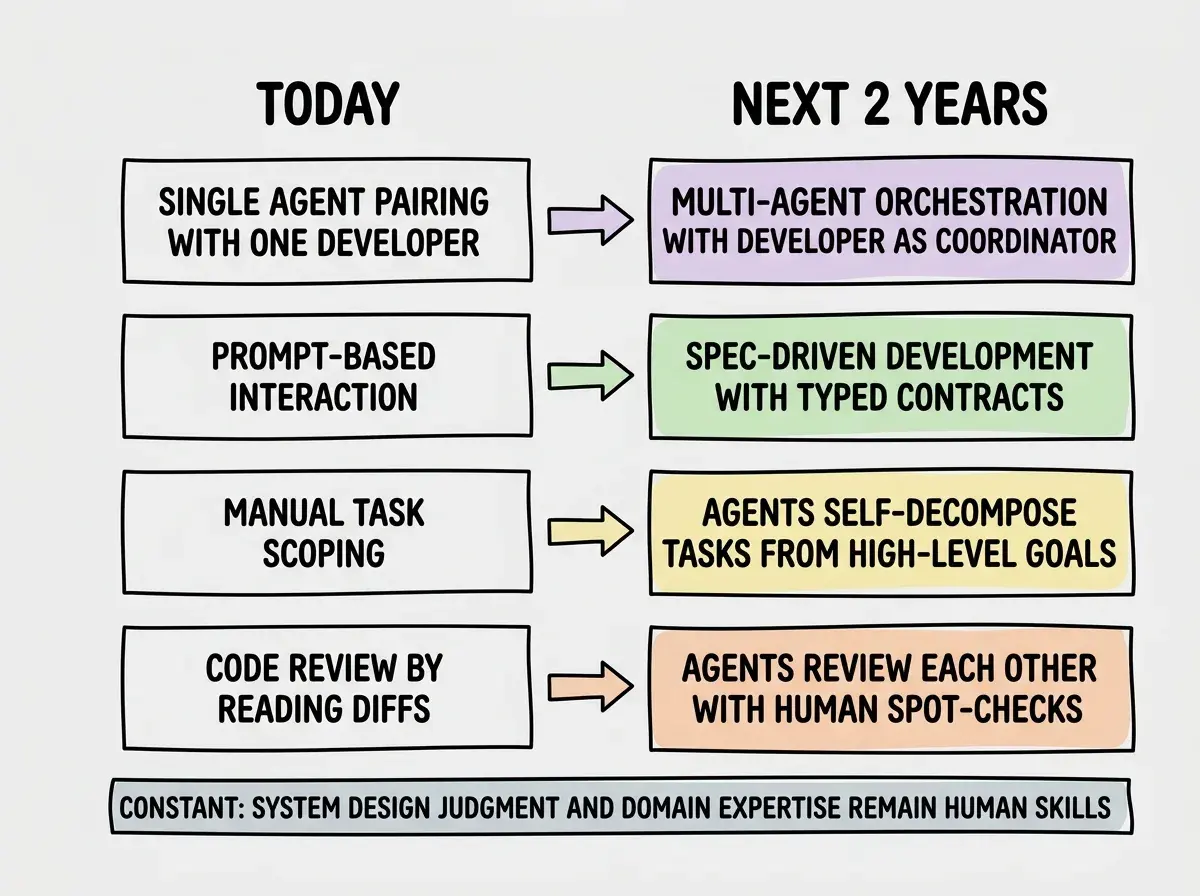
The developer role will not disappear, but it will bifurcate. Some developers will specialize in agent-augmented product engineering, building software faster than ever by coordinating agents effectively. Others will specialize in the systems that agents run on, the infrastructure, tooling, and evaluation layers. Both paths are valuable. Neither is optional.
The biggest bottleneck will shift from writing code to validating correctness. When agents can produce ten implementations in the time it takes to write one manually, the limiting factor becomes evaluating which implementation is right. Testing, type checking, formal verification, and other correctness tools will become the most important part of the development stack.
The hand-cranked car evolved into something its inventors would barely recognize, but we still need people who understand where they are going and why. The same is true for software engineering. The agentic engineering future is not about needing fewer developers. It is about needing developers who operate at a higher level of abstraction, people who can think clearly about systems, communicate precisely about requirements, and judge quality in ways that machines are still learning to approximate.
The drivers who thrived in each era of automotive evolution were not the ones who resisted the new technology. They were the ones who learned what the new technology was actually good at and adjusted their skills accordingly. That is the playbook.
Explore practical guides on working with AI coding agents and building modern software.
Browse articlesThe question is not whether agents will change how you work. They already have. The question is whether you are adjusting your skillset to match, learning to be the kind of developer who makes autonomous systems better rather than competing with them on raw output. The semi-autonomous era rewards different skills than the hand-cranked era did. And the fully autonomous era, when it arrives, will reward different skills again.
Start learning to write better specs. Get comfortable reviewing code you did not write. Practice articulating architectural decisions in plain language. These are the skills that compound in the agentic future, regardless of which specific tools win or lose.
See how experienced developers are adapting their workflows for the agentic era.
Read more