Emerging job titles like AI-First Developer, Product Engineer, and Agentic Engineer have appeared on hundreds of company job boards in the last 18 months, and most candidates are still confused about what each one actually means. The titles are not just rebranding. They reflect real shifts in how companies organize engineering work in the AI era, and each one comes with different responsibilities, different compensation bands, and different career trajectories. Understanding the differences is what lets you target the right role for your skill set.
This piece walks through the four most common emerging titles, what each one really means, who is hiring for them, and how to position your background to land one.
Why New Titles Emerged
The traditional engineering titles (Software Engineer, Senior Engineer, Staff Engineer) were stable for two decades because the work was stable. AI tools changed the work in specific ways, and the new titles reflect specific aspects of that change. Some companies adopted the new titles to signal modernity in hiring posts, but the substantive ones reflect actual job differences.
The pattern of new title creation usually follows a predictable arc. A small set of frontier companies invents a title to describe a real role they need filled. Recruiters and job boards pick it up. Within 18 months, the title appears on hundreds of postings, but the substance varies wildly across companies. Knowing whether a posting uses the title literally or as a marketing veneer is the candidate's first job.
A 2025 LinkedIn data analysis found that the term "AI-First Developer" appeared in 40,000 job postings, up from fewer than 200 in 2023. Of those, roughly 60% described meaningfully different work than traditional Software Engineer postings, and 40% were rebranded versions of the same role with different keywords for SEO.
The pattern to copy is the way "DevOps Engineer" emerged in the early 2010s. The title was new, the role was real, but for several years some companies posted the title for what was essentially a system administrator role. Candidates who knew the difference targeted the postings that matched the genuine new work, while others ended up in mislabeled jobs.
The Four Emerging Titles
Four titles dominate the new landscape. Each one has a distinct definition, a distinct skill profile, and a distinct trajectory.
AI-First Developer. A software engineer who uses AI tools as the primary code generation method, with strong skills in prompt engineering, code review, and AI-assisted debugging. The role is engineering, but the workflow is fundamentally different from a 2020-era engineer. Compensation is similar to senior software engineer ranges (200k to 400k+ in major US markets).
Product Engineer. A software engineer who owns product outcomes end-to-end, including user research, design contributions, and measurable business metrics. AI tools enable product engineers to ship features faster than traditional teams, which is why this role has expanded. The trajectory is into senior product or engineering leadership.
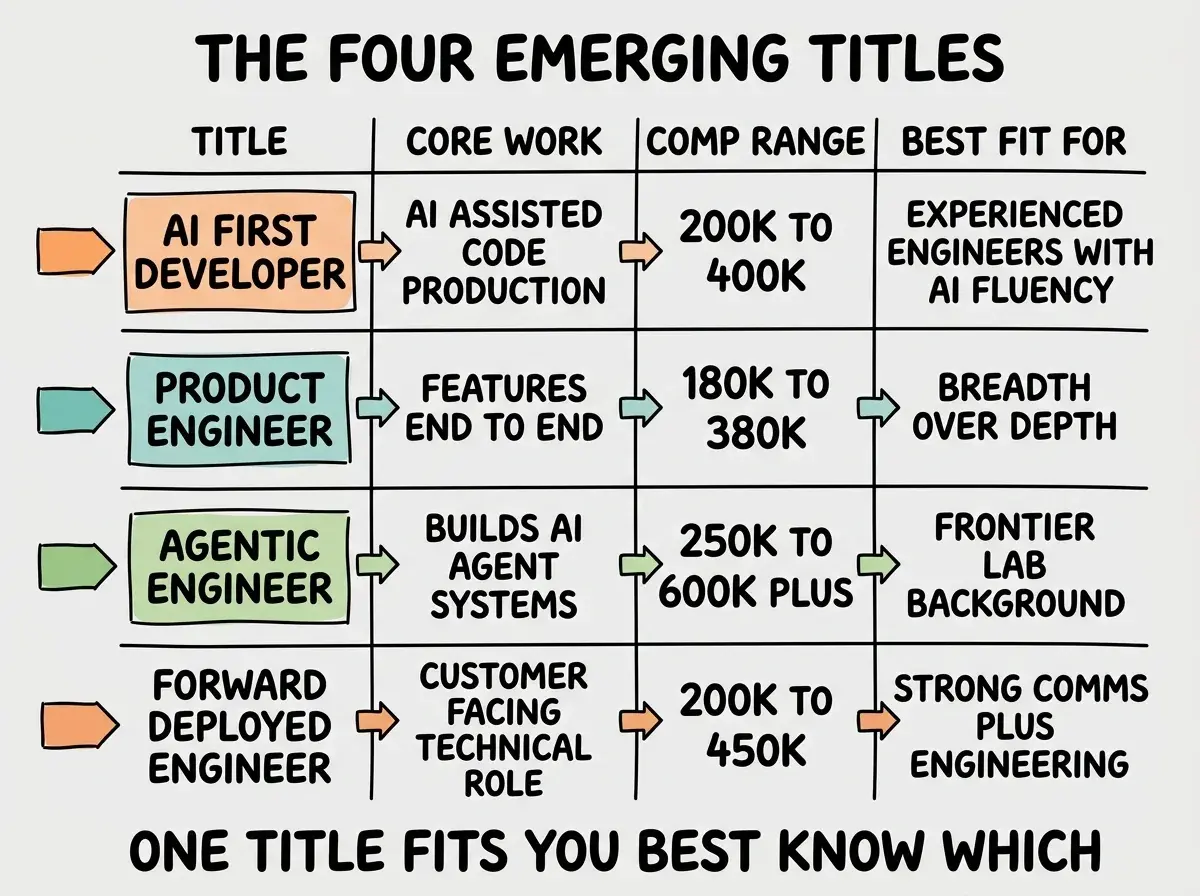
Agentic Engineer. A software engineer who designs and builds systems where AI agents take meaningful autonomous action, with appropriate evaluation, safety, and human oversight layers. This role is the most technically distinct of the four, requiring skills that did not exist three years ago. Compensation is the highest of the group, often 250k to 600k+ at frontier companies.
Forward Deployed Engineer. A customer-facing engineer who works on-site with enterprise customers to integrate AI products. The role combines strong engineering skills with consultative selling and customer success. Compensation is similar to senior engineering, often with significant variable components tied to customer outcomes.
What Each Role Actually Demands
The skills required for each title diverge in specific, predictable ways. Knowing the divergence is what lets you target the right role.
AI-First Developer demands depth in one stack, prompt engineering at the level of advanced patterns (chain-of-thought, few-shot, agent orchestration), code review judgment, and architecture skills. The interview tends to focus on a real take-home project where you build something with AI assistance, with the interviewer watching how you prompt and iterate.
Product Engineer demands the same engineering core plus product analytics (Mixpanel, Posthog), user interview skill, copywriting, and an instinct for what to ship. The interview tends to focus on case studies, "tell me about a feature you owned end-to-end."
Read more career guides for vibe coders
Browse foundations articlesAgentic Engineer demands the engineering core plus deep prompt engineering, evaluation framework design, agent architecture patterns, and safety thinking. The interview is often a system design exercise focused on a multi-agent system, and many companies have a take-home that requires building a small autonomous agent.
Forward Deployed Engineer demands strong engineering plus excellent communication, comfort presenting to executives, and the patience for long sales cycles. The interview heavily emphasizes scenario questions and customer simulation exercises.
How to Position Your Background
Almost every candidate has experience that maps to one of the four titles, even if their resume currently does not say so. The work of positioning is matching what you have done to the language each role uses.
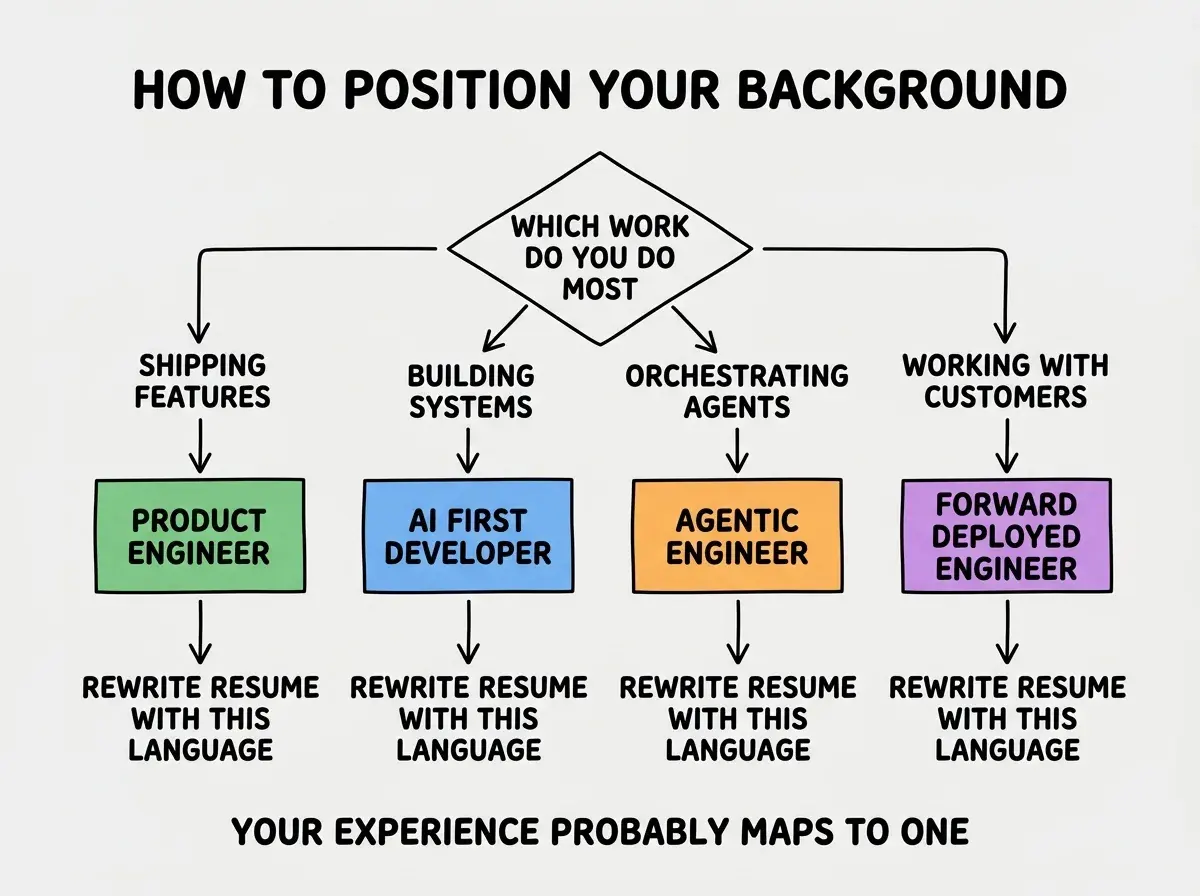
If you ship features end-to-end and care about user outcomes, position as Product Engineer even if your title says Software Engineer. If you spend most days using Claude Code or Cursor and reviewing AI-generated code, position as AI-First Developer. If you have built any kind of automated multi-step system with LLMs, position as Agentic Engineer. If you have worked closely with customers as the technical contact, position as Forward Deployed Engineer.
The most expensive emerging-title mistake is applying to all four with the same generic resume. Each role looks for different keywords, different examples, and different framing. Sending the same resume to all four reduces your hit rate at every single one. Pick the best fit, customize the resume to that title, then iterate if it does not work.
The corollary is that switching titles costs effort but is doable. A Product Engineer can move toward AI-First Developer over 6 to 12 months by changing what they spend their time on. The market values fluency in the new titles, and the doors open quickly once your resume reflects the work.
The other thing worth knowing is that some companies use multiple of these titles internally with different leveling, while others collapse them into one role with multiple expectations. Asking in the interview "how does this title differ from a regular Software Engineer here" is a strong signal of candidate sophistication and reveals which kind of company you are talking to. The answer tells you whether the role is genuinely new or whether the title is decorative.
What This Means For You
The new job titles are not marketing fluff, they reflect real shifts in how companies organize engineering work. Knowing the differences and positioning thoughtfully is one of the highest-leverage career investments you can make in 2026.
- If you're a founder: When you write job postings, pick a title carefully. Calling everyone an "Engineer" obscures the work. The right title attracts the right candidates.
- If you're changing careers: The new titles often have lower seniority requirements than traditional Software Engineer roles, because the supply is small and demand is growing fast.
- If you're a student: Use one of the four titles in your portfolio framing rather than "Junior Developer." The framing alone changes which postings feel approachable.
Browse more career and hiring guides for the AI era
Read more foundations