To use documentation driven development effectively with AI, follow the four DDD patterns (write specification documentation before implementation, generate implementation from specifications using AI, validate implementation matches specification through tests, and maintain documentation as primary source of truth), recognize what makes documentation drive better AI generation than ad hoc prompting, and apply the patterns that produce sustained DDD practice. The DDD with AI capability matters because AI generates better code from clear specifications than from ambiguous prompts.
This piece walks through the four DDD patterns, what makes DDD work with AI, the specific tooling, and the four mistakes when applying DDD to AI development.
Why DDD With AI Matters
DDD with AI matters because clear specifications produce better AI output. The matter; ambiguous prompts produce ambiguous code while clear specifications produce focused code.
The 2026 reality is that DDD has historically faced adoption resistance due to upfront documentation cost. AI accelerates implementation enough to make DDD practical for more contexts.
A 2025 software engineering study comparing DDD with AI versus ad hoc AI development found that DDD plus AI produced 47 percent fewer scope iterations and 67 percent better feature completeness. DDD provides specification framework AI generation needs.
The pattern to copy is the way architects work from blueprints. Architects specify before building; specifications guide construction. AI development with DDD follows similar pattern; specifications guide AI generation.
The Four DDD Pattern Approach
Four patterns produce effective DDD with AI.
Pattern 1, write specification documentation before implementation. Behavior, constraints, examples. Specification guides generation.
Pattern 2, generate implementation from specifications using AI. AI implements what specification describes. AI handles execution.
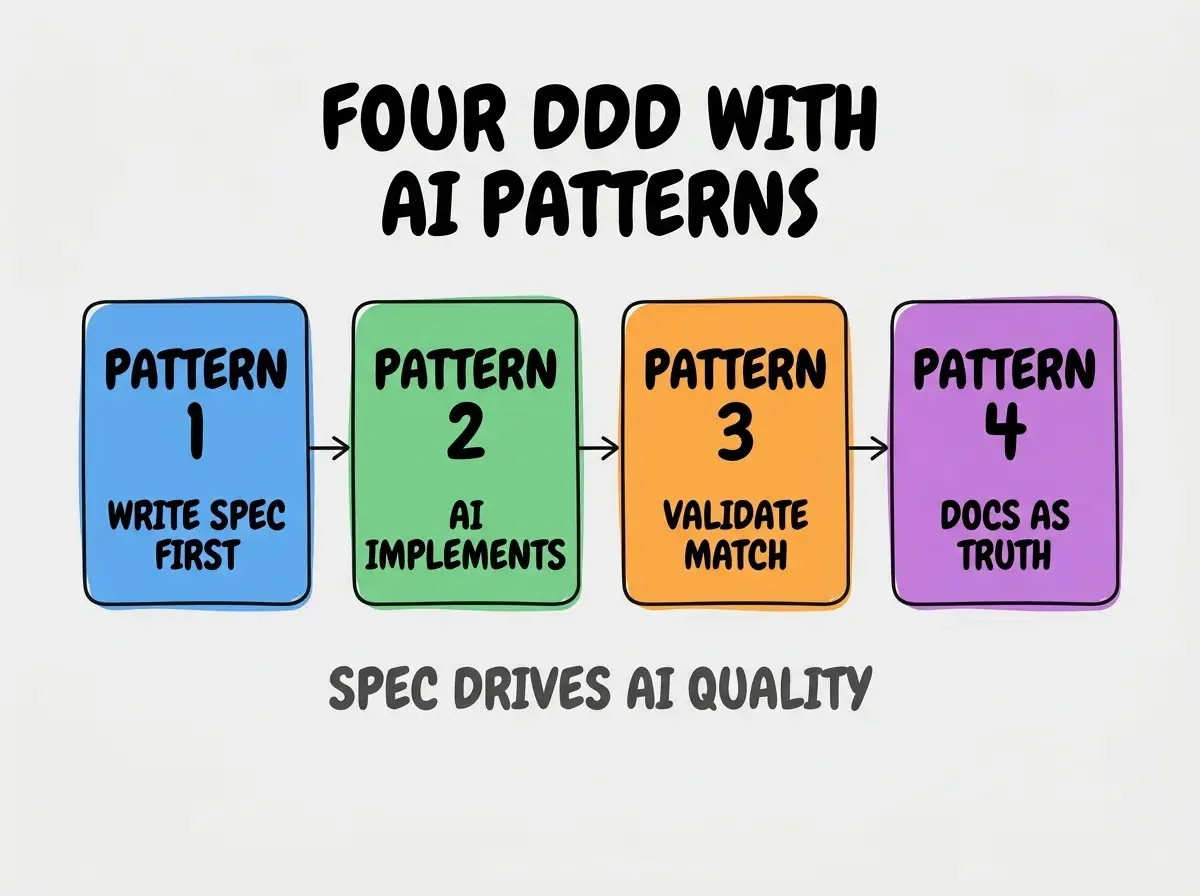
Pattern 3, validate implementation matches specification. Tests verify behavior matches docs. Validation catches drift.
Pattern 4, maintain documentation as primary source of truth. Doc updates precede code updates. Truth in docs not code.
What Makes DDD Work With AI
Three patterns characterize successful DDD with AI.
Pattern 1, specifications detailed enough for unambiguous implementation. Detail matters; vague specs produce vague code. Without detail, AI guesses.
Browse more tools articles
Read more toolsPattern 2, examples in specifications guiding generation. Examples reduce ambiguity. Examples often clearer than description alone.
Pattern 3, specification updates triggering implementation updates. Spec changes drive code changes. Without trigger, drift accumulates.
The Specific Tooling That Works
Three tool categories combine effectively for DDD with AI.
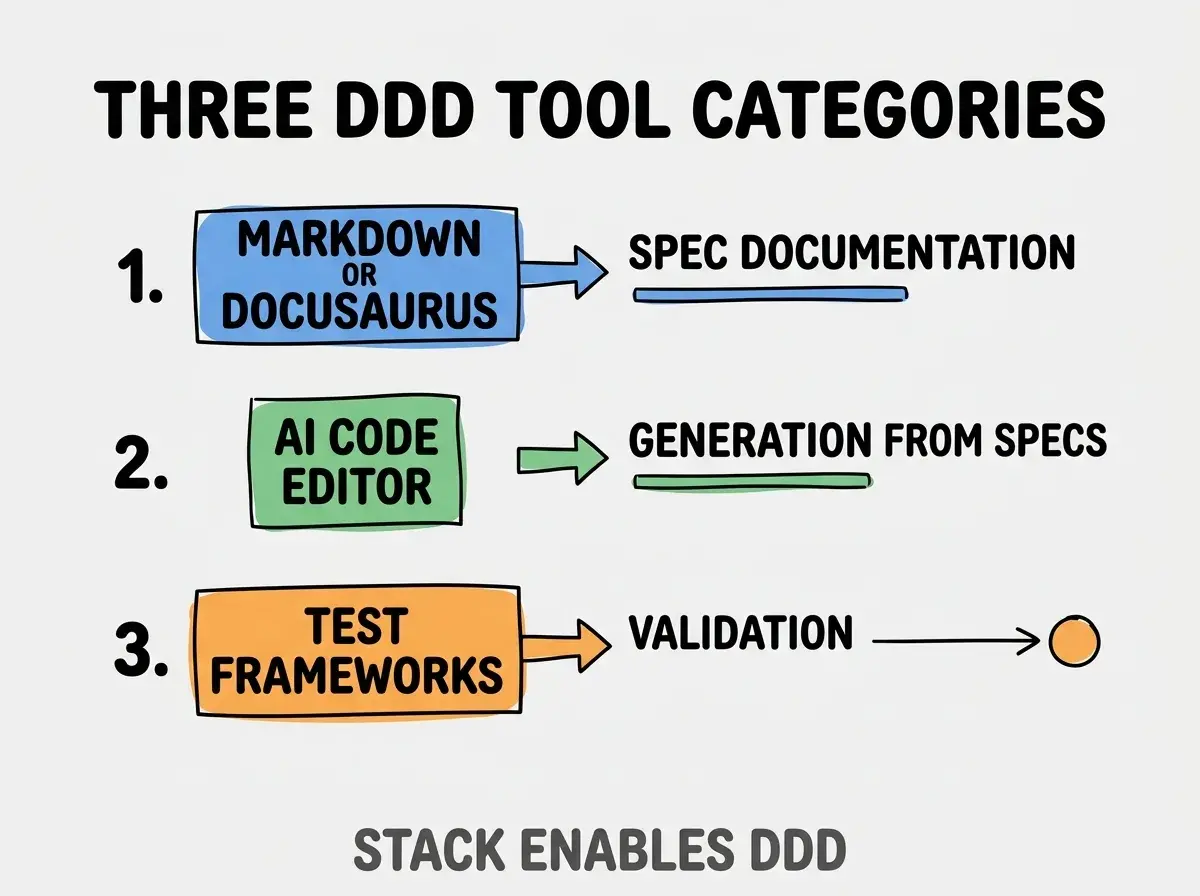
Tool 1, Markdown or Docusaurus for specification documentation. Plain text formats AI processes well. Markdown preferred for AI consumption.
Tool 2, AI code editor for generation from specs. Cursor, Windsurf, Copilot. Editor integrates specs with generation.
Tool 3, test frameworks for validation. Jest, Vitest, language specific frameworks. Tests verify spec compliance.
What Makes DDD With AI Sustainable
Three patterns separate sustainable DDD from problematic patterns.
Pattern 1, specification quality maintained over time. Specs evolve with feature understanding. Without maintenance, specs drift.
Pattern 2, AI assisted spec generation reducing burden. AI helps write specs from rough requirements. Without AI assistance, spec writing burden caps DDD.
Pattern 3, team alignment on DDD as workflow. Team consistency required for DDD success. Without alignment, mixed practices produce confusion.
The combination produces DDD with AI that compounds over time. Without these patterns, DDD plateaus or abandons.
How To Adopt DDD With AI Incrementally
Three adoption patterns help teams adopt DDD with AI.
Pattern A, start with single feature pilot. One feature validates approach. Without pilot, broad adoption faces resistance.
Pattern B, develop spec template for team consistency. Templates reduce decision burden. Without templates, specs vary.
Pattern C, measure impact through quality and velocity metrics. Both metrics needed. Without measurement, value claims stay anecdotal.
The combination produces successful DDD adoption. Without patterns, adoption often stalls.
The most damaging DDD with AI mistake is treating documentation as optional for small features. Small features benefit from DDD because AI needs specification to generate well; without specification, AI guesses small feature intent. The fix is to apply DDD proportionally; smaller features get smaller specs while larger features get larger specs. Teams applying DDD proportionally produce better outcomes than teams applying DDD only to large features.
The other mistake is missing specification updates when implementation changes. Drift between spec and code defeats DDD purpose.
A third mistake is treating AI generated specs as authoritative without review. AI generated specs need review for accuracy.
A fourth mistake is over specifying internal implementation details. Specs should focus on behavior; implementation details belong in code comments.
How To Write Specifications That AI Implements Well
Three writing patterns produce specifications that drive good AI implementation.
Pattern A, behavior focused specifications. What code should do, not how. Behavior matters for AI generation.
Pattern B, explicit edge case coverage. Specify edge cases in spec. AI implements specified edge cases.
Pattern C, examples alongside descriptions. Examples reduce ambiguity. AI implements examples accurately.
The combination produces specifications that AI implements well. Without writing patterns, specs produce inconsistent AI output.
How DDD With AI Will Likely Evolve
DDD with AI will likely continue evolving as AI capabilities mature.
The first likely evolution is AI tools developing native spec support. Tools that understand spec format integrate with generation. Native support reduces friction.
The second likely evolution is bidirectional spec generation. Code generates specs and specs generate code. Bidirectional enables drift detection.
The third likely evolution is collaborative spec authoring. Multiple stakeholders contribute to specs. Collaboration improves spec quality.
The combination suggests DDD with AI will become more accessible. Engineers learning patterns now build skills that remain valuable.
Common Questions About DDD With AI
DDD with AI raises questions worth addressing directly.
The first question is whether DDD slows initial development. Yes initially; pays back through reduced rework. Net velocity higher with DDD.
The second question is whether DDD works for legacy code. Yes; specs added to legacy code improves modification velocity.
The third question is whether to maintain specs after launch. Yes; specs guide future modifications and onboarding.
The fourth question is whether DDD scales to large teams. Yes with team conventions; without conventions, spec inconsistency emerges.
How DDD With AI Affects Team Velocity
DDD with AI affects team velocity beyond individual productivity. Team effects compound over time.
The first compounding effect is onboarding speed. New team members learn from specs faster than from code alone. Speed compounds.
The second compounding effect is collaborative iteration. Multiple stakeholders iterate on specs more easily than on code. Iteration improves quality.
The third compounding effect is institutional knowledge preservation. Specs preserve knowledge code alone cannot. Preservation matters for team turnover.
DDD investment pays back through team velocity that ad hoc development cannot match over time.
Teams adopting DDD with AI build practice that scales with team growth and AI capability evolution. Scaling matters as both team and AI continue evolving.
The combination of clear specifications and AI generation produces development velocity that pure prompt based AI usage cannot match over time. Specification quality matters as much as AI tool quality.
What This Means For You
DDD with AI produces better quality and velocity than ad hoc AI development. The four patterns, tool combinations, and adoption approaches produce framework for sustainable DDD practice.
- If you're a senior dev: DDD with AI changes generation quality dramatically. Invest in DDD; outcomes improve substantially.
- If you're a product manager: DDD aligns with PM workflow naturally. PMs often have spec writing skills that DDD requires.
- If you're a founder: Help engineering team adopt DDD with AI. Adoption produces quality improvements that compound.
Browse more tools articles
Read more tools