A 12-person digital agency tripled their client output in 2025 by adopting AI workflows across their delivery process: AI-assisted code generation in development, AI-powered copy iteration in content creation, automated client intake replacing custom kickoff calls, and AI-summarized status updates replacing manual weekly reports. The 3x output gain came with stable team size, modestly higher margins, and dramatically higher client satisfaction scores. The patterns are replicable at most agencies willing to invest in workflow restructuring.
This piece walks through the agency's four workflow changes, the metrics that proved the gains, the cultural shifts that enabled the transformation, and the four mistakes that prevent most agencies from achieving similar results.
Why This Case Study Matters for the Industry
Most agency AI adoption stories are vague: "we use AI" or "AI saved us time." This case study is specific: a real 12-person agency in a competitive market more than tripled their delivered project count over 12 months while keeping team size constant. The numbers are large enough to be meaningful and small enough to be replicable.
The agency was a typical mid-market shop in early 2024: doing 20 to 25 client projects per year, struggling with margins, often missing deadlines. By late 2025 they were doing 70+ projects per year with the same team, hitting deadlines consistently, and showing improved margins despite increased volume.
The agency's tracking showed that the 3x output gain decomposed roughly as: 40 percent from faster development (AI-assisted coding), 30 percent from faster content creation (AI-powered copy), 20 percent from reduced operational overhead (automation), and 10 percent from better client experience driving fewer revisions. No single change produced the gain; the combination did. Single-tool AI adoption typically produces 1.2x to 1.5x gains; systematic workflow restructuring produces multipliers.
The pattern to copy is the way restaurant chains scaled output during the 1980s with the systematic introduction of standardized operations. Each restaurant did not work harder; they restructured the operation around the new tools. The agencies that will dominate the next five years are the ones doing the equivalent restructuring with AI.
The Four Workflow Changes
The agency made four specific workflow changes. Each was substantial; together they produced the 3x output multiplier.
Change 1, AI-assisted code generation. Developers used Cursor, Claude Code, and similar tools for daily work. Coding output approximately doubled per developer-hour. Code quality remained stable based on review metrics.
Change 2, AI-powered copy iteration. Copywriters used AI for first drafts and variation generation. Copy turnaround time dropped from 3 days to same-day. Client revision rates dropped because more variations were tested upfront.
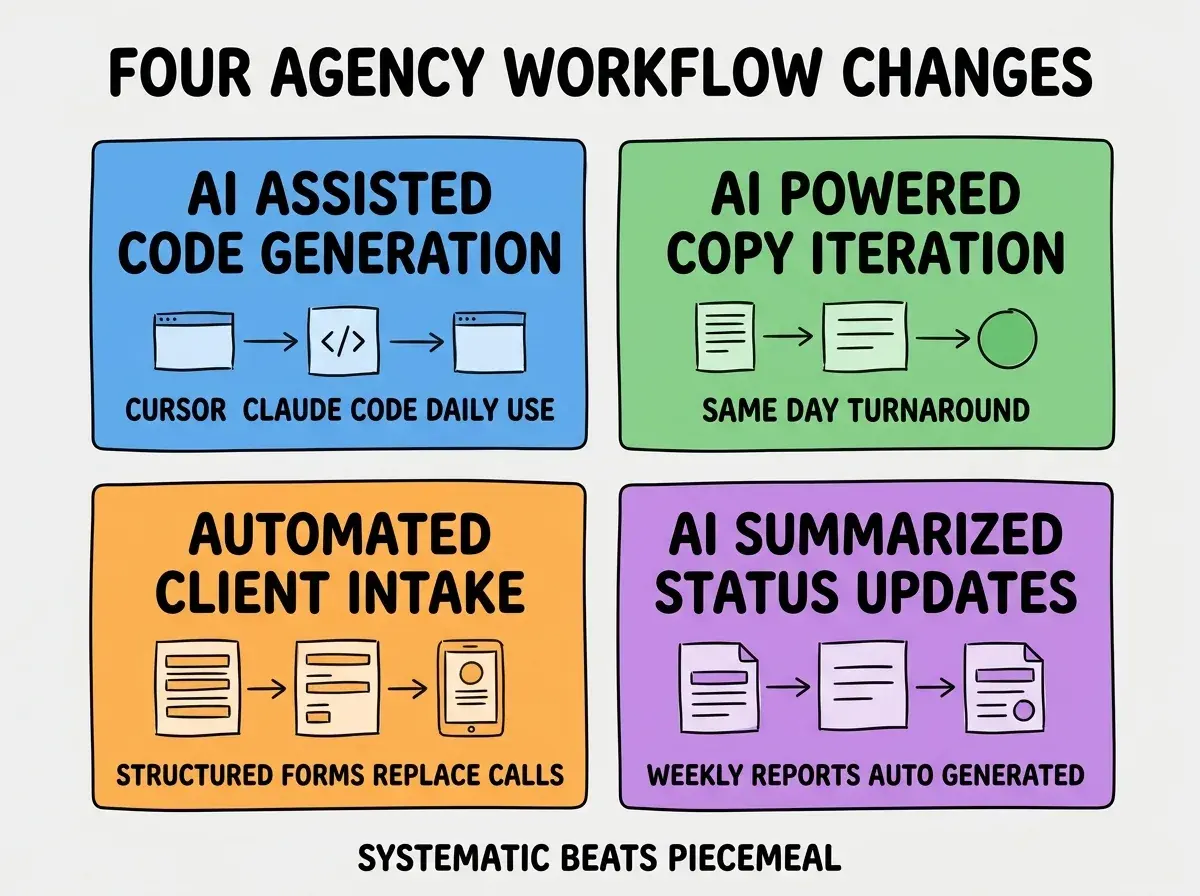
Change 3, automated client intake. Custom kickoff calls were replaced with structured intake forms supplemented by short clarification calls. Total intake time dropped from 4 hours per project to 45 minutes.
Change 4, AI-summarized status updates. Weekly status reports to clients were AI-summarized from the project management tool's data, then human-reviewed. Time per report dropped from 90 minutes to 15 minutes.
The Metrics That Proved the Gains
The agency tracked specific metrics across the transformation. Five numbers tell the story.
Metric 1, projects per quarter. Q1 2024: 6. Q4 2025: 18. The headline 3x metric.
Metric 2, average project duration. 2024 average: 38 days. 2025 average: 14 days. Most of the multiplier came from faster delivery, not from doing more in parallel.
Browse more agency case studies
Read more pulse articlesMetric 3, client satisfaction (CSAT). 2024 average: 4.1/5. 2025 average: 4.6/5. Faster delivery and tighter feedback loops drove higher satisfaction, not lower.
Metric 4, gross margin. 2024: 38 percent. 2025: 44 percent. Output growth produced margin gains because tooling costs grew slower than revenue.
Metric 5, employee retention. 2024 attrition: 25 percent. 2025 attrition: 8 percent. Surprisingly, employees were happier doing high-leverage work than they had been doing tedious parts of the previous workflow.
The Cultural Shifts That Enabled the Transformation
The workflow changes required cultural shifts. Three shifts were the most consequential.
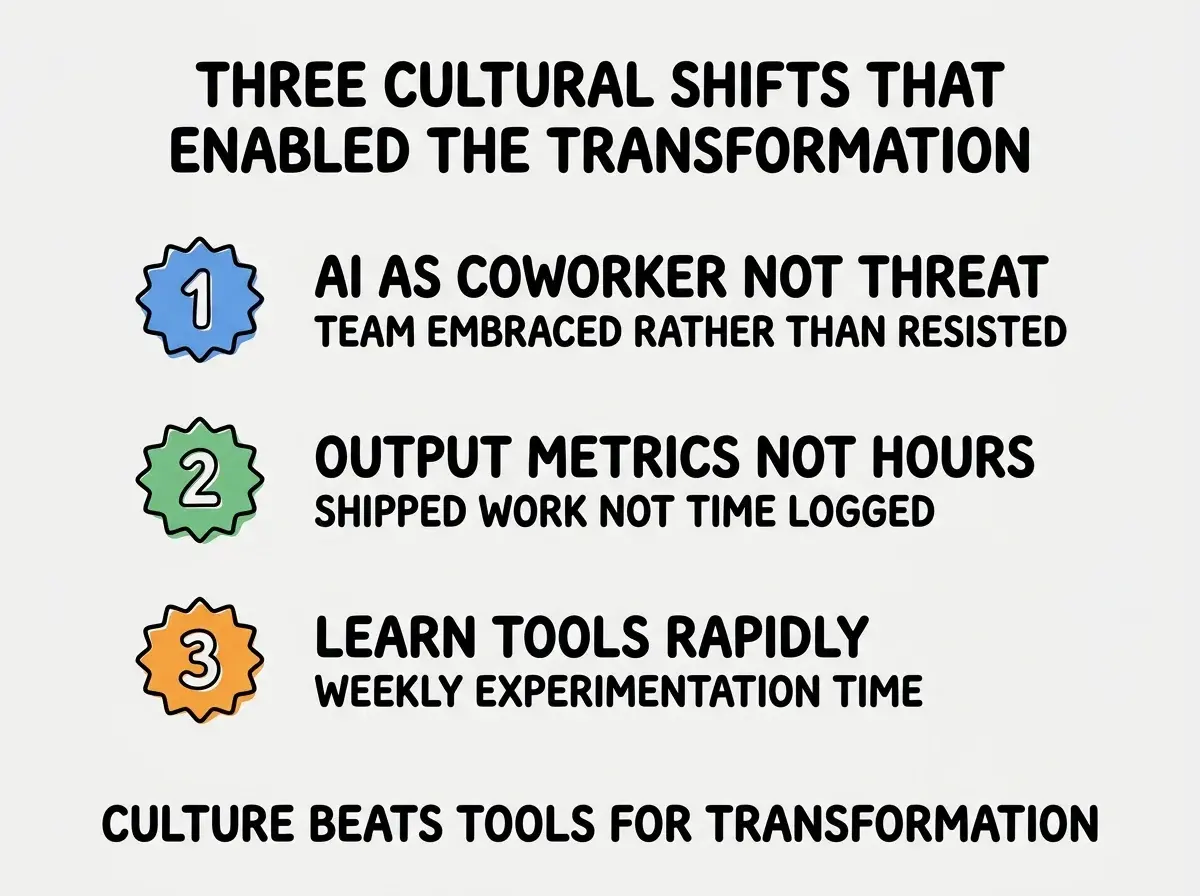
Shift 1, AI as coworker not threat. Leadership framed AI tools as the team's coworkers, not as job-replacement risks. Team members embraced rather than resisted because their roles changed but did not shrink.
Shift 2, output metrics replaced hour metrics. The agency stopped tracking hours and started tracking shipped work. Removed the incentive to inflate effort and aligned compensation with the speed AI enabled.
Shift 3, weekly experimentation time. Every team member got 4 hours per week to experiment with new tools and workflows. The investment paid back through compounding workflow improvements.
What Other Agencies Should Take From This Case
Beyond the specific changes, three meta-lessons generalize.
Lesson 1, systematic beats piecemeal. Single-tool adoption produces small gains; systematic workflow restructuring produces multipliers. Pick three to five workflow changes and implement them together rather than one at a time.
Lesson 2, measure what changed. The agency knew what worked because they tracked specific metrics across the transformation. Without measurement, you cannot know which changes drove gains and which were noise.
Lesson 3, invest in culture before tools. The cultural shifts (AI as coworker, output metrics, experimentation time) preceded most of the tool adoption. Tools applied to the wrong culture produce friction; tools applied to the right culture produce gains.
The combination of these lessons is the underlying message of the case study. The 3x gain is achievable for most agencies; it requires deliberate transformation, not just buying tools.
The most damaging mistake other agencies make trying to replicate similar gains is buying AI tools without restructuring workflows. They install Cursor, sign up for ChatGPT teams, then expect the team to figure out how to use them. The result is modest 1.2x productivity gains and a lot of frustration. The fix is to redesign workflows first, then introduce tools that fit the new workflows. The case study agency spent 3 months on workflow design before any tool rollout. The agencies that try to take shortcuts get shortcut results.
The other mistake is comparing your agency to the case study and concluding you cannot match because you do not have their team or their clients. The case study agency was unremarkable in early 2024; the transformation made them remarkable. The patterns are replicable. The constraint is willingness to invest in the transformation, not raw capability.
What to Do This Quarter
Three concrete actions any agency leader can take this quarter to start moving toward similar gains.
Action 1, audit your current workflow time. Track where the team's time actually goes for two weeks. Most agencies discover that 30 to 40 percent of time is on operational overhead (status updates, intake calls, manual reporting) that is high-leverage to automate.
Action 2, pick one workflow to restructure. Not all four at once; one. Pick the highest-overhead workflow and redesign it with AI tools. Ship the new workflow in 4 weeks. Measure the change.
Action 3, run a team retrospective. What worked, what did not, what to try next. The retrospective is where the cultural shift starts. Repeat monthly for the next year.
The combination of these three actions produces measurable gains within a quarter and sets up the cultural pattern that drives multi-year transformation. The case study agency did not transform overnight; they transformed deliberately, one workflow at a time.
Dig deeper
A few hand-picked sources if you want to go further.
What This Means For You
This case study shows what is achievable with systematic AI workflow adoption in 2026. The specific gains are reproducible for agencies willing to invest in the transformation.
- If you're a founder running an agency: Plan the workflow transformation deliberately. Three months of investment can produce a multi-year competitive advantage.
- If you're changing careers into agency work: Look for agencies with measured AI workflow adoption. They will be the market leaders for the next decade.
- If you're a student: Study the operational patterns documented in agency case studies like this. The principles transfer to any production-oriented business.
Browse more agency case studies
Read more pulse articles