To understand developer sentiment about AI coding tools in 2026 surveys, recognize the four sentiment patterns the data reveals (enthusiastic adopters who use AI tools heavily and report substantial productivity gains around 30 percent of developers, pragmatic users who use AI tools selectively for specific tasks around 45 percent of developers, skeptical reluctant users who use AI tools because they must but prefer not to around 15 percent, and categorical opponents who refuse to use AI tools around 10 percent), see what the patterns reveal about developer perspective beyond simple adoption metrics, and consider what the sentiment data means for tool vendors, employers, and individual developers thinking about career direction. The sentiment patterns reveal more than adoption rates suggest.
This piece walks through the four sentiment patterns, what they reveal, the implications for various stakeholders, and the four mistakes interpreters make when reading sentiment data.
Why Developer Sentiment Matters
Developer sentiment matters beyond simple adoption metrics because adoption without enthusiasm produces minimal productivity gains. Sentiment predicts whether tool deployment translates into real productivity benefit; reluctant adoption often produces compliance with minimal benefit while enthusiastic adoption produces substantial gains.
The 2026 reality is that developer sentiment varies dramatically across the developer population. The variance reveals nuance that aggregate adoption statistics miss; some developers find AI tools transformative while others find them frustrating.
A 2025 Stack Overflow developer survey of 90,000 developers found that 75 percent reported using AI coding tools, while only 30 percent reported finding them substantially useful. The 45 percent gap between use and substantial benefit reveals that adoption metrics overstate productivity impact; sentiment data tells the more accurate story about real benefit.
The pattern to copy is the way smartphone adoption surveys revealed nuance beyond simple adoption rates. Smartphone owners varied dramatically in actual use patterns; some used smartphones primarily as phones while others used them for everything. Similar nuance applies to AI coding tool adoption; the sentiment data reveals what aggregate metrics hide.
The Four Sentiment Patterns
Four sentiment patterns characterize developer relationships with AI coding tools.
Pattern 1, enthusiastic adopters around 30 percent. Heavy daily use, substantial reported productivity gains, evangelism within their teams. These developers experience AI coding as transformative and lead adoption within organizations.
Pattern 2, pragmatic users around 45 percent. Selective use for specific tasks, moderate productivity gains, neither evangelism nor opposition. These developers use AI tools as tools among other tools rather than as transformation.
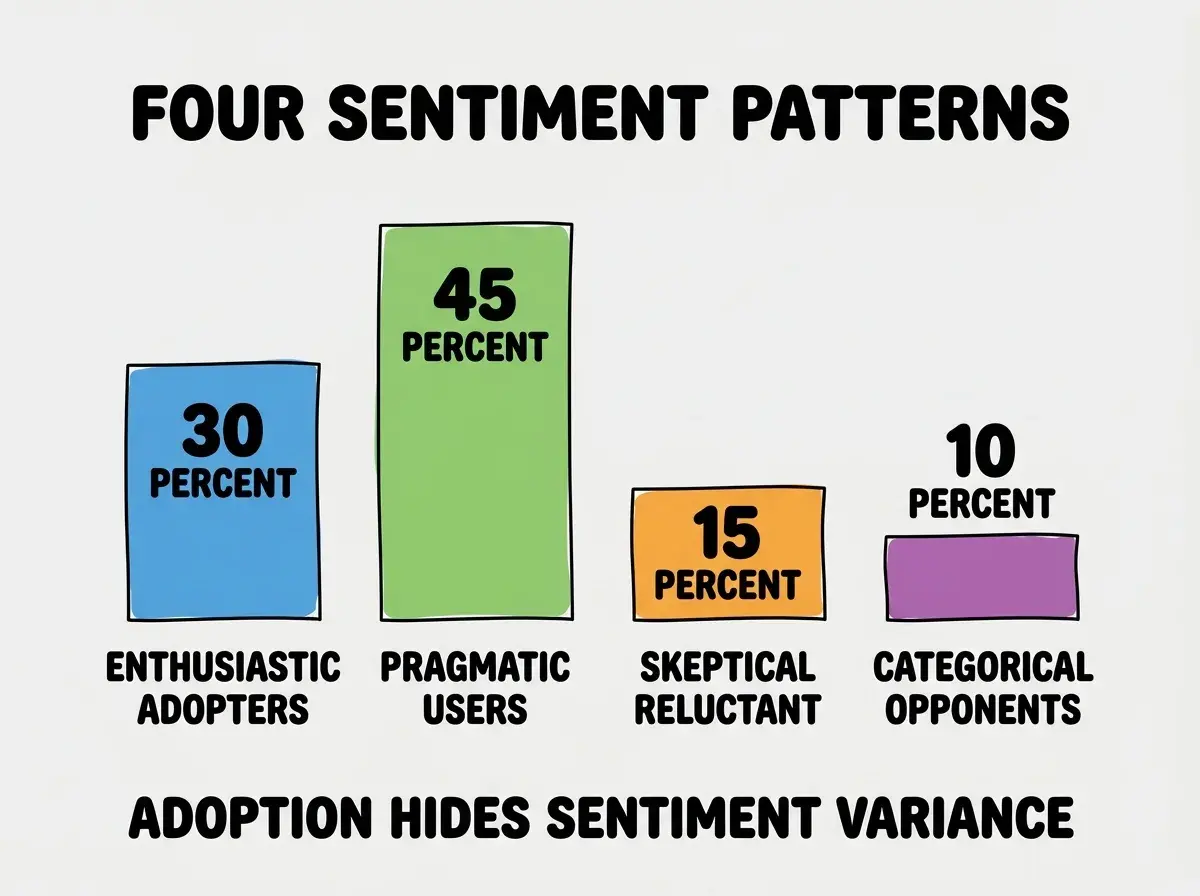
Pattern 3, skeptical reluctant users around 15 percent. Use AI tools because employer mandates or peer pressure but prefer not to. Reluctant adoption produces minimal productivity benefit despite use compliance.
Pattern 4, categorical opponents around 10 percent. Refuse to use AI tools regardless of pressure. Some have principled objections; others have technical objections. Categorical opposition is real and persistent.
What the Patterns Reveal
Three patterns from sentiment data reveal nuances that adoption metrics miss.
Pattern 1, productivity benefit concentrates among enthusiastic adopters. The 30 percent enthusiastic group produces most of the aggregate productivity gain reported. Pragmatic users contribute less per user; skeptical and categorical groups contribute essentially nothing.
Browse more developer analysis
Read more pulse articlesPattern 2, sentiment correlates with tenure inversely in some studies. Newer developers tend toward enthusiasm; longer tenure developers tend toward skepticism. The pattern has exceptions but the trend is consistent.
Pattern 3, sentiment predicts retention in roles requiring AI tool use. Skeptical developers in roles mandating AI tools show higher turnover than enthusiastic developers in same roles. Sentiment matters for talent retention.
What Sentiment Data Means For Stakeholders
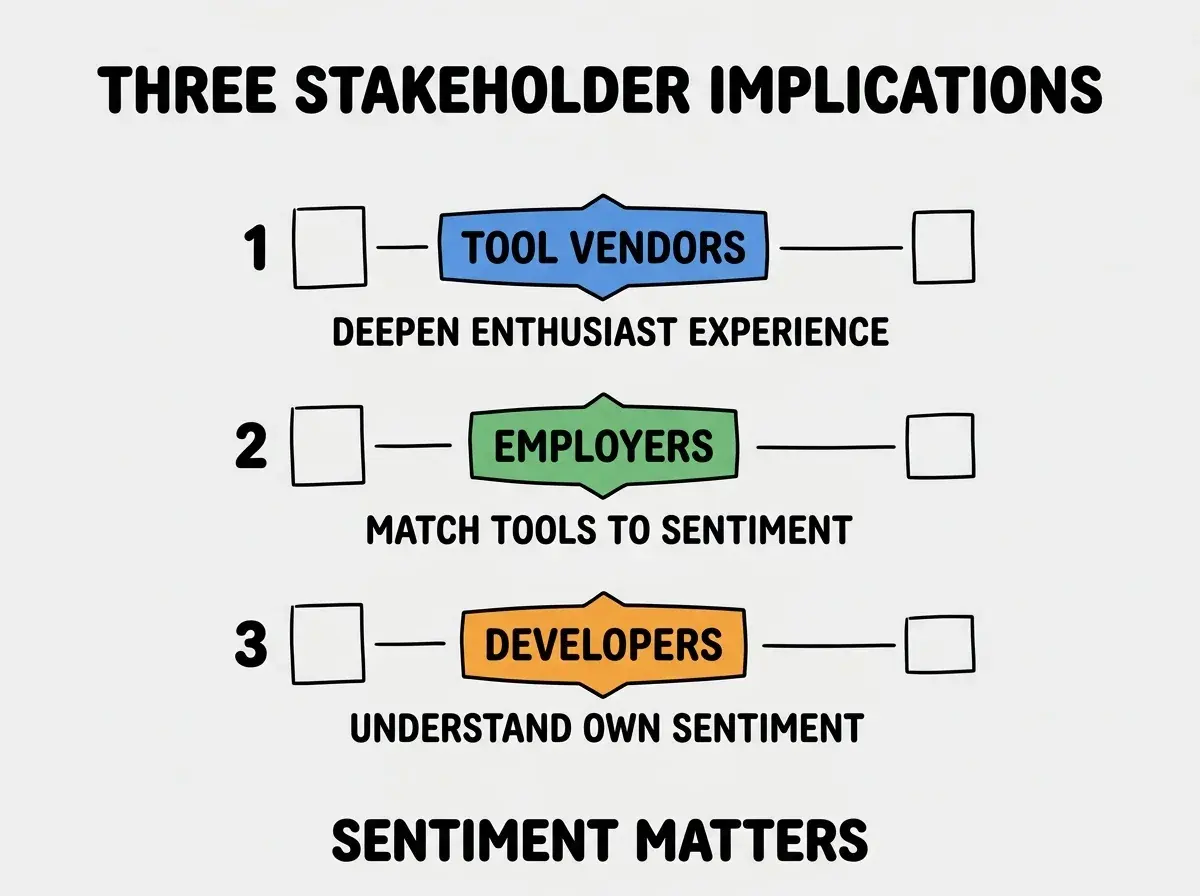
Three implication patterns matter for different stakeholders.
Implication 1, tool vendors should focus on enthusiast experience deepening. Enthusiasts produce the highest value from tools; making tools dramatically better for enthusiasts often produces more revenue than converting skeptics.
Implication 2, employers should match tool requirements to sentiment. Mandating AI tools for skeptical or categorical users produces compliance without benefit. Voluntary tools with enthusiastic users produce more aggregate benefit than mandatory tools across all sentiment groups.
Implication 3, individual developers should understand their own sentiment. Forcing yourself toward enthusiasm if you are skeptical rarely works; understanding your sentiment helps career and tool choice decisions.
How Different Stakeholders Can Apply These Insights
Three application patterns help stakeholders apply sentiment insights.
Pattern A, tool vendors should segment user base by sentiment. Different sentiment groups need different product approaches. One size fits all products often serve no group well.
Pattern B, employers should consider sentiment in hiring and team formation. AI tool first roles attract enthusiastic adopters; traditional roles work better for skeptical developers. Matching role to sentiment produces better outcomes.
Pattern C, developers should choose roles aligned with their sentiment. Skeptical developers in AI mandated roles produce friction; enthusiastic developers in AI averse roles produce frustration. Sentiment alignment matters for career satisfaction.
The combination produces better outcomes for vendors, employers, and developers. Without these patterns, mismatches between sentiment and roles produce friction that hurts everyone.
The most damaging sentiment interpretation mistake is treating skeptical or categorical users as wrong. Skepticism and opposition often have valid bases; principled disagreement deserves respect rather than conversion attempts. The fix is to accept sentiment diversity rather than trying to convert skeptics; the conversion attempts rarely succeed and often produce resentment that hurts team dynamics. Some developers will not adopt AI tools regardless of evidence or pressure; designing systems that accommodate this reality produces better outcomes than fighting it.
The other mistake is assuming sentiment will shift toward enthusiasm over time. Some skepticism converts through experience; some persists or intensifies. The fix is to plan for persistent sentiment diversity; assuming convergence produces disappointment.
A third mistake is conflating adoption with enthusiasm. High adoption with low enthusiasm produces minimal benefit; low adoption with high enthusiasm produces substantial benefit. The fix is to track both adoption and sentiment; they reveal different things.
A fourth mistake is missing the cultural dimension of sentiment. Different countries, languages, and engineering cultures show different sentiment patterns. The fix is to consider cultural context; assuming universal sentiment patterns produces wrong predictions.
How Sentiment Likely Evolves Over Time
Three predictions matter for thinking about how sentiment patterns may shift. First, the enthusiastic adopter share will likely grow as tools improve and skeptical objections lose force; the growth may add 10-15 percent over 3 years. Second, the categorical opponent share will likely persist; principled opposition rarely converts through tool improvement, and some opposition is unlikely to change. Third, the pragmatic middle will continue dominating; most developers use AI tools as tools rather than transformations, and this pragmatic relationship is the most stable sentiment position over time. Tool vendors who design for the pragmatic middle while serving enthusiasts often outcompete vendors who target only enthusiasts.
What This Means For You
The developer sentiment data reveals nuance beyond aggregate adoption metrics. The four patterns, implications for stakeholders, and application insights produce framework for thinking about developer relationships with AI coding tools.
- If you're a senior dev: Your own sentiment matters for career and role choice. Understand where you fit in the sentiment patterns; the understanding informs better career decisions.
- If you're a student: New developers tend toward enthusiasm; this gives entering developers advantages over skeptical experienced developers in AI fluent roles. Use the timing advantage deliberately.
- If you're a founder hiring engineers: Sentiment matters for hiring decisions. Match candidate sentiment to role requirements; mismatched sentiment produces friction and turnover.
Browse more developer analysis
Read more pulse articles