Design thinking matters MORE with AI coding in 2026 because AI removes the implementation bottleneck that previously masked the cost of bad decisions, surfaces the design questions earlier in the process, and amplifies the leverage of every design choice across more shipped features. The frame that AI replaces designers is wrong; the right frame is that AI makes design judgment the binding constraint on product quality. Designers who recognize this shift get more impact, not less.
This piece walks through why the bottleneck shift matters, the four areas where design judgment is now the binding constraint, the redistribution of designer time that follows, and the four mistakes that keep design teams from capturing the value.
Why the Bottleneck Shift Changes Everything
For decades, the implementation bottleneck (engineers being limited resources who could only ship so many features) hid the cost of mediocre design decisions. Bad UX choices got buried because the team could not ship enough to feel them. Good UX choices got delayed because they competed with implementation backlog.
AI coding removes that bottleneck. Teams can ship 5 to 10 times more features per quarter, which sounds great until you realize the design decisions are now the rate-limiting step. A team that can ship 50 features but designs 10 of them well will produce a worse product than a team that ships 10 features designed well across all 10.
A 2025 Nielsen Norman Group study of 600 product teams using AI coding tools found that teams with strong design practices shipped 67 percent more features that improved user metrics, while teams with weak design practices shipped 142 percent more features but only 23 percent of those features improved metrics. The implementation throughput went up for everyone; the value capture diverged sharply based on design judgment. Design is the binding constraint in 2026.
The pattern to copy is the way logistics changed when shipping became cheap. When ocean freight got cheap, the bottleneck moved from transportation to product selection: companies that picked the right products to ship won; companies that picked badly went under. AI coding does the same thing: when implementation is cheap, the bottleneck moves to deciding what to build.
The Four Areas Where Design Judgment Now Binds
Design judgment matters in many places. Four areas have become the new binding constraints in 2026.
Area 1, problem framing. Choosing which user problem to solve first. AI can build any solution; designers determine which problems are worth solving. The opportunity cost of building the wrong thing is now higher than ever.
Area 2, information architecture. How features fit together into a coherent product. AI builds individual features cleanly; designers ensure those features compose into something the user can navigate. Without IA judgment, products become collections of features rather than products.
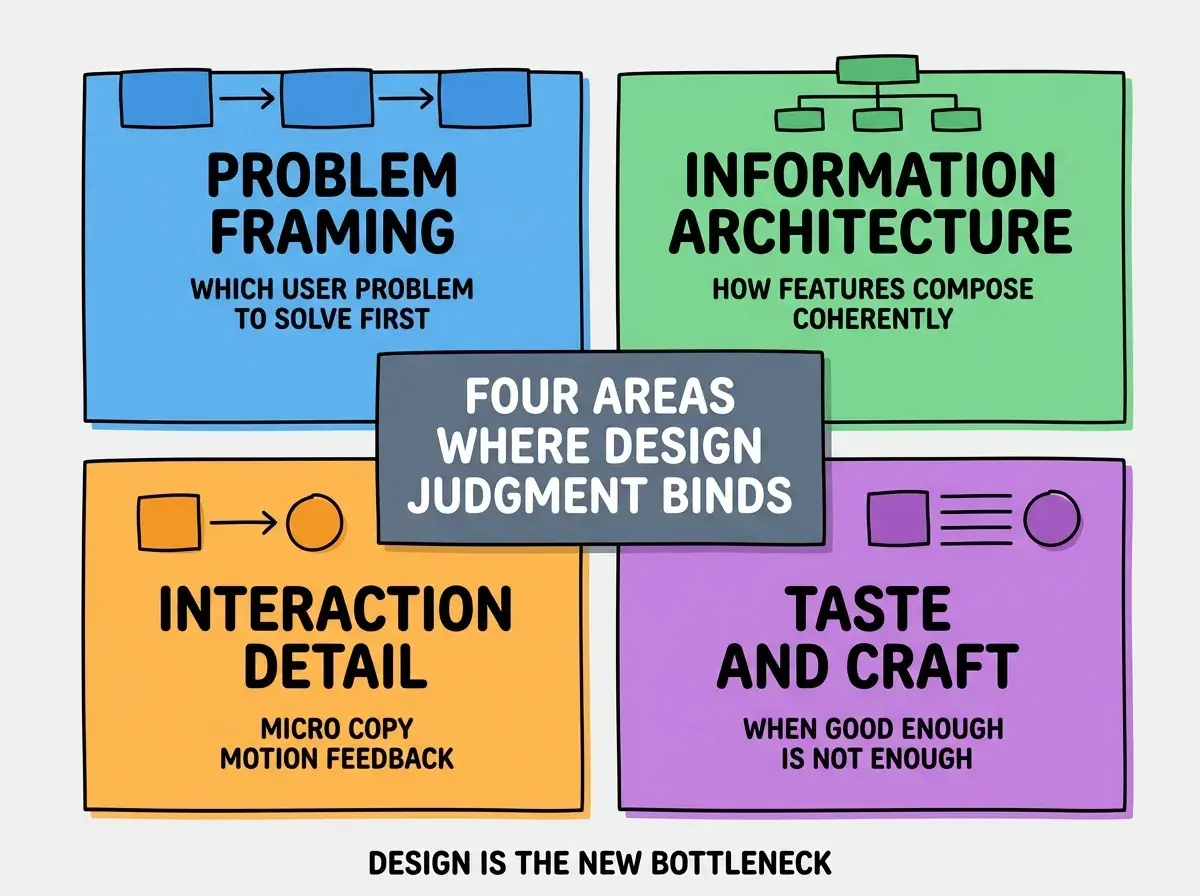
Area 3, interaction detail. Microcopy, motion, feedback states. The thousand small decisions that AI handles with defaults but that designers can elevate. Defaults add up to mediocrity; elevation adds up to delight.
Area 4, taste and craft. Knowing when "good enough" is not enough. Knowing when to push back on a good-but-not-great solution. The qualitative judgment that AI cannot replicate. Becomes more important as more options become available.
The Redistribution of Designer Time
When AI handles implementation, designer time gets redistributed across the design process. The old time allocation (production-heavy) gives way to a new allocation (judgment-heavy).
Old time allocation. 60 percent on production work (mockups, specs, handoffs), 25 percent on user research, 15 percent on strategic decisions. Production was the rate-limiting step.
Browse more design strategy guides
Read more tools articlesNew time allocation. 30 percent on production (AI handles much of it), 40 percent on user research and validation, 30 percent on strategic decisions. Production becomes assistive; judgment becomes primary.
The shift is uncomfortable for designers who built their identity around production craft. The opportunity is enormous for designers who build their identity around judgment.
How to Capture the Value
Recognizing the shift is one thing; capturing the value requires specific changes in how design teams operate.
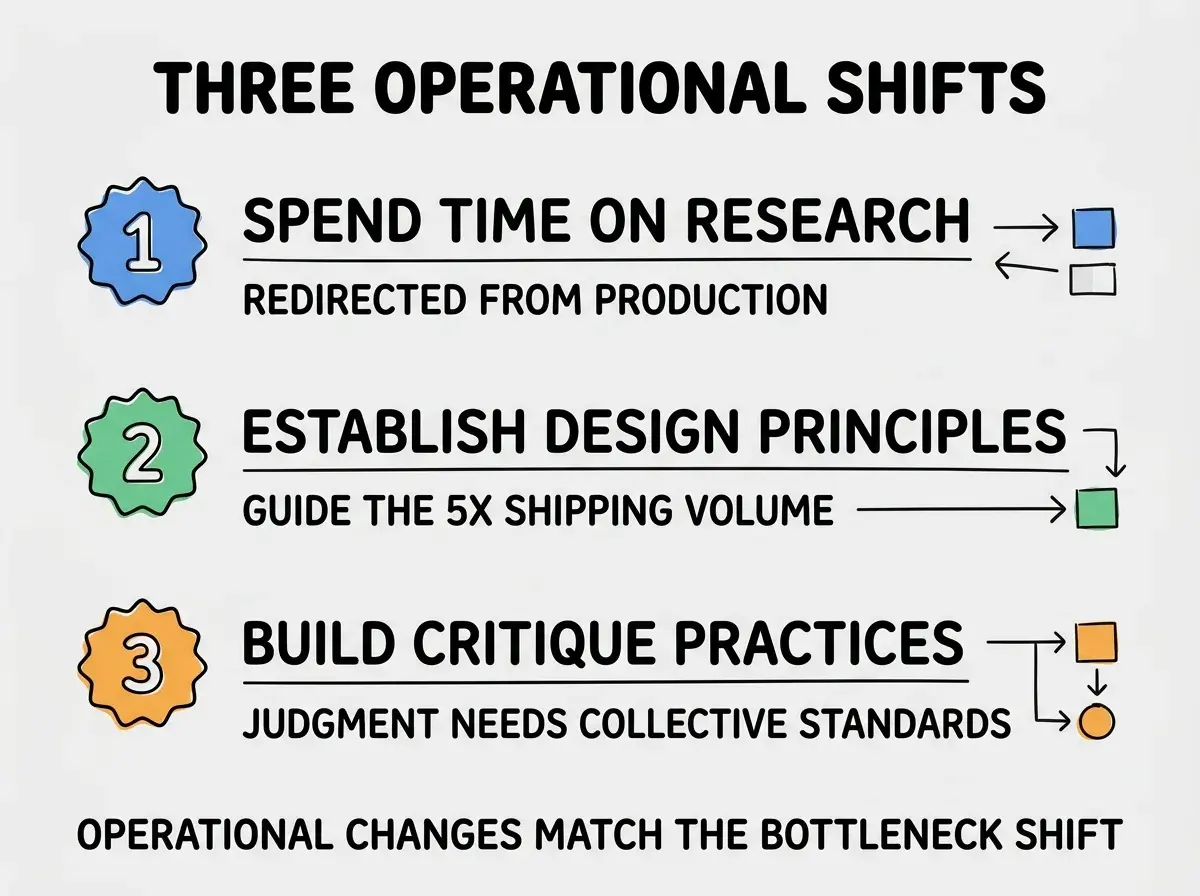
Shift 1, redirect time to research. Use the time AI saves on production for user research, validation, and strategic thinking. The teams that do this systematically pull ahead; the teams that just ship more without research fall behind.
Shift 2, establish strong design principles. When the team is shipping 5x more features, every individual feature needs less direct design attention but the principles guiding those features need more attention. Documented design principles scale judgment.
Shift 3, build critique practices. Critique was always valuable; in the AI era it becomes essential. The collective design judgment of a team via regular critique is the only way to maintain quality across the shipping volume.
Practical Adjustments for Designer Day-to-Day
Beyond the strategic shifts, four day-to-day adjustments help designers thrive in the new bottleneck.
Adjustment 1, learn to read code at the level needed to evaluate AI output. You do not need to write production code, but you do need to understand what AI is generating well enough to catch design failures hidden in the code.
Adjustment 2, get faster at user research. Lightweight methods (5-user usability tests, 1-day prototype tests, weekly analytics reviews) become the cadence. Heavy quarterly studies are too slow for the new shipping volume.
Adjustment 3, document principles aggressively. Every design decision worth making once is worth documenting so it can scale across the team without you personally being involved in every feature.
Adjustment 4, develop opinions about the boring stuff. Forms, error states, empty states, loading states. The places AI defaults are weakest. Designers who have strong opinions about these areas elevate the quality of every feature they touch.
The four adjustments are individually small but collectively transformative. Designers who make all four shift from being production specialists to being judgment specialists, which is exactly the role the new bottleneck demands.
What Companies Are Doing Differently
Forward-looking companies in 2026 are restructuring design teams to match the new bottleneck. A few patterns stand out.
Pattern X, fewer designers, more strategic. Some teams have reduced headcount on production-focused designers and increased headcount on staff-level designers focused on principles, research, and strategy. The total design budget often stays flat; the allocation shifts.
Pattern Y, dedicated design ops. Investment in tooling that scales design judgment across more shipped features. Token systems, component libraries, design linting. The infrastructure work that used to be optional is now central.
Pattern Z, designer-led research. Research that used to be outsourced to dedicated researcher roles is increasingly done by designers themselves with lighter-weight methods. The continuous research loop replaces the quarterly research cadence.
Companies that are not making these shifts are quietly losing ground. The shipping speed gain from AI is real, but the value capture depends on the design team being structured for the new bottleneck. Design leaders who proactively restructure for the new reality position their teams (and themselves) for the next decade.
The most damaging design mistake in the AI era is treating AI as a threat rather than as a tool. Designers who fight against AI coding (refusing to engage with it, hoping it goes away) lose ground rapidly to designers who embrace the shift. The right frame is that AI removes the production tax and makes design judgment more valuable, not less. Designers who internalize this become more impactful, not less. Designers who resist it become marginal even at companies that previously valued them.
The other mistake is undervaluing the work designers always did. Designers who get caught up in AI hype sometimes start undervaluing the user research, the principles work, and the craft work they were already doing well. These were always the high-leverage parts of design; AI coding makes them more leveraged, not less. The right response is to do more of what designers were always best at, with the time AI gives back.
What This Means For You
The bottleneck shift in 2026 raises the value of design thinking dramatically for those who recognize the shift and adjust their practice accordingly.
- If you're a founder: Invest more in design, not less. The leverage went up. The teams that under-invest in design while shipping faster will produce worse products.
- If you're changing careers into design: Lean into judgment-heavy work (research, principles, strategy). The production-heavy entry-level work is shrinking faster than the judgment-heavy work.
- If you're a student: Build taste actively. Study products you admire. The taste you develop is the most durable asset in a world where implementation is cheap.
Browse more design strategy guides
Read more tools articles