The dark flow trap is the cognitive bias where AI assisted coding feels dramatically faster than traditional coding while measurable productivity is actually slower or unchanged. The METR study found developers using AI tools were 19 percent slower on real tasks than developers without AI, despite reporting feeling 24 percent faster. Understanding the trap, recognizing when you are in it, and applying counter measures all produce real productivity gains rather than imagined ones.
This piece walks through the METR study findings, why dark flow happens, how to recognize when you are trapped, and the four mistakes that perpetuate the productivity illusion.
Why The Dark Flow Trap Matters
The dark flow trap matters because the gap between perceived and actual productivity drives bad decisions. Builders who feel productive ship slower, take on more projects than they can finish, and experience burnout from working hard without proportional results.
The 2026 reality is that AI coding tools have measurably improved since the METR study, but the dark flow trap persists because it is a cognitive phenomenon, not a tooling phenomenon. Better tools reduce the gap; they do not eliminate it.
The METR study (Modeling the Economic Trajectory) of 16 experienced developers found that AI assisted coding produced 19 percent slower task completion compared to baseline, while developers self reported feeling 24 percent faster. The 43 percentage point perception gap is the dark flow trap; perception and measurement diverge dramatically.
The pattern to copy is the way professional poker players track results to avoid the cognitive bias of feeling lucky. Self perception in any complex skill is unreliable; measurement reveals actual performance that intuition obscures.
What The METR Study Actually Found
The METR study is widely cited and widely misunderstood. The actual findings reveal specific dynamics worth understanding.
Finding 1, time per task increased. Developers with AI tools spent 19 percent more time on the average task than developers without AI tools. The increase was statistically significant.
Finding 2, perception of speed increased. The same developers reported feeling 24 percent faster than baseline. Perception moved in the opposite direction from measurement.
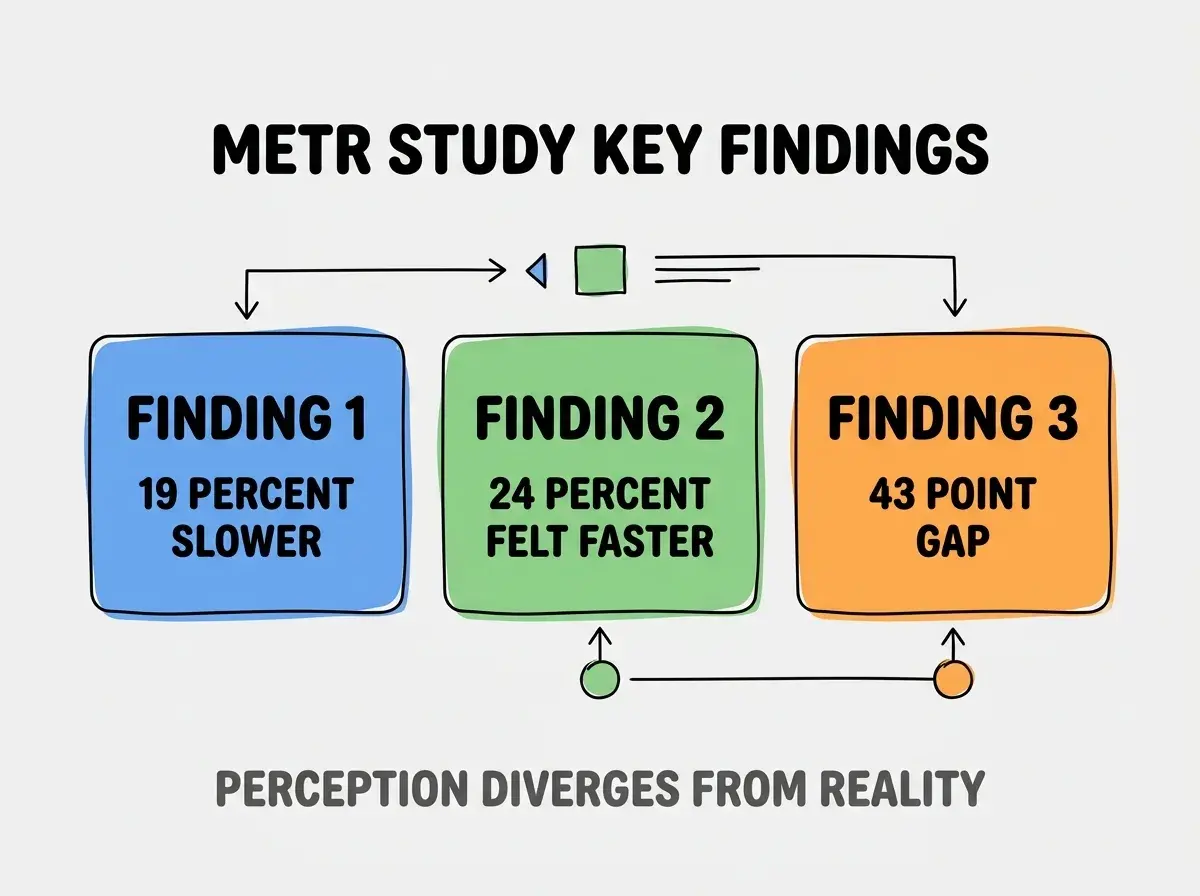
Finding 3, task complexity mattered. The slowdown was largest on complex, novel tasks; trivial tasks showed neutral or positive results. Complexity reveals the trap.
Finding 4, experience level affected results. Senior developers experienced the largest gap; they overestimated AI benefits the most.
The findings do not mean AI coding is bad. They mean honest measurement is required to claim productivity gains.
Why Dark Flow Happens
Three psychological mechanisms create the dark flow trap.
Mechanism 1, action substitution. Reading AI suggestions feels like progress. Accepting suggestions feels like writing code. The activity feels productive even when the output is not.
Browse more foundations
Read more foundationsMechanism 2, cognitive load reduction feels like speed. AI tools reduce the cognitive effort of each step. Less effort feels like more output even when output is the same or less.
Mechanism 3, completion bias. AI completes incomplete code; completion feels satisfying. Satisfaction substitutes for actual progress measurement.
The combination produces the perception that AI is making you faster when measurement shows otherwise. Awareness of the mechanisms helps counter them.
How To Recognize When You Are Trapped
Three warning signs indicate dark flow trap activation.
Warning 1, time disappeared faster than work appeared. "I just spent 4 hours and have nothing to ship" is the trap signature. Track time and outputs to catch it.
Warning 2, accepting suggestions you would not have written. When AI suggestions surprise you positively but you do not fully understand them, you are likely producing slower than your baseline.
Warning 3, feeling productive without external validation. If your tests are not passing and your features are not shipping but you feel productive, the feeling is unreliable signal.
The pattern recognition matters because the trap is invisible from inside. External signals are required to catch it.
What Makes Real Productivity Different
Three patterns separate real productivity from dark flow productivity.
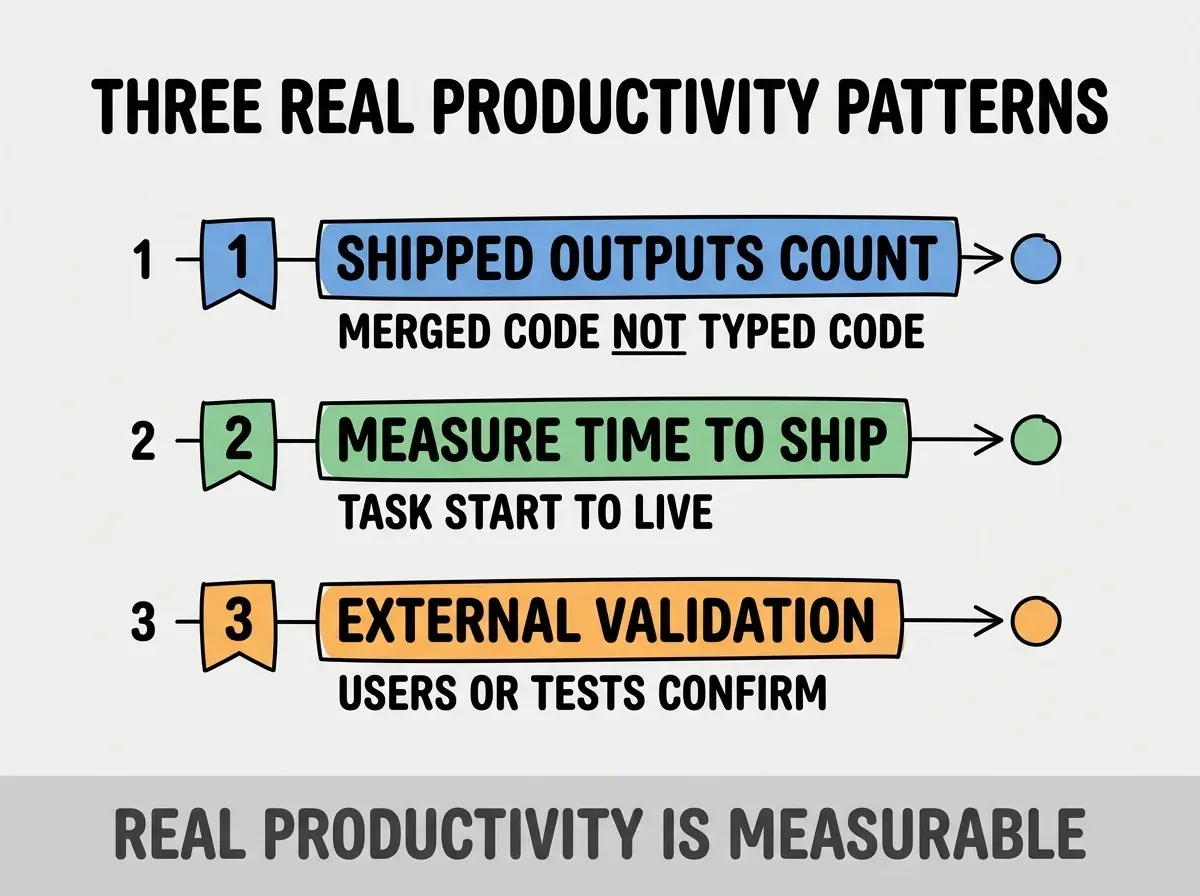
Pattern 1, shipped outputs count, not typed code. Code typed but not shipped is unfinished work. Real productivity counts merged, deployed, working features.
Pattern 2, measure time from task start to shipped. End to end time matters more than time at keyboard. Cycles that include planning, debugging, deployment.
Pattern 3, external validation confirms productivity. Tests passing, users using, problems solved. Without external validation, productivity is self perception.
The combination produces honest productivity measurement. Without these patterns, dark flow trap goes undetected.
How To Escape The Dark Flow Trap
Three counter measures break dark flow patterns.
Counter measure 1, time tracking against outputs. Simple time log that pairs hours spent with what was shipped. Reveals the gap between feeling and measurement.
Counter measure 2, daily ship metric. "What did I ship today that users will see?" Single question answered honestly catches dark flow days.
Counter measure 3, external review of approach. Friend, mentor, or AI review of your work approach. Outside perspective catches what self perception misses.
The combination produces sustained dark flow trap escape. Without counter measures, the trap recaptures even informed builders.
Common Questions About The Dark Flow Trap
The dark flow trap raises questions worth addressing directly.
The first question is whether AI coding tools have improved enough to eliminate the trap. Tools have improved measurably since 2024, but the cognitive trap remains because it is psychological, not technical. Better tools reduce trap intensity; awareness still matters.
The second question is whether the trap means you should stop using AI tools. No; the trap means you should measure rather than assume. AI tools deliver gains in some scenarios; measurement reveals which.
The third question is whether the trap affects all developers equally. The METR study found senior developers experienced the largest gap; junior developers experienced smaller gaps. Experience does not protect.
The fourth question is whether team productivity differs from individual productivity. Team contexts often hide the trap because shared work obscures individual measurement. Individual measurement still matters within teams.
How Dark Flow Trap Affects Career Decisions
The dark flow trap affects career decisions in compounding ways. Career effects last longer than single project decisions.
The first compounding effect is project commitment. Builders who feel productive commit to more projects than they can finish; abandoned projects accumulate.
The second compounding effect is skill atrophy. Heavy AI reliance combined with feeling productive can hide skill atrophy until critical moments expose it. Skill atrophy limits long term capability.
The third compounding effect is income misalignment. Feeling productive while shipping less produces income that does not match perceived effort; misalignment causes burnout.
The combination produces career trajectories that diverge from intentions. Without dark flow awareness, the divergence goes unnoticed until late.
What Changes The Dark Flow Math
Three changes shift the dark flow math toward real productivity.
Change 1, task type matching to AI strength. AI excels at boilerplate, scaffolding, well documented patterns. Use AI for these; use human focus for novel work.
Change 2, shorter feedback loops. Ship in hours not days; users tell you what works faster than self perception does.
Change 3, deliberate practice without AI. Periodic AI free coding sessions maintain skills and provide perspective on AI contribution.
The combination produces productivity gains that match perception. Without these changes, perception and measurement continue diverging.
The most damaging dark flow trap mistake is assuming the METR findings do not apply to you because your perception feels accurate. The trap defines itself by perception feeling accurate; that is the mechanism. The fix is to measure regardless of how confident you feel; let measurement override perception when they conflict. Builders who measure produce honest productivity assessments; builders who trust perception remain trapped.
The other mistake is using the METR findings to dismiss AI tools entirely. The findings show measurement matters; they do not show AI is universally slower.
A third mistake is measuring only typing speed or lines of code. These are the metrics that dark flow inflates; ship time and feature completion are the metrics that reveal truth.
A fourth mistake is treating dark flow as a personal failing rather than a universal cognitive pattern. The trap is built into how human brains process AI assistance; awareness is the response, not shame.
How The Dark Flow Trap Will Likely Evolve
The dark flow trap will likely evolve as AI tools mature and as builder awareness spreads.
The first likely evolution is tool quality reducing the perception gap. Better AI tools deliver more of what they promise; the gap between feeling and reality narrows.
The second likely evolution is measurement tools becoming standard. Time tracking integrated with code output may make dark flow visible automatically.
The third likely evolution is cultural awareness spreading. As more builders learn the trap, social pressure shifts toward measurement based productivity claims.
The combination suggests dark flow becomes more recognized over time. Builders who learn now build measurement habits that compound throughout their careers.
What This Means For You
The dark flow trap reveals that perceived AI productivity gains often do not match measured outcomes. The METR findings, the recognition patterns, and the counter measures produce honest productivity that compounds over time.
- If you're a senior dev: Track time and outputs for 2 weeks; the data will reveal whether your perception matches measurement. The exercise is uncomfortable and clarifying.
- If you're an indie hacker: Add a "shipped today" question to your evening routine. Daily honesty catches dark flow drift before it accumulates.
- If you're a founder: Apply dark flow awareness to your team's productivity claims. Measurement based productivity decisions outperform perception based decisions.
Browse more foundations
Read more foundations