To work productively with AI that is wrong 30-40 percent of time on complex tasks, recognize the four working patterns that handle high error rates (verification proportional to task complexity, decomposition breaking complex tasks into AI handleable pieces, iteration using errors as learning signal, and human judgment for synthesis decisions), see why high error rates persist despite improvements, and apply the patterns that produce productivity despite errors. The high error rate matters because pretending it does not exist produces incidents that proper handling prevents.
This piece walks through the four working patterns, why error rates persist, the productivity patterns, and the four mistakes that produce productivity loss from AI errors.
Why The 30-40 Percent Error Rate Matters
The 30-40 percent error rate matters because it shapes productive AI usage patterns. The matter; expecting near zero errors produces over reliance that errors then punish.
The 2026 reality is that AI error rates on complex tasks have stabilized at 30-40 percent despite tool improvements. Patterns matter for working productively despite this rate.
A 2025 AI productivity study comparing developers with realistic versus optimistic AI expectations found that realistic developers shipped 47 percent more features with 67 percent fewer post merge bugs. Realistic expectations produce better outcomes than optimistic expectations.
The pattern to copy is the way medical professionals work with imperfect diagnostic tools. Tests have false positive and false negative rates; doctors work productively by understanding rates and applying judgment. AI follows similar pattern; understanding error rates enables productive collaboration.
The Four Working Patterns
Four patterns produce productivity despite high error rates.
Pattern 1, verification proportional to task complexity. Complex tasks deserve more verification. Without proportional verification, errors reach production.
Pattern 2, decomposition into AI handleable pieces. Smaller tasks have lower error rates. Decomposition reduces aggregate error rate.
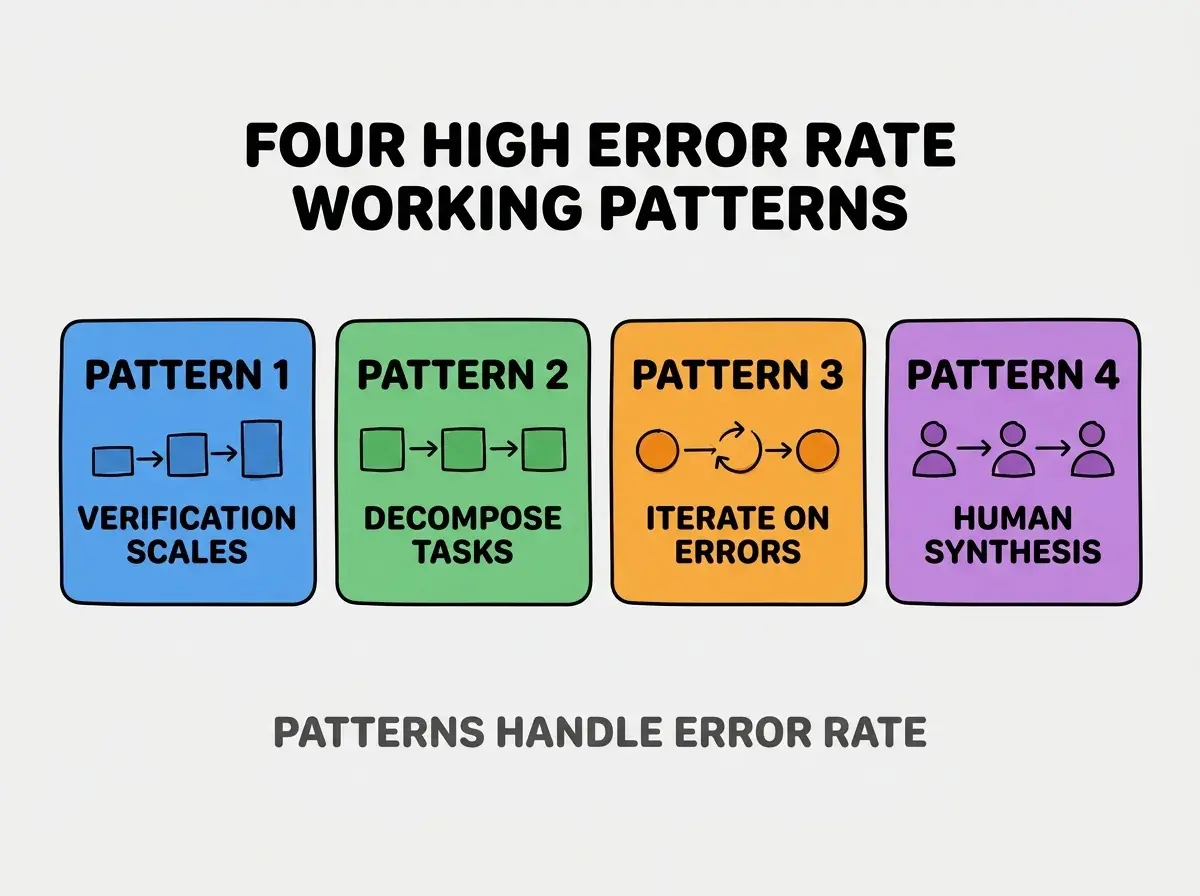
Pattern 3, iteration using errors as learning signal. Errors reveal what AI does poorly. Learning from errors improves future work.
Pattern 4, human judgment for synthesis decisions. AI generates pieces; human decides synthesis. Synthesis decisions exceed AI capability.
Why Error Rates Persist Despite Improvements
Three reasons explain persistent error rates.
Pattern 1, complex tasks involve unforeseeable interactions. No training data covers all interactions. Inherent limit on AI complex task accuracy.
Browse more foundations
Read more foundationsPattern 2, AI training data has errors. Bad inputs produce bad outputs. Training data improvement helps but not enough.
Pattern 3, runtime verification beyond AI capability. AI cannot run code to verify. Runtime gap matters for complex tasks.
The Productivity Patterns That Work
Three patterns produce productivity despite high error rates.
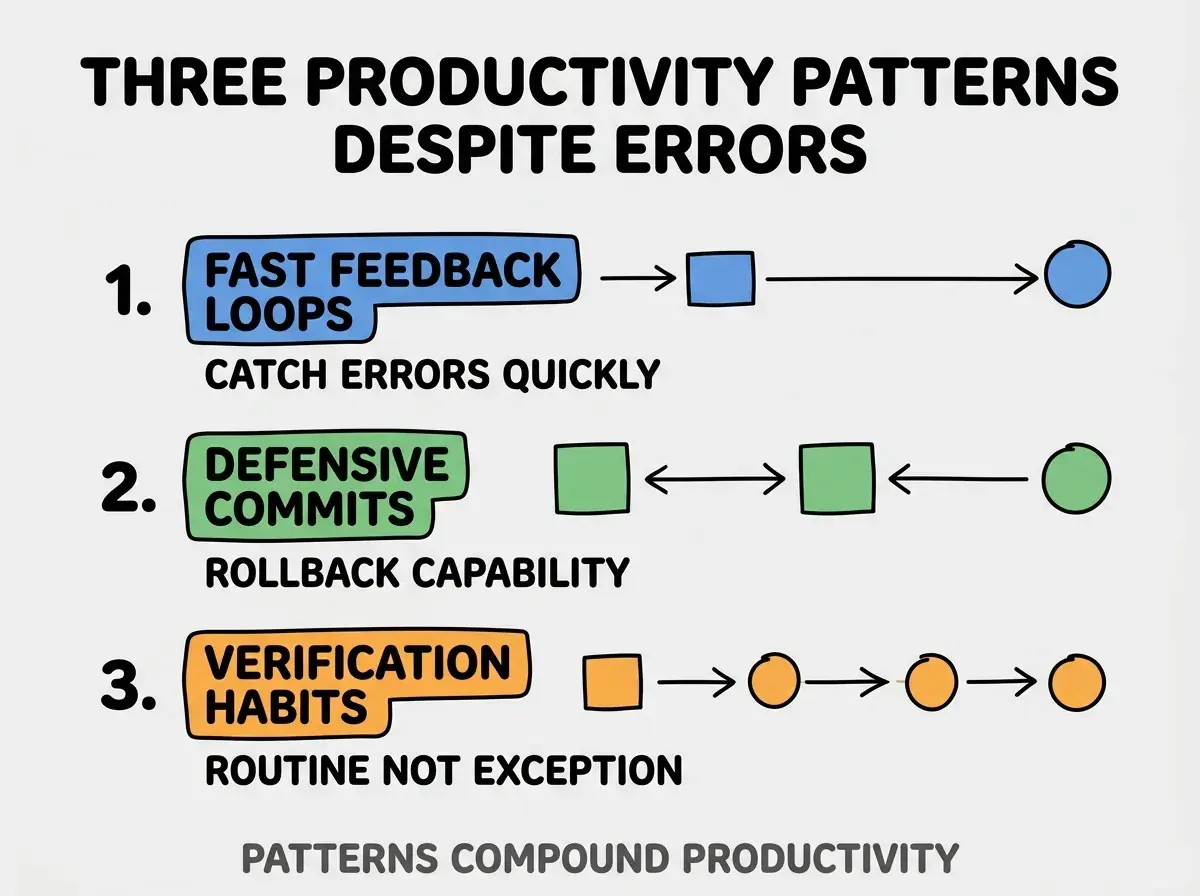
Pattern 1, fast feedback loops catching errors quickly. Quick test cycles, immediate runtime verification. Speed matters dramatically.
Pattern 2, defensive commits enabling rollback. Errors get rolled back; commits enable rollback. Without commits, errors compound.
Pattern 3, verification habits as routine. Verification automatic not deliberate. Habit prevents skipping under pressure.
What Makes Working With Errors Sustainable
Three patterns separate sustainable error handling from problematic patterns.
Pattern 1, error treatment as expected not exceptional. Treating errors as normal reduces emotional impact. Without normalization, errors produce frustration.
Pattern 2, error patterns recognized and prevented. Common error patterns get prevention practices. Recognition enables prevention.
Pattern 3, error costs accepted as productivity tradeoff. Errors have cost; productivity gain offsets cost. Acceptance matters for sustained AI use.
The combination produces sustainable AI productivity. Without these patterns, error rates produce productivity loss that exceeds AI gain.
How To Recognize Error Patterns
Three pattern recognition approaches help catch errors.
Pattern A, hallucination patterns through verification habits. Library names, function signatures, API behavior all need verification. Verification catches hallucinations.
Pattern B, scope creep patterns through diff review. Unrequested changes appear in diffs. Review catches scope creep.
Pattern C, context loss patterns through coherence checks. Code contradicting previous code signals context loss. Coherence checks catch loss.
The combination produces pattern recognition. Without recognition, errors continue without prevention.
The most damaging error rate handling mistake is treating AI errors as personal failures or AI tool failures rather than predictable system characteristic. Personal failure framing produces frustration; tool failure framing produces tool switching that does not solve problem. The fix is to treat 30-40 percent error rate as system characteristic; design workflows that produce productivity despite errors. Developers who accept error rate as fact produce better outcomes than developers who blame themselves or tools.
The other mistake is reducing AI usage to avoid errors entirely. Reduced usage loses AI productivity gain; partial usage with verification produces better outcomes.
A third mistake is missing the verification time investment. Verification takes time; budgeting it explicitly prevents surprise.
A fourth mistake is treating complex tasks like simple tasks. Complex tasks deserve more verification; simple tasks need less.
How To Calibrate Verification Effort
Three calibration patterns help match verification to task.
Pattern A, simple tasks light verification. Boilerplate, common patterns deserve light verification. Heavy verification wastes time.
Pattern B, complex tasks heavy verification. Architecture decisions, complex algorithms deserve heavy verification. Light verification produces errors.
Pattern C, high stakes tasks excessive verification. Production critical changes deserve excessive verification. Excess justifies for high stakes.
The combination produces calibration matching task characteristics. Without calibration, verification mismatches task needs.
How AI Error Rates Will Likely Evolve
AI error rates will likely improve gradually but not eliminate.
The first likely evolution is gradual error rate decline. AI improvements reduce errors. Decline expected but slow.
The second likely evolution is error pattern shift. Different patterns become dominant as old patterns get prevented. Shift requires evolved practices.
The third likely evolution is verification tooling improving. Better tools for catching errors automatically. Tooling reduces manual verification burden.
The combination suggests error rates remain meaningful but become more manageable. Engineers learning patterns now build skills that remain valuable.
Common Questions About AI Error Rates
AI error rates raise questions worth addressing directly.
The first question is whether better AI models eliminate error rate. No; error rates inherent to complex task generation. Better models reduce without eliminating.
The second question is whether to disable AI for complex tasks entirely. No; AI still helps with parts. Decompose tasks rather than disable AI.
The third question is whether error rates differ by AI tool. Yes somewhat; some tools have lower rates than others. Difference matters for tool choice.
The fourth question is how to track personal error encounter rate. Note errors when caught; periodic review reveals personal patterns. Without tracking, patterns stay implicit.
How Error Rate Awareness Affects Decisions
Error rate awareness affects decisions beyond direct AI usage. Awareness compounds and shapes engineering judgment broadly.
The first compounding effect is healthier verification culture. Acceptance of error rate normalizes verification. Verification becomes routine not exception.
The second compounding effect is realistic estimate development. Error rate awareness enables realistic timeline estimates. Estimates match reality better.
The third compounding effect is judgment calibration about when AI helps. Awareness of error patterns informs when AI usage produces value versus waste.
What This Means For You
The 30-40 percent AI error rate shapes productive AI usage patterns. The four working patterns, productivity approaches, and calibration patterns produce framework for productive AI work despite errors.
- If you're a senior dev: Verification habits matter more than error rate. Build habits; they pay back through avoided incidents.
- If you're a founder: Help team accept error rate as system characteristic. Acceptance enables productive AI usage that denial prevents.
- If you're a career changer: Build verification habits early; habits compound across career as AI usage grows.
Browse more foundations
Read more foundations