Cursor Composer 2.5 launched on May 18, 2026, and it does something the vibe coding market has been waiting for: it matches Claude Opus 4.7 and GPT-5.5 on standard benchmarks while priced at roughly one tenth the cost per token. That gap matters because agentic coding sessions are expensive, and the economics of long-running agent work just shifted.
The release is not just a number bump. Cursor rebuilt training around three specific failure modes that developers actually hit in production: sessions that drift on long tasks, models that over-spend tokens on trivial changes and under-spend on hard ones, and tool calls that silently fail partway through a multi-step plan. All three got direct fixes in Composer 2.5.
Why Does Agentic Session Cost Matter for Vibecoders
Long agentic sessions are the core use case for vibecoders, and cost has been the silent tax on that workflow. When a model like Opus 4.7 handles a serious multi-file refactor, the token spend across dozens of tool calls adds up fast. Cursor Composer 2.5 at $0.50 per million input tokens (standard tier) versus frontier model rates changes the math on how often you can run these sessions and for how long.
The practical implication is that the ceiling on "how ambitious can I make this agent task" just rose. Sessions that previously would have eaten a meaningful portion of a monthly budget can now run more freely, which changes how vibecoders scope their prompts. Instead of carefully breaking up a large task to save tokens, you can describe the whole thing and let the model work.
Cursor Composer 2.5 scores 79.8% on SWE-Bench Multilingual and 63.2% on CursorBench v3.1, matching Claude Opus 4.7 and GPT-5.5 at standard pricing of $0.50/M input and $2.50/M output tokens. Fast tier (the default for interactive sessions) is $3.00/M input and $15.00/M output, which is still dramatically cheaper than equivalent frontier models for the same benchmark performance.
Cursor also launched double usage for the first week after release, so anyone on a paid plan has an unusually good window right now to stress-test the model on real workloads before committing to a workflow change.
What Three Training Changes Actually Mean in Practice
The performance gains come from three specific training decisions, each targeting a different failure mode in agentic sessions.
Textual feedback reinforcement learning. Standard RL training gives a reward signal at the end of a trajectory. Composer 2.5 instead receives short, localized hints at the specific point in the trajectory where the model made a mistake, not just at the end. The result is more precise error correction: instead of learning broadly that a session failed, the model learns exactly which tool call or reasoning step went wrong and why.
Feature deletion synthetic tasks. Cursor's training data includes a synthetic task type where the model is given a working codebase with tests, asked to delete functionality until tests for a specific feature fail, then asked to reimplement that feature until tests pass again. This forces the model to hold a complete mental model of the codebase across multiple destructive and reconstructive steps. It is a training task that almost perfectly mirrors the "fix a regression while refactoring" scenario that breaks most AI coding sessions.
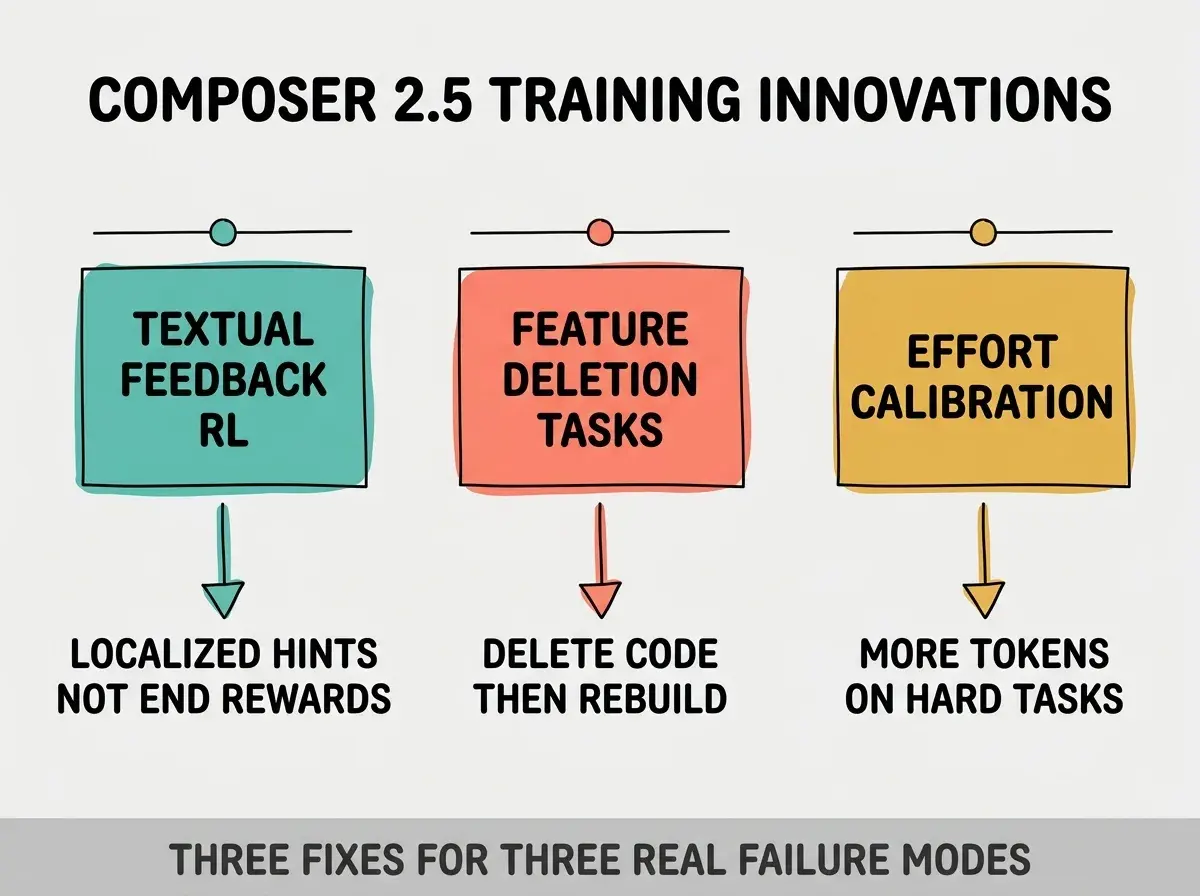
Effort calibration. Composer 2 (and most frontier models) had a flat effort profile: roughly similar token spend regardless of whether you asked it to rename a variable or restructure a module. Composer 2.5 publishes effort curves showing sharper alignment between task difficulty and actual tokens spent. Simple changes get short, clean replies. Hard multi-file changes get structured reasoning with more steps. This is not just a cost optimization; it makes the model noticeably faster on easy tasks and more thorough on hard ones.
How Cursor Composer 2.5 Compares to Other Models Available in Cursor
Cursor does not lock you into Composer 2.5. You can still route specific tasks to Claude Sonnet 4.6, Opus 4.7, or GPT-5.5 through the model picker. The release is best understood as Cursor giving vibecoders a strong default for the majority of agentic work, while preserving access to frontier models for tasks where the benchmark gap matters.
The base model is Moonshot's open-source Kimi K2.5 checkpoint, retrained by Cursor with 25 times more synthetic coding tasks than Composer 2. The architecture baseline is public, which is why Cursor could ship this two months after Composer 2 rather than waiting for a full training run from scratch. Alongside the release, Cursor announced a partnership with SpaceXAI to train a significantly larger model from scratch at 10x compute; Composer 2.5 is the current production model while the larger collaboration is the longer bet.
Track what changes in the vibe coding landscape week by week
Explore the blogWhat Changes in Your Day-to-Day Cursor Workflow
Practically, three things shift for Cursor users starting today.
First, the default model for background agent tasks (Agent tab) is now Composer 2.5. If you were manually selecting Sonnet 4.6 as a cost compromise, you can revisit that. The benchmark parity with Opus 4.7 suggests Composer 2.5 is the better default for most agentic work, and the lower cost means you can use it more freely.
Second, long refactoring sessions are the specific use case Cursor optimized for. If you have been breaking large refactors into smaller chunks to avoid session drift, try giving Composer 2.5 the full task in one prompt. The feature deletion training and localized RL feedback both target this exact failure mode.
Third, the Fast tier pricing ($3.00/M input, $15.00/M output) is what you will hit during interactive sessions where latency matters. The Standard tier applies to background tasks. Understanding which tier applies to which workflow affects your actual monthly cost.
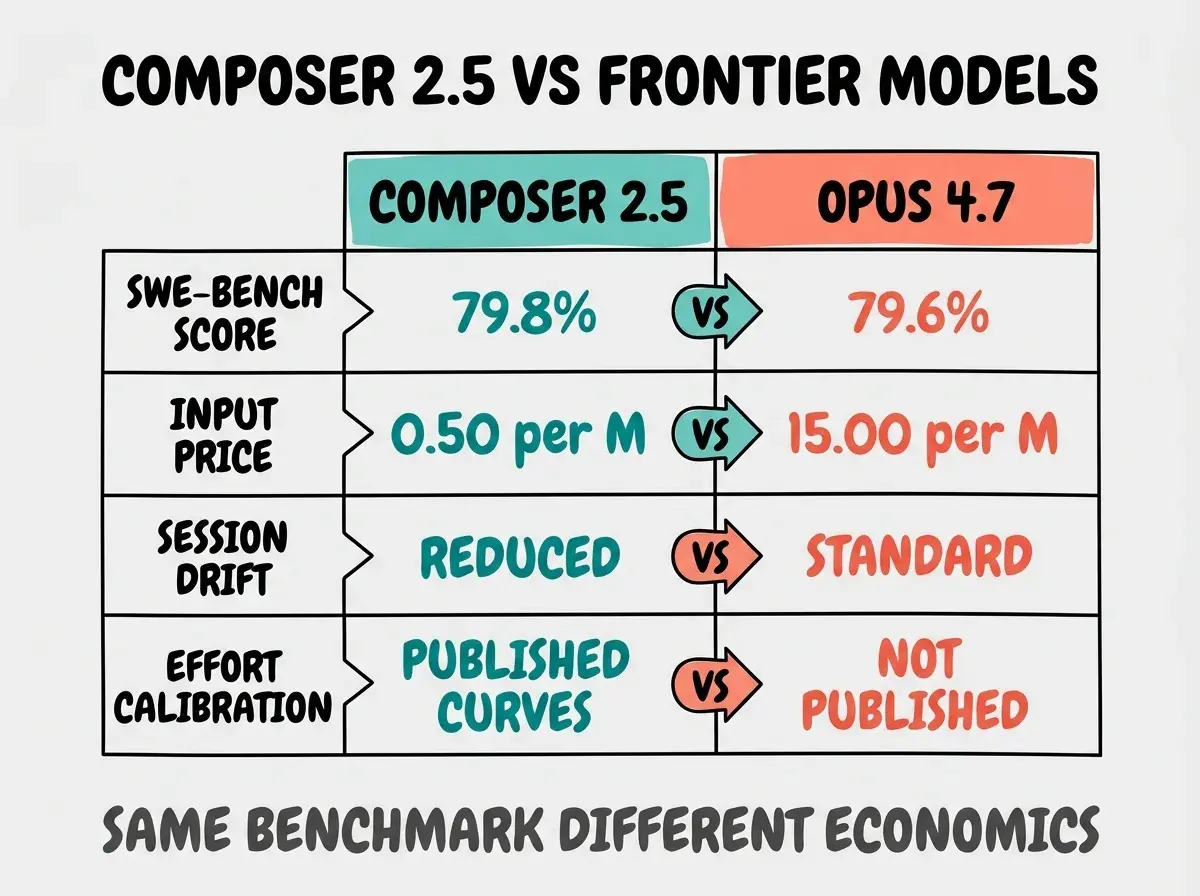
The most common mistake when evaluating model releases like Composer 2.5 is treating benchmark scores as the only signal. SWE-Bench Multilingual measures whether a model can resolve GitHub issues on specific repos. It does not measure effort calibration, sustained focus over a 45-minute refactor, or the quality of inline reasoning summaries. Cursor explicitly says the dimensions that matter most for real workdays are not well captured by existing benchmarks. Use the first week of double usage to run your actual workflows, not synthetic tests.
The most useful evaluation approach is to pick a task that failed or drifted on Composer 2, give Composer 2.5 the full task without chunking it, and watch whether it completes. The effort calibration and sustained-focus improvements target that exact failure mode, so it is the clearest signal of whether this release changes your workflow. Double usage is live for the first week after launch, so now is the time to run the test.
What This Means for Vibecoders Right Now
Cursor Composer 2.5 removes cost as the primary reason to avoid long agentic sessions. The model now handles sustained multi-file work at frontier benchmark scores for a fraction of frontier inference cost.
- Indie hackers: Tasks you were chunking to save tokens are worth delegating to Composer 2.5 as full background jobs.
- Team developers: Model routing for CI-integrated agent tasks (PR reviews, test generation, refactors) should be revisited. The cost-per-task math now favors Composer 2.5 over Opus 4.7 for most agentic workloads.
- Evaluating Cursor vs alternatives: Composer 2.5 is the clearest evidence yet that Cursor is betting on model ownership as a competitive moat, training specifically for the IDE context where vibecoders work.
We track what ships and what actually changes your workflow
Read more pulse posts