To pick the right cross-platform strategy for vibe-coded apps in 2026, compare four main approaches (responsive web app, progressive web app, React Native or Flutter, native iOS and Android), assess your app's specific needs (offline behavior, native features, distribution), pick the simplest approach that meets your needs rather than the most powerful, and revisit the choice when you hit specific limits rather than upfront. Most vibe-coded apps are best served by a responsive web app or PWA; native is rarely the right starting point.
This piece walks through the four strategies, the trade-offs that matter most, the decision framework, and the four mistakes that lead teams to the wrong choice.
Why Cross-Platform Choice Matters So Much
The cross-platform choice is one of the highest-leverage architectural decisions in any mobile project. Pick well and your team ships fast across all platforms; pick badly and you spend weeks fighting the chosen tool's limitations. The choice affects shipping speed, maintenance cost, hireable team size, and even the kinds of features you can add.
In 2026, the choice is more nuanced than the binary "native vs cross-platform" debate of 2018. Four approaches now compete, each with distinct sweet spots. Understanding the trade-offs lets you pick deliberately rather than defaulting to whatever is currently trendy.
A 2025 Stack Overflow developer survey of 25,000 mobile developers found that teams who picked their cross-platform strategy based on app-specific requirements shipped 2.7x faster than teams who picked based on team familiarity or industry trends. The gap closed dramatically when teams used a structured framework (offline needs, native features, distribution channels) versus when teams picked based on what they had used before. The wrong cross-platform choice costs months; the right one compounds across years.
The pattern to copy is the way construction crews pick materials based on the building's actual requirements (climate, load, code) rather than based on what the crew used last time. Wood works for some buildings, steel for others, concrete for still others. Cross-platform mobile follows the same pattern: the right material depends on what you are building.
The Four Strategies Compared
Four strategies cover almost all vibe-coded mobile apps in 2026. Each has clear sweet spots.
Strategy 1, responsive web app. Mobile-friendly website. No native install. Easiest to build, most limited capabilities. Right for content sites, B2B SaaS, internal tools.
Strategy 2, progressive web app (PWA). Installable web app with offline support and push notifications. Most of native's benefits, none of the app store overhead. Right for most consumer apps that do not need deep native integration.
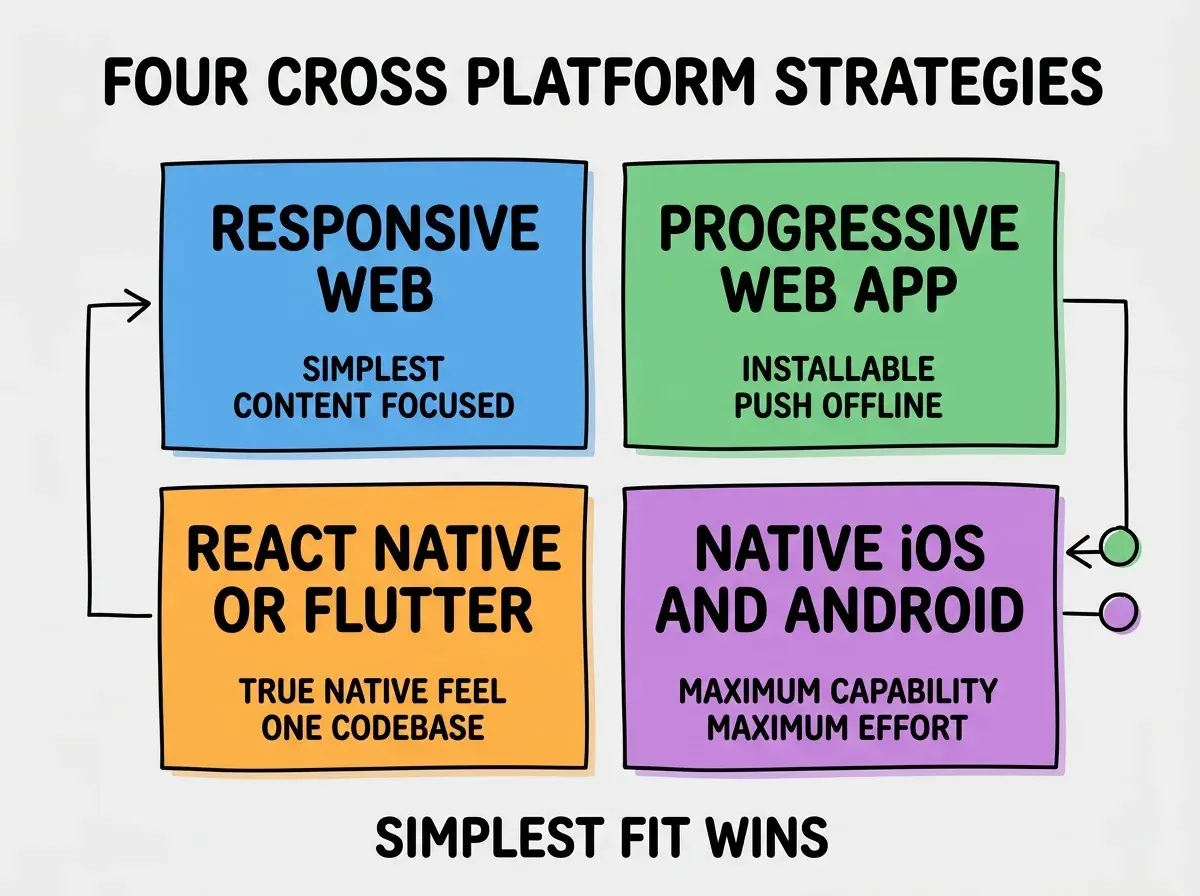
Strategy 3, React Native or Flutter. True native apps from a single codebase. Significant capability, single team. Right for apps that need native feel and gestures but want one codebase.
Strategy 4, native iOS and Android. Two separate codebases, full native capability. Maximum effort, maximum capability. Right for apps where every native feature matters.
The Trade-Offs That Determine Fit
Four trade-offs determine which strategy fits your app. Be honest about each one.
Trade-off 1, offline behavior. How important is offline support? Web apps require workarounds; PWAs handle moderate offline; React Native handles most offline; native handles all offline scenarios.
Browse more mobile architecture guides
Read more build articlesTrade-off 2, native features. Camera, biometrics, deep notifications, in-app purchases. Each strategy supports a different subset. Match strategy to your specific feature needs, not to a maximum hypothetical.
Trade-off 3, distribution. Web URL, PWA install, App Store, Play Store. Different strategies enable different distribution. Match to where your users actually are.
Trade-off 4, team size and skills. Solo developer, small team, large team. Web technologies scale to all sizes; native iOS/Android adds platform-specific specialization. Match strategy to team capacity.
The Decision Framework
A simple framework prevents the wrong choice. Answer four questions in order; the answer determines the strategy.
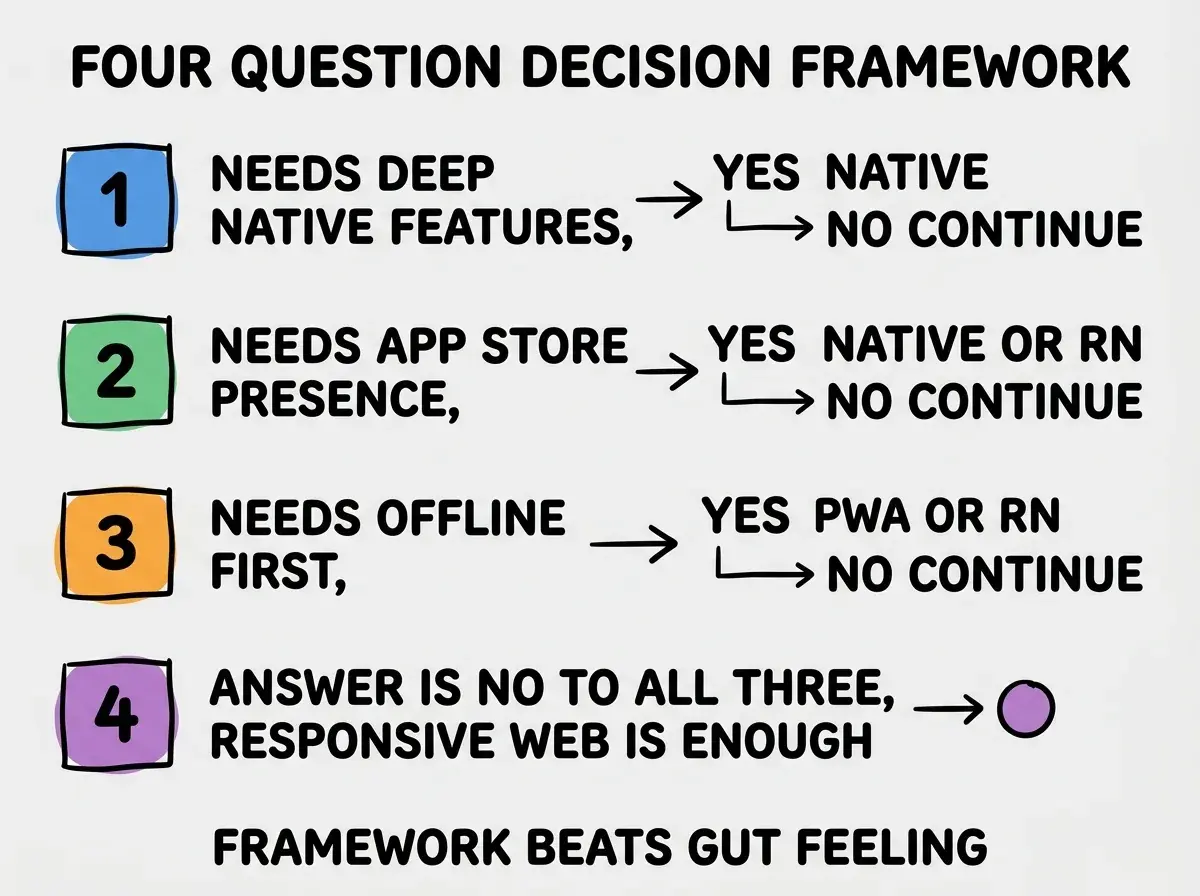
Question 1, do you need deep native features? Apple Pay, advanced biometrics, custom Bluetooth, complex AR. If yes, go native. If no, continue.
Question 2, do you need app store presence for marketing or revenue? App Store ratings, in-app purchases, app store search traffic. If yes, native or React Native. If no, continue.
Question 3, do you need offline-first behavior? Long offline sessions, local-only data, sync when connected. If yes, PWA or React Native. If no, continue.
Question 4, none of the above? Responsive web app is enough. Most vibe-coded apps end here, and that is fine.
When to Revisit the Choice
The right strategy when you start may not be the right one at scale. Three signals indicate it is time to revisit.
Signal 1, hitting platform limits. You wanted a feature your current strategy cannot deliver. Time to consider migration.
Signal 2, performance issues that will not budge. Web technologies have a ceiling for some app categories. If you have hit that ceiling, native may be needed.
Signal 3, distribution requirements changed. You started on web but enterprise customers require an MDM-distributable native app. Time to reconsider.
The key insight is to revisit the choice based on actual evidence rather than upgrading speculatively. Many teams "graduate" to native when they would have been better off with PWA forever. Match the strategy to what you actually need, not what you imagine you might need someday.
Migration Patterns Between Strategies
When the migration time comes, three patterns reduce the cost of switching strategies.
Pattern A, share business logic. A well-architected web app has business logic separated from UI. The logic can move into React Native or native largely unchanged; only the UI layer needs rewriting. Plan for this even if you do not migrate.
Pattern B, parallel run during migration. Keep the web app running while you build the native version. Users can use both during the transition. Cuts the risk of a big-bang migration that could fail.
Pattern C, migrate by feature, not by app. Pick one feature that needs native capability, migrate just that feature, leave the rest in the web app. Hybrid architectures (Capacitor wrapping a PWA with native plugins for specific features) often outperform either pure choice.
The combination of these patterns means migration is usually less expensive than teams fear. The fear of being "stuck with the wrong choice" leads to over-engineering the original choice. Start simple, migrate when justified, and use these patterns to keep migration costs reasonable.
The most damaging cross-platform mistake is picking based on what is "modern" or "what real apps use" rather than what fits your specific app. Teams choose React Native because Facebook uses it, then spend months fighting it for an app that would have been better as a PWA. The fix is to start from your app's specific requirements (offline needs, native features, distribution channels) and pick the simplest strategy that meets those requirements. Simplicity is a feature; complexity is a tax. Most vibe-coded apps are over-engineered for their actual needs.
The other mistake is treating the choice as permanent. Cross-platform strategy can be changed as the app evolves; many successful apps started as PWAs and added a React Native version when justified. Plan for the possibility of migration; the original choice is rarely the final one.
What This Means For You
Cross-platform strategy is one of the highest-leverage architectural decisions in any vibe-coded mobile project. Pick deliberately, revisit when justified, and resist the pull toward complexity.
- If you're a founder: Default to the simplest strategy that meets your needs. Most founders should start with responsive web or PWA, not React Native or native.
- If you're changing careers: Learn web technologies first. The skills transfer to all four strategies; native-only skills do not transfer back.
- If you're a student: Build one project in each strategy over time. The cross-strategy experience is rare and valuable.
Browse more mobile architecture guides
Read more build articles