Think of autonomous AI agents like hiring a junior contractor. They bill by the hour (or by the token), they can handle a surprising amount of work unsupervised, and sometimes they spend four hours on a task you could have knocked out in twenty minutes. The question is not whether autonomous agents cost money. Everything costs money. The question is whether the money they cost is less than the money they save.
With 92% of developers now using AI tools daily, autonomous agents like Devin, Codex, and API-powered tools like Cline and Aider have moved from experiment to line item. But the pricing models are wildly different, the hidden costs are real, and most developers have no idea what they are actually paying per task.
The Pricing Landscape Right Now
Autonomous agent costs fall into three categories: flat subscription, usage-based API, and hybrid models. Here is what the major players charge.
| Agent | Pricing Model | Base Cost | What You Get |
|---|---|---|---|
| Devin | Monthly subscription | $500/mo | Autonomous agent with its own dev environment, browser, terminal |
| Codex (OpenAI) | Usage-based (tokens) | ~$0.01-0.06 per 1K tokens | Cloud-based agent running in sandboxed environment |
| Cline + Claude API | Pay-per-token | ~$3-15 per complex task | VS Code extension calling Anthropic API directly |
| Aider + Claude API | Pay-per-token | ~$2-10 per complex task | Terminal-based agent calling your chosen LLM API |
| Claude Code | Subscription + usage | $20-200/mo (Pro/Max) | Anthropic's own CLI agent with built-in tool use |
Devin at $500/mo is the most expensive fixed cost. For that price, you get an agent that can take a GitHub issue, spin up its own environment, write code, run tests, and submit a PR. The pitch is that Devin replaces a junior developer. The reality, as we will see, depends entirely on what tasks you give it.
API-based agents like Cline and Aider look cheaper on paper because you only pay for what you use. But token costs add up in ways that surprise people. A single complex task that requires multiple iterations, context refreshes, and debugging loops can burn through $15-30 in API calls. Do that five times a day and your "pay-as-you-go" agent costs more than Devin.
The sticker price of an autonomous agent tells you almost nothing about its actual cost. A $500/mo subscription that completes 100 tasks is $5/task. A pay-per-token agent that burns $15 on a single failed attempt is infinitely more expensive for that task. Track your cost per successful task completion, not your monthly bill.
The Hidden Costs Nobody Talks About
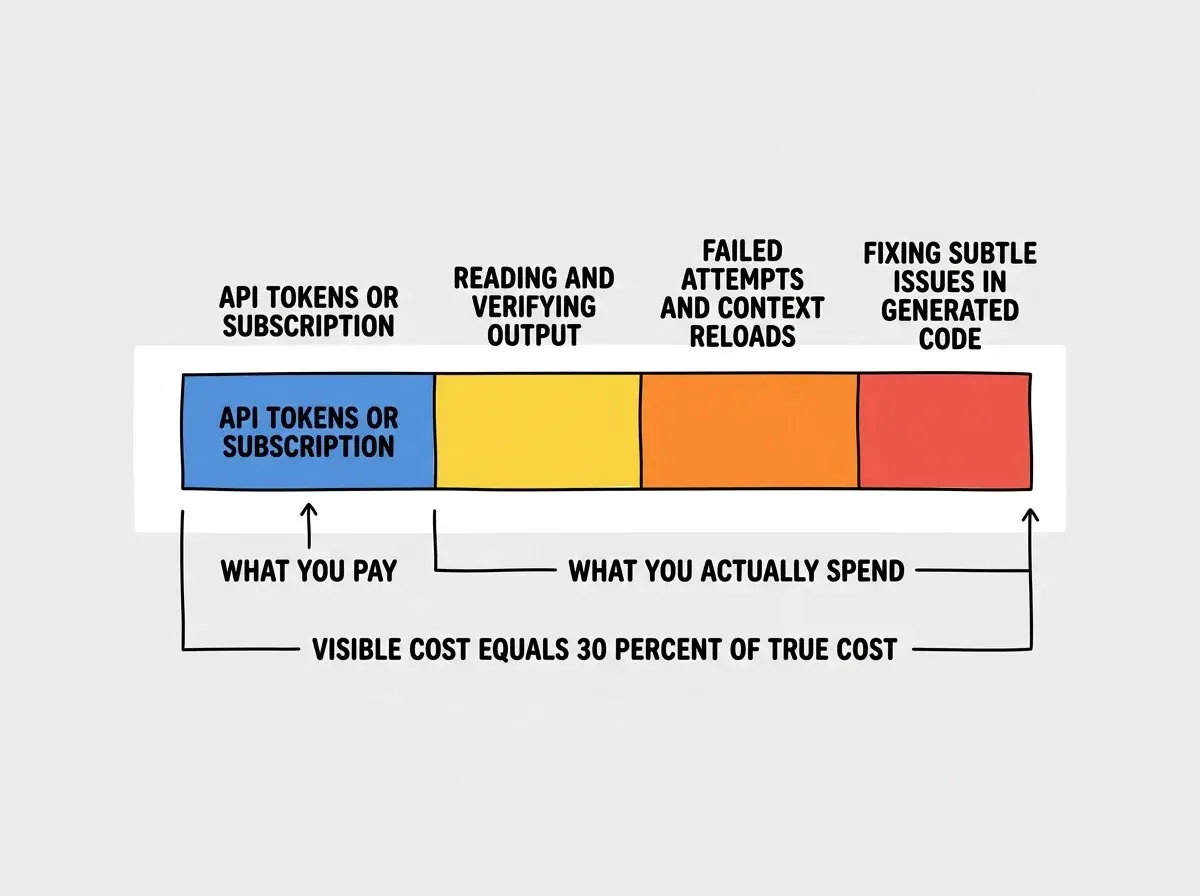
Back to our junior contractor analogy. When you hire a junior contractor at $30/hour, the real cost is not $30/hour. It is $30/hour plus the time you spend reviewing their work, explaining requirements they misunderstood, and fixing the things they got almost right. Autonomous agents have the same hidden costs, and they are substantial.
Debugging agent output. Autonomous agents produce code that works on the surface but contains subtle issues. Wrong error handling patterns, missing edge cases, security holes that pass basic tests. Every hour your agent saves you writing code, you spend some fraction of an hour reviewing and fixing what it wrote.
Context window reruns. This is the cost that catches most developers off guard. When an API-based agent like Cline hits a complex problem, it often needs multiple attempts. Each attempt re-sends your entire codebase context plus the conversation history. A project with 50K tokens of context costs roughly $0.15-0.75 per API call just for the input tokens. An agent that makes 20 attempts at a tricky bug just spent $3-15 on input alone before generating a single useful line.
Yak shaving at scale. A human developer recognizes when a task is going sideways and pivots. An autonomous agent will happily spend 45 minutes installing dependencies and fixing type errors that exist only because it hallucinated an API. You come back to find your junior contractor has reorganized the entire filing cabinet instead of writing the one document you asked for.
Context switching cost to you. When an agent fails partway through a task, you have a codebase in a state you did not create. Understanding what it changed and why is often harder than doing the task yourself from scratch.
When Autonomous Agents Save Money
Not every task is a trap. Autonomous agents genuinely save money in specific, predictable scenarios. The pattern is clear once you see it.
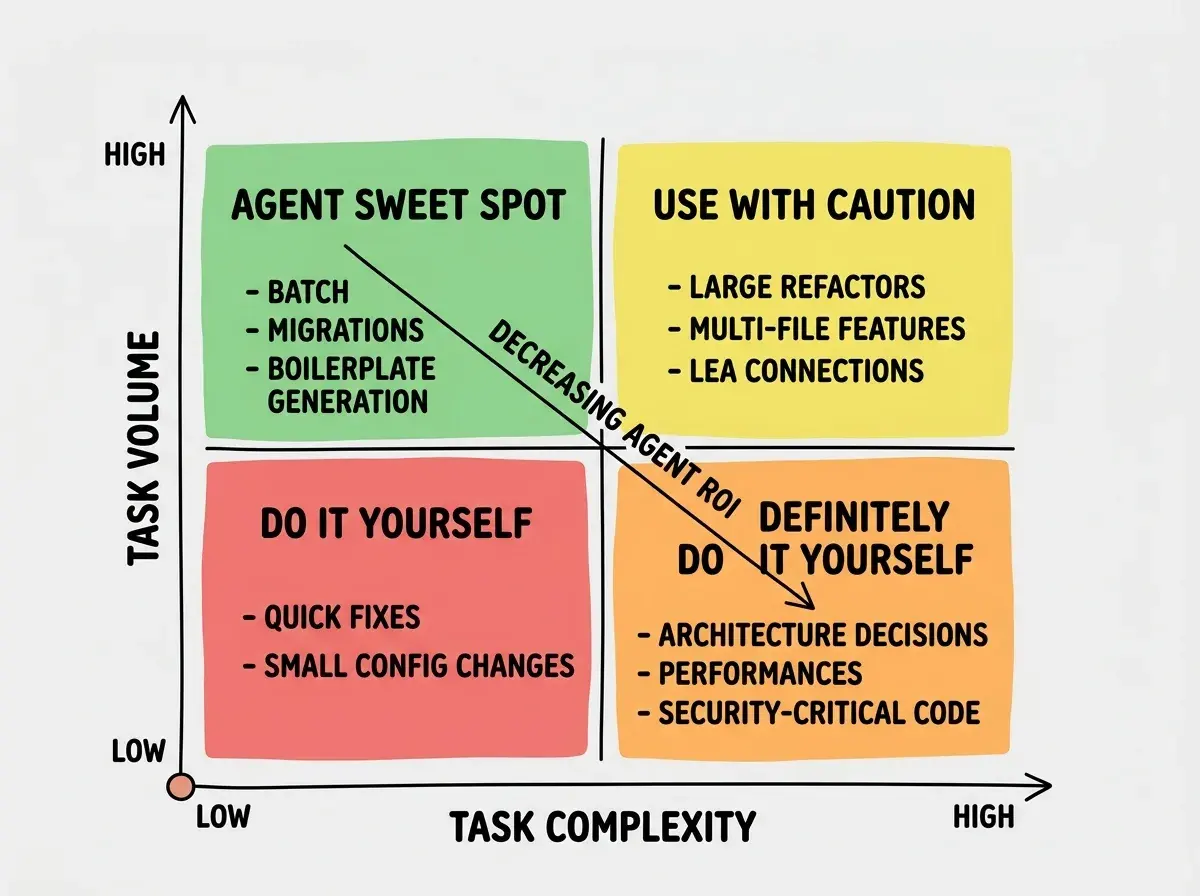
Batch repetitive work with clear patterns. Need to add TypeScript types to 50 untyped files? Migrate 200 components from one CSS framework to another? Convert a test suite from Jest to Vitest? The pattern is consistent, the success criteria are obvious (it compiles, tests pass), and the cost of a mistake is low. Your junior contractor is excellent at painting 50 identical fence posts. Let them paint fence posts.
Boilerplate generation across a codebase. Creating CRUD endpoints, scaffolding new pages that follow an existing pattern, generating migration files from a schema change. When the output is 90% structural and 10% logic, agents produce reliable results because the patterns are well-represented in training data.
First drafts of documentation and tests. An autonomous agent can generate initial test coverage faster than you can write it manually. The tests will not be great. They will miss edge cases. But they give you a starting point that is cheaper to refine than to create from nothing.
After-hours background tasks. Devin's strongest argument is that it works while you sleep. Queue up ten well-defined tasks before bed, wake up to PRs that need review instead of starting from scratch. Five minutes reviewing a PR beats thirty minutes writing the code yourself, even if two of the ten PRs need to be thrown away.
See which development tools actually deliver on their promises.
Browse tool reviewsWhen Autonomous Agents Waste Money
The same junior contractor who paints fence posts beautifully will make a mess of your kitchen renovation. Autonomous agents have the same failure mode: novel tasks, ambiguous requirements, and complex architectural decisions.
Novel problems that require reasoning. If the task requires understanding why your system is designed a certain way before changing it, an autonomous agent will skip the understanding part and go straight to changing things. Debugging a race condition or fixing a subtle performance regression requires contextual reasoning that agents consistently fail at. You pay for the agent's attempt, pay to review its wrong approach, and then pay with your own time to do it correctly.
Tasks with vague acceptance criteria. "Make the dashboard look better" is a task a senior developer interprets through experience and taste. An autonomous agent interprets it literally and often incorrectly. It might reorganize your entire component structure when you wanted a CSS tweak. The vaguer the task, the more expensive the agent becomes because you pay for multiple wrong attempts.
Anything touching authentication, payments, or security. The cost of an agent-generated security vulnerability is not measured in tokens. If your autonomous agent writes a Stripe integration that accidentally charges customers twice, the real cost is customer trust and potentially legal liability. Some code paths should never be delegated to unsupervised automation.
Small, quick tasks. If a task takes you five minutes to do manually, sending it to an autonomous agent is almost always more expensive. The overhead of prompting, waiting, and reviewing costs more than just doing it. Your contractor charges a minimum of two hours even if the job takes ten minutes.
Running an autonomous agent on a task without estimating what it would cost to do manually first. Developers get excited about delegation and queue up every task without considering that a $12 agent run on a 5-minute manual task is a 10x cost increase. Before assigning a task to an agent, ask yourself: would I pay a contractor $15 to do this? If not, do it yourself.
A Simple Framework for Deciding
Before you send a task to your autonomous agent, run it through this filter.
Give it to the agent if:
- The task has a clear, testable definition of done (tests pass, types check, build succeeds)
- You have seen the agent succeed at this type of task before
- The cost of failure is low (you can revert and try again cheaply)
- The task is one of many similar tasks (batch economics)
Do it yourself if:
- The task requires understanding context the agent does not have
- You cannot easily verify correctness by running automated checks
- The task touches security-critical code paths
- It would take you less than 15 minutes manually
The break-even calculation is straightforward. Estimate your hourly rate. Estimate the task duration manually. Multiply to get your cost. Then estimate the agent's total cost including tokens, review time, and probability of failure. If the agent is cheaper, delegate. If not, do it yourself.
For most developers, the sweet spot is using autonomous agents for 20-30% of their tasks. Trying to push that to 80% is where costs spiral because you are forcing the agent into tasks it is structurally bad at.
Learn how to measure the real ROI of every tool in your stack.
Read the analysisWhat This Means For Your Budget
Autonomous agent costs are real, growing, and poorly understood by most developers paying them. The $500/mo Devin subscription or the $200/mo in API tokens is only the visible portion. The true cost includes your review time, failed attempts, and the occasional mess that takes longer to clean up than doing it right from the start.
The developers who get the most value treat agents exactly like that junior contractor. You give them well-scoped tasks with clear acceptance criteria, check their work regularly, and save the complex judgment calls for yourself. Track your cost per completed task, compare it to your manual cost, and cut the tasks where the agent consistently costs more. That is the entire strategy.