The convergence of code editors and app builders is the 2026 phenomenon where Cursor adds drag and drop UI, Lovable adds code editing, Bolt adds component libraries, and Replit adds visual workflows. Four convergence patterns drive this, and the result is a unified tool category that did not exist 2 years ago. Understanding the convergence, its patterns, and what it means for tool selection helps developers and founders make decisions that age well as the category settles.
This piece walks through the four convergence patterns, why convergence is happening now, what the unified category looks like, and the four mistakes when interpreting the convergence trend.
Why Code Editor And App Builder Convergence Matters
Code editor and app builder convergence matters because it changes the tool selection problem. Old categories no longer describe new tools; old comparisons no longer help.
The 2026 reality is that tool boundaries have blurred dramatically. Selecting between "code editor" and "app builder" was 2024 thinking; selecting between unified tools is 2026 thinking.
A 2025 development tool market survey of 800 builders found that 67 percent now use tools that combine code editing and visual building, up from 12 percent in 2024. The convergence has moved from edge case to mainstream pattern; tools that do not converge are losing ground.
The pattern to copy is the way smartphones converged cameras, music players, and computers into single devices. Convergence reduced choice complexity while expanding capability; tool category convergence works the same way.
The Four Convergence Patterns
Four patterns characterize code editor and app builder convergence.
Pattern 1, code editors adding visual capabilities. Cursor, Windsurf, and similar tools adding visual UI editing, component libraries, drag and drop. Code first tools adding visual capabilities.
Pattern 2, app builders adding code editing. Lovable, Bolt, and similar tools adding direct code editing, file system access, terminal integration. Visual first tools adding code capabilities.
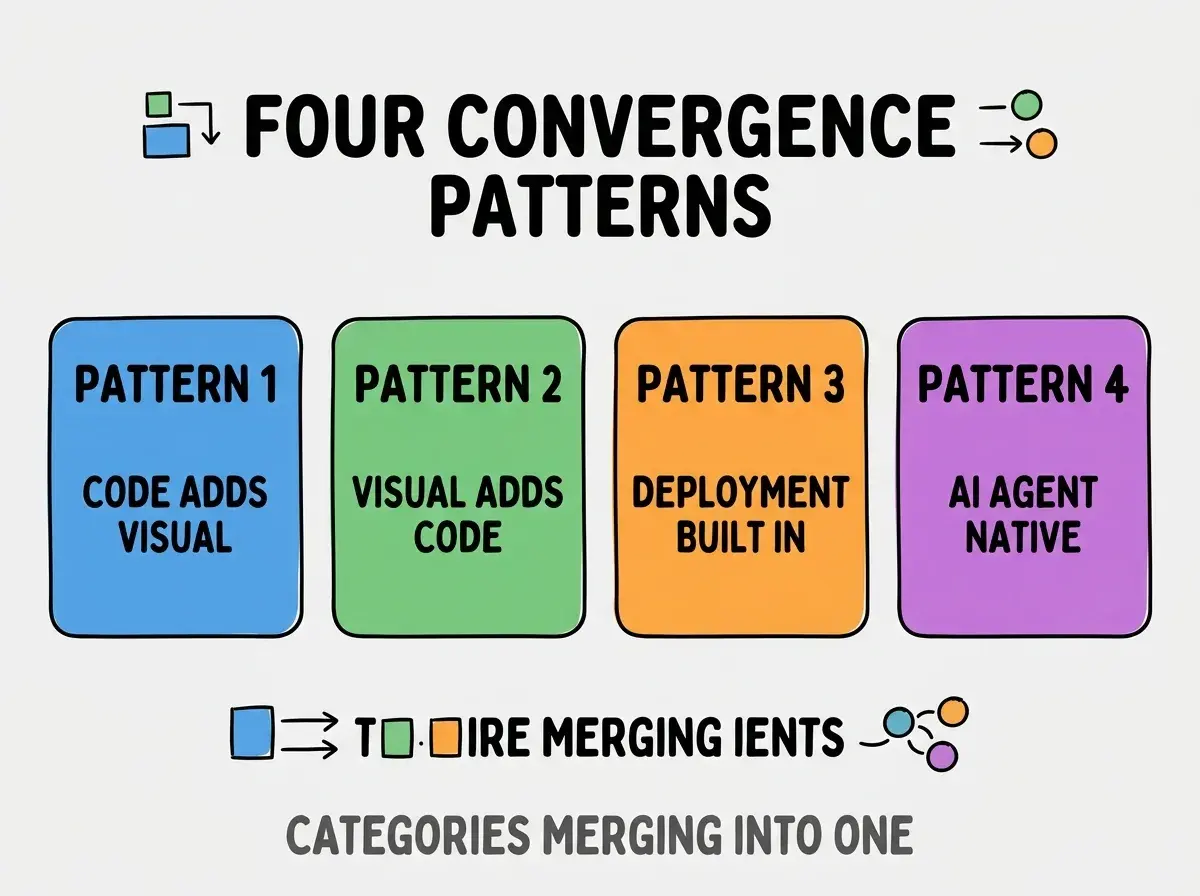
Pattern 3, deployment becoming built in. Both categories now include hosting, deployment, and infrastructure. Build to live cycle compresses.
Pattern 4, AI agent native architecture. New tools designed around AI agents from start; not retrofit. Agent native produces different ergonomics.
Why Convergence Is Happening Now
Three forces drive code editor and app builder convergence in 2026.
Force 1, AI capabilities erase old constraints. Code generation eliminates the "code is hard so use visual" tradeoff; visual generation eliminates "visual is limited so use code" tradeoff.
Browse more pulse
Read more pulseForce 2, user demand for unified workflows. Builders dislike switching tools; unified tools win even with capability tradeoffs.
Force 3, competitive dynamics push toward parity. Each tool wants to capture maximum users; capturing requires matching competitor features. Matching produces convergence.
The combination explains why convergence accelerated through 2025 and 2026. Forces will likely continue producing further convergence.
What The Unified Category Looks Like
Three patterns characterize the unified development tool category.
Pattern 1, three modes of work coexist. Visual building, AI prompting, direct code editing all available; users move between modes as task requires.
Pattern 2, workflow continuity between modes. Changes in one mode reflect in others; no lossy translation. Continuity matters for adoption.
Pattern 3, deployment and hosting integrated. Single click from edit to live; no separate hosting tool needed. Integration reduces complexity.
The combination defines what "converged tool" means in 2026. Tools matching all three patterns have advantage; tools missing patterns lose ground.
What Makes Convergence Sustainable
Three patterns separate sustainable convergence from feature creep convergence.
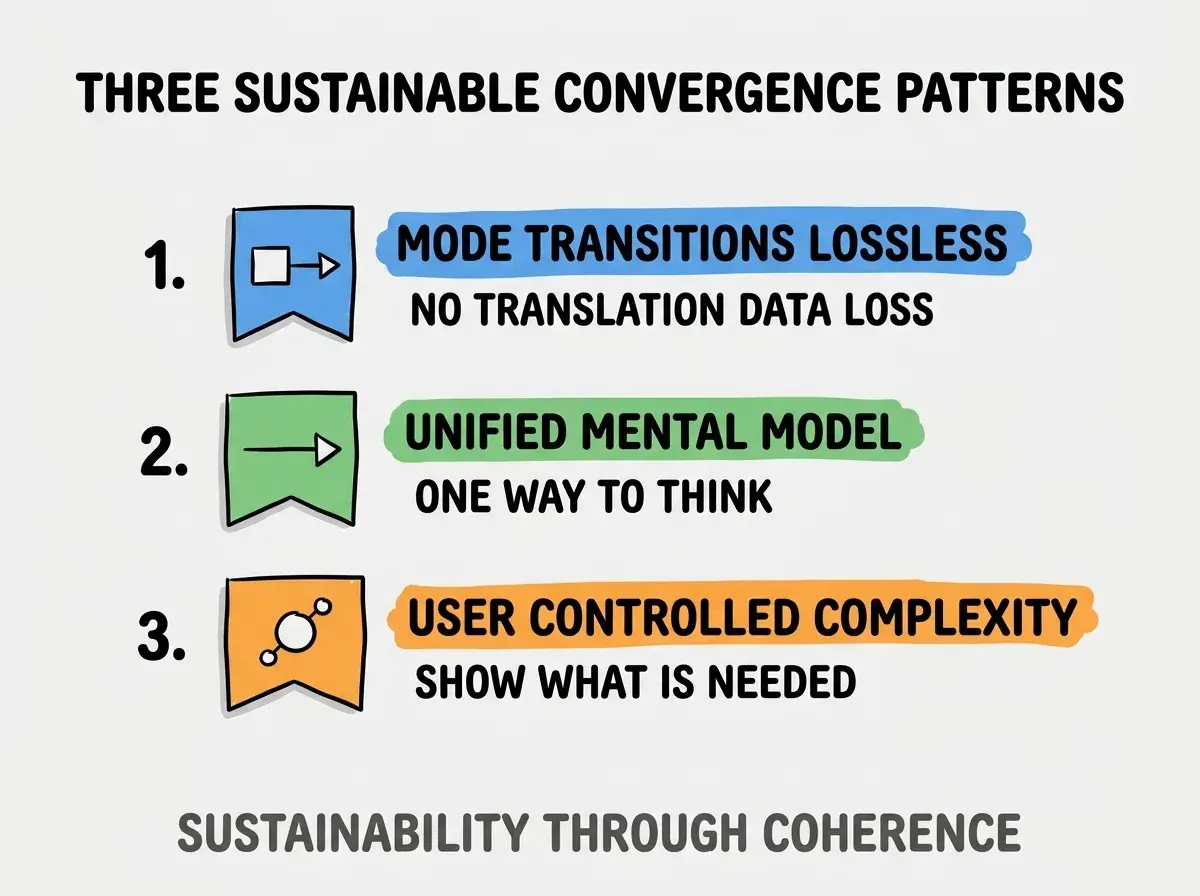
Pattern 1, mode transitions lossless. Switching between visual and code preserves work. Without losslessness, mode switching produces friction.
Pattern 2, unified mental model across modes. Same concepts, same vocabulary, same patterns regardless of mode. Unified model reduces cognitive load.
Pattern 3, user controlled complexity. Surface only the complexity user needs; hide rest. Without control, converged tools overwhelm beginners.
The combination produces sustainable convergence. Without these patterns, convergence becomes feature bloat that satisfies no audience.
How To Choose Tools In Converged Category
Three selection patterns help tool choice in the converged category.
Pattern A, evaluate primary mode preference. Code first or visual first preference shapes which converged tool fits. Preference is not wrong; tools serve different preferences.
Pattern B, test mode transitions specifically. Build something visual, switch to code, switch back. Friction in this test predicts friction in usage.
Pattern C, evaluate deployment integration depth. Some tools integrate deployment well; others integrate poorly. Depth matters for production usage.
The combination produces tool selection matched to actual workflow. Without these patterns, selection follows brand awareness or recent demos.
Common Questions About Convergence
Code editor and app builder convergence raises questions worth addressing directly.
The first question is whether convergence kills specialized tools. No; specialized tools survive in niches. Convergence dominates middle market; niches keep specialists.
The second question is whether to switch tools as convergence proceeds. Generally no; switching has cost. Switch when current tool stops evolving or specific need emerges.
The third question is whether converged tools are complete replacements for specialized tools. For most builders yes; for specialized work, specialized tools still win.
The fourth question is what to do when convergence makes your favorite features redundant. Adapt; redundant features get cut. Resist nostalgia for features that no longer differentiate.
How Convergence Affects Tool Markets
Convergence affects tool markets in compounding ways. Market effects compound across years.
The first compounding effect is consolidation. Many tools converging means fewer winners in each category. Consolidation reduces choice.
The second compounding effect is pricing pressure. Converged tools compete with each other directly; competition drives pricing down.
The third compounding effect is innovation pace. Converged tools innovate across more dimensions; pace accelerates as competition intensifies.
The combination produces market dynamics that benefit users while challenging tool makers. Users get more for less; makers face higher competitive pressure.
How To Build Skills That Survive Convergence
Three skill patterns help developers navigate converged tool category.
Pattern A, focus on patterns over tool specifics. Tool specific skills depreciate; pattern skills transfer across tools.
Pattern B, build agent collaboration skills. AI agents work across all converged tools; agent skills transfer.
Pattern C, develop deployment and integration skills. Deployment patterns transfer across tools; specific tool deployment differs in details.
The combination produces skills resilient to tool churn. Without pattern focus, skills become outdated as tools converge.
The most damaging convergence interpretation mistake is treating it as zero sum competition between tool categories. Convergence is positive sum; users get capability that neither original category provided alone. The fix is to evaluate converged tools on their merits, not against the category they came from; new category requires new evaluation criteria. Builders who use new criteria produce better tool decisions than builders who use legacy criteria.
The other mistake is assuming all converged tools are equivalent. Significant differentiation remains across dimensions; surface similarity hides depth differences.
A third mistake is missing the agent native shift. Tools designed agent native have advantages; tools retrofitting AI face limits.
A fourth mistake is treating convergence as complete. Convergence continues; current state is mid trajectory, not destination.
What This Means For You
Code editor and app builder convergence reshapes tool selection and skill investment. The four patterns, selection criteria, and skill recommendations produce framework for navigating the converged category.
- If you're a senior dev: Evaluate converged tools alongside specialized ones; capability gap may be smaller than reputation suggests.
- If you're a founder: Default to converged tools for new projects; specialized tools require specific justification.
- If you're a product manager: Track convergence in your tool category; convergence affects competitive dynamics that affect product strategy.
Browse more pulse
Read more pulse