To understand context window degradation and why AI quality drops as projects grow, recognize the four degradation patterns AI exhibits at scale (lost coherence between distant code sections, forgotten context introduced earlier in session, conflated patterns from similar but distinct code, and incomplete understanding of project structure), see how degradation emerges from context window limits, and apply the patterns that maintain AI quality at project scale. The degradation understanding matters because all projects eventually exceed AI context window capacity.
This piece walks through the four degradation patterns, why they emerge, the mitigation patterns, and the four mistakes that accelerate context degradation.
Why Context Window Degradation Matters
Context window degradation matters because it determines AI quality ceiling for project scale. The ceiling matters; projects that exceed AI context capacity face quality degradation that smaller projects do not face.
The 2026 reality is that AI context windows have grown dramatically but project complexity grows faster. Even 1M token context windows fill up; understanding degradation enables effective work despite window limits.
A 2025 AI coding study tracking 100 projects from inception to 100K lines of code found that AI suggestion quality dropped 47 percent as projects grew past 50K lines without explicit context management. Among projects with structured context management, quality maintained at higher levels through scale; degradation depends on management practices not just project size.
The pattern to copy is the way librarians manage knowledge at scale. Librarians do not memorize entire library; they use catalog systems that surface relevant information. AI follows similar pattern; surfacing relevant context matters more than fitting all context in window.
The Four Degradation Patterns
Four patterns characterize AI context window degradation.
Pattern 1, lost coherence between distant code sections. AI generates code that contradicts patterns established in distant files. Distance produces contradiction.
Pattern 2, forgotten context introduced earlier in session. AI loses track of constraints mentioned earlier in long sessions. Forgetting produces inconsistency.
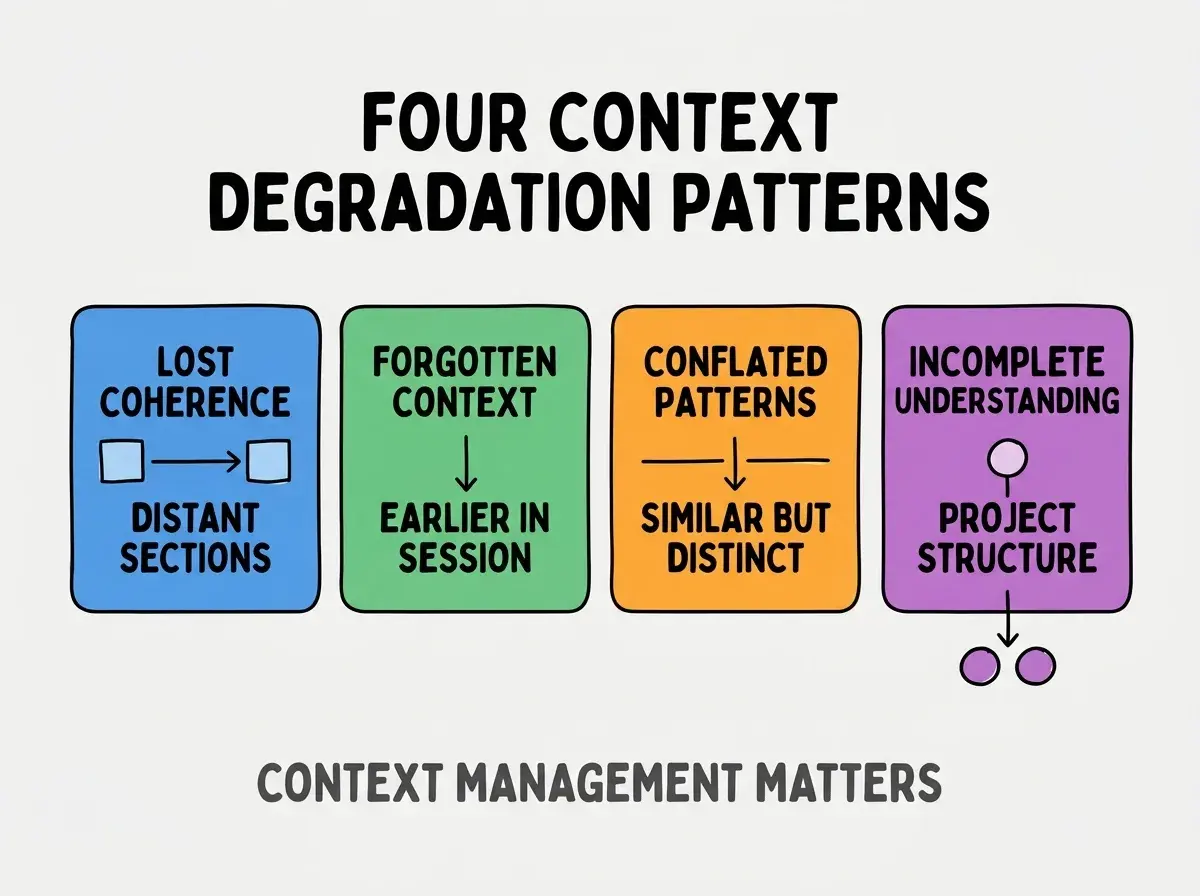
Pattern 3, conflated patterns from similar but distinct code. AI mixes patterns from different but similar code sections. Conflation produces hybrid bugs.
Pattern 4, incomplete understanding of project structure. AI loses sense of how project pieces fit together at scale. Loss produces architectural mistakes.
Why Degradation Emerges
Three reasons explain why context window degradation happens.
Reason 1, context windows have hard limits. Beyond limits, context gets truncated or summarized. Limits produce information loss.
Browse more foundations
Read more foundationsReason 2, attention degrades within context window. Even within window, AI attention varies; middle context often gets less attention. Attention pattern produces uneven quality.
Reason 3, project complexity grows faster than context windows. Code, documentation, history all expand. Growth outpaces window expansion.
The Mitigation Patterns That Work
Three patterns mitigate context window degradation.
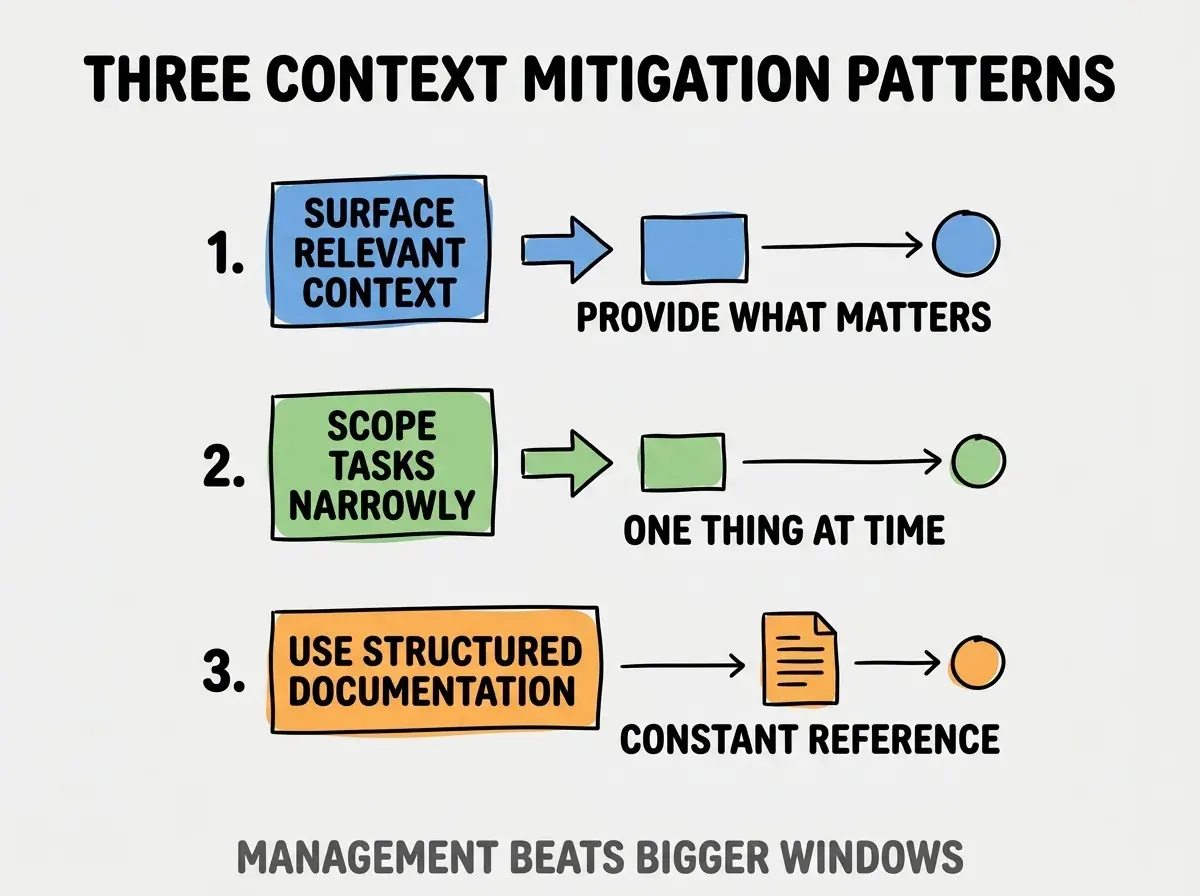
Pattern 1, surface relevant context explicitly. Including only relevant code, constraints, examples. Selectivity preserves window for important context.
Pattern 2, scope AI tasks narrowly. One concern per AI session. Narrow scope reduces context demands.
Pattern 3, use structured documentation as constant reference. README, architecture docs, conventions. Structured docs replace conversation context with persistent reference.
What Makes Context Management Sustainable
Three patterns separate sustainable context management from problematic patterns.
Pattern 1, context management becomes habit not afterthought. Habit develops through deliberate practice. Without habit, context management gets skipped under pressure.
Pattern 2, project organization supports context surfacing. Clear file naming, focused modules, consistent patterns. Organization makes context surfacing easier.
Pattern 3, periodic context review catches degradation. Periodic review catches patterns that incremental work misses. Without review, degradation accumulates.
The combination produces context management that scales with project growth. Without these patterns, context degradation eventually limits AI value.
How To Recognize Degradation Symptoms
Three symptoms reveal context window degradation.
Symptom 1, AI suggestions contradicting existing patterns. Generated code uses different conventions than rest of codebase. Contradiction signals lost coherence.
Symptom 2, AI repeating mistakes corrected earlier. Same correction happens multiple times in session. Repetition signals forgotten context.
Symptom 3, AI suggestions missing obvious project context. Suggestions ignore established conventions or constraints. Missing context signals incomplete understanding.
The combination produces symptom recognition that enables targeted intervention. Without recognition, degradation continues unchecked.
The most damaging context window mistake is treating bigger context windows as solution to degradation. Bigger windows reduce frequency but do not eliminate degradation; attention patterns within windows still produce quality variation. The fix is to combine bigger windows with explicit context management; surfacing relevant context matters even when full context fits in window. Engineers who manage context produce better outcomes than engineers who rely on window size alone.
The other mistake is loading entire codebase into context. Entire codebase often exceeds attention; loading produces processing overhead without quality gain. The fix is to load selectively based on relevance.
A third mistake is treating context management as one time setup. Context needs change as project evolves; management requires ongoing attention.
A fourth mistake is missing the documentation as context reference. Documentation reduces conversation context burden when written for AI consumption.
How To Structure Projects For Better AI Context
Three structural patterns reduce context window pressure.
Pattern A, clear module boundaries with focused responsibility. Each module does one thing; AI work scopes naturally to single module. Without boundaries, context spreads across many concerns.
Pattern B, consistent patterns across similar concerns. Consistency reduces context AI needs to understand each piece. Without consistency, each piece requires its own context.
Pattern C, explicit documentation of decisions and conventions. Documentation captures context that conversation cannot preserve. Without documentation, context gets re explained repeatedly.
The combination produces project structure that supports AI work at scale. Without structure, AI context demands grow faster than projects.
How Context Window Capabilities Will Likely Evolve
Context window capabilities will likely continue improving but management remains important.
The first likely evolution is window sizes continuing to grow. 10M tokens, 100M tokens become accessible. Growth reduces but does not eliminate management need.
The second likely evolution is attention quality improving within windows. Better attention to all context regardless of position. Improvement reduces middle context degradation.
The third likely evolution is automatic context management emerging. AI tools that surface relevant context automatically. Automation reduces manual context management burden.
The combination suggests context management will remain important but become more tooled. Engineers learning patterns now build skills that remain valuable as tools mature.
Common Questions About Context Window Degradation
Context window degradation raises questions worth addressing directly.
The first question is when to start worrying about context degradation. From project start; managing context early prevents accumulation of issues. Early management is easier than late mitigation.
The second question is whether to switch tools when degradation appears. Sometimes; tools differ in context handling. Switch if current tool consistently degrades despite management practices.
The third question is whether breaking projects into smaller pieces helps. Yes; smaller projects fit context better. Breaking helps when project structure permits.
The fourth question is how to test whether degradation is happening. Compare AI suggestion quality on similar tasks across project growth points; quality drops indicate degradation. Without explicit testing, degradation accumulates invisibly.
What This Means For You
Context window degradation determines AI quality ceiling at project scale. The four patterns, mitigation approaches, and structural patterns produce framework for maintaining quality as projects grow.
- If you're a senior dev: Context management becomes critical skill at project scale. Invest in management practices; they apply across tools.
- If you're an indie hacker: Solo projects accumulate context demands gradually. Build management practices early to prevent degradation accumulation.
- If you're a founder: Help engineering team prioritize context management practices. Without management, AI value erodes as projects grow.
Browse more foundations
Read more foundations