To understand the three major compliance frameworks vibe coders need to know in 2026, recognize that SOC 2 covers operational security for businesses with enterprise customers, GDPR covers EU citizens' privacy regardless of business location, and HIPAA covers protected health information in US healthcare contexts. Most vibe-coded products need none of them initially; the question of which apply becomes important once you have specific customer types or geographic markets that trigger requirements.
This piece walks through the four key differences between the three frameworks, the trigger conditions that make each one apply, the order to tackle them in, and the four mistakes that lead to expensive compliance retrofits.
Why Compliance Basics Matter Even for Small Products
Small products often dismiss compliance as "enterprise concerns" until they hit a deal that requires it. A SaaS product gets a 6-figure deal contingent on SOC 2 attestation; a marketplace expands to Europe and discovers GDPR; a health-tech startup discovers HIPAA after a breach exposes them to fines. In each case, the compliance gap blocks revenue or creates liability.
The 2026 advantage is that compliance frameworks are better-understood and the tooling has matured. Achieving SOC 2 used to require months of consulting; now it is achievable in weeks for small products willing to systematize. Knowing the basics helps you avoid retrofitting compliance into products that should have been built with it in mind.
A 2025 Vanta survey of 1,500 SaaS startups found that 73 percent reported losing at least one enterprise deal due to incomplete compliance documentation. The median deal size lost was $35K annual contract value; total revenue impact across the surveyed startups was $48M. Compliance is a sales blocker, not just a legal requirement, and the cost of the gap shows up in lost deals long before it shows up in fines.
The pattern to copy is the way professional kitchens approach food safety. Food safety is not optional for restaurants serving the public; the protocols are baked into operations from day one. Compliance frameworks are the food safety of software businesses serving regulated markets. You either build with them in mind or retrofit them painfully later.
The Three Frameworks at a Glance
Each framework covers different concerns. Knowing the basics prevents confusion about which applies.
Framework 1, SOC 2. Operational security for businesses serving enterprise customers. Voluntary attestation showing your security practices meet defined standards. Most B2B SaaS needs this for enterprise sales.
Framework 2, GDPR. Privacy protection for EU citizens. Mandatory if you have EU users (regardless of where your business is located). Massive fines for violations.
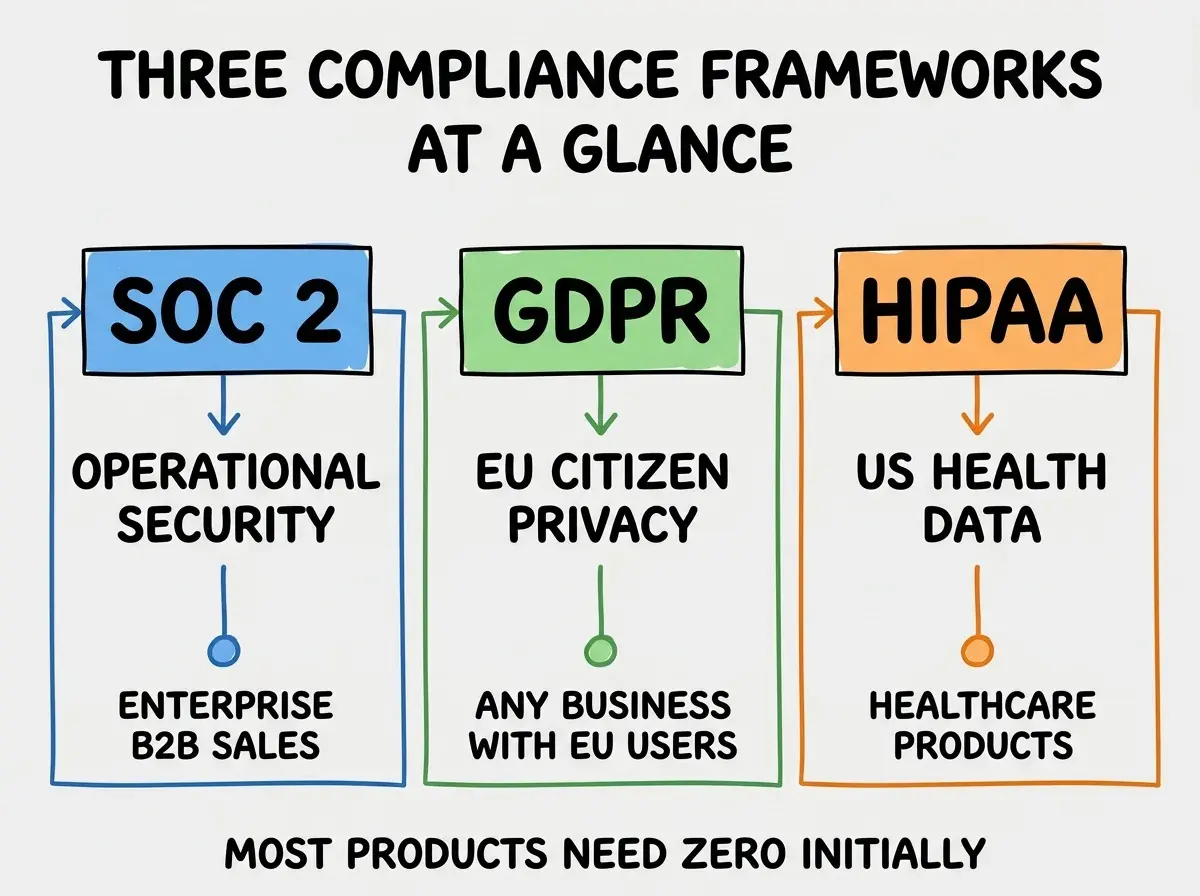
Framework 3, HIPAA. Protected health information in US healthcare contexts. Required if you handle health data from US healthcare providers, insurers, or their business associates.
The Four Key Differences
Beyond the headline scope, four differences determine how each framework works in practice.
Difference 1, voluntary vs mandatory. SOC 2 is voluntary (driven by customer demand). GDPR and HIPAA are mandatory (legal requirement when triggers apply).
Difference 2, attestation vs certification. SOC 2 produces an attestation report from an auditor. GDPR has no formal certification (compliance is your responsibility to maintain). HIPAA has neither but enforcement actions hit non-compliant entities.
Browse more operations guides
Read more grow articlesDifference 3, scope of coverage. SOC 2 covers your operational security broadly. GDPR is specifically about personal data. HIPAA is specifically about health data.
Difference 4, consequence of non-compliance. SOC 2: lost deals. GDPR: fines up to 4 percent of global annual revenue. HIPAA: fines up to $1.5M per year per violation category.
When Each Framework Applies to You
Three trigger conditions determine which frameworks you actually need.
Trigger for SOC 2. Selling to enterprise customers (typically $50K+ contract values) who include security requirements in their procurement. If your sales conversations include "we need your security questionnaire," you need SOC 2.
Trigger for GDPR. Any user from the EU. Even if your business is US-based and 99% of users are American, the 1% from EU triggers GDPR for those users. If you collect emails or run analytics, you almost certainly have EU users.
Trigger for HIPAA. Handling protected health information from US healthcare providers, insurers, or their business associates. Direct-to-consumer health apps usually do not trigger HIPAA; B2B health tech almost always does.
Most vibe-coded products initially trigger only GDPR (because EU users are unavoidable for any internet product). SOC 2 and HIPAA become relevant when specific customer types appear.
The Order to Tackle Compliance
Three principles guide which framework to tackle first.
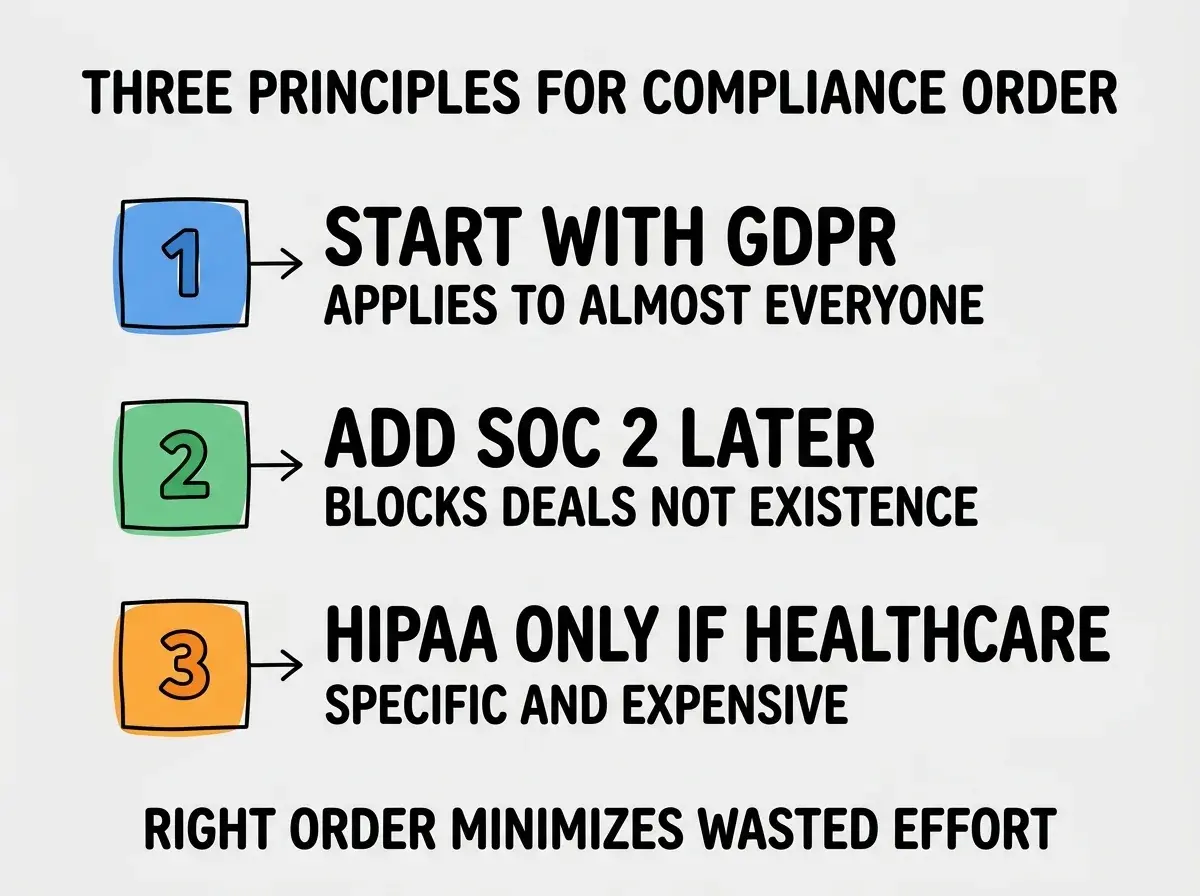
Principle 1, start with GDPR. Almost every internet product has EU users. Basic GDPR compliance (privacy policy, cookie consent, data deletion on request) is a one-day implementation. Do this first.
Principle 2, add SOC 2 when enterprise sales appear. Do not pursue SOC 2 before you have enterprise sales conversations that require it. Pursuing it preemptively wastes 3-6 months on a framework that may not be needed yet.
Principle 3, HIPAA only if you are in healthcare. HIPAA is significantly more complex than the other two. Pursue it only if you are explicitly building healthcare products. Other compliance work does not satisfy HIPAA, so getting it wrong is expensive.
What Compliance Tooling to Use
Modern compliance tooling reduces the time investment dramatically. Three categories cover most needs.
Category 1, attestation platforms. Vanta, Drata, Secureframe automate the SOC 2 documentation work. Reduce SOC 2 timeline from 12 months to 3 months. Worth their cost for any SOC 2 effort.
Category 2, GDPR consent management. Cookiebot, OneTrust, Termly handle cookie consent and privacy policy generation. Free or low-cost tier handles most small product needs.
Category 3, HIPAA-compliant infrastructure. AWS, GCP, and Azure all offer HIPAA-eligible services with Business Associate Agreements. Use them rather than rolling your own HIPAA infrastructure, because the BAA itself is a major piece of HIPAA compliance that hyperscalers handle automatically once you sign their agreement.
The right tooling makes compliance tractable for small teams. Without the tools, compliance work takes 5 to 10 times longer.
The most damaging compliance mistake is treating it as a one-time milestone rather than as an ongoing operational practice. Teams achieve SOC 2 attestation, celebrate, then let practices drift. The next year's audit reveals the gaps and they scramble. The fix is to build compliance practices into daily operations: access reviews quarterly, vendor reviews annually, employee security training continuously. The companies that maintain compliance year over year built operational rhythms; the companies that rebuild every year suffer through periodic crises.
The other mistake is over-claiming compliance to win deals before achieving it. A SaaS company tells an enterprise prospect "we are SOC 2 compliant" when they are mid-attestation; the prospect requests the report; the deal collapses because the report does not exist. The fix is to be precise about your status: "in process" versus "attested" matters significantly. Honesty about compliance status protects your reputation; over-claiming destroys it once it is discovered, and it always gets discovered eventually because enterprise procurement teams know how to verify these claims.
What This Means For You
Understanding compliance basics is one of those quiet operational competencies that becomes critical at specific moments. Knowing the basics now prevents painful retrofitting later.
- If you're a founder: Implement basic GDPR compliance from day one. Plan for SOC 2 when your sales conversations start including security questionnaires.
- If you're changing careers into a SaaS role: Compliance literacy is increasingly expected for senior product and engineering positions. Knowing the frameworks demonstrates business maturity.
- If you're a student: Read each framework's overview documentation once. The exposure builds intuition that becomes valuable in your first compliance-relevant project.
Browse more operations guides
Read more grow articles