Code organization patterns AI coding tools skip by default include consistent file naming, separation of concerns across layers, single responsibility per module, and dependency direction enforcement. AI generates working code that often violates these patterns; violations accumulate as technical debt that slows future development. Adding organization enforcement to CLAUDE.md, code review, and CI catches violations early when fixes are cheap.
This deep dive walks through the four organization patterns, why AI skips each, how to enforce them, and the four mistakes builders make when adding organization to vibe coded projects.
Why Code Organization Matters For AI Projects
Code organization matters specifically for AI projects because AI generates code volume faster than traditional development. Disorganized code at AI scale becomes unmaintainable faster than disorganized human code.
The 2026 reality is that organization debt accumulates invisibly until it dominates development time. Refactoring at year two costs ten times what enforcement at month one would have cost.
A 2025 maintenance cost study of 200 vibe coded projects found that projects with enforced organization patterns spent 67 percent less time on maintenance than projects without enforcement. Enforcement upfront produces dramatic long term savings.
The pattern to copy is the way warehouses use consistent shelving systems. Random shelving works for small inventories; large inventories require systems. AI generated codebases follow the same principle; system enforcement matters more as scale grows.
The Four Organization Patterns AI Skips
Four patterns characterize AI organization failures.
Pattern 1, inconsistent file naming. Some files use kebab-case, others use camelCase, others use PascalCase. Inconsistency forces lookup overhead.
Pattern 2, mixed concerns across layers. Database queries in components, UI logic in API routes, business logic in middleware. Mixed concerns produce coupling.
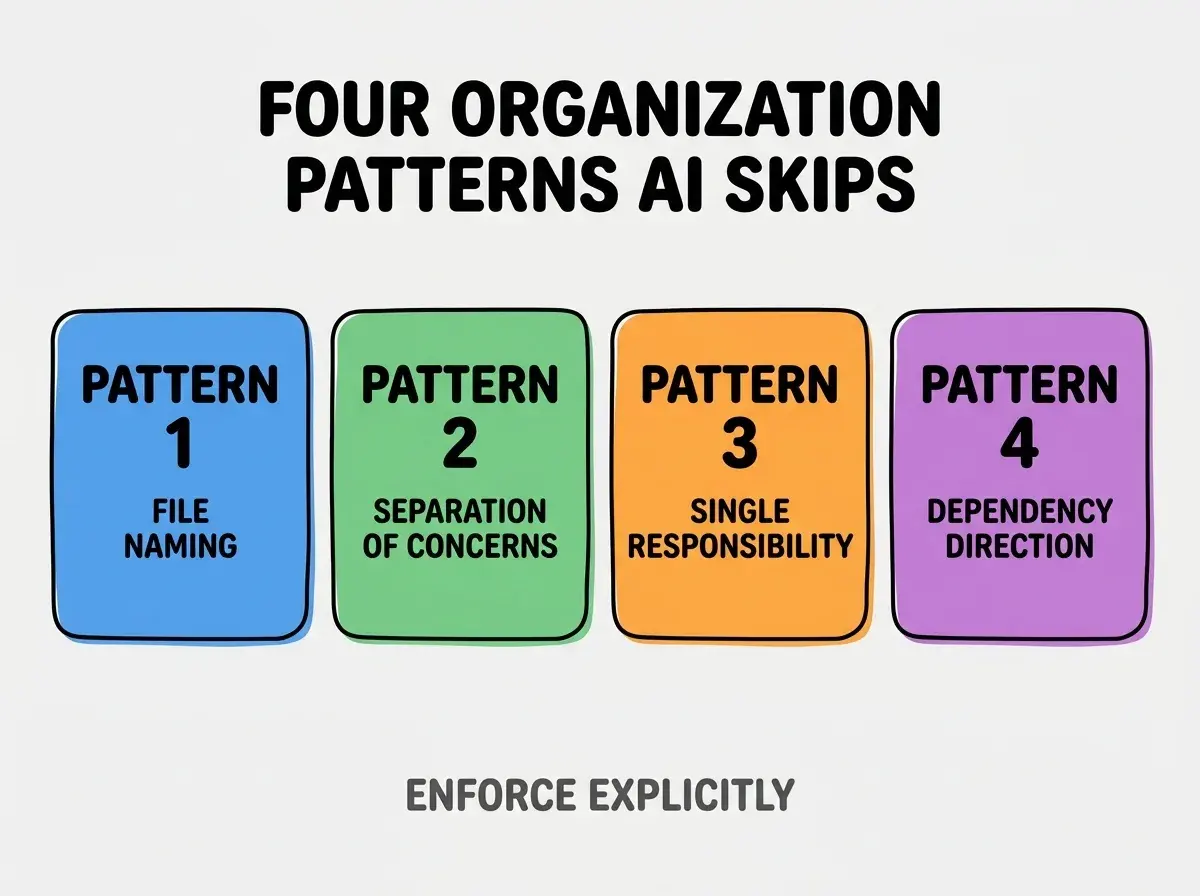
Pattern 3, multiple responsibilities per module. Single file containing routing, validation, database access, response formatting. Multiple responsibilities prevent reuse.
Pattern 4, wrong dependency direction. Low level utilities depending on high level features. Wrong direction prevents extraction.
Why AI Skips These Patterns
Three reasons explain AI organization failures.
Reason 1, training data variance. AI trained on code with mixed organization quality; outputs reflect input variance.
Browse more ship articles
Read more shipReason 2, optimization for working code. AI optimizes for code that runs; organization is secondary objective without explicit prompting.
Reason 3, no project context awareness. AI generates each request fresh; project conventions invisible without explicit reference.
How To Enforce Each Pattern
Four enforcement approaches address the four failures.
Enforcement 1, file naming convention in CLAUDE.md. Document convention; reference in every prompt. AI follows documented conventions reliably.
Enforcement 2, layer separation via folder structure. Folders enforce concerns. components/, lib/, app/api/ structure makes mixing harder.
Enforcement 3, file size limits for single responsibility. ESLint rule limiting file size to 200 lines forces split when responsibilities grow.
Enforcement 4, dependency cruiser for direction. Tool like dependency-cruiser enforces dependency rules in CI; violations block merge.
What Makes Organization Enforcement Sustainable
Three patterns separate sustainable enforcement from temporary cleanup.
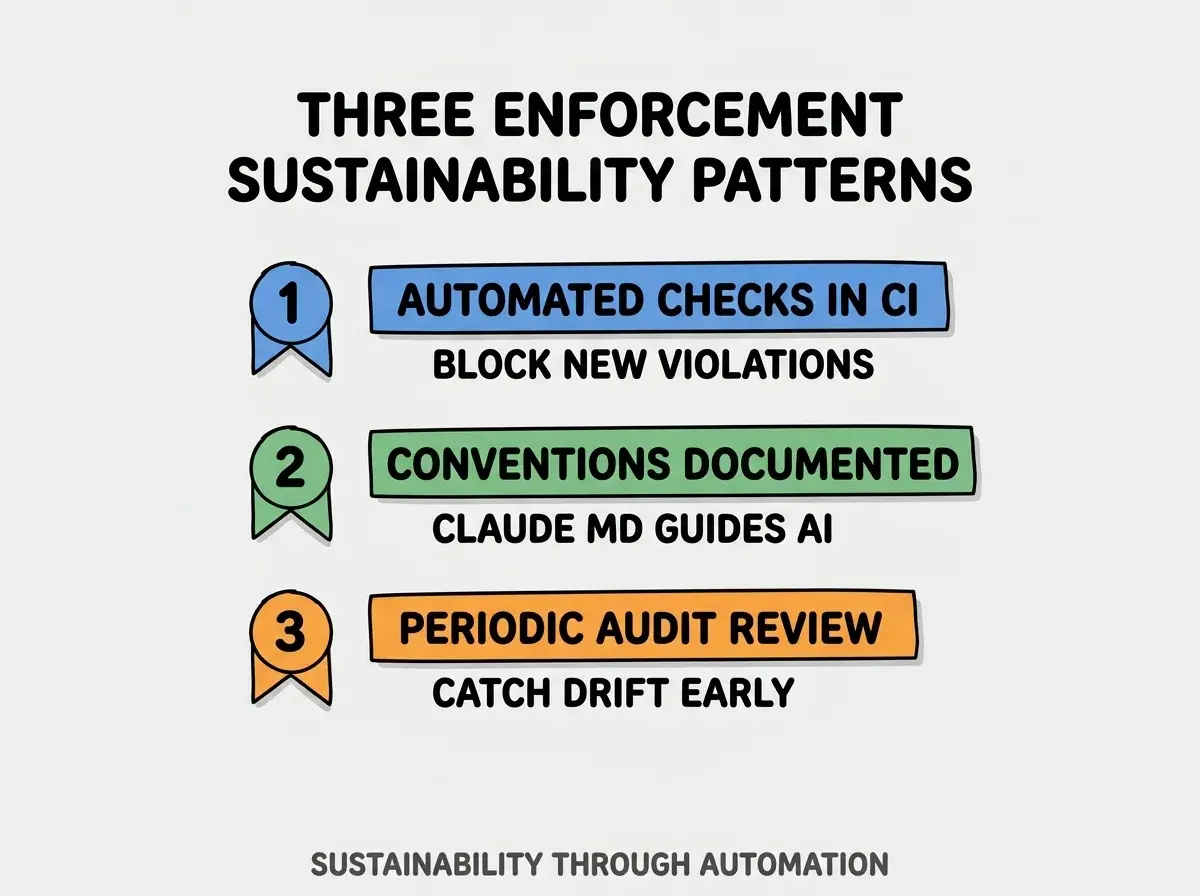
Pattern 1, automated checks in CI. ESLint, dependency cruiser, custom checks all run automatically. Manual checks fail.
Pattern 2, conventions documented in CLAUDE.md. AI reads conventions and follows them; documentation becomes enforcement.
Pattern 3, periodic audit review. Monthly review of organization metrics catches drift; drift compounds without review.
The combination produces sustainable organization. Without these patterns, enforcement is one time event.
How To Adopt Organization Progressively
Three adoption patterns help teams add organization to existing codebases.
Pattern A, fix newly added code first. New code follows new rules; old code grandfathered until touched.
Pattern B, fix during refactoring. When touching old code for other reasons, apply new organization. Spreads work over time.
Pattern C, dedicate quarterly cleanup time. Reserve days for pure organization work; addresses accumulated debt.
The combination produces sustainable adoption. Without progression, enforcement attempts produce overwhelming initial work.
Common Questions About Code Organization
Code organization for AI projects raises questions worth addressing directly.
The first question is whether organization rules slow AI generation. Slightly slower per generation; dramatically faster for total project completion due to reduced rework.
The second question is whether to use feature folders or type folders. Feature folders for larger projects; type folders for smaller. Convention matters more than choice.
The third question is whether AI tools could enforce organization automatically. Some yes; comprehensive enforcement still requires humans plus tools.
The fourth question is how strictly to enforce conventions. Strict enough that AI follows them; flexible enough for genuine exceptions. Balance matters.
How Organization Affects Long Term Velocity
Code organization affects long term velocity in compounding ways. Velocity effects compound across project lifetime.
The first compounding effect is onboarding speed. Organized code is faster to learn; new contributors productive faster.
The second compounding effect is bug rate. Organized code has lower bug rates; bug investigations resolve faster.
The third compounding effect is refactoring confidence. Organized code refactors safely; refactoring keeps code clean.
The combination produces velocity that increases over time. Without organization, velocity decreases as code accumulates.
How To Recover From Disorganized Existing Code
Three recovery patterns work for existing disorganized codebases.
Pattern A, document current organization first. Map current structure; documentation reveals problems before fixing them.
Pattern B, refactor by feature not by file. Refactor entire feature for organization rather than scattered file fixes.
Pattern C, use AI to suggest reorganization. AI tools can suggest reorganization plans; humans validate and apply.
The combination produces recovery for existing disorganization. Without recovery, disorganization compounds across years.
The most damaging organization mistake is treating organization as polish rather than foundation. Polish gets skipped under deadline pressure; foundation cannot be skipped because everything depends on it. The fix is to treat organization as foundation; document conventions before generation, enforce in CI from day one. Builders who treat organization as foundation produce maintainable AI codebases; builders who treat it as polish produce codebases that collapse under maintenance load.
The other mistake is over engineering organization for small projects. Solo weekend projects do not need enterprise level organization; match enforcement to project scale.
A third mistake is missing the AI prompting opportunity. AI follows documented conventions; documentation is leverage that compounds.
A fourth mistake is treating organization as one time setup. Conventions evolve as project grows; periodic review keeps conventions current.
What This Means For You
Code organization patterns AI doesn't follow without help require explicit enforcement to maintain code quality. The four patterns, enforcement approaches, and adoption strategies produce maintainable AI codebases.
- If you're a senior dev: Add organization enforcement to your team's CLAUDE.md and CI; setup pays back across project lifetime.
Browse more ship articles
Read more ship