To understand the cleanup economy that emerged in 2026, recognize how AI-built products produced widespread quality issues that created demand for specialist developers, four service categories that pay best (security audits of AI-generated code, refactoring monolithic AI codebases, performance optimization of slow AI implementations, and architectural rework of AI products that scaled past their original assumptions), and the business patterns that successful cleanup developers use to build sustainable practices. The cleanup economy is real and growing; understanding it reveals career opportunities and warning signs.
This piece walks through the four service categories, the business patterns of successful cleanup developers, the demand patterns driving the market, and the four mistakes founders make that create cleanup work for others.
Why the Cleanup Economy Emerged
AI tools made building software dramatically faster, which produced an explosion of shipped products. Many of those products had quality issues that surfaced as the products grew: security vulnerabilities, performance problems, architectural dead ends, maintenance nightmares. The cleanup economy is the response to that quality gap.
The 2026 reality is that cleanup work is some of the highest-paying developer work available. The combination of high demand, specialized skill, and urgent client need produces strong economics for developers who position themselves correctly. The opportunity is real and likely to grow through 2027.
A 2025 Stack Overflow developer income survey found that developers specializing in AI code cleanup earned 1.7x more per hour than developers doing equivalent traditional development work. The premium reflected three factors: specialized expertise, urgent client need, and willingness to pay because alternatives (rewriting from scratch) were even more expensive. The cleanup economy is creating new high-paying developer specializations; the opportunity is just emerging.
The pattern to copy is the way auto body shops emerged after cars became widespread. Cars created accidents which created demand for repair specialists. AI-built software creates quality issues which create demand for cleanup specialists. The dynamics of specialty service economies repeat across industries.
The Four Service Categories That Pay Best
Four cleanup service categories consistently pay premium rates in 2026. Each requires specialized skill.
Category 1, security audits of AI-generated code. AI generates plausible-looking code with subtle security issues. Security audits catch the vulnerabilities before they become incidents. High value, urgent need.
Category 2, refactoring monolithic AI codebases. AI tools often produce monolithic structures that work initially but become unmaintainable. Refactoring into proper architecture is hands-on, expert work.
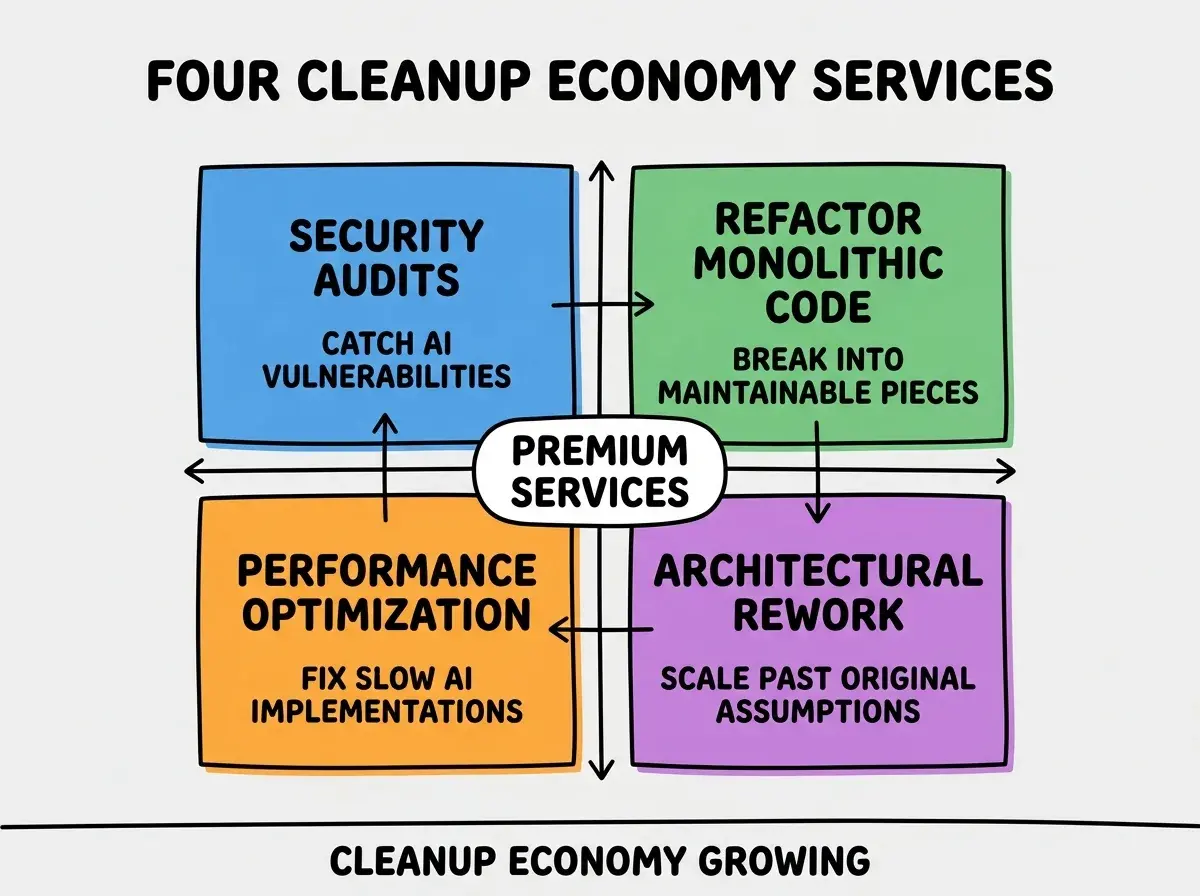
Category 3, performance optimization of slow AI implementations. AI generates correct but inefficient code. Performance optimization requires deep technical knowledge AI cannot provide. Specialist work that scales with product success.
Category 4, architectural rework of products that outgrew original design. Products built for 100 users that need to serve 100,000. The original AI-generated architecture rarely scales; rework is substantial work that pays accordingly.
How Successful Cleanup Developers Build Practices
Three business patterns characterize developers who build sustainable cleanup practices.
Pattern 1, productized service offerings. Specific service packages with specific deliverables and prices. "AI security audit, $5K, 2 weeks." Productization scales better than custom engagements.
Browse more career and freelance guides
Read more pulse articlesPattern 2, content marketing about AI failure modes. Blog posts, YouTube videos, conference talks about specific AI quality problems. The content positions the developer as expert; clients find them through expertise demonstration.
Pattern 3, repeat client relationships through retainers. Many companies need ongoing cleanup as they continue building with AI. Retainer relationships produce predictable income; the recurring work is more stable than project work.
The Demand Patterns Driving the Market
Three demand patterns explain why the cleanup economy is growing through 2026 and 2027.
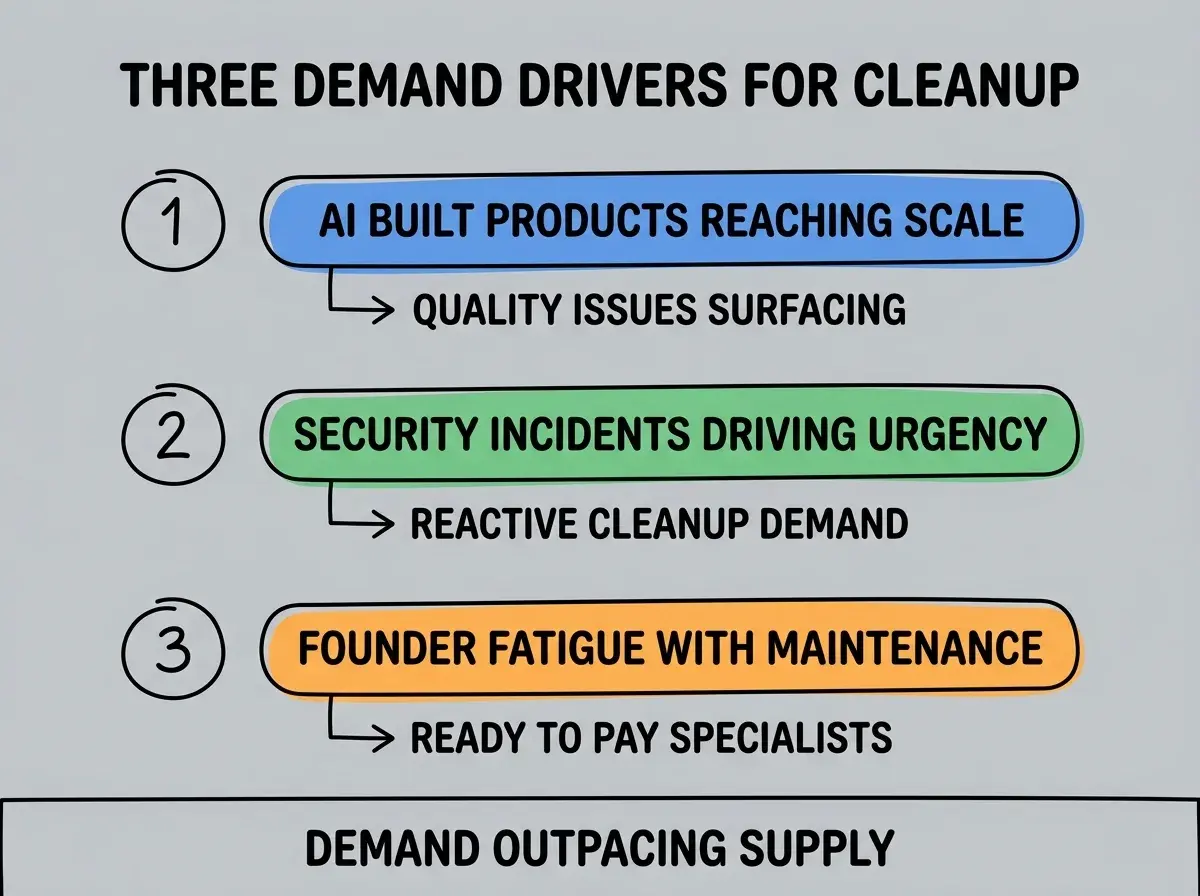
Driver 1, AI-built products reaching scale. Products that worked at MVP scale hit problems at production scale. The transition from MVP to scale creates concentrated cleanup demand.
Driver 2, security incidents driving urgent demand. When AI-built products experience security incidents, founders suddenly need cleanup work yesterday. Urgency premium pricing follows.
Driver 3, founder fatigue with maintenance. Founders who shipped quickly discover that maintenance is harder than they expected. They become willing to pay specialists rather than continue self-maintaining.
How Cleanup Pricing Differs From Standard Development
Three pricing pattern differences make cleanup work more profitable than equivalent standard development.
Difference 1, urgency premium. Cleanup is often urgent (security incidents, performance crises, scaling problems). Urgent work commands 50-100 percent premium over comparable non-urgent work.
Difference 2, expertise premium. Cleanup requires both deep technical expertise and AI codebase familiarity. The combination is rare; rare skills command premium pricing.
Difference 3, outcome-based pricing. Cleanup outcomes are measurable (security issues resolved, performance improved by X percent). Outcome-based pricing produces higher effective hourly rates than time-based pricing for the same work.
The combination explains why cleanup developers earn 1.5-2x more per hour than equivalent standard development work. The premium reflects real value, not arbitrage.
How to Position for Cleanup Work
Three positioning patterns help developers attract cleanup engagements.
Pattern A, demonstrate expertise through public work. Open-source contributions to security tools, blog posts about AI failure modes, conference talks. Public work positions you as expert before clients need you and serves as constant lead generation.
Pattern B, build a portfolio of specific cleanup case studies. "Rebuilt the security layer for X startup; audit caught Y issues; production incidents dropped Z percent." Specific case studies prove capability better than general claims of expertise.
Pattern C, charge for outcomes, not hours. Project pricing for defined cleanup work. Hourly billing rewards slow work; project pricing rewards efficient cleanup that produces clear outcomes the client values.
The combination produces cleanup practice with consistent pipeline. Without these patterns, cleanup work depends on referrals and luck; with them, the practice generates inbound interest predictably.
The most damaging cleanup work mistake for founders is waiting until crisis to engage cleanup specialists. Crisis-driven cleanup costs 3-5x more than planned cleanup because the work is urgent, the codebase is in worse condition, and there is less time for thoughtful approach. The fix is to engage cleanup work proactively when products reach inflection points (PMF, scaling, security audit triggers). Proactive cleanup is dramatically cheaper than reactive cleanup; founders who plan cleanup work spend significantly less than those who wait for it to become emergency.
The other mistake (for cleanup developers) is taking on every cleanup engagement that comes through the door. Some engagements are unproductive (founder unwilling to address root causes, scope unclear, unrealistic timelines). The fix is to qualify ruthlessly; the engagements you say no to matter as much as the ones you accept. Selective practice produces better outcomes than comprehensive practice.
A third mistake is failing to teach clients enough that they can prevent future cleanup needs. Some cleanup developers prefer client dependency for repeat work. The fix is to teach clients what you are doing and why; clients who understand the work refer better and trust more. The relationship economics favor education over dependency.
What This Means For You
The cleanup economy is real and growing through 2026 and 2027. The four service categories, business patterns, and demand drivers produce real career and business opportunities.
- If you're a founder: Plan cleanup work proactively at predictable inflection points. The cost is dramatically lower than emergency cleanup.
- If you're changing careers into development: Cleanup specialization is one of the highest-paying entry points for senior developers. Worth considering as career path.
- If you're a student: Study what makes cleanup work valuable. The same skills (security analysis, refactoring, performance optimization) are valued across many development roles.
Browse more career and market analysis
Read more pulse articles