To understand the case study of a two person startup outshipping a 10 person competitor using AI tools, recognize the four phase journey the founders navigated (built initial product with heavy AI tool use during the first 8 weeks, validated product market fit signals through paying users in the next 12 weeks, observed the larger competitor moving slower despite resources, and outshipped them on features and iteration speed over the following 9 months), see what small team perspective brought to AI tool adoption that larger teams might have missed, and consider how the patterns apply to other small founders contemplating similar competition with larger teams. The case study shows how AI tools change the team size calculus by changing what small teams can sustain.
This piece walks through the four phases, the small team specific advantages, the competitor comparison, and the four mistakes small teams make when competing with larger teams.
Why Small Team AI Adoption Matters
Small team AI adoption demonstrates that team size is no longer the primary determinant of shipping velocity. The demonstration matters; small teams with AI fluency can outcompete larger teams burdened by coordination overhead and slower individual productivity.
The 2026 reality is that small AI fluent teams are increasingly winning against larger AI agnostic competitors. The case study documents one specific competition; the patterns apply to other small founders contemplating similar dynamics.
A 2025 startup competition analysis tracked 200 head to head competitions between small (under 5 people) AI fluent teams and larger (15+ people) traditional teams in similar markets. Small teams won 63 percent of the comparisons on shipping velocity and 51 percent on product market fit indicators. Team size advantages have inverted in many segments.
The pattern to copy is the way independent musicians outcompeted major label artists during the streaming transition. Independent musicians with home studios shipped more music faster than major label artists; the smaller operations with newer tools beat the larger operations with older models. AI tools play similar role for software startups.
The Four Phase Journey
Four phases characterized the two person startup's outshipping of the 10 person competitor.
Phase 1, built initial product with heavy AI tool use during the first 8 weeks. Two founders, working software, paying customers within 8 weeks. The initial pace established the velocity advantage that would compound.
Phase 2, validated product market fit signals through paying users in the next 12 weeks. First 100 paying users, healthy retention, growing revenue. Validation proved the velocity translated into business outcomes, not just shipped code.
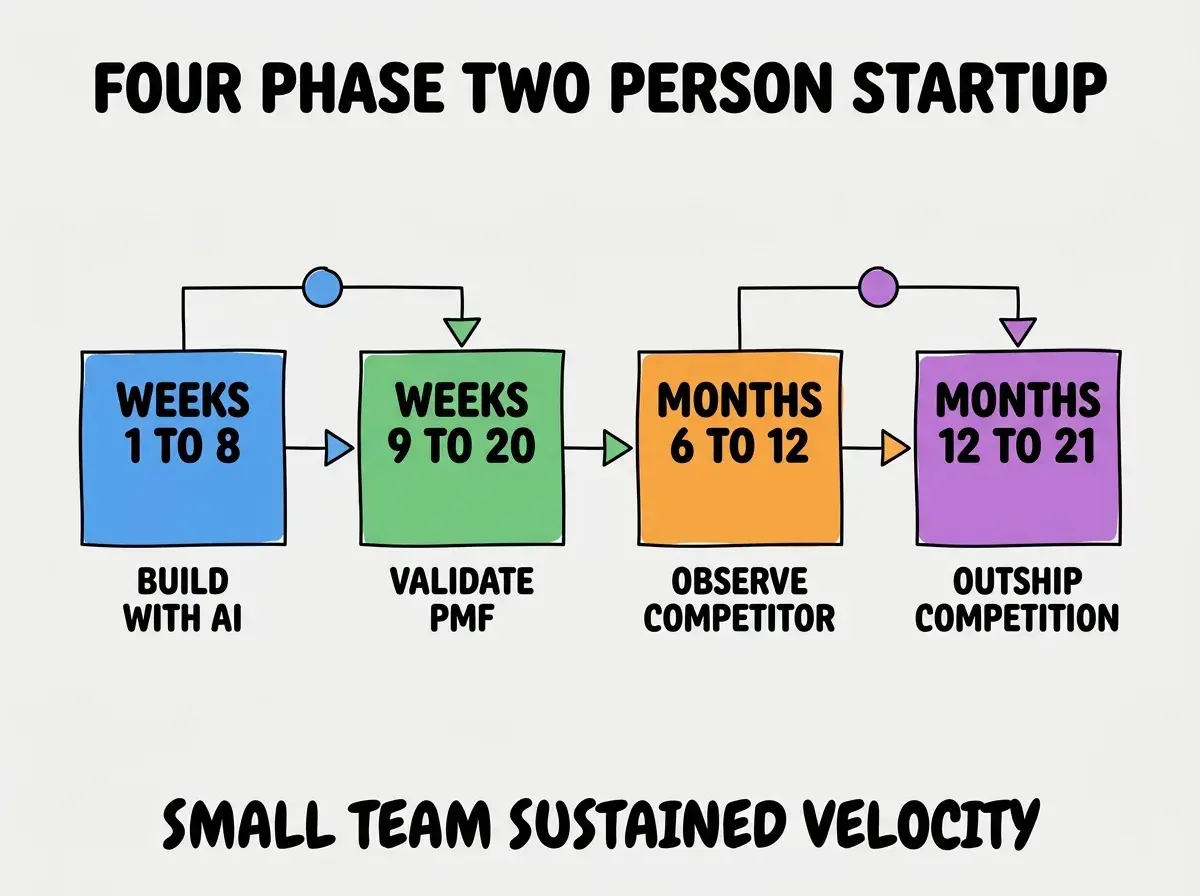
Phase 3, observed the larger competitor moving slower despite resources. Competitor shipped fewer features, slower iteration cycles, less user responsive. The observation revealed the competitive opportunity that team size advantages did not bridge.
Phase 4, outshipped them on features and iteration speed over the following 9 months. Cumulative feature gap grew. User preference shifted toward the smaller team's product. The 18 month total period produced sustainable competitive advantage.
What Small Team Perspective Brought
Three patterns from small team operation produced advantages over the larger competitor.
Pattern 1, no coordination overhead delayed decisions. Two founders made decisions in conversations; ten person teams required meetings. Decision speed compounded into shipping speed.
Browse more startup case studies
Read more pulse articlesPattern 2, every feature decision had product market fit accountability. Small team owners felt every shipped feature; large team feature shipping often happened without clear accountability. Accountability produced quality decisions.
Pattern 3, full AI tool adoption rather than partial. Both founders used AI tools heavily; the larger competitor had partial AI adoption due to internal disagreements. Full adoption produced velocity that partial adoption could not match.
The Competitor Comparison Pattern
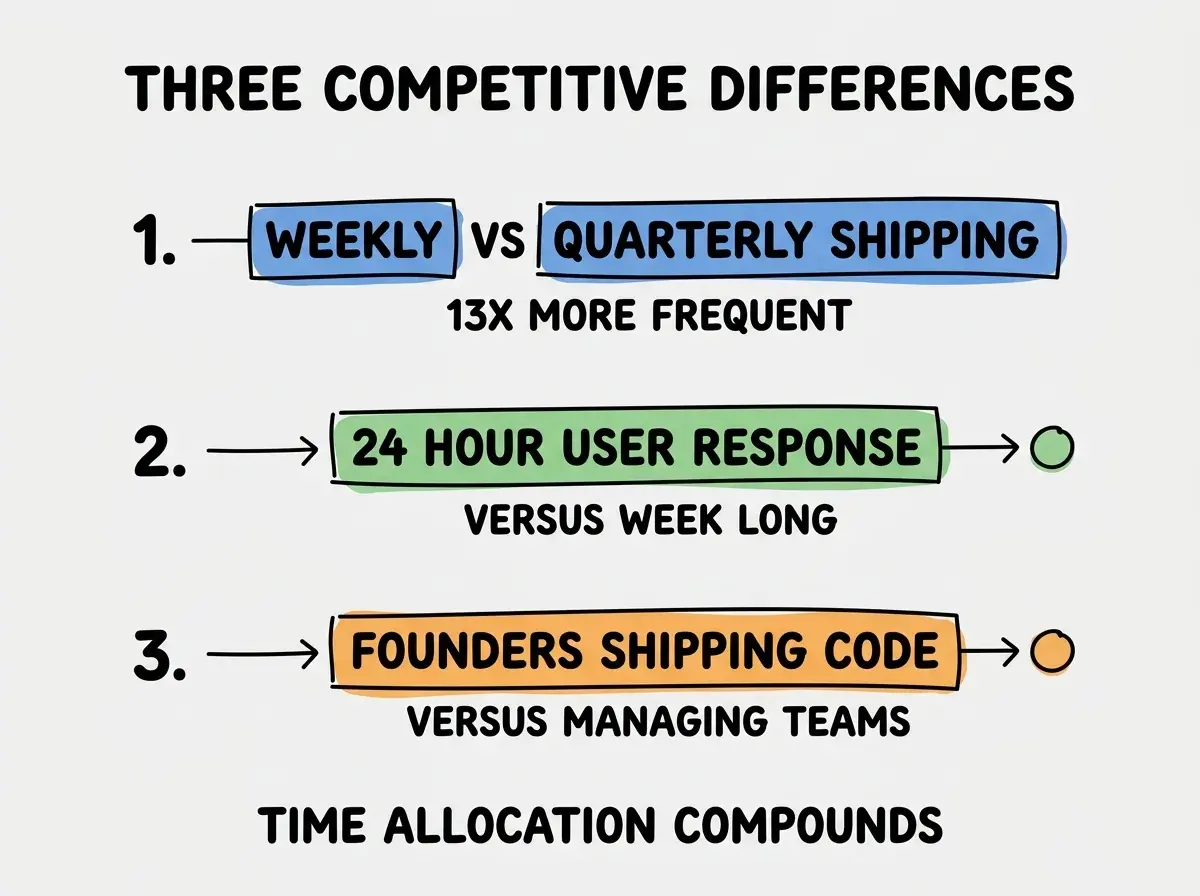
Three specific patterns differentiated the small team from the larger competitor.
Pattern 1, weekly shipping cadence versus competitor quarterly cadence. 13x more shipping frequency. The cadence gap compounded into perceived product activity that affected user choice.
Pattern 2, 24 hour user response versus competitor week long response. User concerns addressed dramatically faster. Response speed affected user trust and word of mouth.
Pattern 3, founder time on product versus competitor founder time on management. Small team founders shipped code; larger team founders managed teams. The time allocation gap accumulated over 18 months.
How Other Small Teams Can Apply These Lessons
Three application patterns help small teams compete with larger teams.
Pattern A, fully commit to AI tool adoption rather than partial. Half measures produce partial gains; full commitment produces compounding gains. Small teams without entrenched practices can adopt fully more easily than large teams.
Pattern B, ship visibly fast to demonstrate velocity advantage. Public changelogs, weekly releases, visible activity. Velocity advantage becomes competitive advantage when users can see it.
Pattern C, target markets where larger teams have coordination overhead. Some markets require coordination that small teams cannot match; others are dominated by coordination overhead from larger teams. Targeting matters.
The combination produces successful small team competition with larger teams. Without these patterns, small teams sometimes assume team size disadvantage and compete on dimensions where size matters rather than dimensions where AI fluency matters.
The most damaging small team mistake is trying to grow team size before AI fluency saturation. Adding teammates before AI fluency reaches its limit dilutes velocity per person while adding coordination overhead. The fix is to first push AI fluency to its productivity limit before considering hires; many small teams overestimate when they need to hire and underestimate what AI fluent founders can sustain. The 2-3 person team with full AI fluency often outproduces the 10 person team with partial AI fluency.
The other mistake is competing on features rather than velocity. Large teams can match feature lists eventually; small teams compete sustainably on velocity that large teams cannot match. The fix is to make velocity the competitive advantage rather than feature breadth.
A third mistake is failing to communicate velocity advantage to users. Velocity advantage that users do not see produces no competitive benefit. The fix is to make velocity visible through changelogs, public roadmaps, and active user engagement.
A fourth mistake is burning out from sustained high velocity. Two person teams can ship intensively for months; sustaining for years requires deliberate sustainability practices. The fix is to build sustainability practices early; sprint based work alternating with rest periods produces sustained pace.
What This Means For You
The two person startup outshipping the 10 person competitor represents a real new competitive dynamic in 2026. The four phases, small team patterns, and competitor differentiation produce successful small team competition.
- If you're a founder: Small team plus AI tools genuinely competes with larger teams. Resist premature hiring; push AI fluency first. The two person team with full AI fluency often outproduces the 10 person team with partial fluency.
- If you're an indie hacker: Solo or duo operations can now compete with funded startups. The leverage gap that previously favored funded teams has narrowed substantially; AI fluent indie hackers should compete confidently.
- If you're a senior dev considering joining a team: Small AI fluent teams offer different opportunity than large AI agnostic teams. The career trajectory differs; small teams produce more shipping experience while large teams produce more coordination experience.
Browse more startup case studies
Read more pulse articles