A 16-year-old high school junior shipped a class scheduling app used by 1,200 students at their school in 2025, built solo over four months using AI assistance, with the school administration formally adopting the tool after a successful student pilot. The case study below documents the four phases of the build, the lessons learned, and the patterns that any teen can replicate. The story is significant because it shows what is now achievable for ambitious teens with vibe coding skills.
This piece walks through the case study in detail, the four build phases, the patterns that made it succeed, and the four mistakes the teen avoided that often derail similar projects.
Why This Case Study Matters
Teen-built apps that real schools adopt are still rare enough to be remarkable. The case study below shows what is achievable with current AI tools and what patterns made this particular project succeed where similar attempts often fail.
The teen (referred to as "M" for privacy) had been vibe coding for about 18 months before starting this project. The skills were intermediate but not advanced; the project succeeded through smart scoping and persistent execution rather than through exceptional talent.
The full project took 4 months from idea to formal school adoption, with M working approximately 8 hours per week. The timeline included 6 weeks of build, 4 weeks of student pilot, and 6 weeks of administration evaluation and approval. The total active development time was about 40 hours. Faster shipping was technically possible; the timeline was paced by the school's evaluation processes, not by M's ability to ship code.
The pattern to copy is the way student-built tools have always succeeded historically: solving a real problem the student personally experienced, building with real users available immediately, and iterating fast based on feedback. AI assistance amplifies this pattern; it does not replace it.
The Four Phases of the Build
The project unfolded across four distinct phases. Each phase taught different lessons.
Phase 1, problem identification (week 1). M noticed students struggling with the school's official scheduling tool: slow to load, hard to use on mobile, lacked search. The frustration was widespread; M decided to build something better.
Phase 2, MVP build (weeks 2-7). M built the core functionality with AI assistance: scrape the school's published schedule data, present it in a clean mobile interface, add search and filtering. About 25 hours of work.
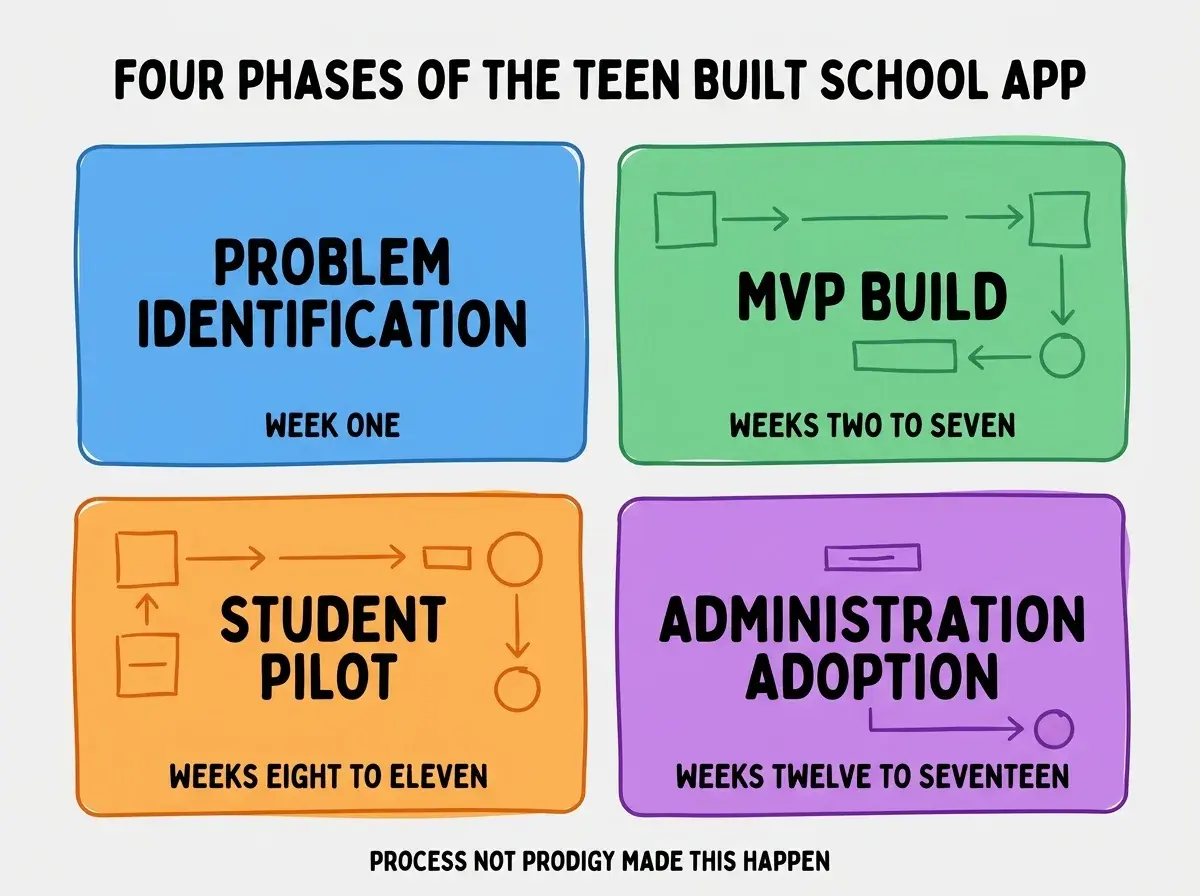
Phase 3, student pilot (weeks 8-11). M shared the app with classmates. Word spread through Snap and Discord. Within 4 weeks, 800 students were using it daily. Real usage feedback drove improvements.
Phase 4, administration adoption (weeks 12-17). With proven student usage, M approached the school administration. After demos, security review, and integration discussions, the school formally adopted the tool and credited M publicly.
The Patterns That Made It Succeed
Three patterns separated this project from similar attempts that did not succeed.
Pattern 1, solving a personal problem. M was a daily user of the original tool and felt the pain personally. The motivation came from real frustration, not from "what should I build" brainstorming.
Browse more teen builder case studies
Read more pulse articlesPattern 2, real users from day one. Classmates were available to test immediately. No "find users" problem because users were everywhere. The feedback loop was tight.
Pattern 3, persistent through administrative process. Many teen-built tools die in the administrative approval stage. M was patient through 6 weeks of meetings and security reviews, providing requested information promptly.
The Mistakes M Avoided
Three mistakes consistently kill similar teen-built school projects. M avoided all three.
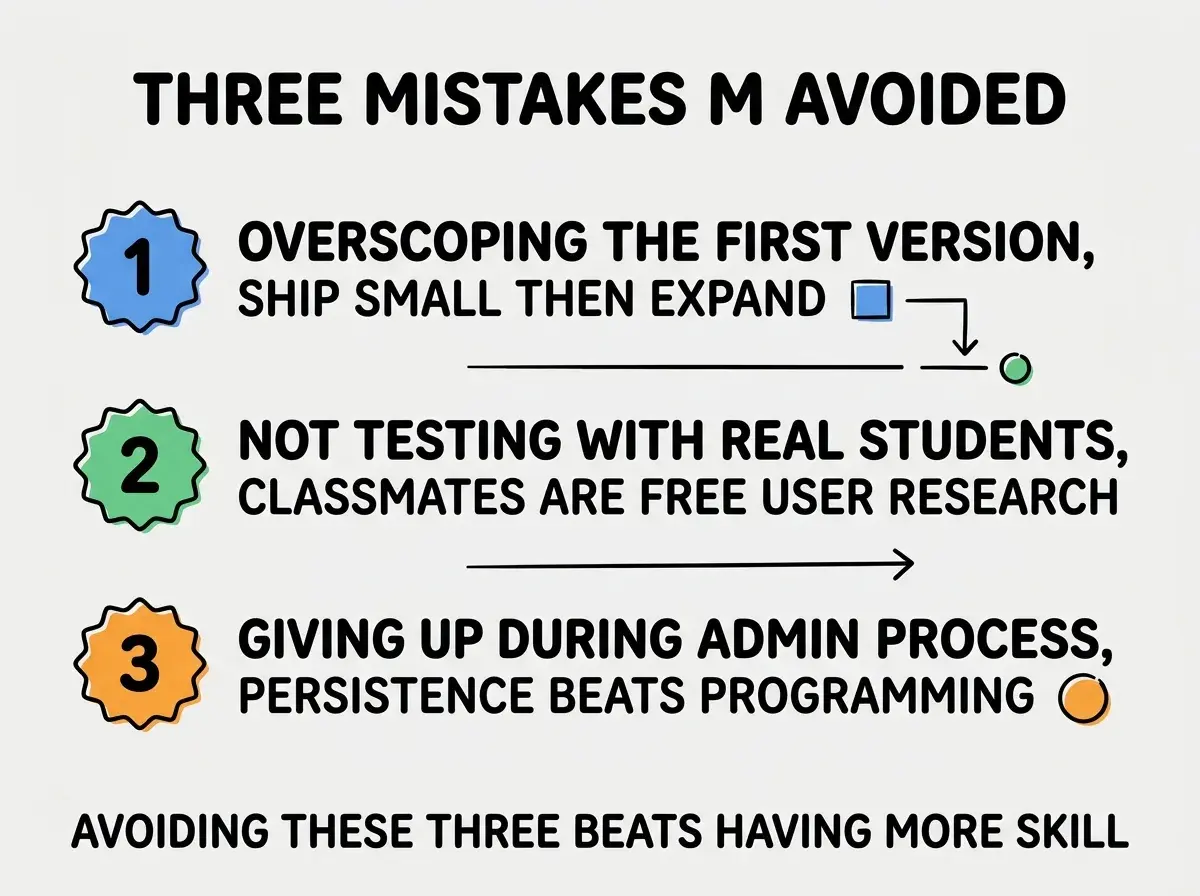
Mistake 1, overscoping the first version. Many teens want to build "the complete platform" before launching. M shipped the minimum useful version (read-only schedule display) and added features based on student requests.
Mistake 2, not testing with real students. Some teen builders polish in private and never get user feedback. M shared early and often, treating classmates as ongoing user research.
Mistake 3, giving up during admin process. When the security review took 3 weeks longer than expected, M stayed engaged rather than abandoning. The patience paid off when the school approved.
What Other Teens Can Learn
Three lessons from this case generalize to other teens considering similar projects.
Lesson 1, the bar is lower than you think. Schools are using outdated, frustrating tools because they lack budget for replacements. A teen with vibe coding skills can credibly improve on what schools currently have. The opportunity is real.
Lesson 2, social proof from peers is powerful. Once classmates were using M's tool daily, the case for school adoption became almost automatic. Build with peers first; institutional adoption follows.
Lesson 3, patience matters as much as skill. The technical work took 25 hours; the rest of the project was waiting and following up. Teens who can navigate institutional patience win opportunities that purely technical teens cannot.
The combination of these lessons means more teens could ship similar tools than currently do. The constraint is not capability; it is the meta-skills of identifying problems, persisting through process, and managing the human side of school adoption.
The most damaging mistake teens make trying to ship school-adopted tools is going to administration too early, before student adoption is proven. Teens often pitch admin first ("I want to build a tool for the school") and get politely declined. The fix M demonstrated is to build with peer adoption first, then approach admin with proof of usage. Schools approve tools that students are already using; they rarely approve tools that students might use someday. Reverse the order: build, get peer usage, then approach admin with the data.
The other mistake is treating one school's adoption as the end goal rather than as a starting point. M's tool was eventually offered to other schools in the district, with M's permission. Tools that succeed in one school often succeed in others; treating the first adoption as a launching pad opens larger opportunities.
What M Did After School Adoption
The school adoption was not the end of M's project. Three things happened in the year after that compounded the value.
Outcome 1, college application portfolio piece. M used the project as a centerpiece in college applications. Demonstrated initiative, technical skill, and ability to work within institutions. Helped with admissions to several competitive programs.
Outcome 2, paid licensing to other schools. Three nearby schools offered to license the tool. M structured a small licensing deal (with parent help) that produced ongoing revenue while M was still in high school.
Outcome 3, internship offers. Local tech companies offered summer internships specifically because of the project. The "I shipped a tool used by 1,200 people" story differentiated M from internship candidates with only academic credentials.
The combination of these outcomes shows the long-tail value of teen-built shipped products. The project was not just an interesting hobby; it became a foundational career asset that opened doors years after the initial build.
Dig deeper
A few hand-picked sources if you want to go further.
What This Means For You
This case study shows what is achievable for ambitious teens with vibe coding skills and persistent execution in 2026. The pattern is replicable for teens who identify real problems and follow the process through to adoption.
- If you're a founder: Hire teens who have shipped tools used by real institutions. The skill set is rare and valuable.
- If you're changing careers via tech: Apply the case study patterns to your own work. The problem-solving discipline transfers.
- If you're a teen: Pick a problem you experience daily at school. Build a small tool. Share with classmates. Patience through admin process. The pattern works.
Browse more case studies
Read more pulse articles