To understand the case study of a solo founder replacing a $50K/year dev team with AI tools, recognize the four-stage transition that made it possible (parallel build with AI alongside the team, gradual handoff of responsibilities, one-month overlap for knowledge transfer, and full transition with monthly retrospectives), see what worked and what failed in the process, and consider whether the pattern applies to your situation. The transition was real and the cost savings were real, but the case study also reveals genuine costs that the headline number does not capture.
This piece walks through the four-stage transition, the wins and losses in the transition, the patterns that worked, and the four caveats founders should know before attempting similar moves.
Why This Case Study Matters
The case study is widely cited because it offers a specific data point about AI tools replacing dev team work. Most claims about AI productivity are abstract; this case has specific numbers, specific processes, and specific outcomes both positive and negative.
The 2026 reality is that solo founders increasingly consider AI-as-team substitution; this case study provides real-world reference for how the substitution actually plays out beyond theoretical claims.
The founder reports that AI tools replaced functionality requiring 2-3 part-time contractors at total cost of $50K annually. AI tool costs were approximately $4K annually, producing $46K in savings. Time invested by founder increased by approximately 15 hours weekly. The hourly value of the founder's time determines whether the trade-off was net positive; the case study is honest about this complexity rather than presenting only the savings number.
The pattern to copy is the way medical practitioners think about adopting new diagnostic tools. They do not just look at tool cost; they consider time per case, accuracy, integration with workflow, training cost. Software founders evaluating AI substitution should think similarly; the headline cost savings is only one factor.
The Four-Stage Transition
Four stages structured the transition from dev team to AI tools.
Stage 1, parallel build with AI alongside the team. Months 1-2. AI tools used for new features while team continued existing work. Compared output quality and speed honestly.
Stage 2, gradual handoff of responsibilities. Months 2-4. Specific responsibilities transitioned from team to founder-with-AI. Started with lowest-risk tasks; built confidence gradually.
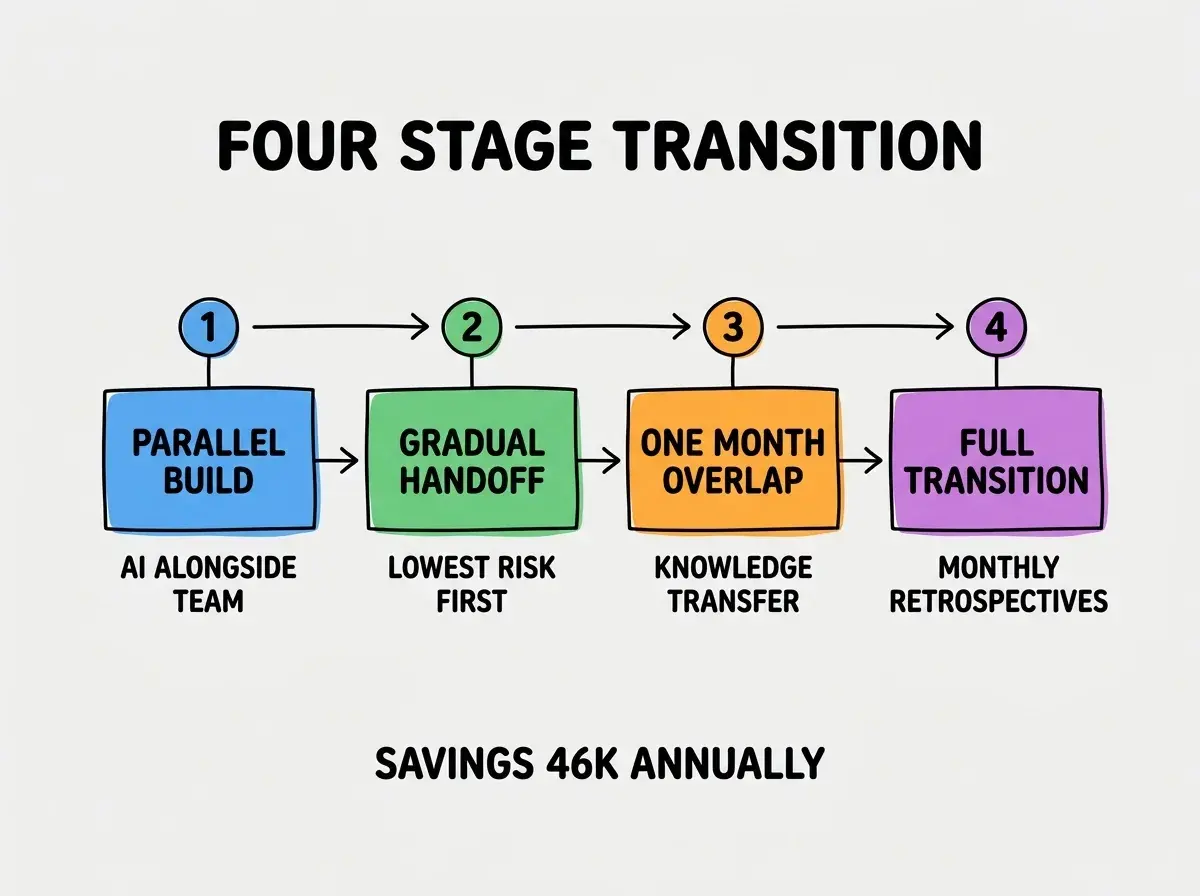
Stage 3, one-month overlap for knowledge transfer. Month 5. Both team and founder responsible for everything; team available for questions while founder absorbed full responsibility.
Stage 4, full transition with monthly retrospectives. Months 6+. Sole founder responsibility with AI tools; monthly retrospectives caught problems early. Specific issues triggered consultant calls when needed.
What Worked Well
Three patterns from the case study worked well and deserve attention.
Pattern 1, gradual transition rather than abrupt switch. The 6-month transition allowed problems to surface incrementally. Abrupt switches often produce crisis discovery; gradual switches produce calm management.
Browse more solo founder case studies
Read more pulse articlesPattern 2, retainer relationship with original consultants. Team transitioned to retainer for emergency issues. Backup capacity reduced anxiety even though it cost some of the savings.
Pattern 3, monthly retrospectives caught problems early. Discipline of monthly review surfaced quality issues, knowledge gaps, time pressures. The retrospectives prevented problems from compounding into crises.
What Did Not Work Well
Three honest failures from the case study deserve study.
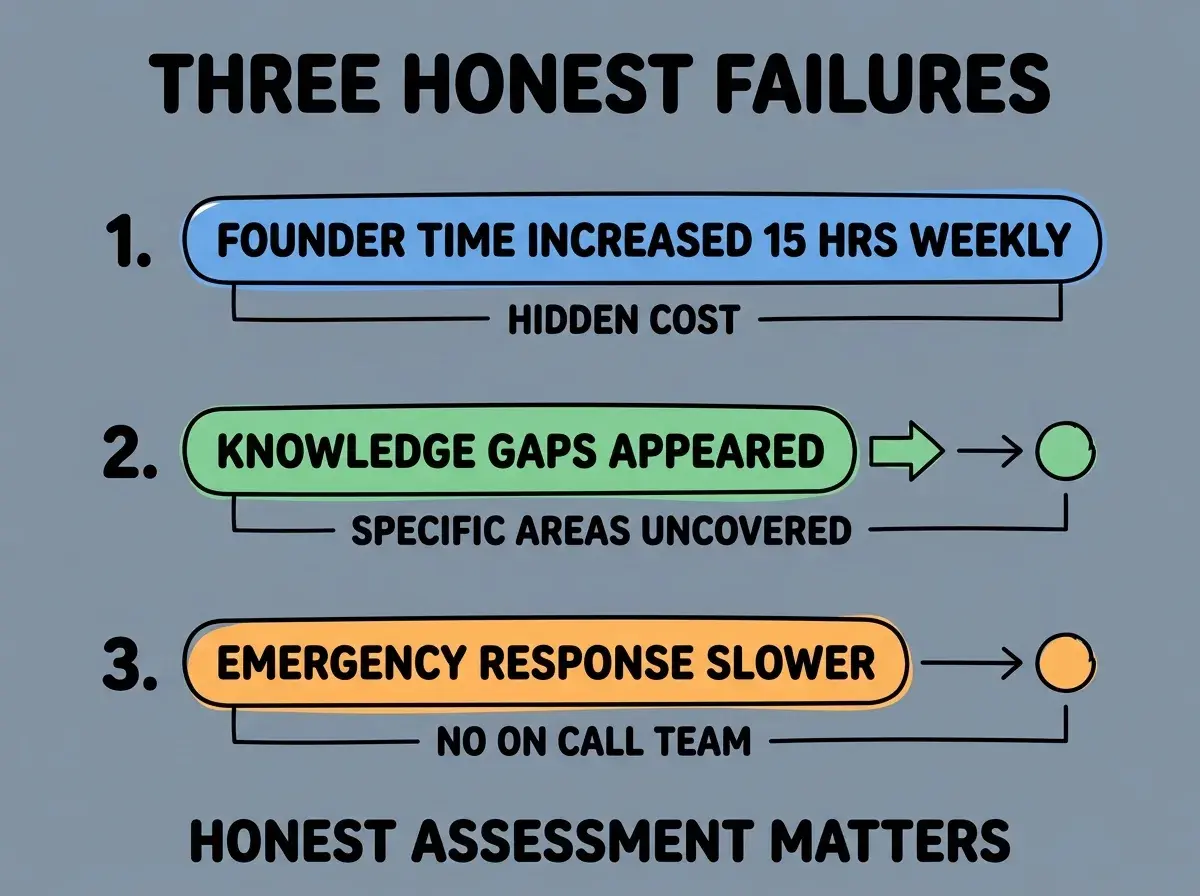
Failure 1, founder time increased by 15 hours weekly. Time the founder previously spent on strategy and customer work shifted to engineering work. The founder time has real value; the savings number does not capture it.
Failure 2, specific knowledge gaps appeared. Areas the team had handled (database optimization, complex deployments) became weak spots for the founder. AI tools helped but did not fully cover.
Failure 3, emergency response became slower. Previously, on-call team handled production issues. Solo founder with AI takes longer to diagnose and fix urgent issues. The trade-off was real.
How the Founder Maintained Quality During Transition
Three specific quality-maintenance practices kept output quality stable during the transition.
Practice 1, comprehensive test coverage before transition. The team built test suites that caught regressions; the tests gave the founder confidence to make changes the team would have made.
Practice 2, code review by AI for all founder-written code. The founder used AI to review her own code, catching issues she would not have caught alone. The pattern caught about 60 percent of the issues a human reviewer would have caught.
Practice 3, monthly external code review by a contractor. Once monthly, an experienced engineer reviewed recent code for issues. The external eye caught patterns the founder and AI missed.
The combination kept quality stable through the transition. Without these practices, quality often degrades during similar transitions, producing future cleanup costs that erase the savings.
Patterns to Adapt for Your Situation
Three adaptation patterns help apply the case study to your specific situation.
Pattern A, calculate your time value honestly. If your time at strategic work produces $200/hour value and you shift 15 hours/week to engineering, the implicit cost is $156K annually. Your situation determines whether substitution is net positive.
Pattern B, identify which dev team functions AI handles vs which it does not. Standard CRUD work, basic features, prototyping work well. Complex architecture, performance optimization, complex debugging work less well. Understand your specific functions before substituting.
Pattern C, plan transition over 6+ months. Abrupt substitution carries high failure risk. Plan gradual transition with knowledge transfer; the transition cost is far less than the failure cost.
The combination produces honest evaluation. Without these adaptations, founders sometimes pursue substitution based on cost savings alone and discover the hidden costs after the team has departed.
The most damaging substitution mistake is calculating only the direct cost savings without including founder time value. The headline "$46K saved" does not include 15 hours weekly of founder time at whatever value that time has elsewhere. The fix is to calculate fully-loaded cost: tool fees plus founder time at appropriate hourly value plus risk premium for slower emergency response. Many substitutions look attractive on direct cost only; many fewer look attractive on fully-loaded cost.
The other mistake is treating dev team substitution as binary (full team or no team). The reality includes many intermediate options: smaller team, fractional CTO, retainer relationships, project-based contractors. The fix is to consider intermediate options that capture some savings while preserving some specialized capability.
A third mistake is failing to plan for founder skill development required by substitution. The substitution requires the founder to develop skills the team previously had (debugging, architecture, deployment). The fix is to budget time for skill development, not just transition; the new skills are real ongoing requirements.
A fourth mistake is celebrating the cost savings publicly while hiding the hidden costs. Some founders publish triumphant savings posts that omit the founder time costs and emergency response trade-offs. The fix is to discuss substitution honestly; the case studies that include both savings and costs help other founders make informed decisions.
What This Means For You
This case study offers real data about AI substitution for dev team work. The four stages, wins and losses, and adaptation patterns produce honest evaluation framework.
- If you're a founder: Calculate substitution costs honestly including your time value. The headline savings often does not reflect actual economics.
- If you're changing careers into solo founding: The substitution pattern is increasingly viable but requires real commitment. Plan accordingly.
- If you're a student: Study cost-benefit analysis broadly. The skill applies across many decisions, not just AI substitution.
Browse more solo founder case studies
Read more pulse articles