To understand the case study of building a SaaS from $0 to $10K MRR using AI tools, recognize the four-phase journey the founder navigated (build the MVP in 30 days using AI-assisted development, find the first 10 paying customers through founder-led sales over 60 days, scale to 100 customers through systematic marketing in months 3-6, and reach $10K MRR through retention and expansion in months 6-12), see the specific milestones at each phase, and consider how the patterns apply to your situation. The journey is real and verifiable; the patterns are studied as reference for similar founder paths.
This piece walks through the four phases, the specific milestones, the patterns that worked, and the four caveats that distinguish replicable patterns from circumstantial outcomes.
Why the $10K MRR Milestone Matters
$10K MRR represents the threshold where a SaaS becomes a sustainable solo business. Below this, most founders need other income; above this, the business can support a focused founder. The milestone is meaningful both psychologically and economically.
The 2026 reality is that AI tools have lowered the barrier to reaching $10K MRR for solo founders. The case study documents one specific journey; understanding it helps calibrate expectations for similar journeys.
The case study documents reaching $10K MRR within 12 months from project start. The founder reports 25-35 hours weekly during the building phase, increasing to 50+ hours during scaling. AI tools were used for approximately 70 percent of code production; founder judgment shaped what to build and customer development drove the roadmap. The combination of AI plus founder judgment plus customer focus produced the outcome.
The pattern to copy is the way successful first-time entrepreneurs build profitable small businesses. They typically spend more time on customer development than on production; they invest in marketing systematically; they reach sustainability through retention rather than constant new customer acquisition. SaaS journeys with AI follow similar patterns.
The Four-Phase Journey
Four phases characterized the journey from idea to $10K MRR.
Phase 1, build the MVP in 30 days using AI. Days 1-30. Vibe coded a working version of the core idea. Single workflow, no auth in MVP, hardcoded what could be hardcoded. The MVP was demo-quality, not production-quality.
Phase 2, find first 10 paying customers through founder sales. Days 30-90. Direct outreach, demos, pricing conversations. Each customer required substantial founder time; the early phase taught customer needs and willingness-to-pay.
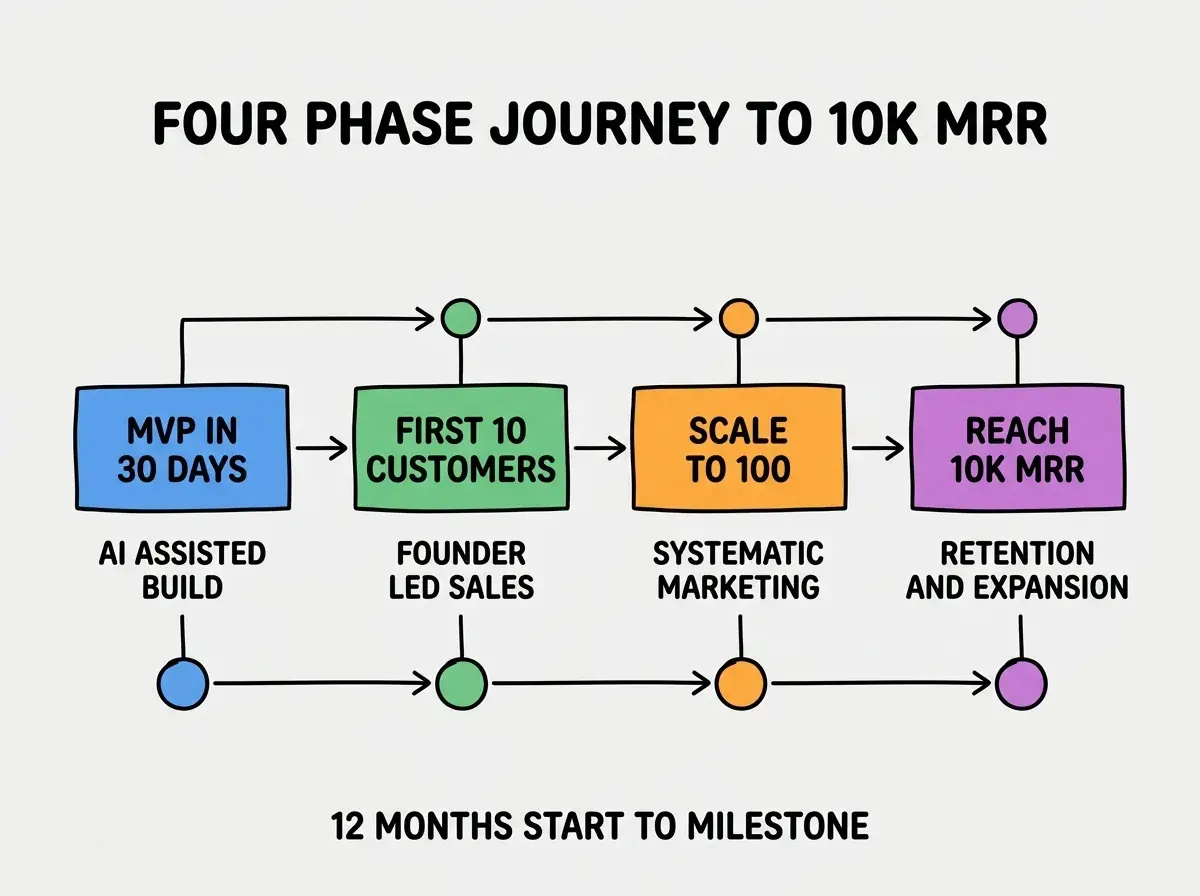
Phase 3, scale to 100 customers through systematic marketing. Months 3-6. Content marketing, SEO, paid acquisition tested. Identified which channels produced cost-effective acquisition. Built marketing systems rather than continuing pure founder sales.
Phase 4, reach $10K MRR through retention and expansion. Months 6-12. Existing customer success drove expansion revenue. New customer acquisition continued but at scale; the focus shifted to keeping and growing existing customers.
The Specific Patterns That Worked
Three specific patterns from the case study deserve study.
Pattern 1, charged from day one. Even the MVP customers paid. The founder argued (correctly) that paid customers provide better validation than free users. Free tier was added later, after pricing was understood.
Browse more SaaS case studies
Read more pulse articlesPattern 2, content marketing as primary acquisition channel. Long-form blog posts targeting specific keywords produced acquisition that compounded. By month 6, content was driving 60 percent of new signups.
Pattern 3, customer success as retention foundation. Direct outreach to customers when they showed disengagement signals. Manual customer success in early days; systems came later. The personal touch produced retention that pure self-service would not have.
What Did Not Work as Well
Three honest failures deserve consideration alongside the wins.
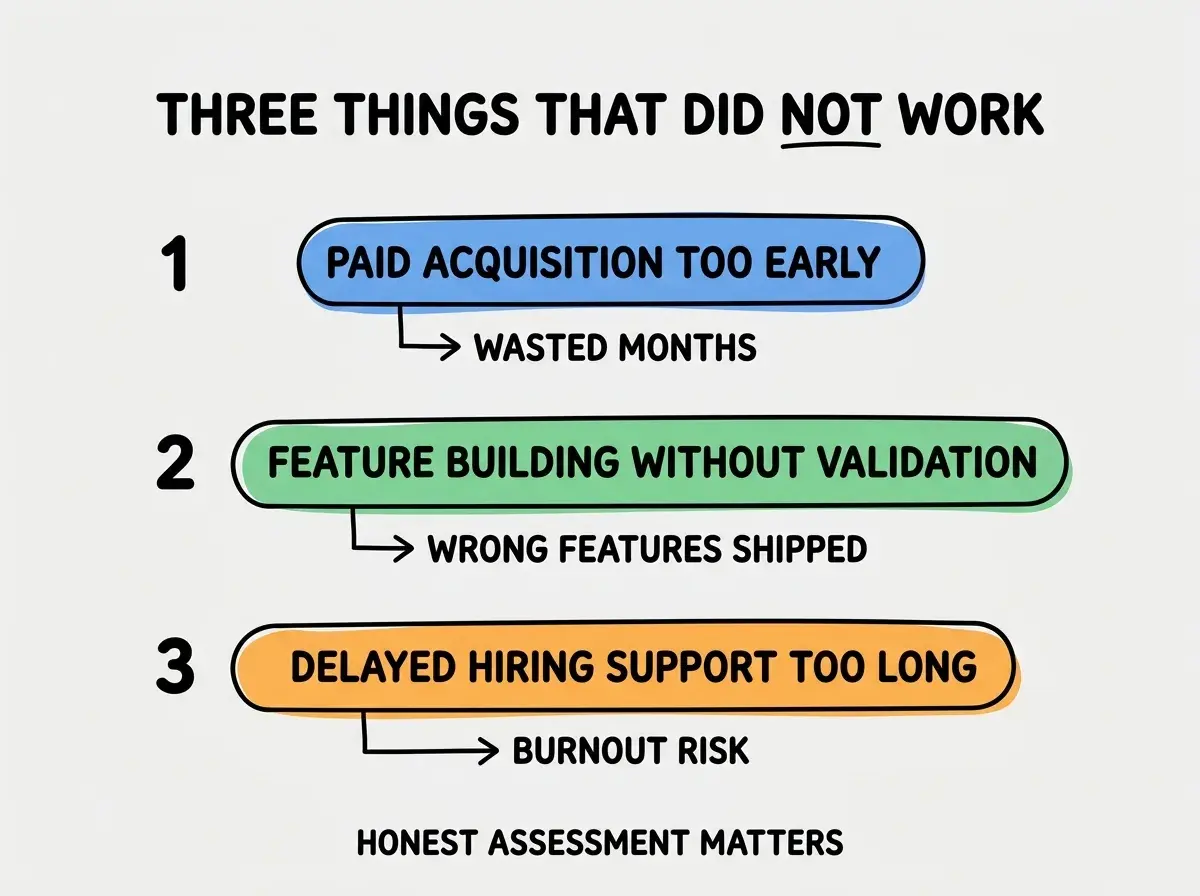
Failure 1, paid acquisition too early. Months 2-3 included paid ads experiments that produced poor unit economics because conversion was not yet optimized. The spend was wasted; the lesson was that paid comes after organic optimization.
Failure 2, feature building without validation. Several features were built based on founder intuition; usage data showed customers did not want them. The wasted building time was real; the lesson was to validate before building larger features.
Failure 3, delayed hiring support too long. Founder handled all customer support through month 8. By that time, support consumed 25 hours weekly and produced burnout risk. Earlier support hire would have preserved founder time for higher-value work.
How the Founder Used Time at Each Phase
Three time-allocation patterns characterized the founder's work at different phases.
Phase 1 allocation, 80 percent building, 20 percent customer conversations. The MVP phase needed rapid building; customer conversations validated direction. Heavy building, light customer time.
Phase 2 allocation, 20 percent building, 80 percent customer development. First customers required sustained founder attention. Building shifted to nights and weekends; customer time dominated.
Phase 3 allocation, 40 percent marketing, 30 percent building, 30 percent support. Scaling phase required marketing investment, ongoing building, and increasing support load.
The combination shows how founder time evolved as the business evolved. Without explicit time allocation, founders often default to comfortable activities (more building) and neglect uncomfortable but important work (sales, marketing, support).
How to Adapt These Lessons
Three adaptation patterns help apply the case study to your situation.
Pattern A, charge from day one even at low prices. Even $10/month produces real signal that free does not. The discipline of charging shapes product decisions powerfully.
Pattern B, invest in content marketing early. Compound returns take months; starting late delays the compounding. Content from month 1 produces traffic by month 6 that delayed content cannot produce.
Pattern C, plan support hiring at $5K MRR. Once support exceeds 15 weekly hours, hiring becomes ROI-positive even before $10K MRR. Late hiring exhausts founders.
The combination produces realistic SaaS journey planning. Without these adaptations, founders sometimes pursue patterns that worked in other contexts but do not match their situation.
The most damaging case study mistake is treating $10K MRR as the goal rather than as a milestone. $10K MRR is sustainable but not transformative; the journey to $100K MRR or $1M ARR has different patterns that the early case study does not cover. The fix is to study the early-stage case study for early-stage patterns and study larger-scale case studies for later-stage patterns. Different stages need different reference cases; one journey rarely teaches all stages.
The other mistake is assuming AI tools were the differentiator in the case study. AI tools enabled the journey but did not cause it; the founder's discipline, customer focus, and marketing investment produced the outcome. Founders who treat AI tools as sufficient miss the broader skills that the case study actually demonstrates.
A third mistake is copying the technology stack without understanding why it was chosen. The case study founder picked specific tools that fit her specific situation; copying tools without copying the reasoning produces poor fit. The fix is to understand the principles behind the tool choices and select tools that fit your situation accordingly.
What This Means For You
This case study offers honest data about AI-assisted SaaS journeys to $10K MRR. The four phases, patterns, and failures produce useful reference for similar attempts.
- If you're a founder: Plan your own journey using these patterns as input. The principles transfer; the specific tactics may need adaptation.
- If you're changing careers into founding: Use the case study to calibrate expectations. The journey is achievable but real; both upsides and difficulties apply to similar paths.
- If you're a student: Study how the founder structured the journey. The strategic thinking transfers across business types.
Browse more SaaS founder case studies
Read more pulse articles