To understand the case study of an enterprise team adopting AI coding over 6 months with a retrospective on what worked and what did not, recognize the four phase journey the team navigated (initial pilot with volunteer adopters during months 1-2, expanded rollout to interested team members during months 3-4, organization wide availability with training during months 5-6, and stabilization with patterns that survive month 6 and beyond), see what enterprise perspective brought to AI tool adoption that smaller teams might have missed, and consider how the patterns apply to other enterprise leaders contemplating similar rollouts. The case study shows the realistic enterprise adoption timeline beyond the optimistic projections AI tool vendors often promote.
This piece walks through the four phases, the enterprise specific patterns, the productivity measurement, and the four mistakes enterprise leaders make when rolling out AI coding.
Why Enterprise AI Coding Retrospectives Matter
Enterprise AI coding retrospectives provide realistic baseline expectations for adoption beyond marketing claims. The retrospectives matter; AI tool vendors promote optimistic adoption timelines, while real enterprise adoption involves coordination, training, security review, and culture change that take longer than vendor projections suggest.
The 2026 reality is that enterprise AI coding adoption is now common but uneven. The case study documents one specific 6 month adoption journey; the patterns apply to other enterprise leaders contemplating similar rollouts.
A 2025 enterprise development survey of 800 large engineering organizations found that median time to organization wide AI coding adoption was 7.4 months from initial pilot. The timeline includes security review, training, change management, and pattern establishment. Vendor projections often suggest 1-2 months; the reality is 4-8x longer for most enterprises.
The pattern to copy is the way enterprises adopted cloud computing through the 2010s. Cloud adoption was inevitable but slower than vendor projections; the realistic timeline involved security review, compliance updates, and team training that compressed cloud benefits but also produced sustainable adoption. AI coding adoption follows similar patterns; realistic timeline produces sustainable adoption.
The Four Phase Journey
Four phases characterized the enterprise team's 6 month adoption.
Phase 1, initial pilot with volunteer adopters during months 1-2. Five engineers volunteered, established usage patterns, identified security concerns. The pilot scale was small enough to learn without organization wide commitment.
Phase 2, expanded rollout to interested team members during months 3-4. 30 engineers across multiple teams adopted. Training materials developed from pilot learnings. Security questions addressed through internal review.
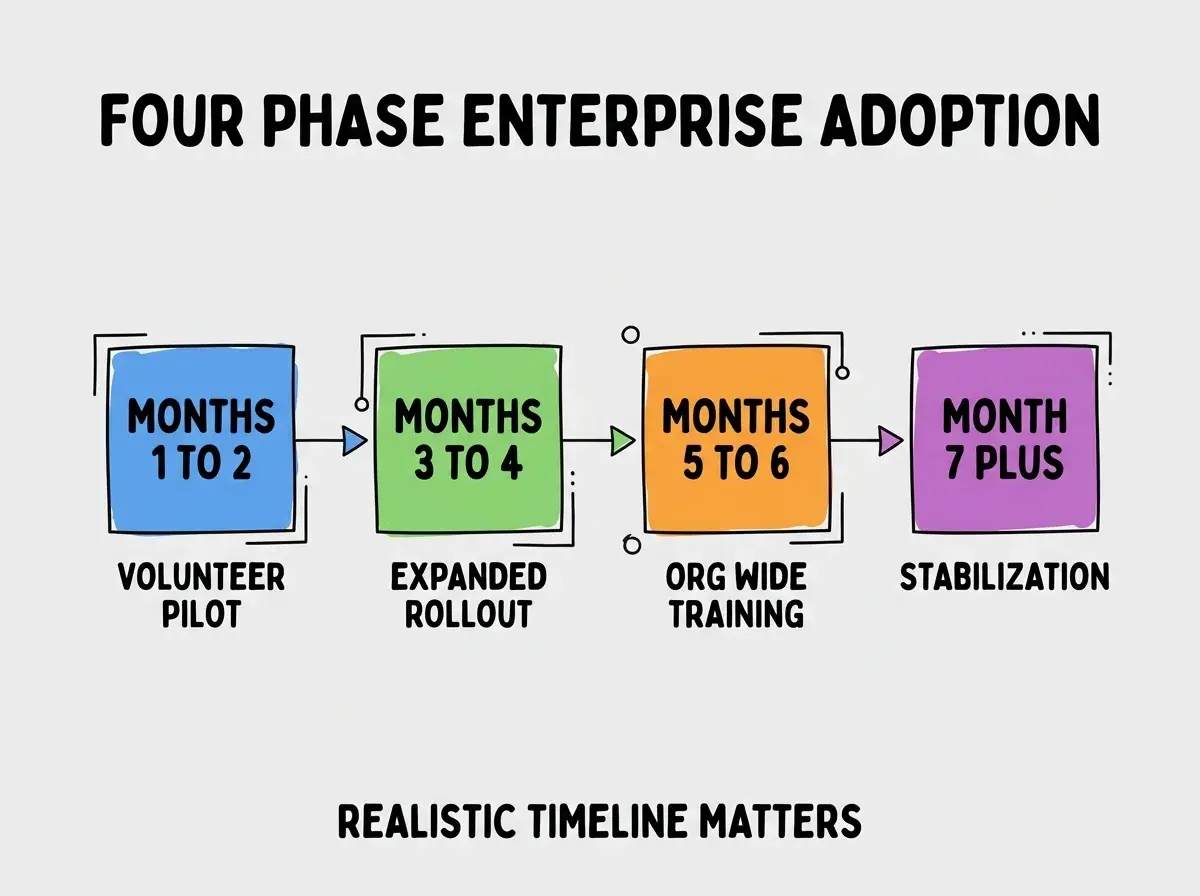
Phase 3, organization wide availability with training during months 5-6. All 200 engineers had access. Optional training sessions, internal champions, peer learning. Adoption rate varied dramatically by team and individual.
Phase 4, stabilization with patterns that survive month 6 and beyond. Sustained usage patterns emerged. Some teams achieved high utilization, others remained skeptical. The variation produced ongoing change management work.
What Enterprise Perspective Brought
Three patterns from enterprise perspective produced advantages over individual or small team adoption.
Pattern 1, security review produced trust before adoption. Security clearance reduced individual concerns; without security review, individual concerns slow adoption. Enterprise scale makes security review worth the investment.
Browse more enterprise case studies
Read more pulse articlesPattern 2, formal training accelerated team learning. Structured training produced faster individual adoption than individuals figuring out tools alone. Training materials developed once served the whole organization.
Pattern 3, internal champions provided peer support. Champions answered questions without formal support process. Peer support scaled better than centralized support for AI tool adoption.
The Productivity Measurement
Three patterns characterized the productivity measurement at month 6.
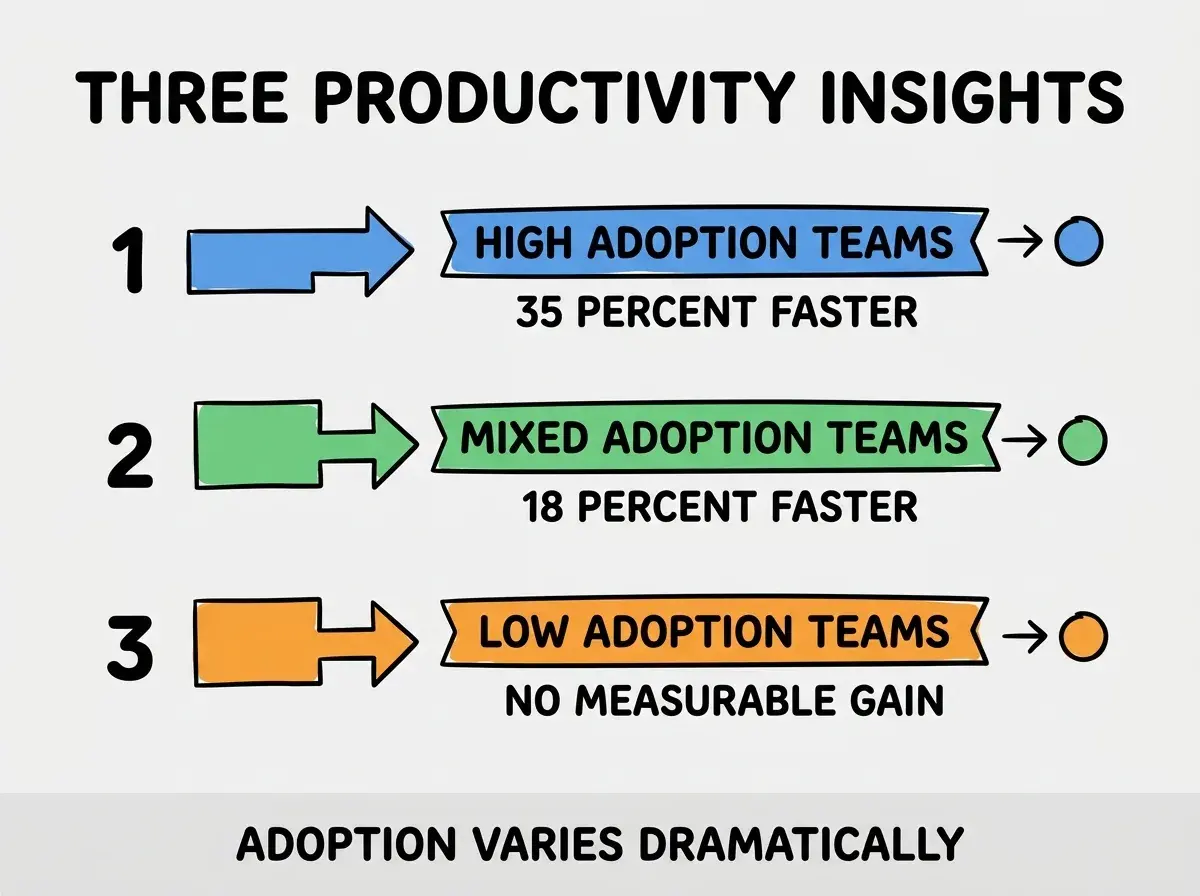
Insight 1, high adoption teams gained 35 percent faster shipping. Teams that committed to AI tools saw substantial productivity gains. The commitment was the dominant factor.
Insight 2, mixed adoption teams gained 18 percent faster shipping. Teams with partial adoption gained less than full adoption teams. Half measures produce half gains.
Insight 3, low adoption teams showed no measurable gain. Teams with low adoption could not be distinguished from pre AI baseline. Mere availability did not produce gains; adoption was required.
How Other Enterprise Leaders Can Apply These Lessons
Three application patterns help enterprise leaders attempt similar rollouts.
Pattern A, plan 6-9 month timeline rather than 1-2 months. Realistic timeline produces sustainable adoption; optimistic timeline produces frustration when reality emerges. Plan for the realistic timeline.
Pattern B, recruit champions before broad rollout. Champions provide the peer support that scales better than centralized support. Champion recruitment matters as much as tool selection.
Pattern C, measure adoption alongside productivity. Productivity measurements without adoption measurements miss the cause; productivity gains correlate with adoption rates. Track both.
The combination produces successful enterprise rollouts. Without these patterns, rollouts often produce uneven adoption with mixed productivity outcomes that disappoint leadership expectations.
The most damaging enterprise rollout mistake is mandating AI tool use rather than enabling it. Mandates produce surface compliance with subsurface skepticism; the skepticism limits actual usage benefits. The fix is to enable rather than mandate; provide tools, training, champions, and time for skeptics to convert through experience rather than coercion. Enabled adoption produces sustained gains; mandated adoption produces limited gains.
The other mistake is treating AI coding adoption as IT project rather than culture change. IT projects deliver tools; culture change adoption requires sustained leadership attention. The fix is to treat adoption as culture change; the framing changes how leadership invests in supporting adoption.
A third mistake is failing to measure productivity baselines before rollout. Without baselines, productivity claims become anecdotal. The fix is to measure baseline productivity before rollout; the baseline enables credible measurement of post adoption changes.
A fourth mistake is rolling out without retrospective discipline. Without retrospectives, problems compound undetected. The fix is to schedule retrospectives at months 2, 4, and 6; the retrospectives surface issues while they remain solvable.
What the Retrospective Revealed About Skeptics
Three patterns characterized the skeptical engineers throughout the rollout. First, skepticism often correlated with tenure rather than technical depth; senior engineers were more likely to be skeptical than junior ones. Second, skepticism rarely converted through arguments; it converted through experience or remained permanent. Third, skeptics who eventually adopted often became strong adopters; the conversion produced enthusiasm that initially enthusiastic adopters did not always sustain. The patterns suggest patience with skeptics rather than aggressive conversion attempts; some skeptics convert organically while others need different roles.
The retrospective also revealed that productivity gains accumulated over time rather than appearing immediately. Month 1 gains were modest as adopters learned tools. Month 6 gains reflected the compound effect of accumulated learning. Setting realistic expectations about gain timelines matters; expecting month 1 gains often produces disappointment that affects subsequent adoption decisions.
What This Means For You
The enterprise team adopting AI coding over 6 months represents realistic enterprise adoption in 2026. The four phases, enterprise specific patterns, and productivity measurement produce sustainable rollouts for committed enterprise leaders.
- If you're a senior dev at an enterprise: AI coding adoption follows realistic timelines that vendor projections often understate. Plan for 6-9 months rather than 1-2; the longer timeline produces sustainable adoption.
- If you're a product manager at an enterprise: AI coding affects product velocity but unevenly across teams. Track adoption alongside productivity; the correlation reveals which teams need additional support.
- If you're a founder of a smaller company: Smaller teams adopt AI coding faster than enterprises but face similar adoption variance. Champion recruitment and culture support matter at any scale.
Browse more enterprise case studies
Read more pulse articles