Getting AI coding tools approved by enterprise security requires addressing concerns proactively rather than reactively. Four approval dimensions matter: data residency where prompts and code travel, access controls who can use which features, audit logging what tool usage gets recorded, and vendor security posture how vendor protects customer data. Approvals take 4-12 weeks typically; well prepared submissions move fastest. Engineering teams who understand security concerns get tools approved; teams who treat security as obstacle face longer cycles.
This piece walks through the four approval dimensions, the preparation patterns, what makes approvals sustainable, and the four mistakes engineering teams make pursuing security approval.
Why Security Approval Matters For AI Tools
Security approval matters because AI coding tools touch sensitive code and data. Without approval, individual developers risk policy violations and potential data exposure. With approval, teams gain productivity benefits without compliance risk.
The 2026 reality is that enterprise security teams now routinely review AI coding tools. Routinization makes approval pathway clearer than 2023 when novelty produced caution.
A 2025 enterprise AI adoption survey of 300 Fortune 1000 companies found that companies with formal AI tool approval processes adopted AI coding 2.8x faster than companies relying on individual developer choices, primarily because formal approval reduced legal and security risk that paralyzed informal adoption. Process beats individual initiative for enterprise scale.
The pattern to copy is the way enterprise procurement vendors approve cloud services like AWS, Azure. Vendor evaluation framework already exists; AI coding tools fit similar evaluation. Engineering teams benefit from understanding existing framework.
The Four Approval Dimensions
Four dimensions dominate enterprise security approval.
Dimension 1, data residency. Where do prompts go, where does code go, what gets logged. Geography matters for compliance.
Dimension 2, access controls. Who can use which features, role based access, admin controls. Granularity required.
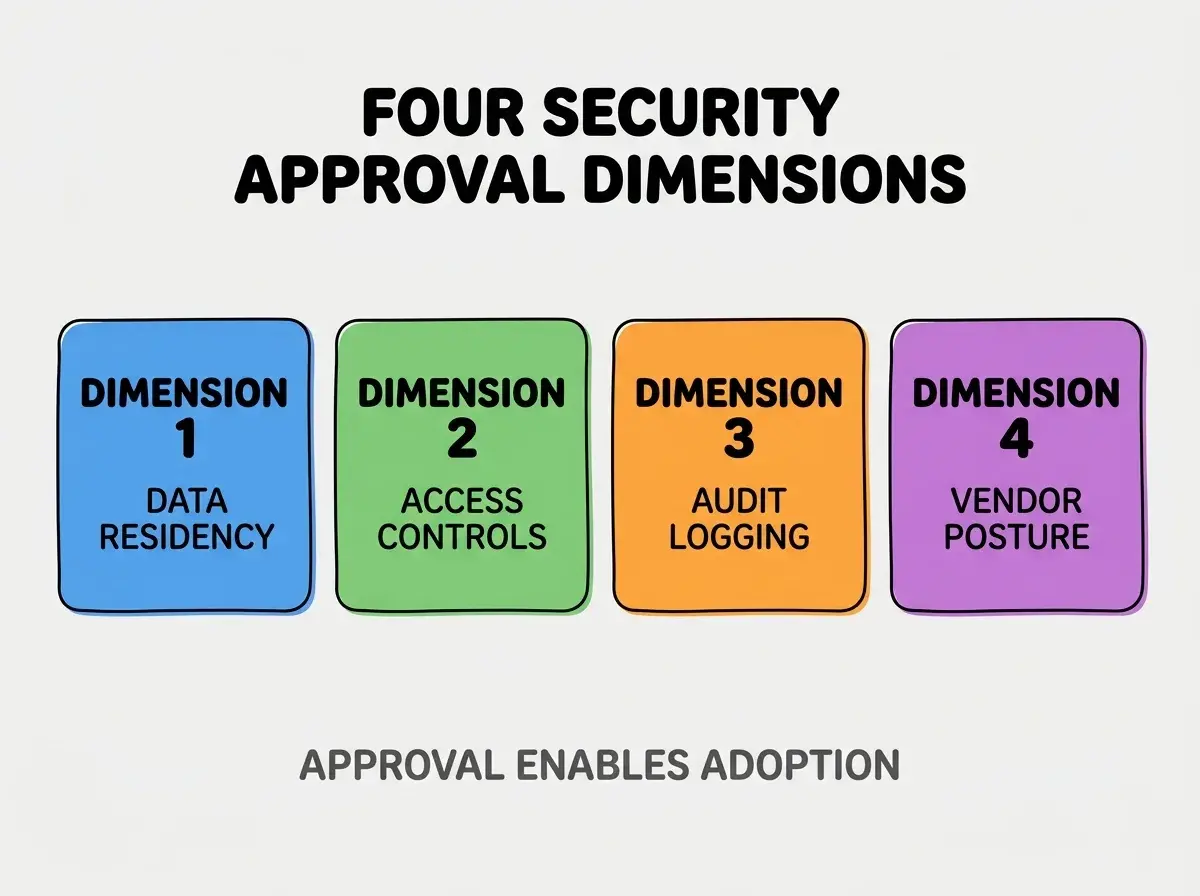
Dimension 3, audit logging. What usage gets recorded, retention period, accessibility for investigations. Compliance often requires.
Dimension 4, vendor security posture. SOC 2, ISO 27001, penetration testing, breach history. Vendor practices matter.
How To Prepare Each Dimension
Four preparation patterns address each dimension.
Preparation 1, document data flows. Diagram showing prompt path, code path, telemetry path. Diagrams enable security review.
Browse more pulse
Read more pulsePreparation 2, propose access control matrix. Roles, permissions, approval workflow. Matrix demonstrates thoughtfulness.
Preparation 3, audit logging plan. What gets logged, where stored, retention, access. Plan addresses compliance proactively.
Preparation 4, vendor security pack. Collect vendor SOC 2, certifications, breach history. Pack accelerates security review.
What Makes Approval Sustainable
Three patterns separate sustainable approvals from one off success.
Pattern 1, security partnership not adversarial. Security as partner produces collaboration; security as obstacle produces friction.
Pattern 2, regular updates as tools evolve. AI tools change; updates inform security. Surprise breaks trust.
Pattern 3, champion within security team. Internal advocate accelerates; external pushers slow.
What Makes Enterprise Adoption Sustainable
Three patterns separate sustainable enterprise adoption from initial pilots.
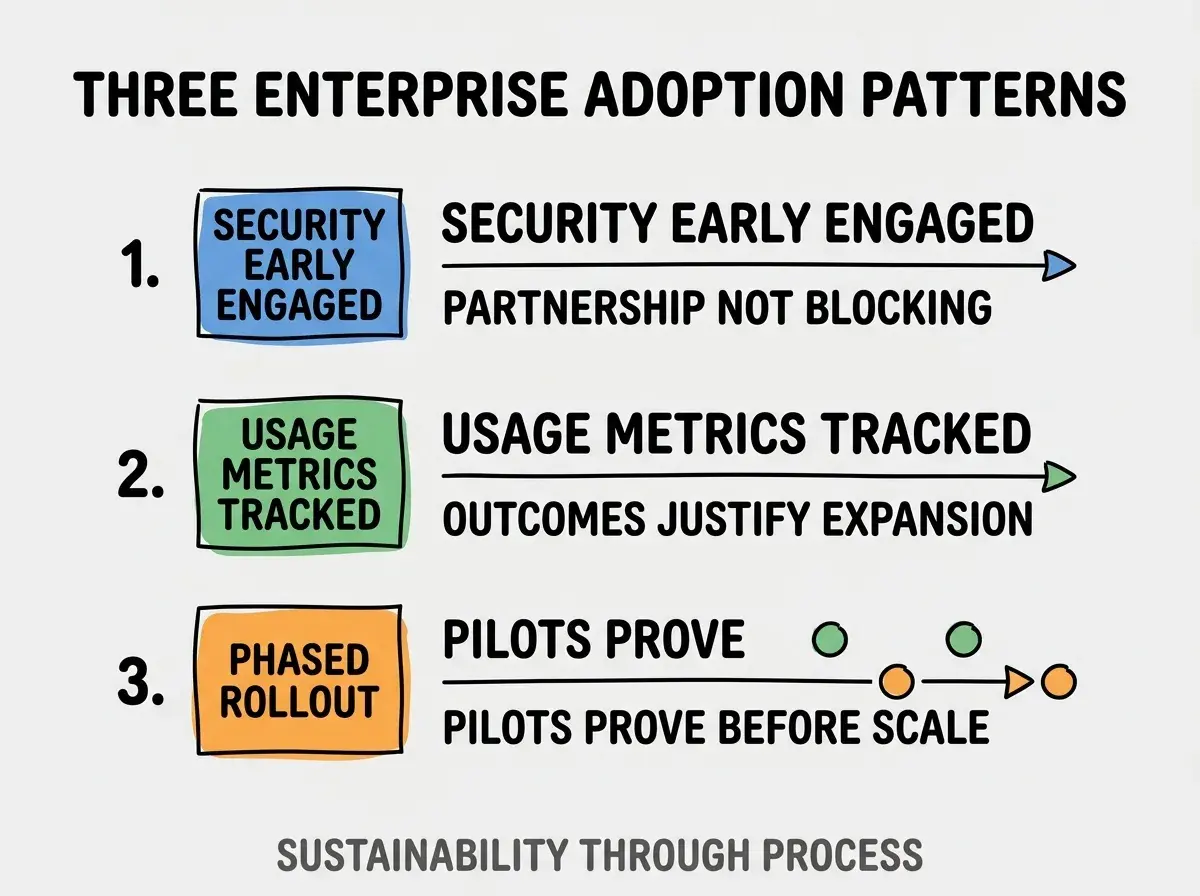
Pattern 1, security engaged early. Early engagement reveals concerns; concerns addressed before launch easier than after.
Pattern 2, usage metrics tracked. Metrics justify expansion; without metrics, expansion arguments weak.
Pattern 3, phased rollout. Pilots prove before scaling; scaling without proof risks reversal.
The combination produces sustainable enterprise adoption. Without these patterns, adoption stalls.
How To Engage Security Team
Three patterns help engineering engage security productively.
Pattern A, security review meeting before submission. Pre meeting reveals concerns; concerns addressed before formal review.
Pattern B, technical detail prepared. Architecture diagrams, data flows, control matrices. Detail demonstrates seriousness.
Pattern C, compliance framework alignment. Map to existing frameworks (SOC 2, NIST). Alignment accelerates review.
Common Questions About Enterprise AI Approval
Enterprise AI approval raises questions worth addressing directly.
The first question is whether to use enterprise tier of vendor. Yes; enterprise tier includes security features approval requires.
The second question is how long approval takes. 4-12 weeks typically; faster with preparation. Slower without.
The third question is whether to pursue approval team by team or company wide. Company wide better; reduces duplicate work.
The fourth question is whether to wait for vendor SOC 2. Yes for regulated industries; sometimes acceptable to use SOC 2 in process for non regulated.
How Approval Affects Engineering Productivity
Approval affects engineering productivity in compounding ways. Productivity effects compound across team scale.
The first compounding effect is tool access for entire team. Approved tools enable team wide adoption; selective use limits benefit.
The second compounding effect is shared learning. Whole team using same tools enables shared learning; isolated users learn alone.
The third compounding effect is integration capability. Approved tools integrate with enterprise systems; unapproved cannot.
The combination produces engineering productivity shaped by approval. Without approval, productivity benefits limited to individual experiments.
How To Build Security Champion Network
Three patterns help build security advocates.
Pattern A, identify security team interests. Where security team wants help; offer help, build trust.
Pattern B, demonstrate security value of AI. AI helps with security tasks (code review, vulnerability scanning); demonstration builds advocacy.
Pattern C, collaborate on policy development. Security policies shaped collaboratively get adopted; imposed policies face resistance.
The combination builds security advocacy. Without engagement, advocacy depends on chance.
The most damaging enterprise approval mistake is treating security as obstacle to bypass. Security teams have legitimate concerns; bypassing produces shadow IT that creates real risk. The fix is to engage security as partner; explain use cases, address concerns, develop joint solutions. Engineering teams who partner get tools approved faster; teams who bypass face crackdowns that delay everything.
The other mistake is missing the data residency complexity. Enterprise data spans regions; data residency varies. Detail matters.
A third mistake is over indexing on speed. Quality submissions approve faster than rushed. Quality compounds future approvals.
A fourth mistake is treating approval as one off. Tools update; approvals need refresh. Ongoing relationship matters.
What This Means For You
Getting AI coding tools approved by enterprise security requires structured preparation across four dimensions. The four dimensions, preparation patterns, and sustainability approaches produce approvals that enable enterprise scale AI adoption.
- If you're a senior dev: Engage security team early; preparation accelerates approval. The investment pays back in adoption speed.
- If you're a founder: Enterprise sales require security approvability; build vendor security posture early to enable enterprise market.
- If you're a product manager: Approval pathway shapes rollout strategy; understanding pathway improves planning.
Browse more pulse
Read more pulse