To build intuition for when AI is wrong, recognize the four intuition signals AI mistakes produce (suggestion feels too smooth for problem complexity, suggestion uses pattern that does not match codebase conventions, suggestion confidence does not match difficulty, and suggestion misses constraint you mentioned earlier), see how to develop the feel through deliberate practice, and apply the patterns that build intuition over time. The intuition matters because it catches AI mistakes faster than analysis alone.
This piece walks through the four intuition signals, how intuition develops, the practice patterns, and the four mistakes that prevent intuition development.
Why Intuition About AI Mistakes Matters
Intuition about AI mistakes matters because intuition operates faster than analysis. The speed matters; intuition catches mistakes during work flow while analysis interrupts flow.
The 2026 reality is that experienced AI users develop intuition that newer users lack. Intuition shifts from explicit verification to implicit recognition over time; the shift produces dramatic productivity differences.
A 2025 AI usage study comparing experienced and new AI users found that experienced users caught AI mistakes 8x faster while requiring 47 percent less explicit verification time. The difference reflects intuition development that experience produces.
The pattern to copy is the way doctors develop diagnostic intuition. Doctors initially follow checklists explicitly; experience produces intuition that operates without checklists. AI usage follows similar pattern; explicit verification gives way to implicit recognition through deliberate practice.
The Four Intuition Signals
Four signals reveal AI mistakes through intuition.
Signal 1, suggestion feels too smooth for problem complexity. Hard problems should produce considered suggestions; smooth suggestions for hard problems often miss complexity.
Signal 2, suggestion uses unfamiliar patterns. Patterns that do not match codebase signal AI worked from training rather than codebase context.
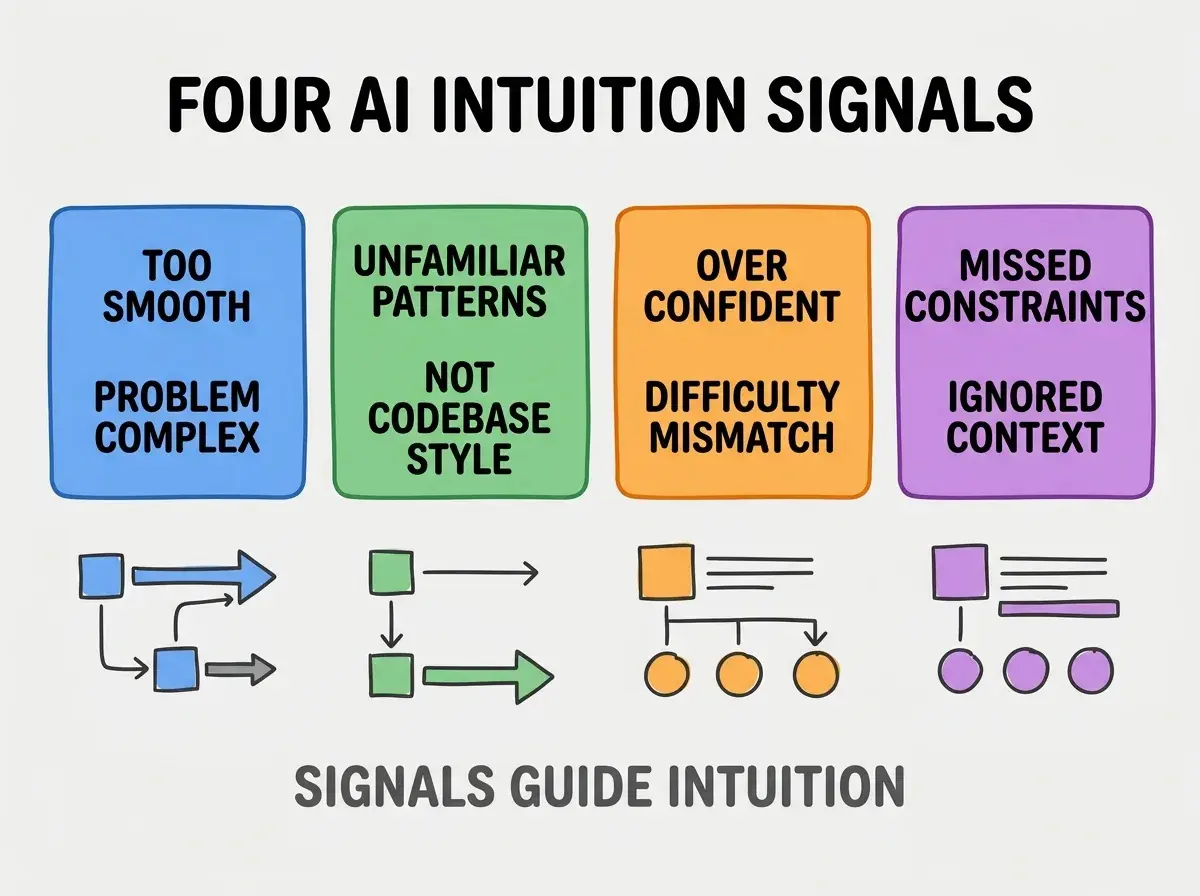
Signal 3, suggestion confidence mismatches difficulty. AI confidence inappropriate to problem difficulty signals possible hallucination or oversight.
Signal 4, suggestion misses constraints mentioned earlier. Forgotten constraints signal context window degradation or attention issues.
How Intuition Develops Over Time
Three patterns describe how intuition develops with experience.
Pattern 1, initial explicit verification builds pattern recognition. Verifying explicitly trains pattern recognition that becomes intuition. Verification is foundation for intuition.
Browse more foundations
Read more foundationsPattern 2, mistake retrospective converts experience into intuition. Reflecting on caught mistakes builds recognition for similar mistakes. Reflection accelerates intuition development.
Pattern 3, deliberate attention to signals develops sensitivity. Conscious attention to signals during early AI usage builds sensitivity that becomes automatic. Without attention, signals pass unnoticed.
The Practice Patterns That Build Intuition
Three practice patterns accelerate intuition development.
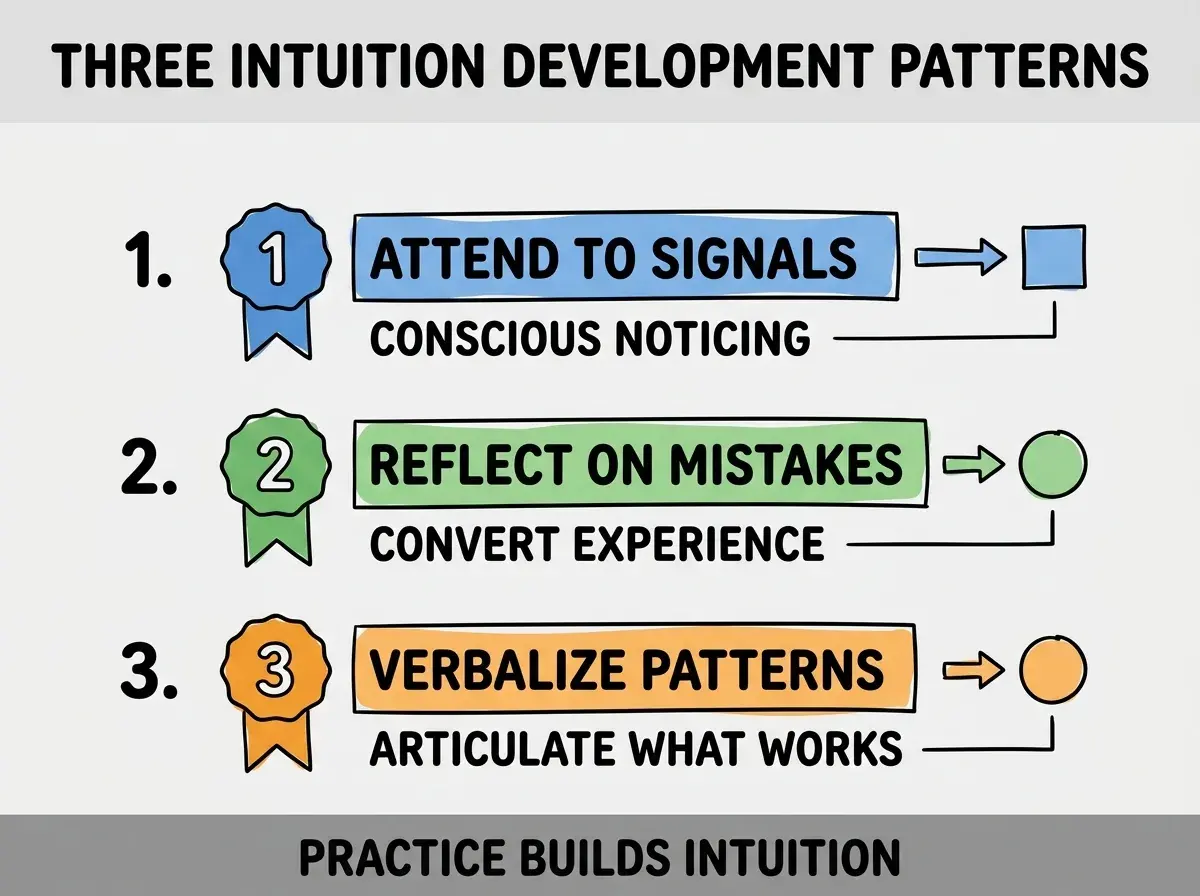
Pattern 1, attend to signals consciously during early usage. Notice when something feels off; investigate why. Attention builds sensitivity.
Pattern 2, reflect on caught mistakes for pattern identification. What signaled mistake; how to recognize sooner. Reflection compounds learning.
Pattern 3, verbalize successful patterns out loud or in writing. Articulation solidifies pattern recognition. Without articulation, patterns stay implicit.
What Makes Intuition Sustainable
Three patterns separate sustainable intuition from problematic patterns.
Pattern 1, intuition supplemented by verification when stakes are high. High stakes deserve verification regardless of intuition. Intuition is fast not infallible.
Pattern 2, intuition recalibrated as AI capabilities change. AI changes; intuition based on old AI may not match new AI. Recalibration matters.
Pattern 3, intuition shared across team for collective learning. Sharing accelerates collective intuition development. Without sharing, intuition stays individual.
The combination produces intuition that scales sustainably. Without these patterns, intuition can become source of false confidence.
How To Calibrate Intuition Against Verification
Three calibration patterns help maintain intuition reliability.
Pattern A, periodic verification confirms intuition accuracy. Track when intuition was right and wrong. Tracking calibrates confidence.
Pattern B, switch to verification mode for unfamiliar territory. Intuition trained on familiar territory; unfamiliar deserves verification. Recognition of unfamiliarity matters.
Pattern C, share intuition disagreements with team. Different intuitions reveal different patterns. Disagreements produce learning.
The combination produces intuition calibration that maintains reliability. Without calibration, intuition can drift from accuracy.
The most damaging intuition mistake is treating intuition as substitute for verification on high stakes work. Intuition is fast but not infallible; high stakes work deserves verification regardless of intuition signals. The fix is to use intuition for filtering and prioritization, then verify high stakes findings; intuition without verification produces compound errors when intuition wrong while intuition with verification produces speed without sacrificing reliability.
The other mistake is over confidence in early intuition. Early intuition not yet calibrated; treat as hypothesis rather than conclusion. Calibration takes time.
A third mistake is missing the deliberate practice that builds intuition. Intuition does not develop automatically; deliberate attention required.
A fourth mistake is treating intuition as transferable across AI tools. Different AI tools produce different patterns; intuition partially tool specific.
How To Apply Intuition To Specific AI Patterns
Three specific patterns deserve intuition development.
Pattern A, intuition for AI hallucinations. Library names that sound right but feel novel; verify quickly.
Pattern B, intuition for context degradation. AI losing track of constraints; restart session or share context explicitly.
Pattern C, intuition for AI misdirection. AI heading wrong direction; redirect early before investment compounds.
The combination produces pattern specific intuition. Without specific patterns, generic intuition handles patterns mediocrely.
How AI Intuition Will Likely Evolve
AI intuition development patterns will likely evolve as AI capabilities change.
The first likely evolution is intuition shifting as AI improves. Patterns that signal mistakes change as AI improves. Recalibration matters.
The second likely evolution is intuition tooling emerging. Tools that surface intuition signals automatically. Tooling reduces conscious attention burden.
The third likely evolution is intuition training becoming standardized. Training patterns shared across community. Standardization accelerates broader intuition development.
The combination suggests intuition will remain critical but become better supported. Engineers learning intuition now build skills that remain valuable.
Common Questions About Building AI Intuition
Building AI intuition raises questions worth addressing directly.
The first question is how long intuition takes to develop. Months of regular usage typically; deliberate practice accelerates. Without practice, development takes years.
The second question is whether intuition transfers between developers. Partially; verbalized intuition transfers better than implicit. Sharing accelerates transfer.
The third question is whether to teach intuition to junior developers. Yes through pattern articulation; without teaching, juniors develop intuition slowly.
The fourth question is whether intuition can produce overconfidence. Yes; intuition without calibration becomes false confidence. Calibration through verification matters.
How Intuition Differs From Heuristics
Intuition differs from heuristics in important ways for AI usage. The differences matter for understanding both intuition and heuristic value.
The first difference is operation speed. Heuristics involve conscious application; intuition operates pre conscious. Speed difference produces practical workflow differences.
The second difference is articulability. Heuristics are articulable; intuition often is not until reflection surfaces it. Articulability affects sharing.
The third difference is failure modes. Heuristics fail predictably; intuition fails unpredictably. Different failure modes require different mitigation.
The fourth difference is teachability. Heuristics teach through instruction; intuition teaches through deliberate practice. Teaching method matters for skill transfer.
The fifth difference is improvement trajectory. Heuristics improve through refinement; intuition improves through exposure variety. Improvement paths differ.
What This Means For You
Building intuition for AI mistakes determines AI usage productivity over time. The four signals, development patterns, and practice approaches produce framework for sustained intuition development.
- If you're a senior dev: Develop intuition through deliberate practice; intuition produces productivity that pure verification cannot match.
- If you're a junior dev: Build intuition through deliberate practice from start; intuition compounds over career.
- If you're a founder: Help team develop intuition through pattern sharing. Without sharing, intuition stays individual when team intuition would be valuable.
Browse more foundations
Read more foundations