To build a team standup bot with AI tools, follow the four phase approach (define how your team's standup should work and what information matters, build the prompting and collection that respects time zones and preferences, design the summary that managers and teammates actually read, and ship with the integration patterns that surface action items), recognize what separates standup bots that produce team awareness from bots that get muted, and apply the patterns that produce sustained engagement. The team standup bot becomes valuable when async standups produce more awareness than sync standups consumed; without that bar, the bot becomes notification noise.
This piece walks through the four phases, the summary patterns, the specific tooling, and the four mistakes that produce standup bots teams mute within days.
Why Team Standup Bots Matter
Team standup bots transform daily syncs into asynchronous awareness. The transformation matters; sync standups consume time across all participants regardless of who has updates worth sharing, while async bots collect updates efficiently and broadcast only what matters.
The 2026 reality is that AI tools dramatically accelerate standup bot building while AI integration during update collection can summarize, surface blockers, and detect coordination needs faster than manual review. The combination means even small teams can have standup automation matching what enterprises previously paid for as separate platforms.
A 2025 distributed team productivity survey of 800 remote engineering teams found that teams using async standup bots saved an average of 47 minutes per teammate per week compared to sync standups while reporting equivalent or better team awareness. The time savings compound dramatically over months while preserving the awareness sync standups provided.
The pattern to copy is the way email replaced postal mail for most coordination. Async coordination through email proved more efficient than synchronous letters that required scheduled response windows. Async standup bots play similar role for team coordination; the async pattern enables coordination without synchronous time consumption.
The Four Phase Approach
Four phases produce team standup bots that drive awareness.
Phase 1, define how your team's standup should work and what information matters. Yesterday, today, blockers structure. Time zones, preferred channels, response windows. Defined process determines bot design.
Phase 2, build the prompting and collection that respects time zones and preferences. DM prompts at user local morning. AI tools generate the integration code effectively given clear specifications.
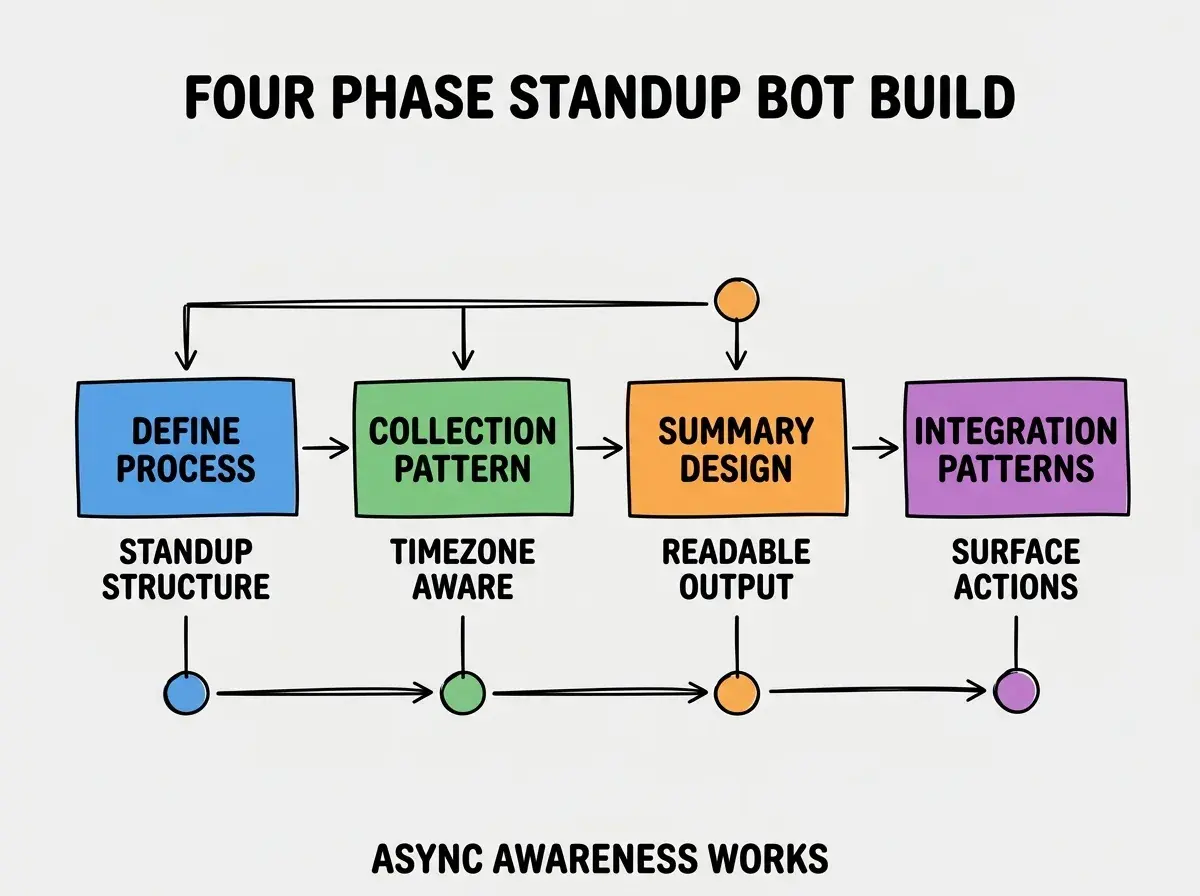
Phase 3, design the summary that managers and teammates actually read. Concise format, blocker visibility, AI summarization. Summary quality determines reading rate; verbose summaries get skipped.
Phase 4, ship with integration patterns that surface action items. Slack notifications, blocker pings, manager dashboards. Integration produces value beyond data collection; isolated standups become unread archives.
The Summary Patterns That Get Read
Three patterns produce summaries teammates actually read.
Pattern 1, blockers prominently surfaced at top. Blockers requiring help drive most decisions; surfacing them prominently produces faster help. Blockers buried at bottom delay help.
Browse more team tool tutorials
Read more build tutorialsPattern 2, AI summarization condenses individual updates into team summary. Pure list of individual updates becomes long; AI summary captures the team picture concisely. Summary length determines reading rate.
Pattern 3, action items extracted and routed. AI identifies who needs to do what; routing produces action. Without action extraction, awareness produces no behavior change.
The Specific Tooling That Worked
Three tool categories combine effectively for standup bot building.
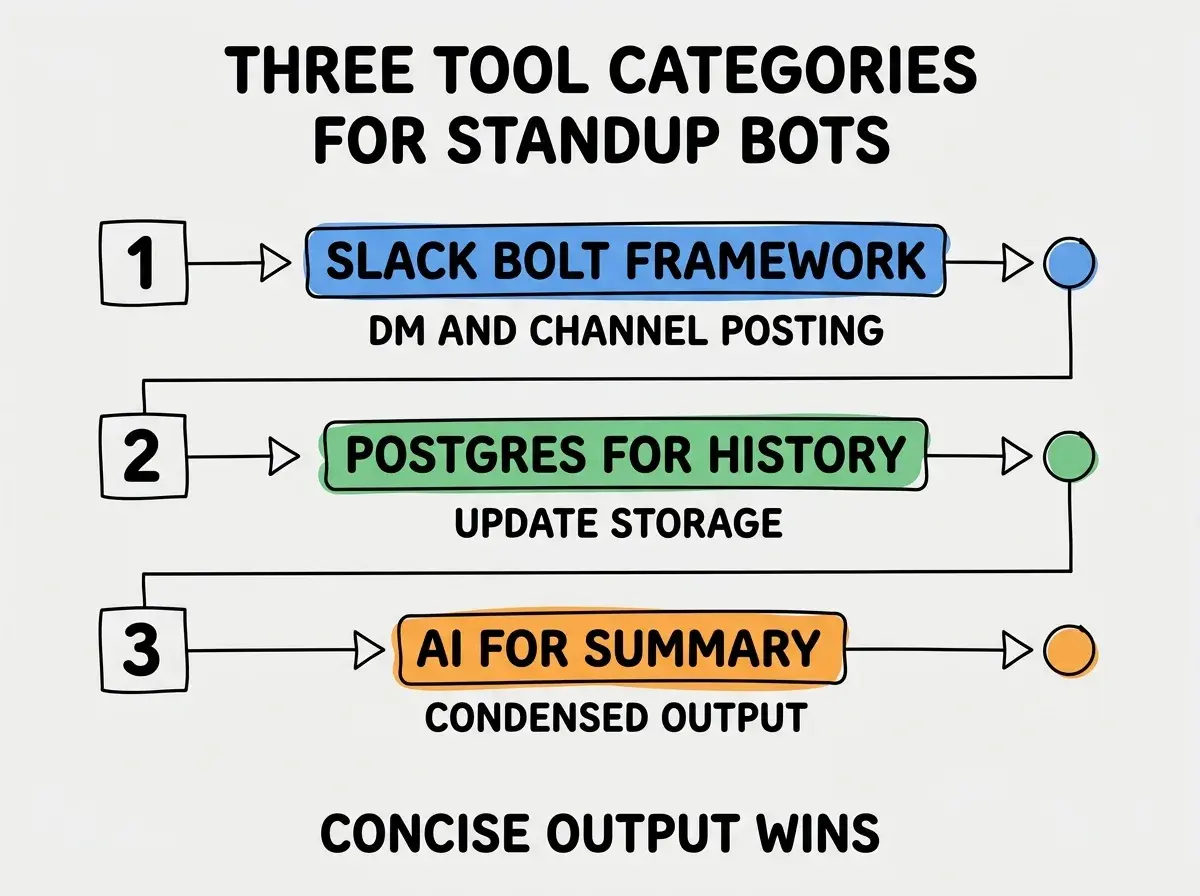
Tool 1, Slack Bolt framework for DM and channel posting. Official Slack SDK. Handles DM prompts, channel summaries, interactive responses effectively.
Tool 2, Postgres for update history storage. Updates, blockers, action items, history. Relational data fits naturally.
Tool 3, AI for summary generation. Claude or GPT condenses individual updates into team summary. Reduces summary effort dramatically; manual summarization rarely sustains.
What Makes Standup Bots Get Sustained Use
Three patterns separate sustained standup bots from muted ones.
Pattern 1, prompts respect user time zones and preferences. Morning prompts at user local time, not server time. Time zone respect produces participation; cross time zone insensitivity produces muted bots.
Pattern 2, summaries get shorter rather than longer over time. Initial summaries verbose; production summaries condensed. Length discipline produces sustained reading; verbose summaries get skimmed then skipped.
Pattern 3, manager review of standups produces team incentive to update. When managers reference standups in real conversations, teammates update; when managers ignore standups, teammates skip updates. Manager engagement matters.
The combination produces standup bots teams genuinely engage with. Without these patterns, bots become unread automation that consumes setup time without producing awareness.
How to Build Your First Standup Bot
Three implementation patterns help first standup bots succeed.
Pattern A, start with one team, not company wide. Single team validates the pattern. Company wide rollout from day one often produces inconsistent practices.
Pattern B, soft launch with manager commitment to read. Manager engagement determines team participation. Without manager reading, team participation fades; with manager reading, team participation sustains.
Pattern C, instrument participation and reading rates. Update completion rate, summary read rate. Without instrumentation, adoption problems stay hidden until they become culture problems.
The combination produces first standup bots that establish the pattern for sustained async coordination. Without these patterns, first bots often launch then fade as the rhythm fails to take hold.
The most damaging standup bot mistake is treating bot launch as standup process change without addressing manager behavior. Bots without manager engagement produce unread updates that teammates eventually stop providing. The fix is to require manager commitment to read and reference standups before launching; manager behavior change matters more than tool features. Bots that automate broken standup processes produce automated broken standups.
The other mistake is overengineering with features no team needs. Comprehensive standup platforms produce friction without value for most teams. The fix is to build for your team specifically; generic standup tools rarely match team patterns.
A third mistake is missing integration with project tracking tools. Standup updates that do not flow to project tracking require duplicate entry. The fix is to integrate with the project tools your team uses; integration eliminates duplicate work.
A fourth mistake is failing to handle planned absences gracefully. Vacation, sick days, focus days all should suppress prompts without producing missing update concerns. The fix is to design for absences; flexible bots survive normal team variation.
A fifth mistake is ignoring user feedback during the first weeks. The first weeks reveal what works and what does not; quick iteration matters. The fix is to actively solicit feedback for the first month and iterate based on it; bots that adapt early sustain better than bots that ship and freeze.
What This Means For You
The team standup bot built with AI tools becomes valuable through async efficiency, summary quality, and manager engagement. The four phases, summary patterns, and tool combinations produce standup automation teams genuinely benefit from.
- If you're a product manager: Standup bots reduce sync coordination time. Build them when team size or distribution makes sync standups inefficient; below that bar, sync standups may suffice.
- If you're a senior dev: AI tools handle standup bot implementation effectively. The bottleneck is summary quality and manager engagement, not implementation; invest in those areas more than feature breadth.
- If you're a founder: Standup bots become valuable as team distributes geographically. Build them when distribution makes sync standups expensive in time zones; for co-located teams, sync standups may remain efficient.
Browse more team tool tutorials
Read more build tutorials