To add AI powered content moderation to your app, follow the four phase approach (define what content types and risk levels matter for your platform, integrate moderation API or model that produces moderation signals, design the workflow that handles flagged content appropriately, and monitor moderation effectiveness across content patterns), recognize what makes AI moderation effective versus problematic, and apply the patterns that produce sustainable user generated content platforms. The moderation capability matters because platforms with user generated content need moderation to prevent abuse while remaining usable.
This piece walks through the four moderation phases, what makes AI moderation effective, the specific tooling, and the four mistakes that produce moderation failure.
Why AI Content Moderation Matters
AI content moderation matters for any platform with user generated content. The need matters; without moderation, platforms accumulate abusive content that drives users away while creating legal liability.
The 2026 reality is that AI moderation has become accessible for small platforms that previously could not afford moderation infrastructure. APIs from major providers handle text, image, and video moderation at costs that fit indie hacker budgets.
A 2025 platform safety study of 400 user generated content platforms found that platforms with AI moderation showed 87 percent fewer policy violation reports and 64 percent higher user retention compared to platforms with manual only moderation. The retention difference reflects how much abusive content drives users away from platforms without protection.
The pattern to copy is the way airport security combines automated screening with human review. Automated screening catches most issues efficiently; human review handles edge cases that automation cannot. Content moderation follows similar pattern; AI catches most issues, humans handle edge cases.
The Four Phase Approach
Four phases produce content moderation that scales sustainably.
Phase 1, define content types and risk levels. Text, images, video, audio each require different moderation. Risk levels determine response severity.
Phase 2, integrate moderation API or model. OpenAI moderation, Hive, Perspective API. Integration choice affects coverage and cost.
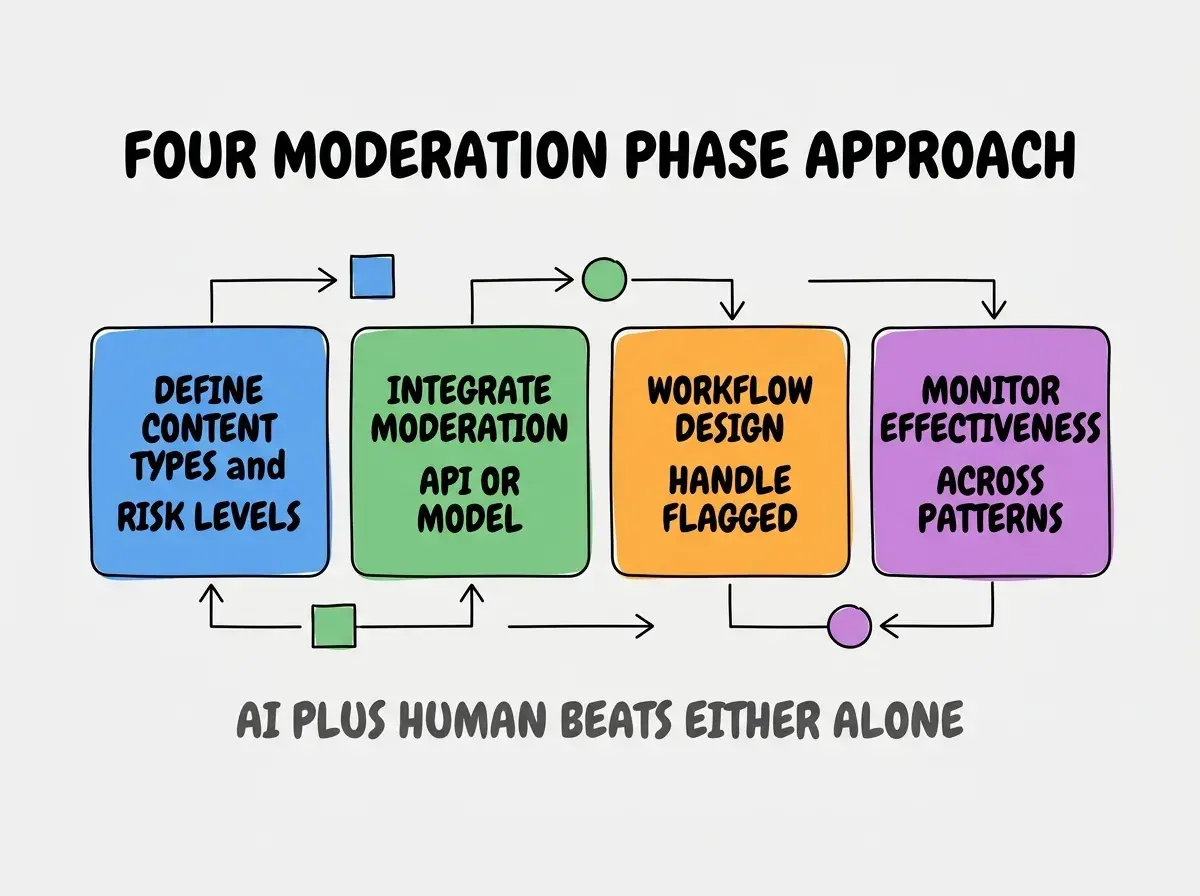
Phase 3, design workflow handling flagged content. Auto removal, human review queue, user notification, appeal process. Workflow determines moderation usability.
Phase 4, monitor moderation effectiveness across patterns. False positive rates, false negative rates, content category effectiveness. Monitoring catches drift from policy.
What Makes AI Moderation Effective
Three patterns characterize effective AI moderation.
Pattern 1, multiple severity levels not binary decisions. Definitely violates, possibly violates, fine, definitely fine. Levels enable graduated response rather than all or nothing.
Browse more AI features
Read more build tutorialsPattern 2, human review for edge cases at appropriate severity. AI handles obvious cases; humans handle ambiguous. Combination outperforms either alone.
Pattern 3, transparent moderation with user feedback. Users informed of moderation decisions; appeals possible. Transparency builds trust that opaque moderation destroys.
The Specific Tooling That Works
Three tool categories combine effectively for content moderation.
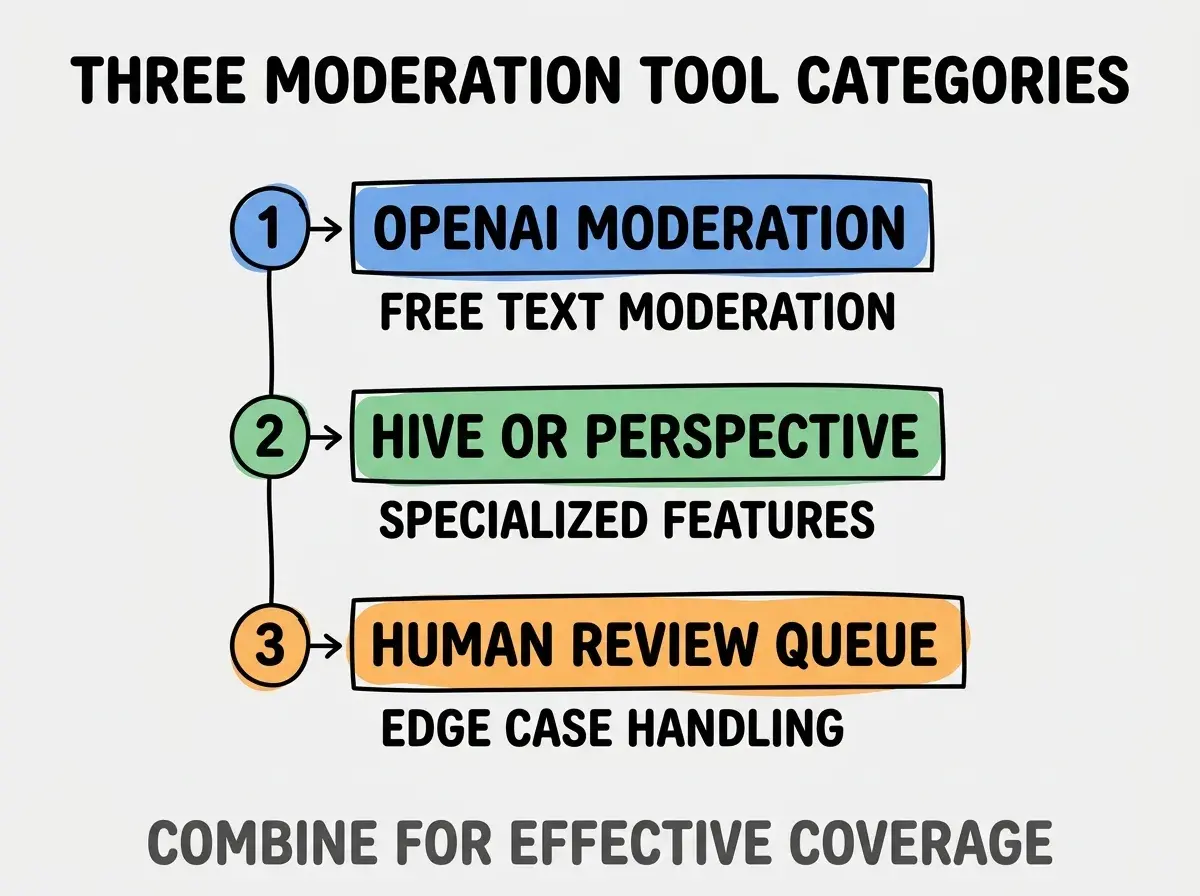
Tool 1, OpenAI moderation API for text moderation. Free tier covers most platforms; effective for common cases. Good starting point for text moderation.
Tool 2, Hive or Perspective for specialized features. Image moderation, advanced text features, custom policy. Specialized tools handle specific needs.
Tool 3, human review queue for edge cases. Internal tools or services like Trust Lab. Human review handles cases AI cannot decide reliably.
What Makes Moderation Sustainable
Three patterns separate sustainable moderation from problematic patterns.
Pattern 1, clear policy informing AI moderation decisions. Policy provides AI prompts and human review guidance. Without clear policy, decisions become inconsistent.
Pattern 2, regular policy review based on observed patterns. New abuse patterns emerge; policy must evolve. Without review, policy becomes stale.
Pattern 3, appeal process building user trust. Mistakes happen; appeals correct mistakes. Without appeals, mistakes erode trust permanently.
The combination produces moderation that handles real platform conditions. Without these patterns, moderation often becomes either too restrictive or too permissive over time.
How To Configure Moderation For Specific Content Types
Three content types deserve specific approaches.
Type 1, text content with context dependence. Same words mean different things in different contexts; moderation must consider context. Context aware moderation outperforms keyword based.
Type 2, images with various risk patterns. NSFW, violence, IP violations. Different image risks require different handling.
Type 3, mixed content combining text and images. Cross modal moderation considers full context. Combined consideration catches issues single modal misses.
The combination produces approaches matched to content patterns. Without type specific approaches, generic moderation produces both false positives and false negatives.
The most damaging content moderation mistake is treating moderation as binary auto removal versus inaction. Binary moderation produces either over removal (good content lost) or under moderation (abusive content remains). The fix is to design graduated responses; flag for review, warn user, hide from public, soft delete, hard delete. Graduated responses enable nuanced handling that binary approaches cannot match. Platforms with graduated responses produce better outcomes than platforms with binary approaches.
The other mistake is missing transparency and appeals. Users need to understand moderation decisions and appeal mistakes. Without transparency, moderation feels arbitrary and erodes trust.
A third mistake is over reliance on single moderation source. AI tools have different blind spots; multiple sources catch what single sources miss.
A fourth mistake is treating moderation as set and forget. Abuse patterns evolve; moderation must evolve with them.
How To Handle Specific Moderation Challenges
Three challenges deserve specific approaches.
Challenge A, false positives blocking legitimate content. Real users frustrated by false flags. Solutions include rapid appeal review, user reputation patterns, human review for borderline cases.
Challenge B, novel abuse patterns evading moderation. Bad actors evolve; moderation must evolve. Solutions include monitoring for novel patterns, regular model updates, manual flag enrichment.
Challenge C, jurisdiction specific content rules. Different countries have different rules; platform may need geographic moderation. Solutions include geo aware moderation.
The combination produces approaches handling real moderation challenges. Without specific approaches, common challenges produce predictable failures.
How Content Moderation Will Likely Evolve
Content moderation will likely continue evolving with AI capability and regulation.
The first likely evolution is multimodal moderation becoming standard. Combined text plus image plus video understanding. Multimodal catches what unimodal misses.
The second likely evolution is regulation increasing globally. EU Digital Services Act, US state level rules, UK Online Safety Act. Regulation increases moderation requirements.
The third likely evolution is custom moderation models becoming accessible. Fine tuned models for platform specific content. Customization improves accuracy for specific platforms.
The combination suggests moderation will become more capable but also more required. Builders learning patterns now build skills that remain valuable as requirements expand.
Common Questions About AI Content Moderation
AI content moderation raises questions worth addressing directly.
The first question is how much to moderate proactively versus reactively. Proactive moderation prevents harm but produces false positives; reactive moderation reduces false positives but allows harm. Balance depends on platform risk tolerance and user trust.
The second question is how to handle moderation across user generated content types. Different content types have different moderation needs; unified moderation often performs worse than type specific moderation. Build for content types you actually have.
What This Means For You
AI content moderation enables user generated content platforms to scale without becoming abuse vectors. The four phases, tool combinations, and graduated responses produce moderation that scales sustainably.
- If you're a founder: Plan moderation from start, not after first abuse incident. Without moderation, abuse accumulates and drives users away.
- If you're a senior dev: Moderation requires combining AI and human review effectively. Build workflow that uses each appropriately.
- If you're an indie hacker: Free tier AI moderation makes solo platforms viable. Without AI moderation, solo founders cannot operate platforms with user generated content.
Browse more AI features
Read more build tutorials