To build a Slack bot with AI capabilities, follow the four phase approach (define what specific team workflows the bot should enhance, build the Slack integration that handles events and commands, integrate AI for the conversational and reasoning layer, and ship with the reliability patterns that produce sustained team usage), recognize what separates Slack bots that get used from ones that get muted, and apply the patterns that produce bots teams genuinely interact with. The Slack bot becomes valuable when it answers questions or executes actions faster than alternatives; without that bar, the bot becomes notification noise.
This piece walks through the four phases, the AI integration patterns, the specific tooling, and the four mistakes that produce Slack bots teams mute within days.
Why Slack Bots With AI Capabilities Matter
Slack bots with AI capabilities turn Slack into a productive interface beyond messaging. The transformation matters; teams already spend significant time in Slack, and adding capability to that interface produces leverage greater than building separate tools that require context switching.
The 2026 reality is that AI tools dramatically accelerate Slack bot building while AI integration during bot interaction can handle natural language queries, summarization, and decision support that previously required leaving Slack to access. The combination means small teams can build internal AI assistants matching what enterprises previously paid significant license fees for.
A 2025 internal tools survey of 600 mid sized companies found that companies with AI enabled Slack bots reduced context switching time by an average of 18 minutes per employee per day. The reduction comes from answering questions and executing actions inside Slack rather than requiring users to leave Slack for separate tools.
The pattern to copy is the way good office assistants make their executives more productive. The assistants do not replace the executive but handle the small queries and tasks that would otherwise consume executive attention. Slack bots with AI play similar role for teams; the bots do not replace teammates but handle small tasks that would otherwise consume team attention.
The Four Phase Approach
Four phases produce Slack bots with AI capabilities that get sustained use.
Phase 1, define what specific team workflows the bot should enhance. Question answering, status reporting, action triggering. The defined workflows determine the bot value; bots without clear workflows become notification noise.
Phase 2, build the Slack integration that handles events and commands. Slash commands, event subscriptions, interactive components. Slack APIs handle the heavy lifting; AI tools generate integration code effectively.
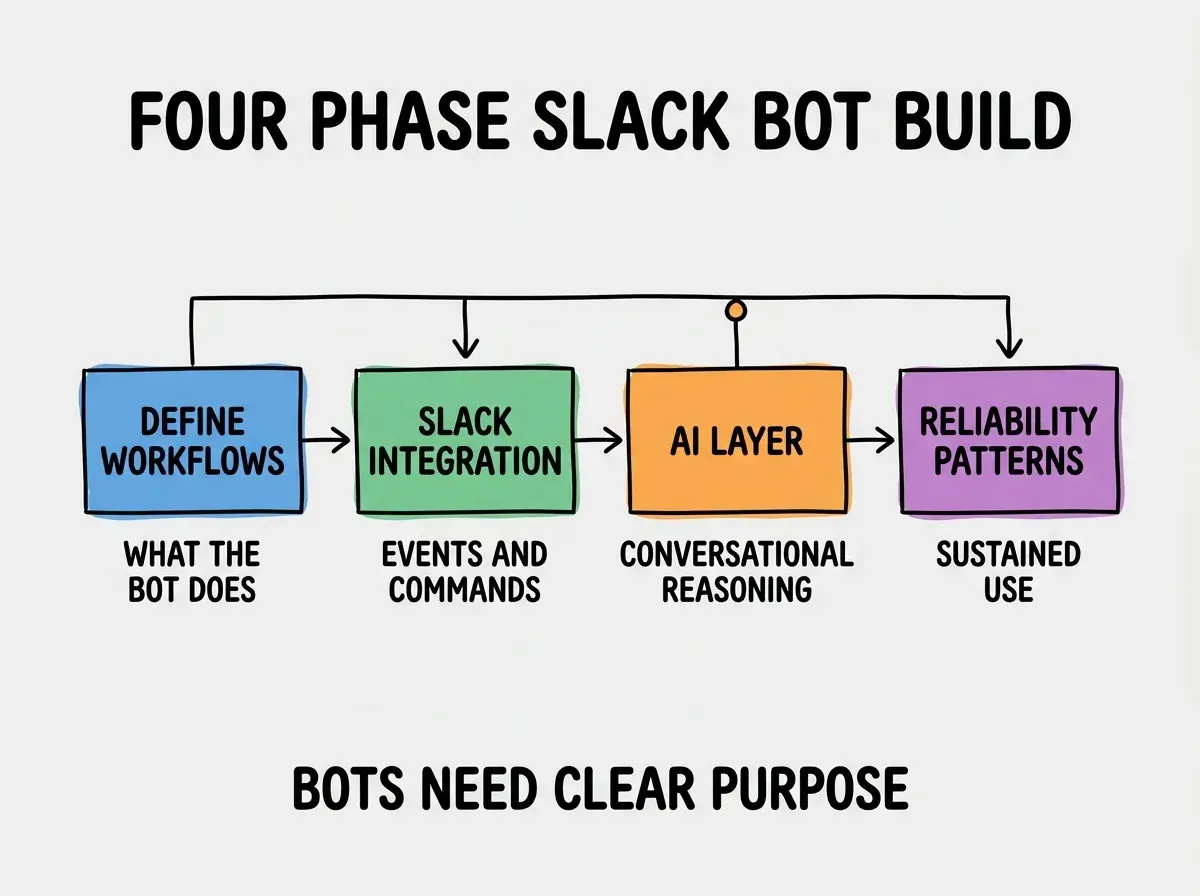
Phase 3, integrate AI for the conversational and reasoning layer. Claude or GPT for natural language understanding. Retrieval for knowledge questions. The AI layer transforms the bot from rule based to conversational.
Phase 4, ship with reliability patterns that produce sustained team usage. Error handling, response time targets, graceful degradation. Reliability matters more than feature breadth; flaky bots get muted.
The AI Integration Patterns That Work
Three patterns produce AI integration that produces useful bot interactions.
Pattern 1, retrieval augmented responses with citations. Bot answers questions using team knowledge bases; cites sources for transparency. Citations preserve trust; uncited bot responses erode it over time.
Browse more AI feature tutorials
Read more build tutorialsPattern 2, action confirmation before destructive operations. Bot confirms before deleting, modifying, or sending. Confirmation prevents disasters; pure action execution produces occasional disasters that destroy trust.
Pattern 3, conversation context retention across messages. Bot remembers previous messages in conversation. Stateless bots feel robotic; stateful bots feel useful.
The Specific Tooling That Worked
Three tool categories combine effectively for Slack bot building.
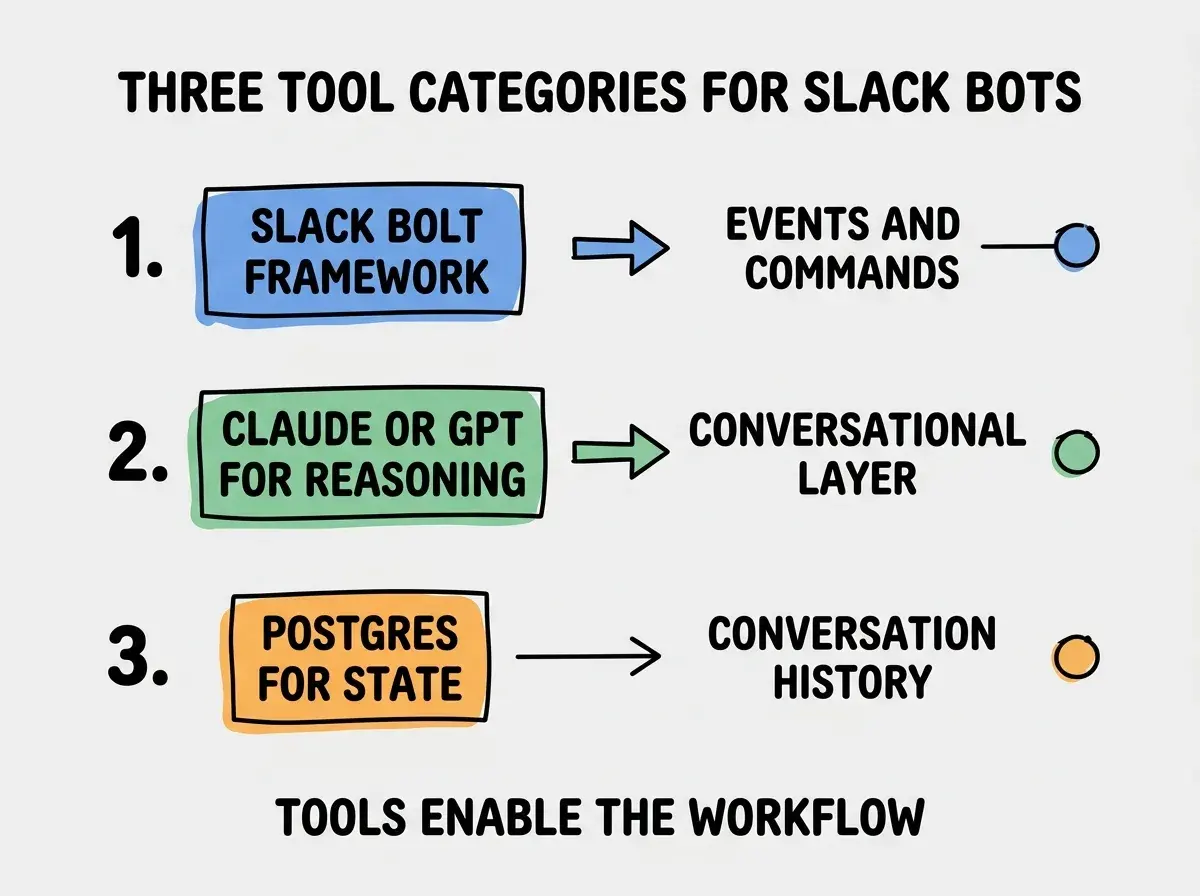
Tool 1, Slack Bolt framework for events and commands. Official Slack SDK. Handles authentication, event routing, response formatting effectively.
Tool 2, Claude or GPT for reasoning layer. Best in class LLMs for conversational responses. Model choice matters less than prompt design and retrieval quality.
Tool 3, Postgres for conversation state. Conversation history, user preferences, action audit logs. Relational data fits naturally.
What Makes Slack Bots Get Sustained Use
Three patterns separate used bots from muted ones.
Pattern 1, response speed under 3 seconds. Slow bots feel broken; fast bots feel useful. Speed matters more than answer perfection in chat context.
Pattern 2, opt in mentions rather than aggressive notifications. Bots that respect notification quiet hours and mention only when needed avoid the mute button. Aggressive bots get muted within days.
Pattern 3, value delivery exceeds friction cost. Bot saves more time than it takes to interact with. The math has to favor the bot for sustained use; bots that produce friction without proportional value get bypassed.
The combination produces bots teams genuinely interact with. Without these patterns, bots become initial novelty that fades into mute.
How to Build Your First Slack Bot
Three implementation patterns help first Slack bots succeed.
Pattern A, start with one specific use case, not general assistant. Status reporting bot. Question answering bot. Action triggering bot. Specific use cases produce successful first bots; general assistants often produce nothing useful.
Pattern B, soft launch with one channel before company wide rollout. Watch first 100 interactions. Identify failure patterns. Iterate before broad exposure; rollout without monitoring produces public failures.
Pattern C, instrument interaction analytics from day one. What questions do users actually ask? What actions do they trigger? Real usage data improves bots; assumed usage often misses what users want.
The combination produces first Slack bots that establish credibility for AI features in team tools. Without these patterns, first bots often produce the negative perception that blocks future AI rollouts.
The most damaging Slack bot mistake is launching without quality guardrails. Hallucinated answers, wrong action execution, or embarrassing outputs damage team trust beyond what the bot helps. The fix is to layer guardrails before public launch; topic restrictions, action confirmations, escalation paths. Bots without guardrails become liabilities; bots with guardrails become assets.
The other mistake is treating bot launch as project completion rather than starting point. Bots improve through ongoing iteration based on real conversations. The fix is to commit ongoing iteration time; launch is the beginning of bot work, not the end.
A third mistake is missing the difference between channel and DM contexts. Channel responses are public; DM responses are private. Bot behavior should differ; treating them identically produces inappropriate responses in one context or the other.
A fourth mistake is failing to handle bot identity transparently. Users need to know they are talking to AI, not human. The fix is honest AI identity in bot profile and responses; deception destroys trust when discovered.
What This Means For You
The Slack bot with AI capabilities built with vibe coding tools becomes valuable through clear workflow purpose, AI integration, and team adoption. The four phases, AI patterns, and tool combinations produce bots teams genuinely use.
- If you're a senior dev: Slack bots reduce context switching for teams. Build them when team workflows have clear automation patterns; specific use cases produce successful bots.
- If you're a product manager: Bots reduce manual coordination work. Build them as team scales beyond ad hoc coordination; below that scale, ad hoc may suffice.
- If you're a founder: Slack bots become valuable when team size makes async coordination important. Build them as team grows beyond 5-10 people; before that, direct coordination may suffice.
Browse more AI feature tutorials
Read more build tutorials