To build a restaurant ordering system with AI tools, follow the four phase approach (define what menu structures and order patterns the system must support, build the data model that supports menus and customizations, design the customer interface that makes ordering pleasant, and ship with the kitchen patterns that handle order flow reliably), recognize what separates restaurant ordering systems that work for both customers and staff from systems that frustrate everyone, and apply the patterns that produce sustained adoption. The restaurant ordering system becomes valuable when it speeds up service while reducing order errors; without that bar, paper menus and verbal orders win.
This piece walks through the four phases, the kitchen patterns, the specific tooling, and the four mistakes that produce restaurant ordering systems that fail in practice.
Why Restaurant Ordering Systems Matter
Restaurant ordering systems turn the chaos of order taking into structured workflows. The transformation matters; without systems, orders get miscommunicated between customer, server, and kitchen, while systems produce the structure that handles complex menus and customizations reliably.
The 2026 reality is that AI tools dramatically accelerate restaurant system building while AI integration during ordering can suggest pairings, detect dietary restrictions, and personalize recommendations faster than manual interaction. The combination means independent restaurants can have ordering quality matching what chains previously required as expensive POS investments.
A 2025 restaurant operations survey of 600 small restaurants found that restaurants using purpose built ordering systems reduced order errors by 47 percent and increased average ticket by 18 percent compared to verbal order taking. The structure produces both accuracy and revenue improvements through better customization and upsell handling.
The pattern to copy is the way pharmacies use prescription systems. Prescription systems prevent the dispensing errors that handwritten prescriptions previously caused; the structure produces accuracy that matters for patient safety. Restaurant ordering systems play similar role; structure produces order accuracy that matters for customer experience.
The Four Phase Approach
Four phases produce restaurant ordering systems that work for everyone.
Phase 1, define what menu structures and order patterns the system must support. Set menus, build your own, modifiers, dietary tags. Defined patterns determine downstream complexity; unclear patterns produce inflexible systems.
Phase 2, build the data model that supports menus and customizations. Menu items, modifiers, prices, dietary info, availability. AI tools generate the schema effectively given clear specifications.
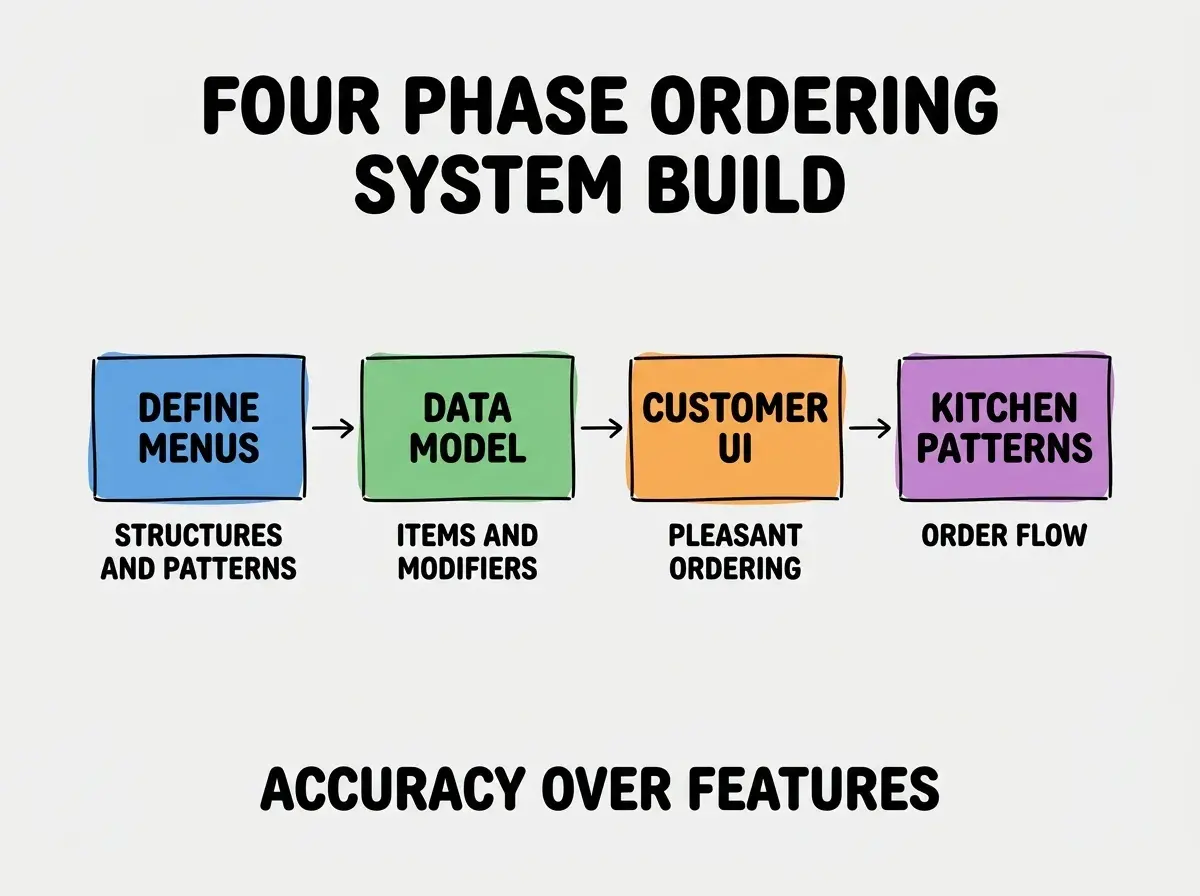
Phase 3, design the customer interface that makes ordering pleasant. Clear menu, easy customization, fast checkout. Customer experience determines order completion; clunky interfaces produce abandoned orders.
Phase 4, ship with kitchen patterns that handle order flow reliably. Order routing, prep timing, modification visibility. Kitchen flow matters; without it, orders pile up or get prepared incorrectly.
The Kitchen Patterns That Work
Three patterns produce kitchen flows that handle order volume reliably.
Pattern 1, kitchen display systems with timer tracking. Visible orders with countdown timers help kitchen staff prioritize. Without timers, orders age unevenly.
Browse more restaurant tutorials
Read more build tutorialsPattern 2, modifier visibility prevents preparation errors. Allergies, customizations, special requests need prominent display. Hidden modifiers produce preparation errors that hurt customer trust.
Pattern 3, prep stage tracking shows order progress. Started, in progress, plating, ready. Stage visibility helps both kitchen coordination and customer expectations.
The Specific Tooling That Worked
Three tool categories combine effectively for restaurant system building.
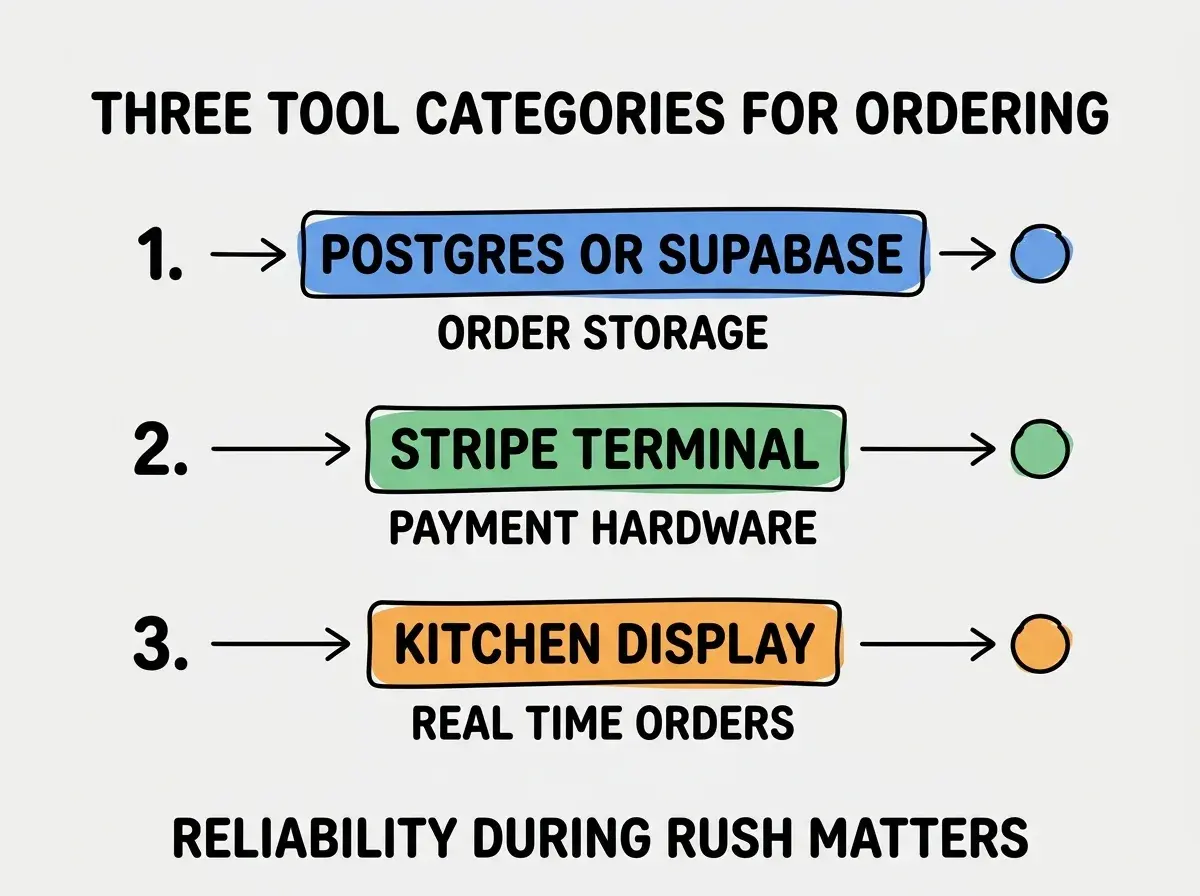
Tool 1, Postgres or Supabase for order storage. Orders, items, modifiers, payment status. Relational data fits naturally.
Tool 2, Stripe Terminal for payment hardware. Card present transactions need physical hardware. Stripe Terminal handles the integration without custom hardware development.
Tool 3, kitchen display with real time order updates. Tablet or display screen showing live orders. Kitchen staff need real time visibility; lag produces order errors.
What Makes Restaurant Systems Get Sustained Use
Three patterns separate sustained system use from system replacement.
Pattern 1, faster than the verbal ordering it replaces. Ordering must be faster than telling the server. Slower digital ordering loses to verbal ordering for in person dining.
Pattern 2, reliable during rush hour above all else. Systems that fail during rush hour cost real revenue. Reliability is non negotiable; rush hour is when failures hurt most.
Pattern 3, simple training requirements. Restaurant staff turnover is high; complex systems produce ongoing training costs. Simple systems train new staff in minutes.
The combination produces ordering systems restaurants stick with. Without these patterns, systems get replaced when alternatives appear that fix any of these gaps.
How to Build Your First Restaurant System
Three implementation patterns help first restaurant systems succeed.
Pattern A, start with one restaurant type, not all types. Quick service, full service, and bar service have different needs. Single type validates patterns; multi type often produces incomplete fits.
Pattern B, dogfood during off hours before rush hours. Off hours testing catches issues before rush hour reveals them painfully. Rush hour is the worst time to discover problems.
Pattern C, train staff before any rush hour use. Untrained staff during rush hour produces failures that look like system problems. Training reveals what is system versus operator issue.
The combination produces first restaurant systems that establish credibility for sustained use. Without these patterns, first restaurants often abandon systems after rush hour failures expose preparation gaps.
The most damaging restaurant system mistake is launching during a busy period rather than soft launching during slow times. Busy launches produce failures that scale dramatically; slow time launches produce manageable issues that get fixed before they affect many customers. The fix is to soft launch during slowest hours, validate the system handles real orders, then gradually expand to busier hours; the gradual ramp prevents the disasters that direct rush launches often produce.
The other mistake is overengineering with features no restaurant needs. Comprehensive restaurant platforms produce training friction without proportional value. The fix is to build for your specific restaurant type; simpler systems train staff faster.
A third mistake is missing offline capability. Internet outages happen; orders during outages need handling. The fix is to design offline ordering with later sync; offline capability prevents revenue loss during connectivity issues.
A fourth mistake is failing to integrate with accounting and inventory systems. Standalone ordering systems require duplicate data entry. The fix is to design integration from the start; integration eliminates the duplicate work that standalone systems require.
A fifth mistake is missing tipping handling for full service restaurants. Tipping flow matters for both customers and staff; clunky tipping reduces both. The fix is to design tipping deliberately for your service type; quick service tipping differs from full service tipping.
Dig deeper
A few hand-picked sources if you want to go further.
What This Means For You
The restaurant ordering system built with AI tools becomes valuable through ordering speed, kitchen flow, and rush hour reliability. The four phases, kitchen patterns, and tool combinations produce systems restaurants depend on.
- If you're a founder targeting restaurants: Restaurant systems serve high volume small businesses. Build them with deep restaurant operational knowledge; generic builds rarely fit restaurant patterns.
- If you're a restaurant owner: Custom ordering systems can match your specific operations better than off the shelf alternatives. Consider building when standard tools constrain your operations.
- If you're a senior dev: AI tools handle restaurant system implementation effectively. The bottleneck is operational understanding and reliability engineering, not implementation; invest in those areas more than feature breadth.
Browse more restaurant tutorials
Read more build tutorials