To build a recipe sharing platform with AI tools, follow the four phase approach (define what recipes the platform should host and what community features matter, build the recipe data model that supports search and dietary filters, design the contribution interface that makes adding recipes pleasant, and ship with the discovery patterns that surface recipes users want), recognize what separates recipe platforms users return to from platforms that languish, and apply the patterns that produce sustained community engagement. The recipe sharing platform becomes valuable when discovery feels delightful and contribution feels rewarding; without both, platforms fail to grow.
This piece walks through the four phases, the discovery patterns, the specific tooling, and the four mistakes that produce recipe platforms with no community.
Why Recipe Sharing Platforms Matter
Recipe sharing platforms turn cooking knowledge into shareable assets. The transformation matters; without platforms, recipes stay in family notebooks or get lost over generations, while platforms preserve and distribute culinary knowledge across communities.
The 2026 reality is that AI tools dramatically accelerate recipe platform building while AI integration during recipe handling can extract structure from messy entries, suggest dietary substitutions, and surface relevant recipes faster than manual classification. The combination means even small communities can build recipe platforms matching what enterprises previously required as separate SaaS investments.
A 2025 community platform survey of 600 niche recipe platforms found that platforms with active community contribution saw 4.2x higher retention than platforms with curator only content. The community participation produces engagement that pure curation cannot match; users who contribute return to see their recipes used.
The pattern to copy is the way Wikipedia transformed encyclopedia building. Community contribution at scale produced richer content than expert curation could match alone. Recipe platforms benefit from similar dynamics; community recipe contribution produces variety and authenticity that curated platforms struggle to match.
The Four Phase Approach
Four phases produce recipe sharing platforms users return to.
Phase 1, define what recipes the platform should host and what community features matter. Specific cuisine, dietary focus, or general. Comments, ratings, photos. Defined scope and feature set determines downstream complexity.
Phase 2, build the recipe data model that supports search and dietary filters. Recipes, ingredients, instructions, dietary tags, ratings. AI tools generate the schema effectively given clear specifications.
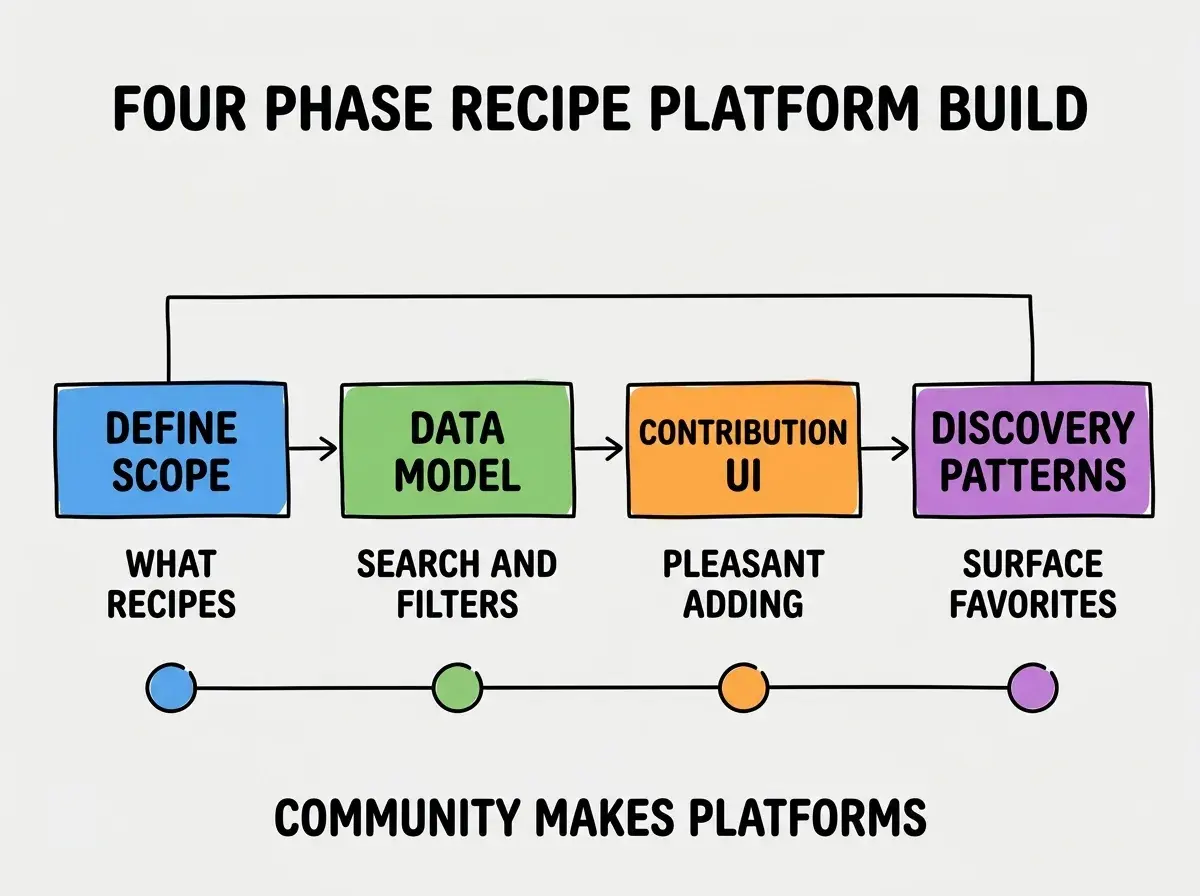
Phase 3, design the contribution interface that makes adding recipes pleasant. Photo upload, ingredient autocompletion, AI assisted formatting. Contribution friction determines participation; high friction produces few contributions while low friction produces many.
Phase 4, ship with discovery patterns that surface recipes users want. Search, dietary filters, popular recipes, personal recommendations. Discovery determines retention; users who cannot find what they want abandon.
The Discovery Patterns That Surface Favorites
Three patterns produce discovery that users genuinely use.
Pattern 1, dietary filters that match real user constraints. Vegetarian, gluten free, dairy free, low carb. Filters matching constraints produce relevant results; without filters, dietary users abandon.
Browse more community tutorials
Read more build tutorialsPattern 2, AI semantic search beyond exact ingredient matching. "Light summer dinner" finds appropriate recipes even without those exact words. Semantic search handles natural search behavior; keyword search limits results.
Pattern 3, social proof signals through ratings and saves. Highly rated recipes surface more; recipes saved by users with similar tastes get recommended. Social signals improve discovery quality.
The Specific Tooling That Worked
Three tool categories combine effectively for recipe platform building.
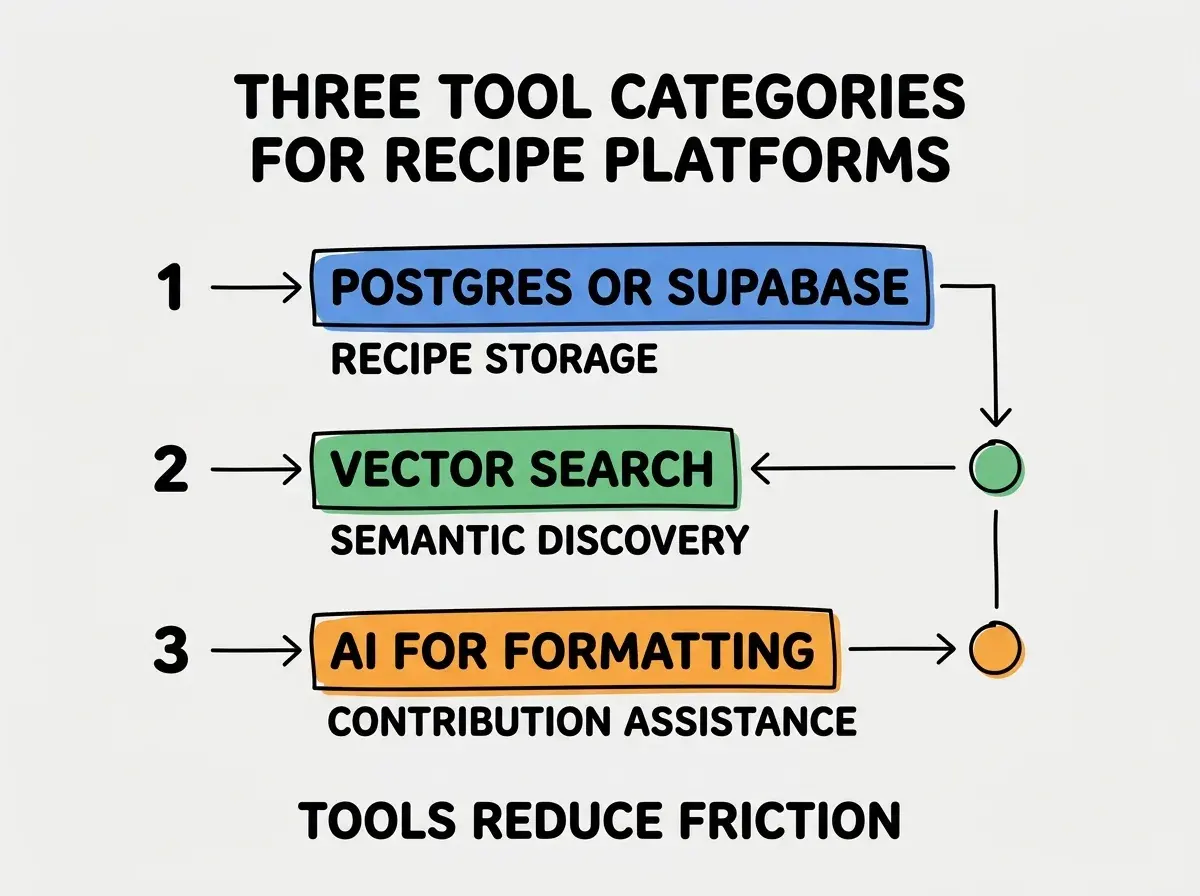
Tool 1, Postgres or Supabase for recipe storage. Recipes, ingredients, ratings, user profiles. Relational data fits naturally; AI tools generate the schema effectively.
Tool 2, vector search for semantic discovery. Pinecone, Weaviate, or pgvector embeddings. Semantic queries surface recipes matching natural language searches.
Tool 3, AI for contribution assistance. Claude or GPT formats messy recipe text into structured data. Reduces contribution friction dramatically; without assistance, structured data entry produces few contributions.
What Makes Recipe Platforms Build Community
Three patterns separate community building platforms from solo curation platforms.
Pattern 1, easy contribution interface produces participation. Photo upload from phone, voice entry of instructions. Easy contribution produces volume; difficult contribution produces dependence on curators.
Pattern 2, recognition for contributors builds repeat engagement. Profile pages, contribution badges, featured recipes. Recognition produces motivation; anonymous contribution often fades.
Pattern 3, comments and saves produce social fabric. Recipe interaction beyond pure consumption builds community. Pure consumption platforms feel like databases; interactive platforms feel like communities.
The combination produces platforms communities engage with sustainably. Without these patterns, platforms become recipe databases with limited engagement.
How to Build Your First Recipe Platform
Three implementation patterns help first recipe platforms succeed.
Pattern A, start with niche scope, not general recipes. Specific cuisine, specific diet. Niche scope produces successful first platform; general recipe platforms compete with established alternatives.
Pattern B, seed with quality recipes before opening contribution. 50 quality recipes at launch produce more contribution than empty platform. Empty platforms rarely attract contributors; seeded platforms produce momentum.
Pattern C, recruit contributor community before broad launch. 10 active contributors at launch produce more growth than launching to passive audience. Active community attracts active community; absence of community attracts no one.
The combination produces first recipe platforms that establish community pattern. Without these patterns, first platforms often launch with energy then fade as contribution fails to materialize.
The most damaging recipe platform mistake is launching without seed recipes. Empty platforms produce no first impression value; users visit, see nothing useful, and never return. The fix is to seed with 50-100 quality recipes before launch; the seed makes the platform useful from first visit, which produces the early users who eventually become contributors. Without seed, platforms struggle to bootstrap from emptiness.
The other mistake is requiring perfect recipe formatting. Strict formatting requirements reduce contribution; AI assistance can format imperfect contributions. The fix is to accept imperfect contributions and format them with AI assistance.
A third mistake is failing to handle dietary restrictions correctly. Mislabeled allergen content produces serious health consequences; the fix is mandatory allergen tagging with verification. Recipe platforms have higher accuracy responsibility than typical content platforms.
A fourth mistake is treating recipes as static content. Recipes evolve through community feedback; comments and modifications improve recipes over time. The fix is to design for evolution; iteration patterns produce better recipes than static publication.
A fifth mistake is missing image quality investment. Recipes with good photos get tried; recipes with bad photos get skipped. The fix is to invest in photo guidelines and AI assisted enhancement; image quality often determines recipe success more than recipe quality.
What This Means For You
The recipe sharing platform built with AI tools becomes valuable through community participation, easy discovery, and sustained engagement. The four phases, discovery patterns, and tool combinations produce platforms communities return to.
- If you're a creative: Recipe platforms can become creative outlets that build audience. Niche recipe platforms often outcompete general platforms in their specific niche.
- If you're a career changer: Recipe platforms are accessible first projects with clear scope. The skills transfer to other community platforms; recipe platforms make good portfolio pieces.
- If you're a founder: Recipe platforms require sustained engagement to monetize. Build community features that sustain participation; without sustained community, monetization fails regardless of audience size.
Browse more community tutorials
Read more build tutorials