To build a local community events board with AI tools, follow the four phase approach (define what events and community patterns the board should aggregate, build the data model that handles events, venues, and submissions, design the discovery interface that helps locals find what is happening, and ship with the curation patterns that prevent spam and low quality listings), recognize what separates community boards locals use weekly from boards that get ignored, and apply the patterns that produce sustained community engagement. The community events board becomes valuable when locals find relevant events easily; without that bar, established platforms or word of mouth win.
This piece walks through the four phases, the curation patterns, the specific tooling, and the four mistakes that produce community events boards locals abandon.
Why Local Community Events Boards Matter
Local community events boards aggregate fragmented local event information into single discoverable source. The aggregation matters; local events get advertised across newspapers, Facebook groups, neighborhood apps, and physical posters. Without aggregation, locals miss events they would have attended.
The 2026 reality is that AI tools dramatically accelerate community board building while AI integration during operation can categorize events, draft descriptions, and detect duplicate submissions faster than manual moderation. The combination means small community organizations can build event boards matching what enterprise event platforms previously required.
A 2025 community engagement survey of 600 small towns and neighborhoods found that communities with active local event boards reported 28 percent higher event attendance than communities relying on scattered event promotion. The aggregation produces attendance increases that benefit organizers and community members.
The pattern to copy is the way Craigslist transformed local classified advertising. Centralized local classifieds beat newspaper and bulletin board advertising dramatically; the structure produced reach that fragmented sources could not match. Local event boards play similar role for community events; centralization produces discovery that fragmented sources cannot match.
The Four Phase Approach
Four phases produce community events boards locals use weekly.
Phase 1, define what events and community patterns the board should aggregate. Town events, restaurant happenings, church activities, school events. Different community types have different event mixes.
Phase 2, build the data model that handles events, venues, and submissions. Events, venues, organizers, attendees. AI tools generate the schema effectively.
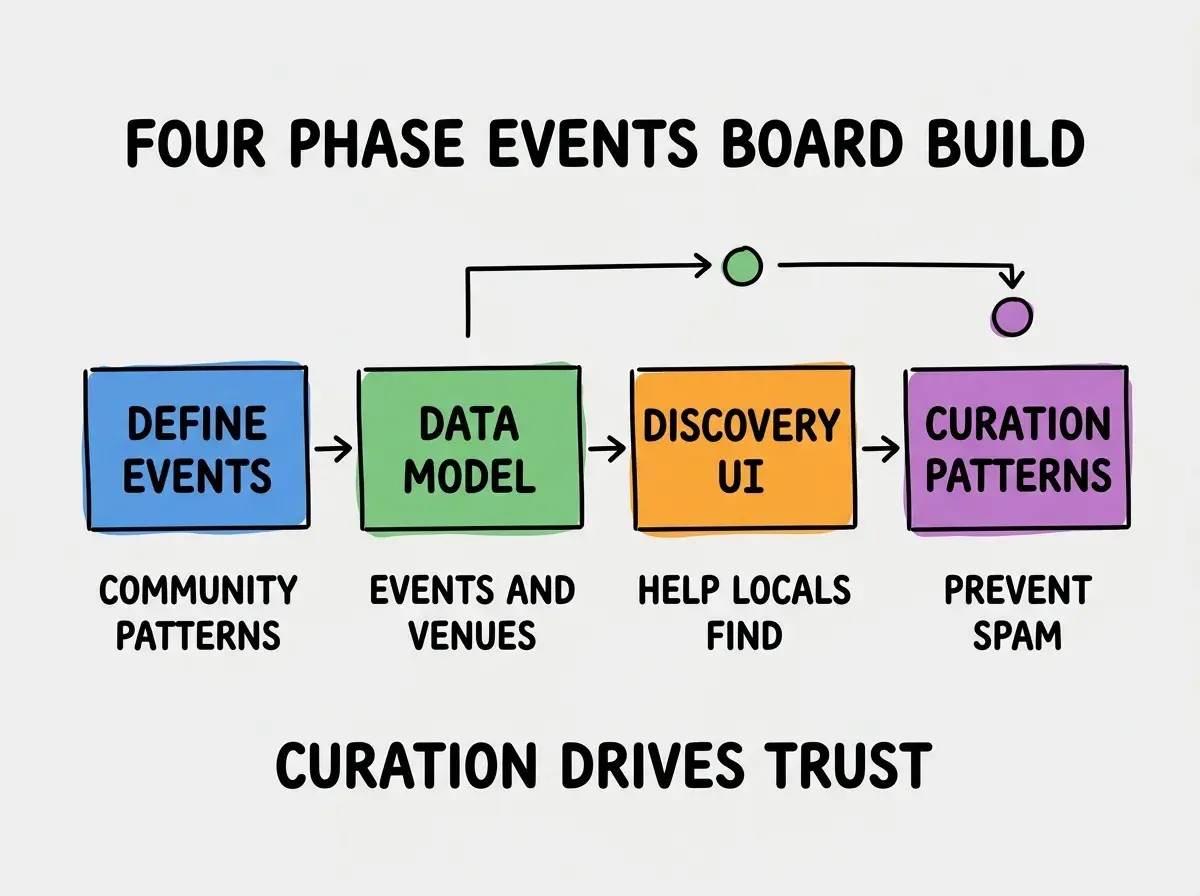
Phase 3, design the discovery interface that helps locals find what is happening. Date filters, neighborhood filters, category filters, search. Discovery quality determines weekly use.
Phase 4, ship with curation patterns that prevent spam and low quality listings. Submission review, AI moderation, community reporting. Curation matters; uncurated boards drown in spam quickly.
The Curation Patterns That Maintain Quality
Three patterns produce curation that maintains community board quality.
Pattern 1, AI assisted moderation queue for new submissions. AI flags potential issues; human reviews. The combination handles volume that pure human review cannot.
Browse more community tutorials
Read more build tutorialsPattern 2, community reporting for quality issues. Locals flag problems; reports trigger review. Community moderation supplements platform moderation.
Pattern 3, organizer reputation tracking over time. Repeat organizers with quality history get faster approval; new organizers get more scrutiny. Reputation reduces moderation burden over time.
The Specific Tooling That Worked
Three tool categories combine effectively for community events board building.
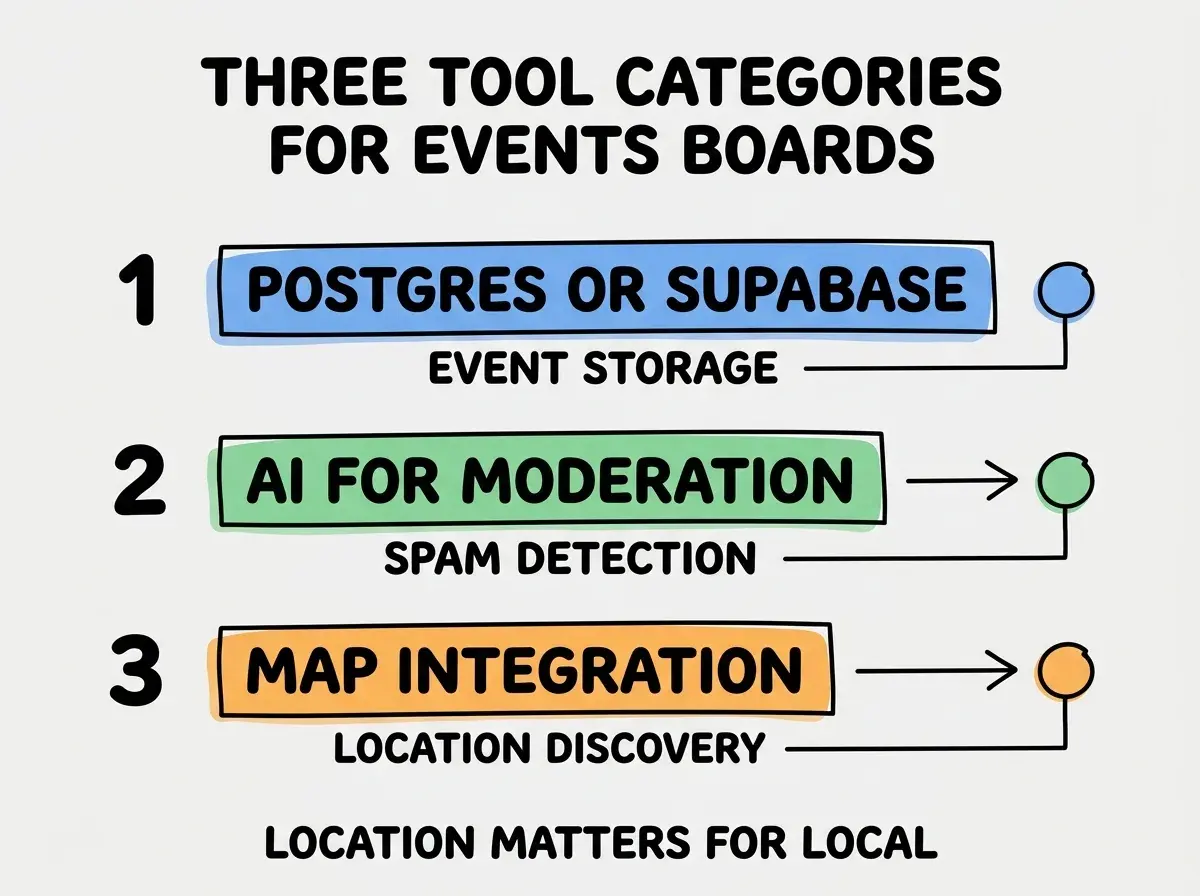
Tool 1, Postgres or Supabase for event data. Events, venues, organizers, submissions. Relational data fits naturally.
Tool 2, AI for moderation and spam detection. Claude or GPT classifies submissions, detects duplicates, surfaces potential issues. AI moderation scales beyond what human review alone can handle.
Tool 3, map integration for location discovery. Mapbox or Google Maps for geographic browsing. Location matters for local events; map view often beats list view for discovery.
What Makes Community Boards Get Sustained Use
Three patterns separate sustained board use from quick abandonment.
Pattern 1, mobile friendly for on the go discovery. Locals check events from phones often. Mobile design matters.
Pattern 2, weekly email digest for engaged users. Email reminds users about upcoming events. Without email, weekly engagement requires user initiative.
Pattern 3, organizer self service produces submission velocity. Organizers should add events without staff intervention. Self service scales submission volume that staff intervention bottlenecks.
The combination produces boards locals reference weekly. Without these patterns, boards launch then fade as submission and engagement struggle to sustain.
How to Build Your First Community Events Board
Three implementation patterns help first community boards succeed.
Pattern A, start with one neighborhood or one town. Hyperlocal focus produces denser content than regional or city wide focus.
Pattern B, seed with 50+ events at launch. Empty boards produce no engagement. Pre populated events from existing sources show value at first visit.
Pattern C, recruit organizer community before broad launch. 10-20 active organizers at launch produce sustained content. Without organizer community, boards depend on staff content creation.
The combination produces first boards that establish community engagement patterns. Without these patterns, first boards often launch then fade as content velocity struggles.
The most damaging community events board mistake is launching without seed content. Empty boards produce no first impression value; locals visit, see nothing useful, and never return. The fix is to seed with 50-100 quality events before public launch; the seed makes board useful from first visit, which produces the early users who eventually become organizers and contributors. Without seed, boards struggle to bootstrap from emptiness.
The other mistake is missing the discovery problem. Local event boards need both submitters and discoverers; building only for submitters produces unread content. The fix is to design discovery features as carefully as submission features.
A third mistake is failing to handle event timing complexity. Recurring events, multi day events, time zones produce complications. The fix is to design for these complications from start.
A fourth mistake is treating community events board as one time launch project. Sustained boards require sustained moderation and curation. The fix is to budget ongoing operations time; without operations, boards drift to spam over time.
How Community Events Boards Build Sustainable Engagement
Three sustainability patterns matter for community board health over years. First, recurring events get featured treatment that one off events do not; the recurring pattern reduces submission work for organizers while providing predictable content for locals. Second, partnerships with local newspapers and radio stations multiply reach; community boards that integrate with traditional local media reach audiences that pure digital platforms miss. Third, community board ownership transitions matter; founders who plan succession to community organizations or local government often produce longer lasting boards than founder dependent boards.
What This Means For You
The local community events board built with AI tools becomes valuable through quality curation, location based discovery, and organizer self service. The four phases, curation patterns, and tool combinations produce boards locals reference weekly.
- If you're a career changer with community focus: Community events boards combine technical work with civic engagement. The combination produces career meaning beyond pure tech work.
- If you're a creative: Community boards can become creative outlets that build local relationships. The local focus produces engagement that broader platforms rarely achieve.
- If you're a founder: Community event platforms have niche opportunity in geographic markets where established platforms have low engagement. Local focus produces moats that general platforms cannot easily disrupt.
Browse more community tutorials
Read more build tutorials