A quote collection and sharing app helps readers capture quotes from books and articles in searchable form rather than losing them in margins or highlights apps. Four quote app components matter: capture flow (add quote with source attribution), tagging system (themes, books, authors for retrieval), search (find quotes by content or context), and share rendering (beautiful share cards for social or messages). Combined components produce quote apps that build personal wisdom library.
This tutorial walks through the four components, the implementation patterns, what makes quote apps sustainable, and the four mistakes builders make on quote collection apps.
Why Quote Apps Matter For Creatives
Quote apps matter because readers encounter wisdom faster than they can integrate it. Quotes get highlighted in Kindle, screenshotted from Twitter, scribbled in margins; without unified app, wisdom scatters and gets lost.
The 2026 reality is that AI tools (Claude, GPT) make quote apps buildable in days; previously required Notion templates that decayed under capture friction.
A 2025 reading study of 300 active readers found that readers using dedicated quote apps revisited captured quotes 3.4x more often than readers using generic note apps, primarily through quote specific UX that makes browsing rewarding rather than tedious. App focus measurably affects wisdom integration.
The pattern to copy is the way librarians historically maintained commonplace books, hand copying meaningful passages from many books into single curated volume. Commonplace books concentrated wisdom; same patterns apply to digital quote apps that consolidate scattered highlights into searchable curated collection.
The Four Quote App Components
Four components form complete quote app.
Component 1, capture flow. Add with attribution. Foundation.
Component 2, tagging system. Themes, books, authors. Organization.
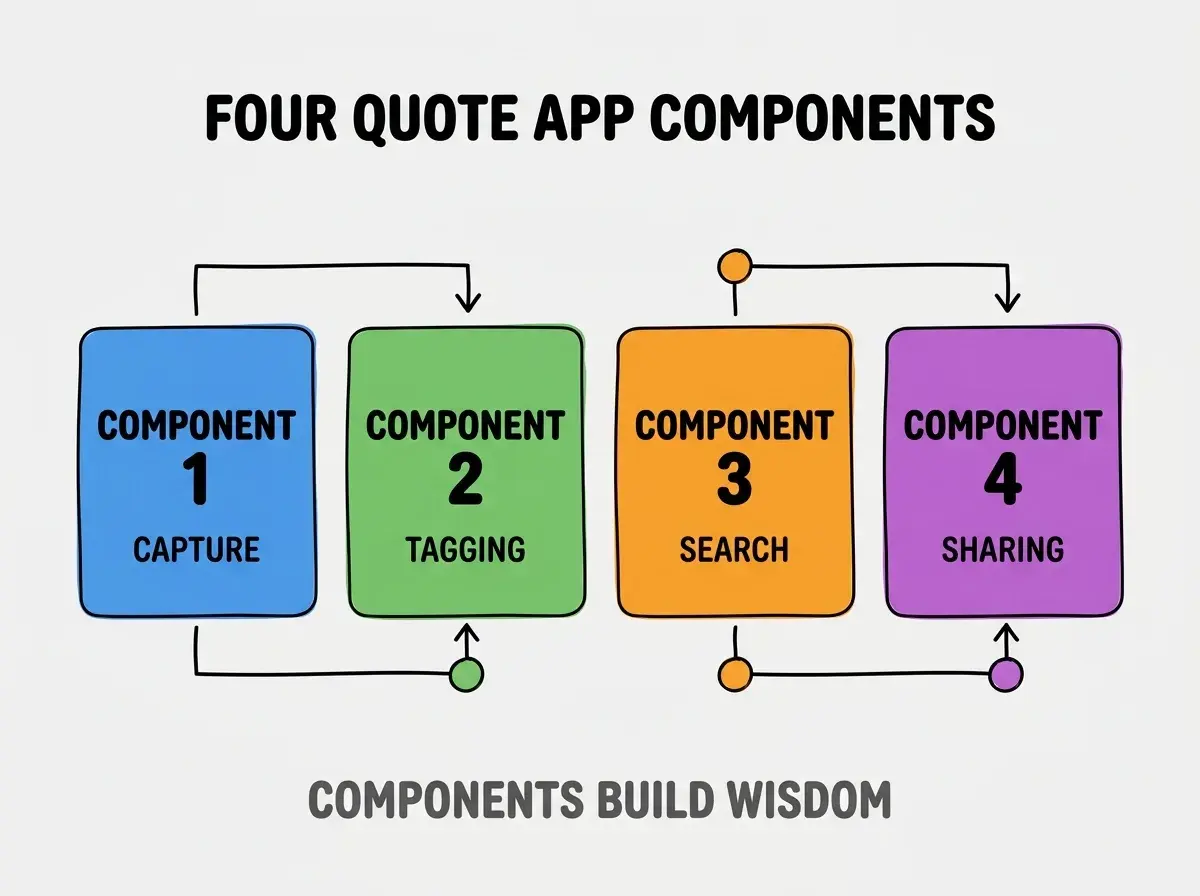
Component 3, search. Find by content or context. Retrieval.
Component 4, share rendering. Beautiful cards. Distribution.
How To Implement Each Component
Four implementation patterns address each component.
Implementation 1, capture form with text plus source. Quote text, author, book, page number; minimal fields.
Browse more build
Read more buildImplementation 2, tag system with autocomplete. Existing tags suggested; new tags allowed.
Implementation 3, full text search with embeddings. Postgres FTS or pgvector for semantic search.
Implementation 4, share image generation. Canvas or SVG renders quote card; image shareable.
What Makes Quote Apps Sustainable
Three patterns separate sustainable from abandoned.
Pattern 1, mobile capture primary. Quotes captured in moment; mobile critical.
Pattern 2, browse rewarding. Beautiful display invites browsing.
Pattern 3, integration with reading apps. Kindle highlight import reduces friction.
What Makes Quote Strategy Effective
Three patterns separate effective from theatrical.
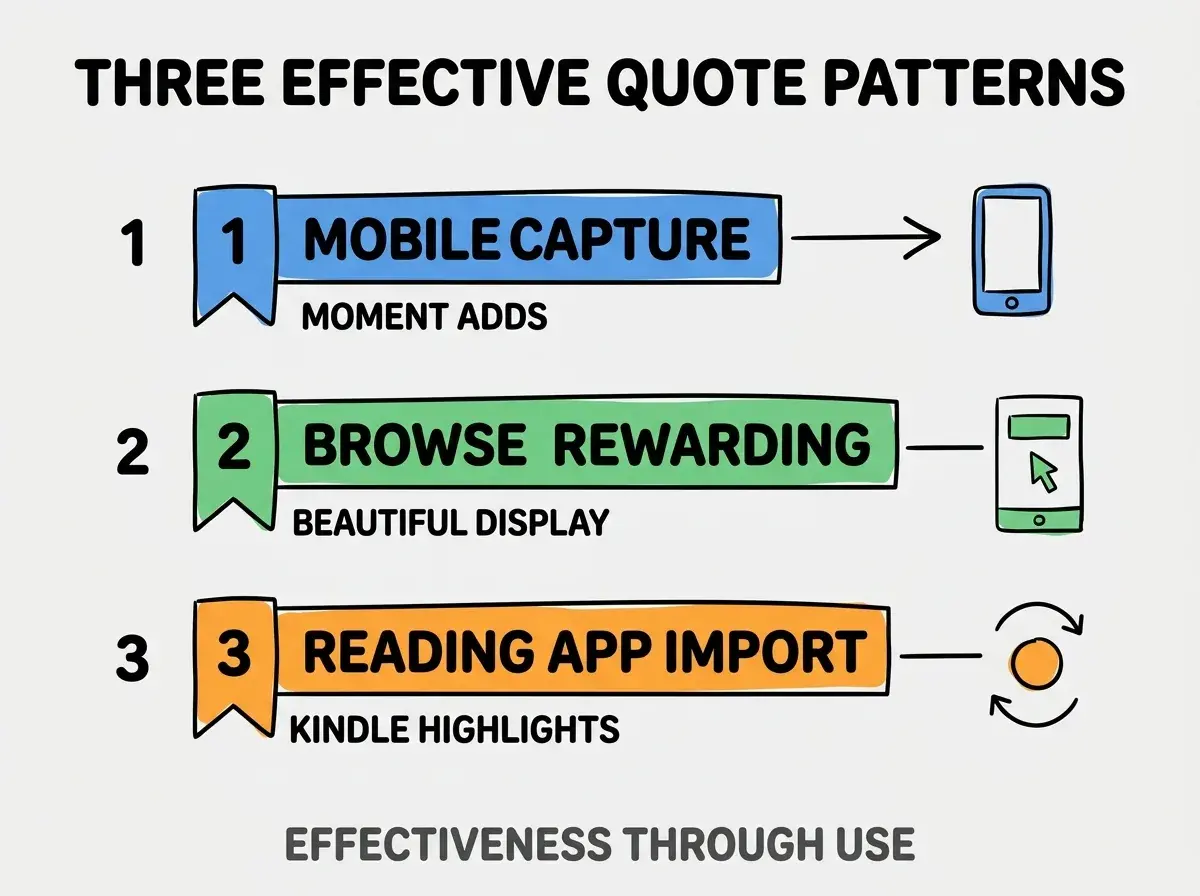
Pattern 1, mobile capture. Moment adds.
Pattern 2, browse rewarding. Beautiful display.
Pattern 3, reading app import. Kindle highlights.
The combination produces effective quote app. Without these patterns, app becomes graveyard.
How To Choose Quote App Stack
Three patterns help stack choice.
Pattern A, web app for accessibility. Browser based.
Pattern B, PWA for mobile. Mobile capture primary.
Pattern C, native iOS for share extension. iOS share sheet integration.
Common Questions About Quote Apps
Quote apps raise questions worth addressing directly.
The first question is what to do about copyright. Personal use generally fine; commercial use varies.
The second question is whether to share publicly. Optional; some quotes private reflection.
The third question is how to handle attribution accuracy. Source URL when possible; citation matters.
The fourth question is whether AI can categorize. Yes; AI suggests tags from quote content.
How Quote Apps Affect Reading Practice
Quote apps affect practice in compounding ways. Practice effects compound across books.
The first compounding effect is engagement depth. Capture forces engagement.
The second compounding effect is wisdom retention. Captured returns to mind.
The third compounding effect is writing inspiration. Quote library inspires own writing.
The combination produces practice shaped by app quality. Without quality, practice bounded.
How To Browse Effectively
Three patterns help browsing.
Pattern A, random quote daily. Surface random quote each day.
Pattern B, themed browse. Browse by tag or author.
Pattern C, recent additions surfaced. New captures highlighted.
The combination produces engaging browse. Without patterns, browse stays manual search.
The most damaging quote app mistake is over engineering tagging system. Complex tagging requires decision per quote; capture friction defeats purpose. The fix is to start with single open ended tag field; let tags emerge from use. Users who keep tagging simple capture more; users with elaborate tag taxonomies face friction that reduces capture rate which reduces app value.
The other mistake is missing the share rendering. Beautiful share cards drive both sharing and personal aesthetic value.
A third mistake is over indexing on AI categorization. Sometimes manual tags more meaningful.
A fourth mistake is treating quote app as one off project. Quote apps are lifetime tools.
What This Means For You
Build a quote collection and sharing app enables readers to consolidate wisdom from scattered sources into curated library. The four components, implementation patterns, and sustainability approaches produce apps that compound reading value.
- If you're a creative: Quote apps inspire creative work; build for your reading practice.
- If you're changing careers: Wisdom library compounds across years; reflection tool.
- If you're a senior dev: Quote apps interesting design problem; transferable to other capture apps.
Browse more build
Read more build